
Jessica Au wins the 2023 Prime Minister’s Literary Award for Fiction.
Cold Enough for Snow (Giramondo Publishing) wins another literary prize. Congratulations!
Read my interview with Jessica Au and other panellists at Brisbane Writers Festival 2023.

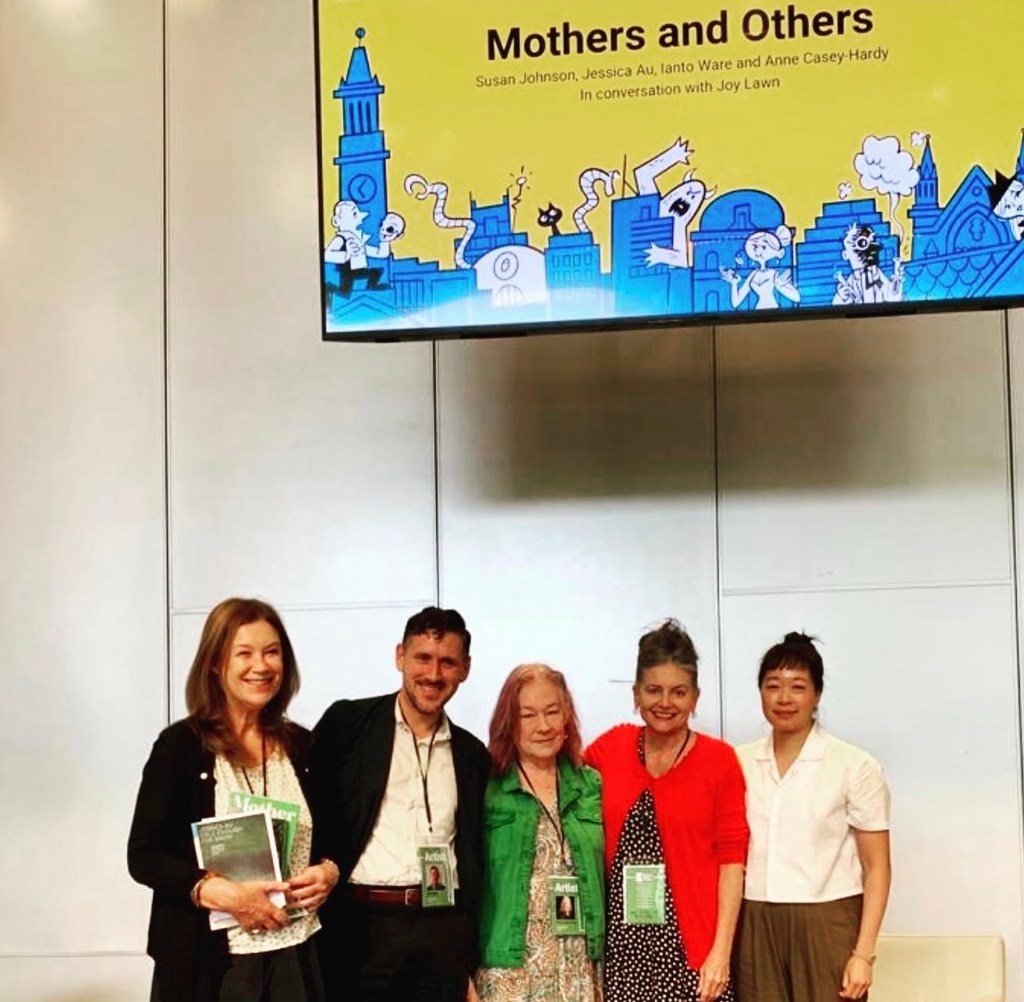
Jessica Au, Susan Johnson, Anne Casey-Hardy & Ianto Ware at BWF 2023
It was great to be moderating sessions at Brisbane Writers Festival in May 2023.
I would like to highlight an amazing session held on Mother’s Day – ‘Mothers and Others’.
After many years of chairing many, many panels at writers’ festivals ranging from Sydney Writers Festival, to Byron, Brisbane and others, I can’t recall such a bonding between the author panellists. This began with email conversations well before the event. The four authors took great care in reading and commenting on each other’s books and then ran with the conversation on stage, sparking off each other’s words, and delighting in each other’s company afterwards.
In other panels I have witnessed incredible instant rapport in the Green Room in that short time authors have to bond before going on stage but this was something special.
The four authors are Jessica Au, Susan Johnson, Anne Casey-Hardy and Ianto Ware.
Acknowledgement of Country
We acknowledged that Brisbane Writers Festival is held on the lands of the Yuggera and Turrbul people. And recognised the important and ongoing contributions of the traditional owners to art and literature, and acknowledged them as the original storytellers of this region.
Acknowledgement of Mothers
We recognised that we were together in a special moment in history with these four authors together talking about mothers on Mothers’ Day. And the audience was part of it.
We felt united in having been birthed by a mother. We acknowledged that many in the audience, and some of our panellists were grieving the recent or past loss of their own mothers. We recognised that some people may not have had positive maternal experiences and were glad they found the fortitude to attend the session. And realised that many there had the privilege of being a mother – with its attendant joys, laughs and also difficulties or burdens.
We paid homage to mothers – living and remembered.

The Books
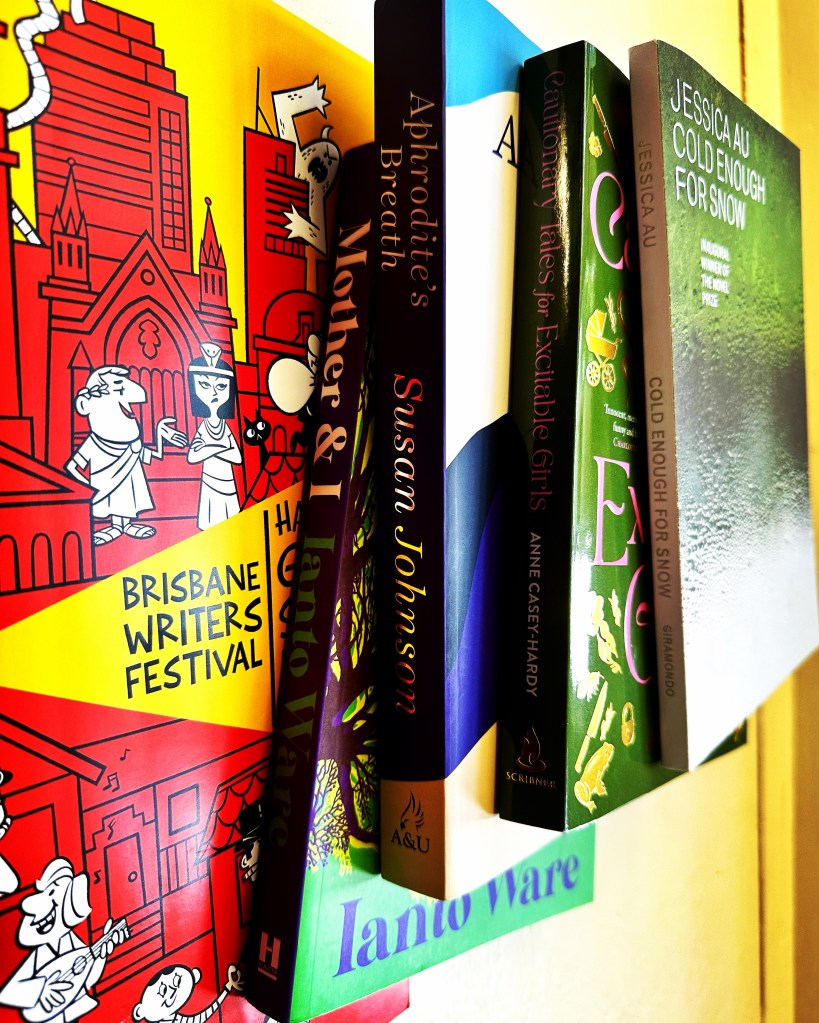
Two of the books are memoirs and two are fiction titles, one a novel and one a book of short stories.
Two books are about travelling with a mother – to Greece and Japan.
All the books are well-written and in all of these stories/books we want to know what happens next.
As well as other things, these books bring mothers to life. At times they immortalise mothers.
THE AUTHORS
SUSAN JOHNSON – Aphrodite’s Breath: A mother and daughter’s Greek Island adventure (Allen & Unwin)
Journalist Susan Johnson is part of the Queensland and Brisbane writing community. I first sought out Susan’s writing about Charmian Clift and George Johnston living and working on the Greek island of Hydra in The Broken Book in 2004 after my own pilgrimage there in my 20s.
Susan’s new book is her memoir Aphrodite’s Breath: A mother and daughter’s Greek Island adventure. I remember avidly following Susan’s social media posts during her trip and the resulting book is far more than I could have imagined.
Many of us would love to know what it’s like to live on a Greek island – and having an elderly mother with you makes it much more complicated – more difficult and also more fulfilling.
As a writer Susan knows how much to reveal and withhold. She faces the contradictions of being a private person exposing herself in memoir.
Aphrodite’s Island is a tribute to Barbara, Susan’s mother.
It is Susan’s first book in 30 years of writing to go into reprint within a week of publication.
(I read this also as a travel guide and feel ready to book a holiday on Kythera.)

JESSICA AU – Cold Enough for Snow (Giramondo)
Jessica Au’s novel Cold Enough for Snow is multi-awarded. It has won several awards, has been shortlisted for numerous awards including the 2022 Queensland Literary Awards (of which I was a judge) and was longlisted for the prestigious international Dublin literary award. At the time of writing it is longlisted for the Miles Franklin award.
In the novel an unnamed daughter takes her unnamed mother on a trip to Japan.
Common places are described in such a way as if to render them with everyday magic.
Mother and daughter travel in Autumn but the mother queries if it will be cold enough for snow, which she has never seen. They don’t quite seem to enjoy doing the same things but they are glad to be together. They have a strong family bond even if they don’t fully understand each other.
The daughter appreciates Greek myths, which she describes to her mother as having an ‘eternal metaphoric quality’.
The book explores the mother/daughter relationship.
It is fiction with an autobiographical feel.
Cold Enough for Snow is subtle, reflective, elegant, luminous and philosophical.
ANNE CASEY-HARDY – Cautionary Tales for Excitable Girls (Simon & Schuster)
Cautionary Tales for Excitable Girls is Anne Casey-Hardy’s first book. It is a short story collection.
The mothers are often quite diabolical in Cautionary Tales for Excitable Girls, and it has a macabre thread where girls and women are stealing babies.
Anne is the eldest of seven children so we can assume she knows a lot about family dynamics and perhaps what it’s like for a young person to take on a mothering role.
Her stories here traverse two young girls stealing a baby for the day; a hallucinating mother whose baby seems to slip down the side of the couch; the teen whose mother would have said, ‘well, what do you expect if you go down to the creek at night’ on New Year’s Eve; the mother, who unlike many birds, didn’t mate for life; the controlling crushing mother from a Greek myth; the older women looking for water babies; and what can happen when a mother is away for the day.
Some of the stories are interlinked.
This is an imaginative, contrary collection that explores different voices and experiences and plays with genres that range from contemporary realism to Greek myth, Gothic and the surreal.

IANTO WARE – Mother & I: The History of a Wilful family (Hunter Publishers)
Ianto Ware was curious from birth. As a little boy he was honest, self-deprecating and endearing. He was also nervous, recalcitrant and preferred his own company.
Mother & I: The History of a Wilful family, is his story and also a memoir about growing up with his wilful mother, a strong woman who overpowered ill health, who hated conformity and who couldn’t tolerate the compromises and comfortable habits of middle-class life and chose her own destiny rather than path of least resistance.
She wanted, and achieved, ‘a strong, free and independent life with a child’.
She was a ground-breaking woman – who was not famous.
In paying homage to and immortalising his mother, Ianto has explored new ground and created a well-written social history.
The book also has wonderful epigraphs at the beginning of every chapter and some Greek allusions.
Perhaps best of all, as we read we really want to know what happens to Ianto and his mother. Mother & I demands a sequel.

THE CONVERSATION
I structured the questions for discussion around ‘mother’-related terms, expressions and idioms because of the panel topic, ‘Mothers and Others’ and for Mother’s Day.
Serendipitously, there is also an intriguing Greek thread running through these books.
Motherland/ Mother Country
‘Motherland’ or ‘mother country’ usually means place of birth. In discussing these books, we explored ‘motherland’ as the place of maternal protection and nurture that a mother provides. This is often intrinsic to the mother’s role.
Most of the author’s own or fictional mothers provide a house, home or shelter for their child.
In Aphrodite’s Breath, ‘house’ was a metaphor for Susan’s mother. Her mother was ‘the house’ and she was ‘married to the house’.
Ianto’s mother, Dimity, bought a house to secure their future and provide maternal protection in Mother & I. She created a garden in the good soil and grew a forest to isolate and shield them.
In the story ‘My Beautiful Dollhouse’ in Cautionary Tales for Excitable Girls, Anne’s character creates their own, ‘ultimate’ dollhouse and dioramas ‘from a miniature world that can be real or imagined.’ The dollhouse becomes a virtual life.
And Laurie’s childhood house in Cold Enough for Snow, gave a ‘deep sense of familiarity, the kind that could only come from childhood’.
Mother Lode
‘Mother lode’ – there are two spellings and meanings of lode/load (and many mothers may resonate with the load of being a mother) but we focused on ‘lode’, which can refer to a wellspring, something valuable or a treasure trove.
Mother lode can refer to the value that the mother brings to the mother-child relationship. We considered how the author’s mother or a mother in their book was a wellspring or the source of her child’s riches – their gifts and talents.
Emulating her mother, the daughter in Jessica’s book is a frugal, conscientious child who takes everything seriously, including her studies.
Ianto’s mother taught him to be open to different possible lifestyles and not to conform. She also taught him not to generalise: to be logical and think intelligently.
Susan’s mother championed her writing and life choices.
Mother Tongue
Two of the books talk about the difficulty of learning another language but communicating in one’s mother tongue is generally how important truths and feelings (family lore and stories) are best shared.
My question was about mother tongue – what the authors would describe as the mother tongue of their book. Rather than what language the mother speaks, I was interested in a metaphorical ‘mother tongue’ – how does the mother speak or convey emotions or important truths – or not?
This is a major concern in Jessica’s story. The mother rarely spoke to another person in her mother tongue. Her first language is Cantonese and the daughter’s is English so they ‘only ever spoke together in one, and not the other’. The daughter couldn’t say what she wanted to share. However, ‘My mother looked at me and smiled, as if she was simply happy that we were in each other’s company, and to have no need for words’.
Susan shares in Aphrodite’s Breath that mothers and daughters who verbalise their feelings seem remote to her. She and her mother were ‘unable to express to each other the contents of their hearts’. Susan was saddened that ‘we could not disclose ourselves in ways which might have helped us’ and kept hoping for the ‘illuminating conversation I have waited for all my life’.
In some of Anne’s stories, the mother is either acerbic or barely interested enough to convey any important truths.
‘Like mother like daughter (or son)’
‘Like mother like daughter (or son)’ is an idiom or expression that can be positive or negative about the mother/daughter relationship.
It seems as though, while generally loving their mother, daughters (and sons) often forge a life that is different from their mother – and may take pride in this.
The panel discussed how they (or their character) paved a different path from the mother and how ‘like mother like daughter’, how similar to their mother (or mother character) they (or their character) may be after all.
Loving son Ianto is very different from his mother in that he is a straight male with quite a different personality and lifestyle!
Anne’s curious, ‘excitable girls’ want to be different from their mothers and others. The girls in ‘What I’d Do if I Was in Charge’ create a new recipe in the bakery when the mother is away for the day, and the girl in ‘Lucy’ exclaims, ‘The feeling of breaking the rules was glorious.’
Susan describes herself as having some passive aggressive tendencies while Barbara, her mother, was a spitfire – albeit a brave, strong, resolute, vulnerable, infuriating, authentic spitfire. Susan’s mother saw beauty as currency while Susan is interested in thoughts and ideas. Despite their differences, Susan ‘would have done anything to ensure my mother’s happiness, or … fallout from my mother’s unhappiness.’
And in a poignant scene in Cold Enough for Snow, mother and daughter in a photo both look ‘not quite ready for the camera: weary, surprised and somehow very alike.’
‘A face that only a mother could love’
‘A face that only a mother could love’ is quite an insulting phrase, often used to describe a newborn, that is meant to be a joke, or can be self-deprecating when someone uses it to describe themself.
Thinking about humour, the four books all have humour but different types of humour.
Anne’s story ‘Starving in the Land of Plenty’, shows plenty of black humour with the 26-year-old PA covering her boss’s affair while being obsessed with food. The story has a funny reveal.
There is much humour throughout Mother & I. It often derives from the difference between Ianto and his mother. She was innately optimistic but thought his disposition melancholy and serious. When lost at a protest rally as a boy, Ianto later asked, ‘was I upset?; ‘no, you were the same as usual. You were frowning.’
‘Smother’
The BWF programmers cleverly gave us a rhyming title, ‘Mothers and Others’. We took it further by adding the letter ‘s’ to ‘mother’ to make ‘smother’. Mothers can smother their children, and most of the authors’ books contemplate at times how painful it can be to forge an independent identity and how they (or their character) navigate growing up through or in spite of the mother or family upbringing.
Susan describes herself as an underwater person, holding her breath against the ‘tide of my mother’.
Anne’s tale ‘When Bees Become Diamonds’ derives from Greek mythology. Kore, the daughter of Demeter and Zeus, is abducted by Hades and becomes Persephone, who is then shared by Demeter (the mother) and Hades. Kore admonishes her mother, ‘I am sick of being your daughter. You squash me down when I long to grow like the almond trees running with sap…’ ‘You … could never be the height you are without me being small.’
She is taken by Hades with her consent. She wants to have love, desire and power and shouts at her mother, ‘I am not your puppet. Not your doll.’
In Mother & I, affable, balanced Ianto unsurprisingly helps to weaken the theory peddled by Bruno Bettelheim that mothers are the source of, and responsible for, all their children’s issues.
Mother Love
The four books either touch on or are completely immersed in mother love, the love between mother and child. This is a primal connection, and generally an essential bond. The mother love bond can be expressed in the book or author’s life as being equally essential both ways, between both.
The family bond in Jessica’s novel is strong, even if mother and daughter don’t fully understand each other. They find happiness in each other’s company, even though they say little of substance to each other
In Anne’s surreal tale, ‘Literally Beside Myself’, the mother believes that, even though one twin has died, ‘In the future we are all safe’.
Ianto’s mother was told that, due to health reasons, she could not have a child but while dying she movingly tells him, ‘you were the best thing I ever created’.
And Susan describes mother love and the mother bond as ‘my mother’s truth entwined with mine.’ Susan is ‘alive and upright because of love … for now I am home … I was a wanderer in many lands whose home was love.’
*****

There are many common links between these books even though they represent a diverse group of mothers who display both idiosyncratic and loving qualities.
In their books and during this session the authors made us think and, while grieving in some cases, and showing respect towards mothers, we were uplifted and had some fun as well.
Thank you to Anne Casey-Hardy, Ianto Ware, Jessica Au, Susan Johnson and Brisbane Writers Festival for this memorable event.
Aphrodite’s Breath at Allen & Unwin
Cold Enough for Snow at Giramondo
Cautionary Tales for Excitable Girls at Simon & Schuster

 paperbarkwords.blog
Wow, fabulous event! At BWF I only managed to see Bryan Brown who talked about his crime book ‘Sweet Jimmy’ but I do love the vibe of book festivals 🙂 G.
LikeLiked by 1 person
Thanks Gretchen. Sorry not to see you at BWF.
LikeLiked by 1 person