
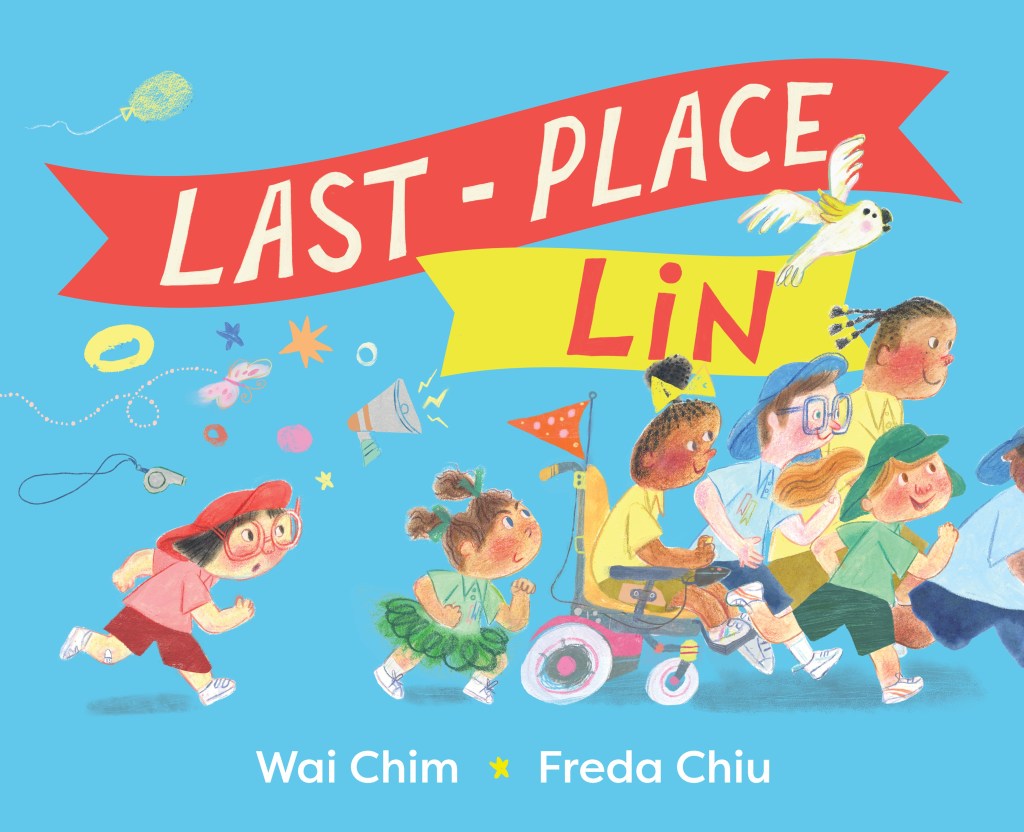
Last-Place Lin by Wai Chim, illustrated by Freda Chiu
Published by Allen & Unwin
“Last-Place Lin. Last-Place Lin. Last-Place Lin. At first, I say the words in my head, then I chant them. My feet match the rhythm.” (Last-Place Lin)
Author Interview with Wai Chim
Thank you for speaking about Last-Place Lin with Joy in Books at PaperbarkWords, Wai.
We last spoke about your popular and critically acclaimed YA novel The Surprising Power of a Good Dumpling. Your earlier chapter books for younger readers, the ‘Chook Chook’ series are also wonderful (I actively promoted them in my role as a consultant for independent bookstores and have kept my copies of all your books).

And, spanning age-groups and book forms, you have now written an endearing and empowering picture book, Last-Place Lin.
How different has it been to write in this form? How have you used repetition and chant?
Firstly, thank you so much for having me back and thank you for all you do for the love of children’s literature – it’s always such a joy to read your reviews and insights, the industry is so lucky to have you!
Thank you Wai, that means alot.
Let me tell you, writing a picture book is NOT easy! I will say that I have had a number of manuscripts previously rejected in this format. And for all that, I am so grateful that Last-Place Lin can be my picture book debut. In a novel, I tend to write in scenes, letting the flow of events and my characters take me in the direction that the story needs to go. But here, I had to really consider the purpose of every single word in the book, its rhythm and its ‘shape’ and how it connected with the whole. Every word in a picture book works so much harder – so every word in a picture book is so much harder to write!
It was very exciting to watch you using your expertise with puzzle and problem-solving on the TV show, Australian Survivor: Brains v Brawn. How has that experience changed you, and also influenced your new book?
Thank you so much for watching! It was probably one of the most challenging things I have ever done, and I am so proud of myself that I did it! I met some amazing people that I never would have ever crossed paths with in my day-to-day. The experience that I was most grateful for, and what inspired me to write the book, was how nice and supportive my tribe mates were (having gotten past the fact they were going to vote me out on that first day!) even when I was so terrified I was dragging them down when it came to the physical elements of the game. Their faith in me, listening to them cheering for me, coming back to physically help me complete the challenge, these moments drove me to try really hard because I didn’t want to let them down. And eventually I was trying very hard because I didn’t want to let myself down; this was an important turning point. The results weren’t always amazing, I fell and hurt myself so many times, but I was happy every time I gave it a red hot go. There were also internet trolls and mockery and I had to work hard to ignore all of that, but it is possible to ignore them, and I hope people who might find themselves in that sort of position will feel better knowing this.

I think it’s sad and poignant that, in Last-Place Lin, Lin is fully involved in all the sports day activities (even though not a natural athlete) and tries hard but her experience is spoiled by being labelled ‘last-place Lin’, causing her to then lose confidence and enjoyment. Her athleticism then also noticeably declines and she gets ‘tangled up in the crab walk’ and has other escalating difficulties. This culminates in her not wanting to continue. Until the name-calling she was prepared to ‘have a go’. Does the bullying here spring from stupid ignorance or meanness? How helpful (or not) are the other children’s reactions? What do you hope that children learn from how you and the illustrator have depicted the scenario here?
How do you and Freda Chiu (as author and illustrator) give children encouragement and possibly help develop resilience through what happens next?
What do you hope the ‘loud-mouth’ behind the name-calling recognises in Lin?
There’s so much to unpack here and I’m so glad you connected with Lin’s emotional journey through this narrative. The ‘bullying’ is brief but it has such an impact on Lin’s story. There are two depictions of bullying that Lin experiences, the first is when she is initially given the nickname Last-Place Lin and it comes from a series of disembodied voices taunting her and Freda has done such a good job on this spread. The second time comes from her teammate who is unhappy to have her on the team because he thinks they will lose.
The bullies in the first example are a non-entity and while their impact on Lin’s confidence is huge, I didn’t want them to be seen as real characters in the story. Bullying happens, it is a part of our lives and there are many reasons and backstories as to why someone becomes a bully (and some of them can be really sad…) But this isn’t a story about bullies getting their comeuppance. This is about focusing on the positive and supportive people around you and developing the ability to ignore the gut wrenching, soul destroying voices tearing you down. It’s not always as simple as that, many bullies are persistent in harassing their targets. But I think the main takeaway I wanted readers to understand, is that we have to work hard to not hone in on the negatives. I know as adults, we might get 1000 compliments and positive notes but we’ll fixate on the one bad review or negative remark – it’s human nature, but we can actively and mindfully steer ourselves to be better.
As for the second bully, I actually have a bit of empathy for him as he just strikes me as hyper competitive child who can’t bear to lose! With maturity and age, I hope he will learn about the value of teamwork and bolstering others up so that everyone can feel good and be their best and there’s so much more to life than winning.
Which illustration best captures some of the essence of, or something important you want readers to understand, in your story? How?
Every one of Freda’s illustrations is so captivating, rich and wonderful, but my favourite is the extreme close up of Lin’s face when she says. I. Will. FINISH.

In my very first go with this manuscript, this line also didn’t exist! It was only after workshopping the initial manuscript with my publisher did I recognise that Lin needed to decide for herself that she would embrace her nickname and get through the race. Young children often crave agency and control because so much of their lives is dictated around them, what they eat, when they go to bed etc. Lin can’t stop the bullies around her and she can’t hide away and not join the race, but she can decide on her own mindset and how she approaches situation. And that determined face Freda has drawn shows her fierceness and determination, the moment she makes up her mind that she will finish even if she finishes last. I am so so in awe of how wonderfully Freda has captured Lin’s determination with simple shapes for Lin’s features.
In your ‘note from the author’ at the end of the book, you tell readers that a few illustrations ‘might remind you of some of your favourite players’ in Australian Survivor: Brains v Brain. Could you give us a clue about one of them?
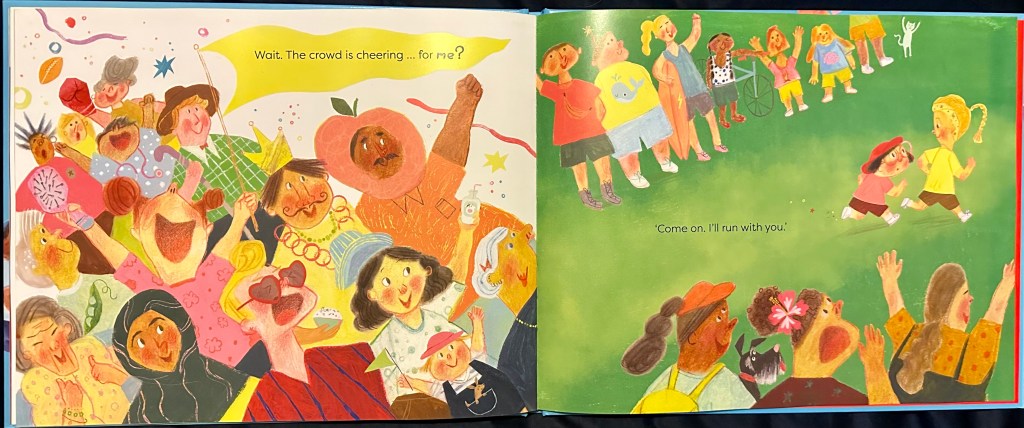
In the crowd scene, Freda has included a little visual totem or object that reminds me of all 24 of the Brains v Brawn cast! There’s the crochet artist Phil in the apple ‘hat’, the pea shirt to remind us of our favourite ‘plant based superman’ Emmett, the surfboard as a nod to Flick. We can all spot the crown that depicts King George as well as the two necklaces that character is wearing to serve as a reminder of Simon’s two idols. And most importantly, and wonderfully, Lin’s friend who runs with her is our champion Hayley, who lovingly endorsed this book and lent her image for the story.
In the show you were known for championing quokkas. Are you still involved with their cause? If so, what’s happening with them now?
I continue to love and promote quokkas as my spirit animal! I was lucky enough to return to Perth last year and visit my little friends again on Rottnest Island during joey season. Best serotonin boost to lift the spirit and always highly recommended.
The book is only just published. It may be too early, but what reception has it received that gladdens your heart?
Before it was published, I gave one of my advance reading copies to an old friend of mine who was visiting from Hong Kong. He took it home and read it to his two young kids. Not only did they ask for the book to be read on repeat, but their little boy (who’s 4) made up a game called ‘Last-Place Lin’; the two would race to the other side of the room and he would let his little sister win. I found that exceptionally endearing! Even if it wasn’t the exact message of trying really hard, I love that he’s definitely exhibiting kindness!
Who do you see getting the most from this book?
I hope children who feel anxious about school competitions and athletics might take solace and comfort in this book and Lin’s story. I also think there’s a cohort of adults out there who remember being Lin when they were little and I hope the book might do a little bit to heal that inner-child and let them know that they did great.
What are you writing now or next?
I’m coming back to YA and have been frustratingly working on a new story that is quite different from my previous books. We’ll see how it goes.
How would you like readers to contact you?
They can find me on socials @onewpc (Insta, Twitter and Tiktok)
Interview with Wai Chim about The Surprising Power of a Good Dumpling at PaperbarkWords blog

 paperbarkwords.blog