
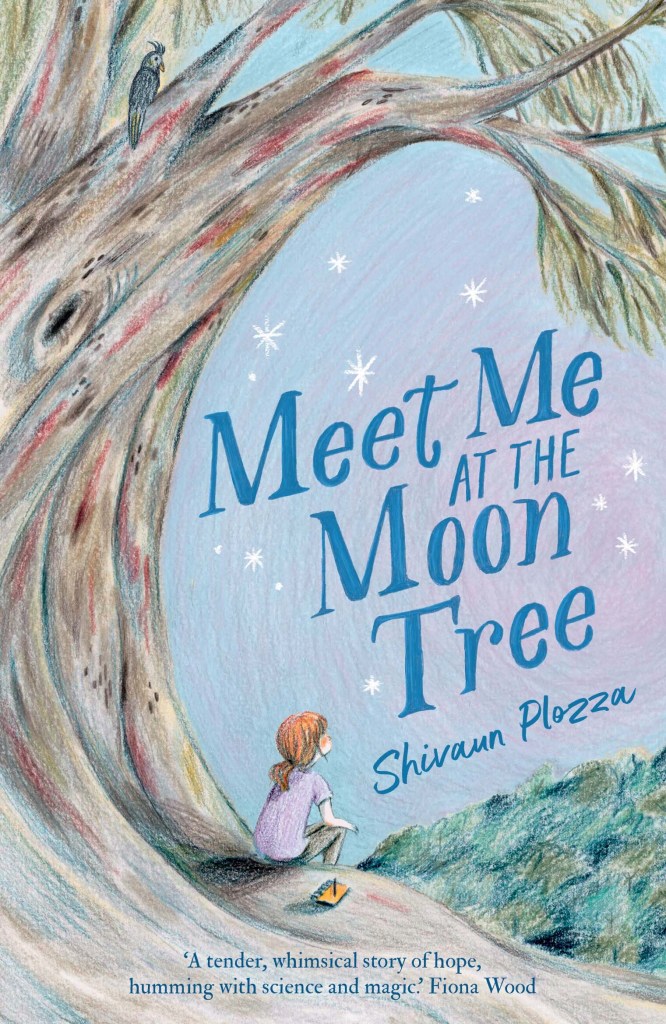
Meet Me at the Moon Tree by Shivaun Plozza
Guest author post by Shivaun Plozza about Meet Me at the Moon Tree
Thank you for your superb body of work for YA and middle-grade, Shivaun and for writing so beautifully about Meet Me at the Moon Tree (published University of Queensland Press) for Joy in Books at PaperbarkWords.
The Magic of Moon Trees
The day I discovered moon trees, I was looking for something else. I was on a deep dive researching haunted forests for another story idea, one I’ve still not written because I was instantly distracted by a single line in an article about the world’s strangest trees. In fact, it was two words in particular that caught my attention: ‘moon trees.’
What are moon trees? I asked myself and followed my curiosity down the rabbit hole. The answer was something magical.
On the 31st of January, 1971, the Apollo 14 mission set off for the moon. On board were three astronauts and over 400 tree seeds. NASA scientists were following their own curiosity down a rabbit hole: would being in zero gravity impact the seeds’ growth? So the seeds were sent into space and when they returned to Earth they were germinated, planted and grew up to be known as moon trees.
I knew instantly I had to write a story about them. And I knew instantly that my main character, Carina, would be someone who loved science with all of her heart—who better than a science-loving ten year old to tell a story about moon trees? I was one of those kids who gave up on science early. It’s boring, my younger-self thought. It wasn’t until later, when I discovered quantum physics and string theory and black holes and more that I realised there is nothing boring about science at all. In fact, it is absolutely fascinating. It wasn’t until later still, after reading everything I could about moon trees, that I thought perhaps my books could do with a few more science-loving main characters in the hopes of showing young readers how fascinating and vital and transformative science can be.
But I had a problem.
My science-loving main character needed to believe in magic, too. Because I love writing about magic—I’ve written two fantasy middle grade novels brimming with it. And there is something inherently magical to me about the idea of moon trees: Trees that orbited the moon! How is that not magical? But my problem was this: how was I supposed to write about magic in a contemporary novel? More importantly, how was I supposed to write about magic when my main character was a self-described scientist?
The answer was surprisingly simple.
Carina showed me that science and magic are two sides of the same coin and believing in both makes more sense than you’d think. They’re both about opening up your mind to the world around you, taking bold leaps of faith and feeling, allowing curiosity to guide you down unexpected paths. As Carina’s father says in the novel: ‘Everything is magic … and science is just figuring out how magic works.’
Through this lens, I wrote a story about grief, about the power of healthy friendships, the intricacies of family, and the beauty of the natural environment. It’s a story about the mysterious world of trees, the fascinating way they communicate, the communities they form, the way that, even in death, they keep life thriving around them. Mostly, it’s about the magic of science and a daughter’s love for her father, a love so strong it is its own kind of magic.
Meet Me at the Moon Tree at UQP
*****
A selection of my interviews with Shivaun Plozza and reviews of her books:
My interview with Shivaun Plozza in Magpies Magazine 2021
(reproduced with permission)
Shivaun Plozza: between heartbreak and humour by Joy Lawn
Most … have come to see the Stars as a myth, a bedtime story for children. But we … are different. We like truth and we love to ask questions… I think you might too. (The Boy, the Wolf and the Stars)
Could you tell us about yourself before we speak about the books you have written?
What is a strong memory from your childhood?
I never know what to say about myself! I’d much rather talk about my characters … I’ll give you three facts: I grew up on a sheep farm, when I’m not writing I enjoy painting and drawing, and I used to be a secondary school teacher.
A strong memory from childhood was accidentally leaving behind a brand new plushie toy in a motel room in Robe while on holiday. I wept for hours over it once I realised what had happened. I recently used that memory as inspiration for a scene in my current work-in-progress so perhaps the pain was worth it.
Where are you now based and what is your background and current role in the literary and publishing world?
I’m based just outside of Geelong in Victoria and I work as a full-time author. That means I get to write a lot, but also I get to visit lots of school, teach creative writing workshops, mentor emerging writers, conduct manuscript assessments, and more.
Your YA novels deal with serious concerns yet are told with a light touch. This is partly because of your major characters – who are often funny. Could you please introduce some of them?
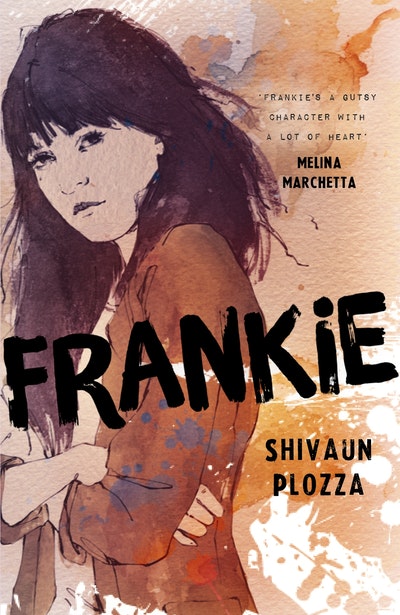
I’m fascinated by the intersection between heartbreak and humour so I’m pleased to hear you highlight that. Frankie (Frankie) came about because I wanted to write the voice of a hardboiled detective, but if that detective was a seventeen-year-old girl who’d grown up in Collingwood. She’s cynical, dry-witted, intelligent and angry. Marlowe (Tin Heart) is a heart transplant recipient who tends to stumble from one bad decision to the next and overthinks everything. Bo (The Boy, the Wolf and the Stars) is dealing with his growing anger and struggling with self-doubt. He also has a sharp sense of humour and isn’t afraid to argue back.
In your three novels, you have written characters with aching hearts who are vulnerable through being abandoned or trapped. Could you share something about some of these?
Do you know, I’ve never noticed this but you’re right. Frankie was abandoned by her mother (though her Aunt Vinnie steps in and fills the roll amazingly), Marlowe is smothered by her mum and feels trapped by the perceptions others have of her and Bo is abandoned by pretty much everyone. I think I write these kinds of characters because that’s often how it feels when you’re young—you can feel trapped by circumstances or by expectations, and when you clash with friends or family it can feel as though they have abandoned you because emotions hit so much harder when you’re young.
What are some other strong emotions or themes that run through your work?
I enjoy writing about found family, fear and anxiety. I’m also keen to make sure my main characters have flaws. I like messy characters who make mistakes so we can watch them work their way out again, stronger and better for it. I think it’s good to show young readers you can make mistakes so long as you learn and grow from the experience.
Forgiveness also seems to be a quality explored in your novels. Why?
I’d never noticed that either but again I think you’re right. I’m about to give away a spoiler here (so look away if you don’t want to know!) but the interesting thing about Tin Heart was that Marlowe doesn’t earn everyone’s forgiveness at the end of the novel; she’s left knowing she’ll have to work hard to earn it and even then it might never happen.
One of the key ideas The Boy, the Wolf and the Stars emphasises is how complicated forgiveness can be. I grew up with a very simplistic idea, I think. The idea of always taking the high ground and viewing forgiveness as a strength. Which it is, but it can’t be given away freely to people who don’t work to earn it, who make no effort to be sorry, to be better. I wanted Bo, who had been wronged by a lot of people, to say: You know what? I don’t think I do forgive this person. Because they’re not even trying to be better. And that’s not my fault. I think that’s a good concept for young readers to consider—it’s great to forgive but if someone keeps treating you badly it’s okay to walk away too.
Many authors move between readerships and genres but without doubt the question everyone wants answered is, after successfully establishing yourself as a YA author of contemporary realism, why have you written a middle-grade fantasy (and you are a gifted author of fantasy by the way)?
Perhaps it’s not very sensible of me but I tend to just follow the idea that excites me the most and I’m someone who has ideas for all kinds of genres and age groups. In terms of the timeline, I actually started writing The Boy the Wolf and the Stars long before my first two contemporary YA novels (it first began as a short story twenty years ago). I’ve always written across multiple genres—it just happened to be two contemporary novels that came out first. I hope to explore contemporary MG and YA fantasy too, as well as many other genres and readerships. I’d even love to do a graphic novel one day.
Would you describe The Boy, the Wolf and the Stars as high fantasy, quest fantasy or something else, and why?
I describe it as high fantasy, as it’s clearly a second-world fantasy and has its roots firmly steeped in the genre’s traditions, but I also emphasise the quest element, as I think that indicates the pacing and tension I was striving for. The other thing I like to emphasise is its roots in folklore—I wanted it to read like a folktale, something that feels a bit timeless and ‘classic’.
How differently did you approach the fantasy world-building from the contemporary settings of your YA novels? Please also describe your setting, including the importance of the forest and trees.
I don’t know that I approached it differently, there just had to be more work that went into it, as I was starting a world from scratch rather than looking at an existing world and deciding which elements I wanted to highlight.
I always approach the setting as a character—I want my settings to feel alive and part of the story. To develop Ulv, I wrote a dictionary of key terms, elements, locations etc. I also wrote a detailed history of the world and drew maps and sketches of any creatures I’d invented. From those documents I could work out which bits needed to be included in the book and which didn’t.
I grew up in the country and have always been fascinated by trees and of course they’re deeply entwined with folklore around the world. It made sense that trees and forests would play an important role in this story. When the world starts to get sick, it’s the trees that show symptoms first. In a way, the trees represent the state of the wider society—as it crumbles, as people get meaner and turn on each other, as they behave selfishly, more trees start to die.
What other conventions of fantasy have you included in this novel?
I wanted to explore the mentor archetype. Without giving too much away I like that the character who starts out set up as the mentor does not end up fulfilling that role—another character steps in. I was interested in the idea of role models—What do you do when your role model lets you down? Who makes a good role model? It was important for me to give Bo, a boy, a strong female role model, for instance.
I also wanted to explore a world with magic, though I have to admit I found that the most intimidating element to include—it took a lot of work! I often take the element that scared me the most in writing a story and make it the centre of my next work, as a challenge to myself. So my next novel, A Reluctant Witch’s Guide to Magic, (coming 2022) is heavily focused on magic.
Why and how have you integrated excerpts from The True Histories of Ulv into the major narrative? Which did you write first – the main narrative or the Histories? Could you give us a brief history of Ulv?
The main narrative came first, then I got the idea of the Histories as I was writing out the worldbuilding information. The voice came through strongly and I realised there should be a character in the story who was writing these histories and that’s how the Scribe was born. At first it was simply a way to slip in any worldbuilding that might help the reader better understand events, but eventually I started to have fun with it—using it build tension, to foreshadow, to explore themes. Someone pointed out that it almost acts like a Greek chorus and I quite like that interpretation.
As for Ulv, it’s a land where the stars and moon have been missing for so long people have started to view them as a myth. Their absence has created a curse: each night the darkness comes alive as ravenous Shadow Creatures. The only way to end the curse is to find and release the stars, which were taken by a bewitched wolf.
What is the importance of Light, Dark and Shadows in your story (and their complex relationship between each other) and how have you personified them?
One of my key inspirations for the book was fear—how to confront and overcome fear—and one of my greatest childhood fears was the dark. I thought shadows were interesting to focus on because when you’re scared, you can easily convince yourself you see monsters in the shadows. I created a world where that was literally the case.
I didn’t want it to be too simplistic though, the typical idea of light versus darkness, good versus evil. That’s where the magic system came in: I wanted it to represent the idea that it really comes down to us, to our actions—good things can become evil in the wrong hands.
What other symbols recur throughout this story? Could you briefly explain how you’ve used one of these?
I think wolves are often used as symbols of evil, especially in fantasy stories. I wanted to make that less clear cut. I did a lot of that throughout—take a common fantasy architype or symbol and slowly twist it away from the usual symbolism into something a lot more complex and, at times, the opposite of what you’d expect. The two wolf characters were a lot of fun to write.
Could you describe the relationship, and its purpose, between Bo and the fox, Nix? (is his name in homage to fantasy writer Garth Nix?)
No, it’s not! I hadn’t thought of that. I chose that name because I knew he would be cheeky. I’ve always wanted to write an animal best friend character and I just really like foxes. He’s there because I wanted to give Bo a break! I put that poor boy through a lot and while I do also let him build a family around him as the journey goes on, I wanted him to have someone by his side right from the beginning, someone who loved him fiercely.
Without giving too much away, what keeps Bo moving forwards and how does he grow and change as a result of his experiences?
At first he is acting on the say-so of others and because succeeding in the quest will give him something he thinks he wants. As the quest goes on, however, he becomes more personally invested, driven to succeed by a desire to make amends for his mistakes. He grows up on this journey, learning a lot of harsh truths. But he also becomes more resilient and learns not to attach his sense of self-worth to people who don’t truly love him.
Your female characters play a diverse range of roles. Could you tell us about some of them?
Tam is a half-bird, half-human warrior and she becomes a parental figure to Bo, though the relationship does have its rocky moments. She learns just as much from him as he does from her, which was important to me—I wanted her as an adult character to grow just as much as Bo does. She’s a bit gruff and abrupt at times but she is deeply loyal.
Selene was a lot of fun to write. She’s a girl coming into her own, discovering her magical abilities. She tries to disguise her loneliness by being overly confident. She never stops being confident, either—Why should she? She’s smart and fierce and brave!—but she learns to trust others with her more vulnerable side, too.
I’m also very fond of the Scribe. She was such a fun character to write as she’s so chaotic and cryptic.
Your work is both engaging and also embedded with literary qualities. Which awards that your books have won or been shortlisted for, or other recognition, have meant the most to you and why?
Winning the Davitt Award for Frankie was amazing. I’m a big Raymond Chandler fan and I set out to write a book as a YA take on the hardboiled detective genre but along the way, despite the mystery at the heart of the story, I’d sort of convinced myself it wasn’t really a crime book. So to be nominated for a crime award and then to win it was a lovely moment of validation. And obviously being short-listed for the CBCAs was special.
It has been such a pleasure to interview Shivaun. Like her novels, her responses are thoughtful, honest and delightfully surprising.
******
My reviews of books by Shivaun Plozza in the Weekend Australian

My review of THE BOY, THE WOLF, AND THE STARS in ‘Paws for Thought’ in the Australian 2021
I have included the full 4-book review for those who are interested.
MUSIC FOR TIGERS
By Michelle Kadarusman
Pajama Press, 192pp, $19.99
THE BOY, THE WOLF, AND THE STARS
By Shivaun Plozza
Puffin, 384pp, $16.99
WE WERE WOLVES
By Jason Cockcroft
Andersen Press/Walker Books, 216pp, $26.99
THE LAST BEAR
By Hannah Gold, illustrated Levi Pinfold
HarperCollins, 304pp, $19.99
Joy Lawn
Bears, wolves and big cats abound in literature for young people and, in the best of these works, are a metaphor for wildness, power and unpredictability or are a conduit to explore fear or grief. Their endangerment and loss also embody the threat to our natural world.
Middle-fiction, also known as middle-grade books for readers aged about 10-14 years, is a flourishing sector of the publishing industry. It intersects with the younger end of the young adult market.
Four novels recently published for this age-group are notable. One explores the fate of the elusive Tasmanian Tiger, two feature wolves and the fourth highlights a bear.
In Music for Tigers,Australian-Indonesian author Michelle Kadarusman transplants violinist Louisa from Toronto to the Tarkine in the northwest Tasmanian wilderness. As soon as she arrives her musician’s senses are attuned to the currawongs who seem to be singing Vivaldi’s Four Seasons.
Her Uncle Ruff runs a camp that is a haven for the endangered species that have lost habitats to land clearing and are threatened by invasive predators. It is to be bulldozed to make an access road to the tin and iron ore mines. Legendary Convict Rock, a landmass in the river, will be dynamited to become a bridge.
Louisa reads her great-grandmother Eleanor’s journal about her life in the bush in the 1930s and 40s. Eleanor established the camp for wildlife at risk and found a secret sanctuary on Convict Rock for the Tasmanian Tigers that were thought to be extinct.
Great-grandmother and granddaughter share a talent for music and it is Lou’s violin playing that lures the last thylacine in the area to her.
Music for Tigers explores Lou’s new friendship with neurodivergent Colin as well as Lou’s own performance anxiety. It has important conservation themes set in a real landscape that is almost magical in its dense lushness and beauty. It is told as a contemporary mystery using sensory, artistic images inspired by nature. The thylacine becomes a symbol of saving the lost in this moving, uplifting tale.
The Boy, the Wolf, and the Stars by Geelong-based author Shivaun Plozza is also intriguing and well composed and paced. Its style and mysterious elements derive from the quest fantasy and folklore genres. Wolves play multifaceted, sometimes subverted, roles and one is a major antagonist.
When 12-year-old orphan Bo fails his weekly task of sprinkling gold-red dust around the hunchbacked oldest tree in the forest, the force that constrains the Shadow Creatures is loosened. The island of Ulv has been overshadowed by the Dark since a bewitched wolf swallowed the stars to gain power to rule the land. The moon and constellations have been missing for so long that the people think they are a myth. Without their light, evil manifests in people and other creatures. The forest is dying and the Shadow Witch is allowing malevolent magic to seep back into the world.
Pursued and threatened by Ranik, his wolf nemesis, Bo and his cheeky fox friend Nix, apprentice healer Selene and the feathered Korahku who has the head of a human and body of a bird, must solve the riddles and face tests and trials to find the three keys to unlock the second wolf’s cage so that the stars can be released back into the sky and good magic can prevail.
Each major character undergoes a rite of passage in this original literary fantasy. Lies are revealed and they must all grapple with rejection, betrayal and anger before they can trust and forgive.
Metaphorical wolves and other wild creatures surface in We Were Wolves, written and atmospherically illustrated by Jason Cockcroft who created some of the iconic Harry Pottercovers. The unnamed boy protagonist lives in a caravan in the wood with his father John who has suffered from PTSD since his war service in Iraq and Afghanistan. John is about to return from prison.
The boy would prefer to live comfortably with his mother rather than endure the cold, lack of food and threat of eviction but his father’s head is “alive with beasts” and he needs help. He tells the boy about the ancient creatures that live under the ground: “beasts that had laid quiet under that wood for thousands of years finally climbed up out of the soil … like the bones of bears and wolves and wild bulls that are there if you dig deep enough.” Prehistoric creatures are stirring underground. The boy dreams of the yellow-eyed wolves awakening and clawing their way into the sunlight because John is coming home.
John is a damaged man. He is battered by his time as a soldier and ensnared in his criminal activities but loves his son in his own way and shares nature, and the art and poems of William Blake (“Tyger Tyger …”) with him.
While full of foreboding and foreshadowing, Cockcroft’s writing is lyrical with nuanced allusions to stars, butterflies and friendship to temper the darkness. This classic-in-the-making leaves us contemplating, who are the wolves?
The children’s novel The Last Bear by debut author Hannah Gold is enhanced by the art of Australian illustrator Levi Pinfold.
When a widowed meteorologist takes his 11-year-old daughter April to the Arctic Circle and neglects her she becomes friends with a polar bear, but is it real or imagined?
The inland lakes, beaches and trio of mountains on Bear Island are populated by rare birds and the Arctic fox but there are no bears. The melting ice caps have prevented them wintering there in recent years but, perceiving the place to have a “whisper of a magical fairy tale”, April thinks she sees a bear.
There is one starving young bear left on Bear Island and he is April’s secret. She has inherited her mother’s affinity with animals and slowly gains Bear’s trust through offering food and cutting the plastic twisted around his paw that stops him hunting. April knows that wild animals are dangerous and is cautious but the story she sees in his eyes shows that they share a bond of loneliness and grief.
Together they explore the coves and mountains. April learns to roar and “with each roar, she became a little bit more bear and a little less human. It didn’t matter how small she was. It only mattered how much she wanted to be heard”. However, her “iridescent shine of happiness” is threatened when her time on the island ends and she must reunite Bear with his mates.
The natural elements reflect and enrich the narrative. In an other-worldly scene April sights Bear in a mantle of fog, and the “hard, wrathful” waves emulate the pounding of grief and rage.
Plastic and litter; climate change and rising sea levels all mirror the wider world as April exemplifies how the young lead the way in saving the natural world.
Joy Lawn is a regular reviewer of literature for young people
****

My review of TIN HEART in the Australian in 2018
I have included the full review of 6 books for those who are interested. Scroll down for Tin Heart.
Young adult fiction: classics set off modern alarms
· By JOY LAWN
- 12:00AM MAY 12, 2018
The Australian young adult novels reviewed today span the contemporary realism, psychological thriller and speculative fiction genres. Some are inspired by classic literature.
Television scriptwriter Clare Atkins tackles significant social and political issues in her books. Her debut YA novel, Nona & Me, looked at cross-cultural friendship, struggling relationships and reconciliation during the period of the Northern Territory Emergency Response and Kevin Rudd’s national apology to the Stolen Generations.Her follow-up, Between Us (Black Inc, 304pp, $19.99) is set between a Darwin school and the notorious Wickham Point Detention Centre. It follows the experiences of Iranian asylum-seeker Anahita on mainland Australia after periods on Christmas Island and Nauru.
She seems equanimous but wears a headscarf to hide the patches of scalp where she has torn out her hair. Her tender yet brittle new friendship with Jono worries Jono’s father Kenny, who was a Vietnamese boatperson and is now an officer at the detention centre. The novel is told from the perspective of each character.
Jono has a history of being abandoned by women. Even his mother left him. At the beginning he reveals his observations and emotions through verse, but anger and depression stifle his voice. Despite her growing fluency in English, Ana’s words become more spare and poetic as her circumstances worsen.
Ana and Jono try to “hover in the corridor, a safe in-between place”. The title also suggests the spaces between people, particularly between the three main characters, where barriers of ignorance, fear and imprisonment shut down interaction and understanding. Acceptance and empathy could better fill these gaps.
Between Us is an insightful, thought-provoking and uncomfortable work that uses the powerful novel form to awaken readers to the plight of migrants, refugees and others at risk in detention.
Tin Heart (Penguin, 310pp, $19.99) is the second novel from Geelong author Shivaun Plozza. The protagonist Marlowe, named after Raymond Chandler’s detective, is nicknamed Ray by the attractive, arrogant butcher’s apprentice Leo. Marlowe is a shy and introverted 18-year-old vegan who feels like the “secondary character” but occasionally manages some smart comeback lines.
Her young brother, Pip, dresses in costumes and makes up dance routines; her best friend Zan labels herself “a gay Chinese-Australian” and her new friend Carmen describes a potential relationship between Marlowe and Leo as a “foodie version of Romeo and Juliet” and helps Marlowe prank him, a source of laugh-out-loud humour.
Even though Plozza writes with a light touch, she portrays many of her characters as trapped. Marlowe is the recipient of a new heart and is trying to contact the family of her donor. She’s not sure who she is now that her life doesn’t revolve around trying to stay alive, and she stalks Carmen, the sister of the boy whose heart she thinks she has been given.
She’s bullied at school and described as Frankenstein’s monster, “made out of dead people bits”. Carmen hides her grief, Leo seems shackled to his harsh father and Pip may have moulded his personality in response to his fear of losing Marlowe.
Allusions to The Wizard of Oz in the “tin heart” of the title, Marlowe being described as “heartless” and Leo’s name, are apt and poignant. The culminating scene is a triumph of wit and awkward pathos, forgiveness and love.Ellie Marney uses another well-known story to enrich her novel White Night (Allen & Unwin, 384pp, $19.99). Bo is a popular figure in his regional community. He loves his family, friends and footy, and is beginning to realise he may prefer cooking to sport. The author crafts his character and relationships with authenticity and affection.
He is a non-stereotyped athlete who cares deeply, particularly as his secure home life seems threatened and he matures to become more curious about the world.
His eyes are opened, particularly to environmental issues such as the plastic in the Great Pacific Garbage Patch, when home-schooled Rory joins his school in Year 11. She lives in “Garden of Eden”, an off-the-grid commune that seems robust and benign but may be operating outside the spirit and letter of the law.
Despite its apparent utopian garden setting and sting in the tail, this novel is not founded on the Biblical story of Genesis.
The white night of the title is multifaceted. It refers to a fundraising light show festival organised by Bo’s friends to raise money for their local skate park, as well as being a code name for the sinister suicides and deaths at the infamous Peoples Temple Agricultural Temple in Guyana, better known as the Jonestown cult. It also alludes to the “white knight in shining armour” of traditional fairytales such as Sleeping Beauty.
Images of Princess Aurora (Rory) hidden behind an overgrown hedge and the heroic knight, Prince Beau (Bo), are skilfully planted into this new story and then subverted. The author knows how boys think and feel, what they want to read and how to make them work without losing narrative momentum. White Night is compulsive, gritty and illuminating.
Now to two tight and terrifying psychological thrillers from debut novelists.
Margot McGovern’s Neverland (Penguin, 366pp, $19.99) transforms the dark nostalgia and arrested growth of JM Barrie’s Peter Pan into the island home of main character Kit Learmonth. Kit grew up on the island, which she calls Neverland, and is now part of an educational and medical institution for troubled youths that Doc, her psychiatrist uncle, established there after the death of her parents. It is home to “pirates, mermaids and Lost Ones”.
Kit self-harms and has tried to kill herself. She has been moulded into a storybook character, “stuck in someone else’s story” and can only describe her pain through the tales of Barrie and Robert Louis Stevenson’s Treasure Island.
Her Neverland is an illusion, “a fairytale in which certain key events occur off page”, to hide her childhood trauma but she doesn’t realise her stories contain male figures who hold women hostage.
Kit and Doc quote Homer to each other and when Kit and her friends sneak out to the lighthouse, they toast to the words of Lord Tennyson’s poem Ulysses.
A new boy, Rohan, is a romantic dubbed “Lord Byron”. His girlfriend has died and he now wants to indulge in make-believe and play with Kit.
The students are encouraged to sail and race against other schools, but when Rohan and Kit escape on to the water, the monsters of her nightmares encroach.
In Sarah Epstein’s Small Spaces (Walker Books, 384pp, $19.99), Tash, as a child, told the police she saw Mallory Fisher taken from the carnival by an “imaginary monster”.
Tash doesn’t trust her memory and fears small spaces, especially the one inside her head. Her psychiatrist told her that she invented Sparrow, her menacing imaginary friend who made her play games and locked her in a box, because she wanted attention when her baby brother was born.
Mallory, her older brother Morgan and their parents move back to the NSW mid-north coast, where the novel is set. Mallory is now 15, mute and home-schooled, and Morgan and Tash tentatively rekindle their friendship. Mallory’s seven-day disappearance, Morgan’s guilt at losing her and Tash’s shame at the red herrings she gave the police and not being the one who was taken still impinge on their lives.
Flashbacks told in Tash’s childish voice, along with newspaper articles and therapy transcripts written in a clinical tone, are juxtaposed with her struggle to be truthful and her longing to be trusted.
The ominous atmosphere is heightened by the cacophonous carnival setting of the past and the disquiet of its derelict skeleton in the present as well as by Tash’s Aunty Ally’s decaying house “with its crack-riddled stucco like the caked-on face paint of a leering clown”.
Despite Tash’s hard-won escape from her childhood fears and fabrications Sparrow may be back and: “Coming to get you. Ready or not.”
The world in James Bradley’s post-apocalyptic The Change trilogy is threatened by infection. The “Change” is affecting the landscape and vegetation, with sentient-like rippling grass, “glowtrees” that emit a cool light and trees like giant baobabs with fleshy trunks and swollen bud-like protuberances that may be animate.
Infected humans are quarantined or terminated and those who escape metamorphose. They retain their physical facade, but “up close their skin was in fact translucent, the lights moving within them like blood or some kind of fire”.
Even more disturbing, their eyes reveal their lost mind and spirit, and their new allegiance to the Change — an intelligent hive-like organism that may be a metaphor for our ever-watching and self-serving society.
In Book One, The Silent Invasion, Callie tries to save her younger sister Gracie by running into the Zone. This episode ends with a cliffhanger that plays out at the beginning of Book Two, The Buried Ark (Pan Macmillan, 258pp, $14.99), which is set in Queensland.
Callie is chased but faces her pursuers to share her knowledge of the Change. She becomes part of a Science Corps reconnaissance mission where she connects with enterprising soldier Ben before reaching the Buried Ark.
The Ark is populated with horticultural and other workers who maintain a seed bank and genetic repository: security for the future of the survivors. Bradley writes assured descriptions of his altered world and builds the atmosphere of how the Change itself evolves with suspense. This trilogy is a fast-paced read that evokes the fecund plant life of The Day of the Triffids and the threat of Cormac McCarthy’s The Road.

 paperbarkwords.blog
2 thoughts on “Meet Me at the Moon Tree by Shivaun Plozza”