
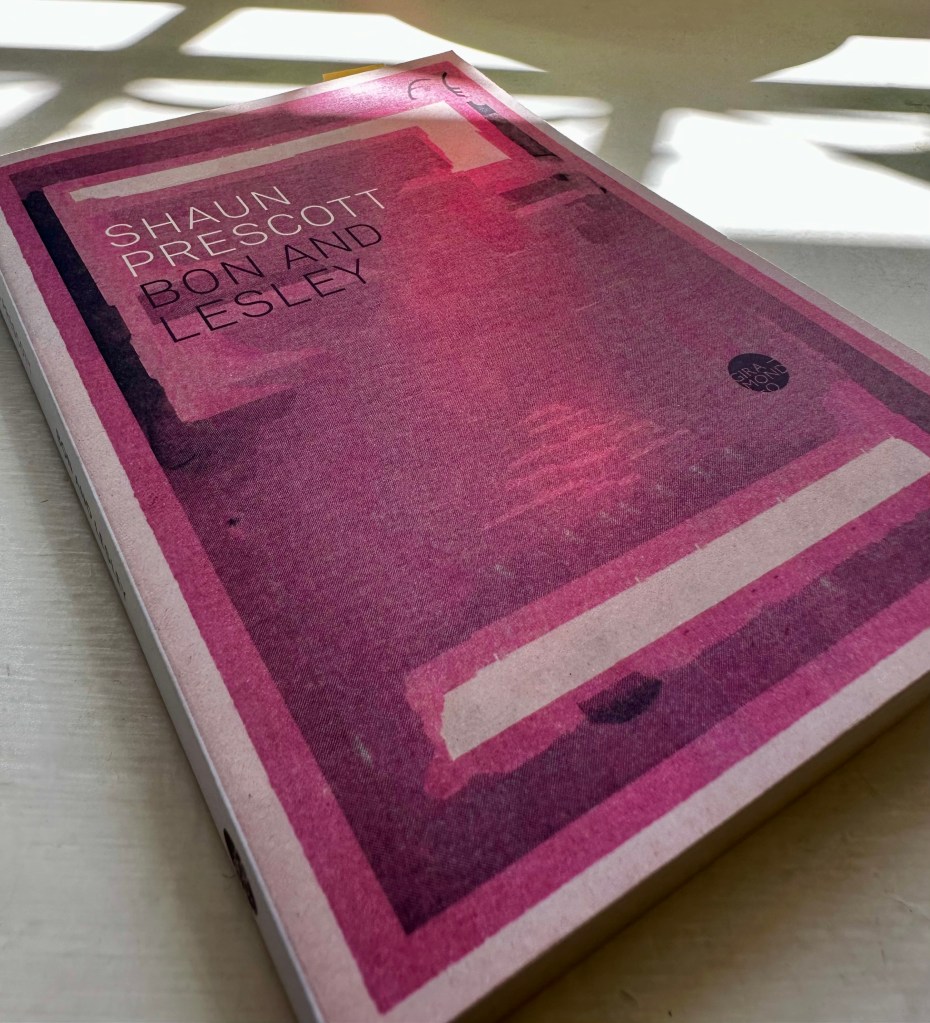
Bon and Lesley by Shaun Prescott
Author Interview at Paperbark Words
“You’d be surprised how many places elude maps, you can fairly easily stray from the known world entirely. And you’re not paying attention if you think it’s untrue, but you must know it anyway because you got off the train. You always thought these stops – and she waved west across the field towards the station – belonged to the half-asleep daydreams you had in transit, you must have thoughts those places were phantasmal, a result of motion and routine blending with the vivid mysteries of sleep. But that doesn’t account for how real they always appeared and how material they’ve proven to be…” (Bon and Lesley)
Shaun Prescott’s well-received debut novel, The Town, is followed by Bon and Lesley, his second work of reflective, quality literary fiction, and a finalist in the prestigious 2023 Queensland Literary Awards: University of Queensland Fiction Book Award.
Bon and Lesley’s co-finalists in the QLA Fiction Book Award
Praiseworthy by Alexis Wright (Giramondo Publishing) Winner
Horse by Geraldine Brooks (Hachette Australia)
The Sun Walks Down by Fiona McFarlane (Allen & Unwin)
An Ungrateful Instrument by Michael Meehan (Transit Lounge)
Bon and Lesley by Shaun Prescott (Giramondo Publishing)
The University of Queensland Fiction Book Award 2023
I was privileged to chair the judging panel of this award and our report about Bon and Lesley said:
When thrown out of your own story, how do you piece together relationships, family, place? In Bon and Lesley, the mundane, the unreal, the frayed edges of memory provide the threads of insensibility grasped by those who find themselves in the food-court ridden town of Newnes. The dystopian Bon and Lesley is a surreal, wry satire. Queensland Literary Awards, judges’ comments
Bon and Lesley is published by Giramondo.
******
Thank you for speaking to ‘Joy in Books’ at PaperbarkWords, Shaun.
Bon and Lesley is likened to the writing of Gerald Murnane and others. I found David Ireland and Patrick White and maybe James Joyce in it. You may or may not be happy with these comparisons because you are creating something unique. However, which would you accept, and why?
I’ve only tried reading one Ireland, The Unknown Industrial Prisoner, and I became frustrated early on and had to put it down. He remains a writer I want to read more carefully some day. Based on what I know about his work, it makes sense to make that comparison.
[As a young 20-year-old under-graduate student studying Australian literature I wrote a long, in-depth piece about David Ireland’s books and must revisit it to refresh my memory of his work and to further compare it with Bon and Lesley.]
I read a lot of Patrick White in my 20s, so there may be an echo of his work in mine, but I can’t see it. Murnane is the greatest living novelist that I have read. His focus on interiority at the expense of every other dominant contemporary novelistic concern was emboldening for me when I first read his books. But I don’t accept that our work is similar or even in the same orbit. Even if I was as technically brilliant as Murnane – which is to say, capable of writing stories and novels as ruthlessly strict about their own internal logics as his – we still wouldn’t be in the same orbit. There is too much of the contemporary world in my novels, too much implied or ambient politics, which I feel is a product of the time and media environment I’m writing in.
As for Joyce, it’s never occurred to me. I’ve only read Portrait… and Ulysses, and neither strike me as similar to my novels.
As I read Bon and Lesley, I jotted down descriptions of it as surreal, a dystopia in the real world now, magic realism in a grunge coat, wryly funny, a trauma satire … Which description goes closest to your vision of the novel? Why?
Of those descriptions I would choose the second. I thought of The Town as a pre-apocalypse novel. In Bon and Lesley, the set dressing is almost banal in its grimness: a world in an ongoing and ascending state of environmental, political and social crisis. We do live in a real dystopia.
I hope my novels are funny, whether wryly or otherwise. I don’t often like novels that aren’t funny, though I rarely read deliberately comedic novels. At the same time I dislike novels that are too mild-mannered, too hedge-betting. I respect severity.
What is the significance of some of your characters’ names?
The only meaningful choice I made was that Jack and Steven should have common names. I named Bon after Bon Scott. Lesley is just a name I like the sound of.
Why can’t Bon “perform gratefulness”?
In the context of the passage, it’s because he wants to maintain his sense of authority over the work he’s doing. It probably makes him feel small that Lesley was the one to solve his problem. That is only Lesley’s guess though, as by that point in the novel we’re hovering closer to Lesley’s point of view. Lesley is correct, though.
Blocked doors, tunnels, portals, hidden roads pathways, a hole …. Where are you leading and blocking us?
None of the mysterious thresholds lead anywhere interesting or remarkable in my novels. The characters seeking these portals are disenchanted and seeking re-enchantment. They are no longer children and this troubles them. In their world, most common adult humans think they know everything that’s important to know. The novel’s chief characters are disappointed with their lives because the physical world is thoroughly charted and mapped out, and anyway its solidity is under threat – what can they do? Meanwhile, they are disappointed and bored by their interior lives because everything they feel is either good or tolerable, or something that can be solved by endless work, exercise, or a medical prescription. Abstraction is not tolerated. Every slight deviation from the norm is pathologised. They are thoroughly enlightened. They wish to be re-enchanted. The characters in Bon and Lesley are a cast of bumbling sentimental heroes.
Mother Grady says, “The past remains inside me, but it’s an existence I’ve come unstuck from. Every new day feels insubstantial measured up against it, every day is a new limbo, like a chunk of surplus time … It’s for a want of a past, present and future again, all three side-by-side in their correct place. Do you know that we’re living in the future … ?”
It might be almost impossible to explain, but how do you somehow let time seep or become loose between past, present and future in the novel?
The events in Bon and Lesley happen in sequential order over a period of nine months, the gestation period. The novel doesn’t specify many events that place it strictly in an ultra-contemporary setting, though the internet and certain franchises are mentioned. There are more specific references in there, some obvious and some possibly less so.
Technically it’s a practice of not over-emphasising specificities and focusing on evocative generalities. Environmental crisis is noted, but it could just as well be a decade ago, or a decade into the future. But I hope the novel captures the mood of the threshold between present and future. As Mother Grady says, we’re living in the future, or at least, the beginning of it. “The present” in this context implies what’s familiar, routine and durable. The pattern of life broadly evoked by the image of suburban settler Australia through most of the 20th century and into the early 21st century is almost over.
Those who experienced most of their lives during that soon-to-be past might feel like they’ve breached the outer perimeter of the existence they were allotted. Mother Grady feels that way. The novel amplifies the weirdness of believing in the continuation of these patterns, despite everything. I am 39-years-old and can relate to Mother Grady.
If we compare writing with painting, the colour palette in your writing seems to be deliberately limited. Lesley describes adult life in Newnes as a “greyscale mediocrity”. No doubt this style is a deliberate choice and it somehow strangely enhances the novel’s power to stick under the reader’s skin. Another difficult question, but could you try to explain what you are doing with your writing style to create place and characters that ingrain themselves into the reader like a print or visual earworm?
I try to find variation within a limited tonal palette. A parallel in music would be drone. The effect can only blossom with duration. A tactic I use deliberately is avoiding naturalistic speech. I dislike breaking tone and I don’t try to create “living, breathing” characters. In a differently written novel my characters would be archetypes at best, cliches at worst. The tone or colour of the text as a whole elevates them, I hope.
Lack of quotation marks is important. It’s not just a relatively modern stylistic quirk. I’ve seen people deride the lack of quotation marks in modern fiction, and in some novels it does seem like the wrong decision to leave them out. I think their lack is important in mine. None of the characters in Bon and Lesley, or The Town, speak like a person would and that’s important to me. They speak like the narrator narrates. Quotation marks imply words spoken – my characters are channelled through the narrator’s specific qualities. There are vague but important rules about what the narrator would or would not notice or mention. The narrator is the character of the novel. The narrator’s tone deepens or lightens by degrees according to who is “speaking”.
Likewise, all locales are described with the same gravitas, or lack thereof, whether a mysterious underground passage, or a regional shopping plaza. The surreal or estranging loses everything that is surreal or estranging about it, if overemphasised, or rationalised.
Lesley always believed that “reading was virtuous …” What is the true virtue in reading?
I’ve not been convinced by any arguments in favour of a virtue in reading. It’s an often made argument, usually vaguely, or else just taken for granted as true without elaboration. It seems stupid to me. It depends on what is being read, and who is deciding what’s virtuous. When it comes to literature, it also serves to make reading seem boring to the majority of people who do not engage with art for the purpose of feeling virtuous. If virtue is replaced by value, then reading – specifically literature – is immeasurably valuable, for too many reasons to list, most of which would probably apply to other serious works of art in other mediums.
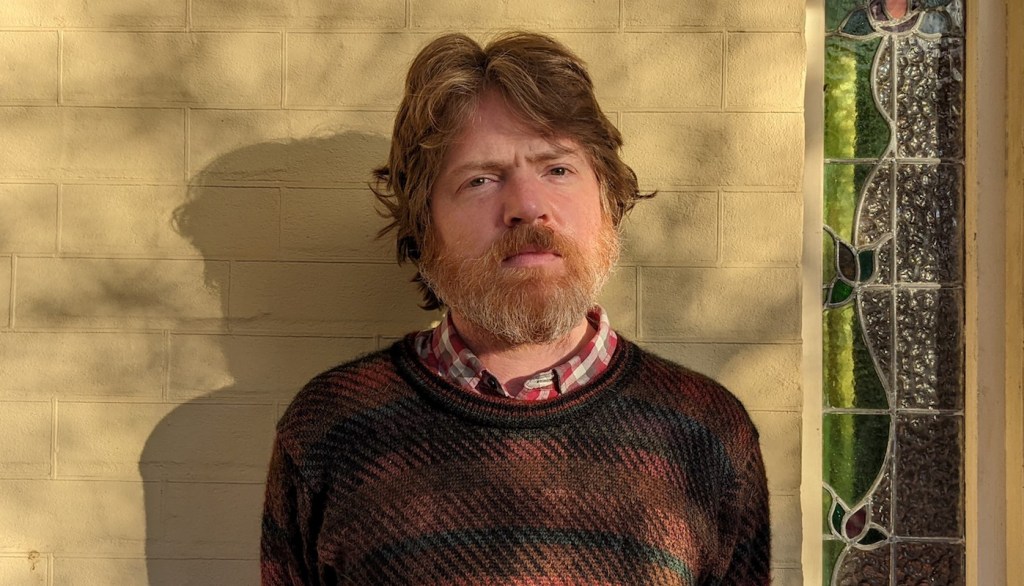
Thank you for your responses, Shaun. They reflect the lateral, metaphysical quality of your ideas and writing and the strangely fascinating experience of reading Bon and Lesley, a book that lingers in the psyche.

 paperbarkwords.blog