
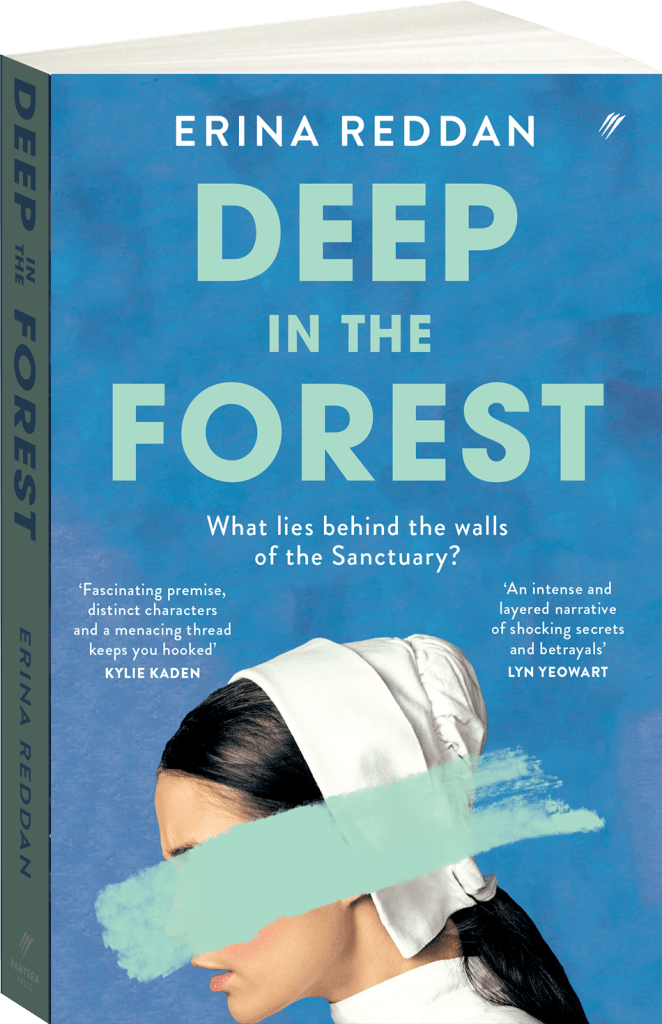
Deep in the Forest
by Erina Reddan
Author Interview for Joy in Books at PaperbarkWords
“I know I’ve spent too much time lost in the river runs of these pages, making notes on the last things to be done before the binding. The moment when all the words, the ideas, the song of it come together. But it’s all just procrastination. I know I have to go up to my mother’s rooms but how do I move that hat stand from the bottom of the staircase and climb those stairs?” (Deep in the Forest)
Deep in the Forest is Erina Reddan’s third novel.
I didn’t know what to expect. All I really knew before reading was that it was about a cult. It turned out to be utterly gripping and surprising and, because it was not set inside the cult but from the viewpoint of an outsider peering in, the story has an abundance of oxygen and layered depths waiting to be explored and peeled away.
One of the layers that I particularly enjoyed was protagonist Charli’s job as a book binder. The descriptions of her creative and intricate work aptly strewed throughout the book were fascinating in themselves and developed our understanding of her character. They also contributed to the plot.
Deep in the Forest is both absorbing to read and very well written.
Deep in the Forest is published by Pantera Press.

Thank you for speaking to ‘Joy in Books’ at PaperbarkWords, Erina.
Erina is such an interesting name. Is there a story behind it?
My mother loved the name ‘Erin’ which is an Irish name, meaning Ireland, but it was too hard to pronounce with my family name so she added the ‘A’ to invent a whole new name, which I have loved all my life because it’s different.
How are you part of Australia’s literary community?
I love our literary community, it’s so generous. I am in a writing group, I do professional development every year to meet other writers and I teach a ‘STORY BONES’ course at Writers Victoria. I also go to lots of launches and do a RAP on READING where we look at how a book works from a writers’ perspective and A Wednesday Writing Whirl which gives writing tips on my Insta and author facebook page.
What genre/s is Deep in the Forest?
It’s a crime thriller with lots about love, connection and relationships.
How does it differ from your previous novels?
I wrote Deep in the Forest using a different method where I started out with a film director as a mentor and plotted it out, so I followed a different process. I have also departed from using personal inspiration and my own experience to create this whole new forest and small town world. Deep in the Forest has a lot more pace too. It gets quite exciting at the end.
Could you please introduce your protagonist Charli and explain something of her complicated, precarious situation?
Charli is a funny, deep, woman in her mid-twenties, whose mother has just died, for which she carries a whole lot of guilt. Charli lives by herself in the forest in a mansion which she’s inherited from her grandmother and mother. While she has this fantastic friend, Amra, most people in her isolated mountain town, Stone Lake, shun her because they blame her for a devastating bush fire, so she’s desperate to get away. When Deep in the Forest begins she has her one way ticket, going to study bookbinding with one of the world’s masters in Venice. But a message asking for help from somebody locked behind the gates of the local religious closed community puts an end to that.
Charli is surrounded by menace yet also by good friends. Whose actions are of great concern? Please give a little detail …
I think every single character’s actions have impacts, for good and bad. The main town’s cop, who’s in pain after losing his generation family farm in a bush fire, is out to get Charli. Charli can feel that there are others out to get her as well, but it’s the power of her connection with the women in the story that hold her head above the water. Don’t you think that is the way of life as well, it’s our friends who help us breathe in the dark and good times.
Which of your other characters do you have a soft spot for, and why?
I think I love Silvie almost the most, although it’s close. She’s an older woman who runs the local milkbar and won’t retire despite her family’s concerns. We only see a few times but she’s such a small town character with a lot of heart which she shows in a restrained way as is the way of woman of her generation, but the two times we see her, she’s really important to Charli and the plotline. I love Amra, who’s this funny aspiring comedian who can’t tell her father because he would try to stop her, believing to be that public would put her in danger. The town also shuns her because of her refugee background. She’s an amazing friend to Charli because she knows her and sees her, so she’s supportive but she also challenges Charli to do better. Deep in the Forest is also about great friendship which is often overlooked because we value romantic relationships so much in books and films.
And I love Gigi, because she’s bold and big in the world as an international lawyer and Charli’s mother’s best friend. She represents the possibilities a bigger life offers Charli.
Look, I can’t stop. Who wouldn’t love Mai and Jess, so smart and brave despite everything that’s happened to them,
In 3 words, could you try to sum up the strengths or qualities of your female characters as a group?
Fun, brave and feisty.
Please tell us something about your setting of Stone Lake, and how it heightens the atmosphere and plot.
The suggested conflict in the metaphor of stone and water is emblematic of the undercurrents in the town of Stone Lake which is both a nourishing and dangerous place. Stone lake is a small town in the Victorian highlands, which is kept afloat by the closed religious community, The Sanctuary, which is nestled deep in the forest and produces the organic food artisanal furniture and attracts tourists. Stone Lake is named for the lake it’s built near which has these million-year-old volcanic rocks which rise up out of the water in precarious formations, with one balanced on top of two others. And in the background there is a once-in-fifty-year event going on in which the Lake has frozen over, which is a huge draw card for tourists and is the reason why the whole story gets going.
What is both positive and negative about the Sanctuary and the New Leaf program?
It can be hard to see beyond the veneer. The locals and the Australian politicians who support The Sanctuary are convinced by the modern clean, organic living aesthetic The Sanctuary presents on its Instagram that it is a positive place. When you visit, people seem happy as they till the fields and work creating the soaps and scents and bath bombs.
The New Leaf program which is a drug rehab program for homeless kids, on the numbers, is also a huge success story. Most observers, including journalists, just see what they’re supposed to see, that The Sanctuary is a place for wounded people to heal and must necessarily be a closed community to protect that healing process. The outside world is positioned as a dangerous place to be.
But the negatives are obvious because any place that doesn’t let you in or out is going to be a place of secrets and lies. And that’s what we find out.
Without giving away any spoilers, how have you created suspense?
I use the forest as atmosphere a lot. It’s the dark, unknown place where anything can happen, a bit like a cult. I also set up a lot of situations and drop a lot of clues which pay off, but way later, so things in the first chapter come back towards the end of the book and that long distance between the two points which creates suspense because the reader is waiting, but doesn’t even know that they are. I also think embedding questions, secrets and lies also create a lot of suspense and keeps the reader guessing. And I use pace. The book starts out at a normal pace but the energy picks up until its racing by the end.
How have you used the senses/sensory writing to enhance the tone of the novel?
The main thing I do is use reaction rather than description. For instance, instead of saying the forest is dark and foreboding, Charli catches sight and reacts to a reflection of herself in the window framed in the cold, darkness of the world outside. On top of that the kind of scenes you experience in Deep are very atmospheric with the dank smell of fungi in the forest and the swish of the fading fly strips at the local milk-bar, so it’s all about sounds, smells, feelings, touch and not just sight.

Which other Australian novels have you recently enjoyed reading?
I have just finished two debut novels, The Heart Is A Star by Megan Rogers and The Modern, by Anna Kate Blair which are great. Loved the Bookbinder of Jericho by Pip Williams, was entranced by Before You Knew my Name by the New Zealander writer Jacqueline Bublitz (New Zealand counts right? ha).
How would you like readers to contact you?
I love hearing from readers because I think together we create the book that they eventually read -i.e. they bring their own experience to the reading. My insta is @erinareddan and you can find me at ErinaReddanauthor on facebook.
Thank you for answering these questions, Erina, and particularly for the thrilling, memorable experience of reading Deep in the Forest.
“Books give me hope. They make me feel connected when I am lost, uplifted when I need lightness and so very often take my breath away in awe.” (Erina Reddan, Author Acknowledgements, Deep in the Forest)

 paperbarkwords.blog