
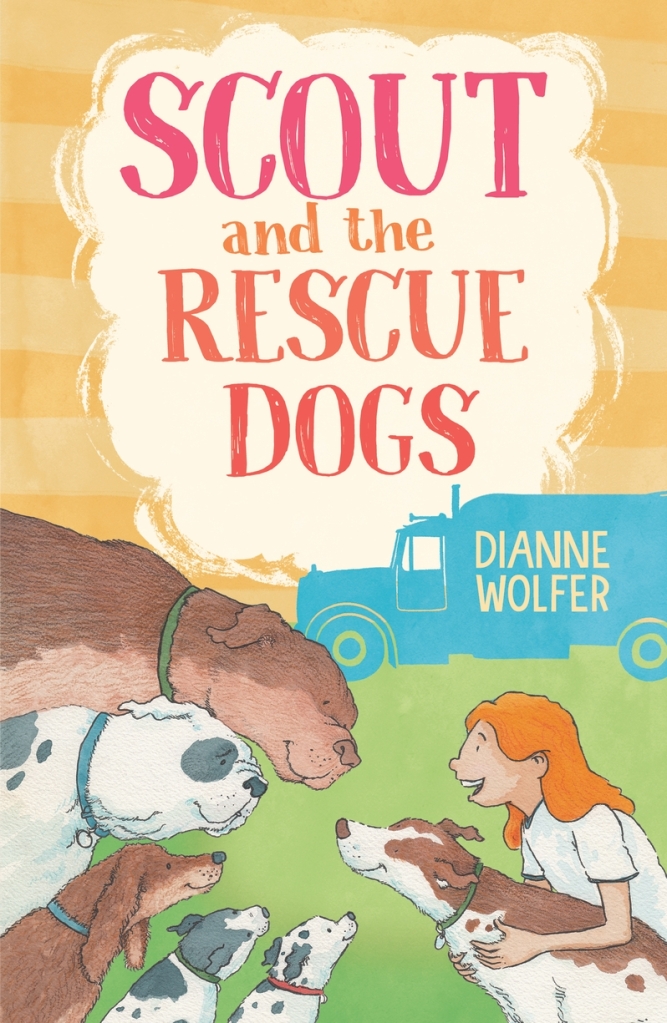
Scout and the Rescue Dogs by Dianne Wolfer
ill. Tony Flowers
(Walker Books Australia)
Inside the CBCA Shortlist
Inside the 2024 CBCA Shortlist
Scout and the Rescue Dogs is shortlisted in the CBCA 2024 Book of the Year Younger Readers category.
Congratulations on having yet another of your books CBCA shortlisted, Dianne (see more about some of Dianne’s other awarded books at the end of this guest author post).
Thank you for speaking to Joy in Books at PaperbarkWords about Scout and the Rescue Dogs.
Guest author post about Scout and the Rescue Dogs by Dianne Wolfer
Scout and the Rescue Dogs is a story close to my heart. Eleven years ago, we welcomed an abused rescue dog into our home. Since settling and learning to trust, Harry has brought us ongoing joy. His recovery was an underpinning inspiration for Scout and the Rescue Dogs.
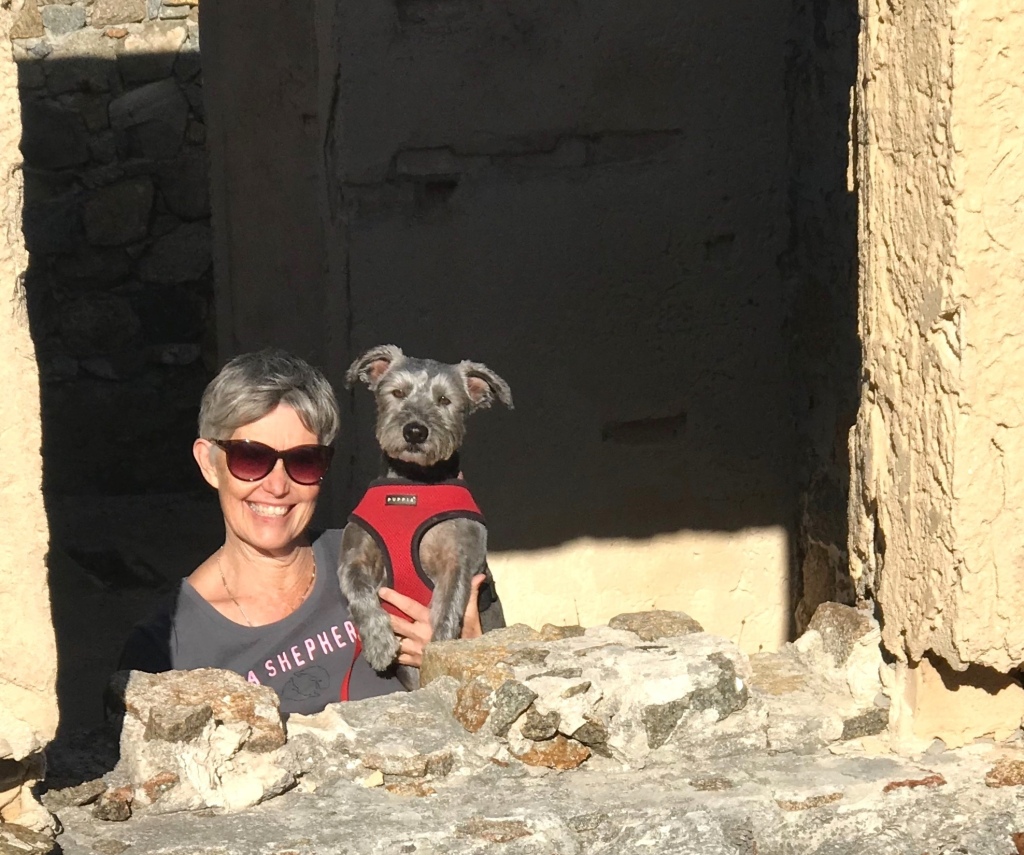
Truckies were another inspiration. I travel a lot, sometimes to remote schools and communities. On lonely bush roads, truckers often give me a wave, or a tail light thank you waggle for slowing down to let them overtake. I’ve always felt that they’re unsung heroes who keep Australia going, driving long hours and distances to deliver goods and services. I have long wanted to include a truck driving character in a story. In Scout and the Rescue Dogs, readers meet a variety of kind-hearted truckies.
Another, more terrible, inspiration was the scourge of illegal puppy-farming, which bloomed in dark corners of Australia during Covid lockdowns. Sadly, many of those ‘grown-up pups’ ended up in rescue shelters as the country reopened.
Scout and the Rescue Dogs is my 25th book. It’s an adventure story for middle-grade readers aged around 9-12 years. While I write across genres, and for a variety of ages, writing novels for middle-grade readers is a sweet spot for me. Perhaps because when I was ten years old my family moved from outer-suburban Doncaster to a traditional part of Bangkok. It’s an age I remember vividly, the transition time between childhood and adolescence.
This book explores some of the challenges of growing up, and touches on themes of courage, grief, friendship and kindness. As a bookworm who loves animal stories, I hope Scout’s compassion will encourage readers to respect animals, safeguard their habitats in these challenging times, and whenever possible, to reach out and help an animal in need. These themes were not ‘planned’ but arose organically over many, many drafts as the story evolved over several years.
The main character, eleven-year-old Scout, is the daughter of a truck driver, Bill. Scout’s mum died soon after her last birthday and she now attends boarding school, which she hates. Scout lives for the holidays when she can collect rocks and leaves and enjoy travel adventures with her dad.
The story begins on the last day of the 2019 school year. Bill collects Scout and they set off to deliver donated pallets of dog food to shelters across Victoria and southern New South Wales. Bill is unaware of Scout’s Holiday Plan: trying to convince him not to send her back to Arcadia Boarding School for Young Ladies.
Early in the journey, which Scout dubs Operation Dog Food, Scout’s teacher pairs her with three school pen pals. Two are disastrous, but the third leads to a blossoming friendship with Anika. They keep in touch throughout the story and Anika helps Scout create a website which matches rescue dogs with truck drivers.
Creating books is a collaborative effort and I’m grateful to the Walker team, and my agent Clive Newman for helping to bring this story to fruition. I’m especially thankful for editorial advice from Mark Macleod who stretched me as a writer.
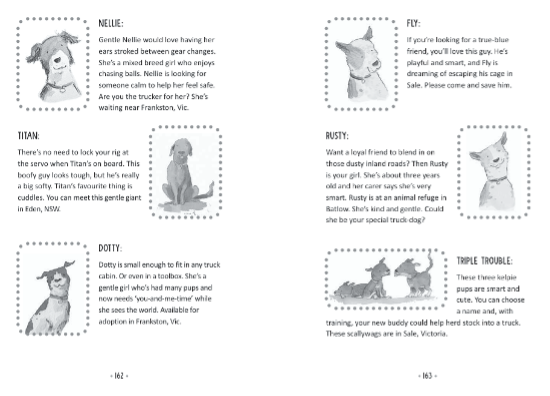
Writing the dog bios for ‘Truckie and Dog Matchmaking’ was my favourite part of the creative process, and I love the way Tony Flowers’ delightful illustrations have brought each rescue dog character to life.
After visiting several animal shelters, Scout and her dad are heading home on Christmas Eve when she meets one more dog, desperate for help. Scout is happy to be back on their small farm near Beechworth, but bushfires are moving closer. This thread was not part of the original draft.
As I was writing Scout’s story, Australia suffered horrendous bushfires. My family was directly impacted: for weeks my elderly mother’s home was inundated with toxic orange smoke, when I flew in at Christmas my flight was diverted to a town 130 km away, my sister evacuated her home in the Snowies twice, and my cousin’s family fought walls of terrifying flames at Corryong.
No one knows how many wild creatures perished during the 2019/2020 ‘Black Summer’. Three billion is one estimate. Balancing this horror were the uplifting stories of compassion; everyday people risking everything to save injured wildlife.
Animal lovers across the world knitted mittens to protect burnt koala paws. Zookeepers brought rare animals into their homes. Convoys of truck drivers drove through fire ravaged areas to deliver hay to starving cattle. Young Australians bundled injured wildlife into their cars and delivered them to safety. The actions of these animal carers also inspired me, and I wove examples of their bravery into the novel.
Including dad jokes helped me balance the narrative tension, as did detailing the kindness of strangers, and Scout’s growing resilience and selflessness. I wanted the strength of community spirit and friendship to help provide relief from the more sobering bushfire details. In response to the devasting effects of bushfires, Scout sews pouches for burnt joeys and bats, sets up water stations for bees and lizards, and asks her father if they can train to become wildlife carers. Scout cares deeply for her environment. She wants to protect both rescue dogs and the other animals sharing her world.
Most importantly, I wanted the story to conclude on a hopeful note, with Scout’s passion empowering readers to take positive actions of their own. She has faced her grief, rethought her Holiday Plan of escaping boarding school to prioritise helping people and animals in need. She’s also made a friend without compromising who she is and together they’ve created a philanthropic website.
Thank you, Joy, for giving me this opportunity to share some of the backstory of how Scout and the Rescue Dogs came to be. I’m deeply honoured to be on the 2024 CBCA shortlist and hope young readers will enjoy Scout’s journey.
*****
Scout and the Rescue Dogs at Walker Books (Australia)
Dianne will be adding teaching links and ideas about Scout and the Rescue Dogs to her website.
Scout and the Rescue Dogs official book trailer by Eden Montgomery
Interview with Tony Flowers about Small Town at Paperbark Words
******
SOME OTHER BOOKS BY DIANNE WOLFER
I have promoted many of Dianne’s books over the years.
Teacher notes and a review follow:
Light Horse Boy by Dianne Wolfer, illustrated by Brian Simmonds (Fremantle Press)
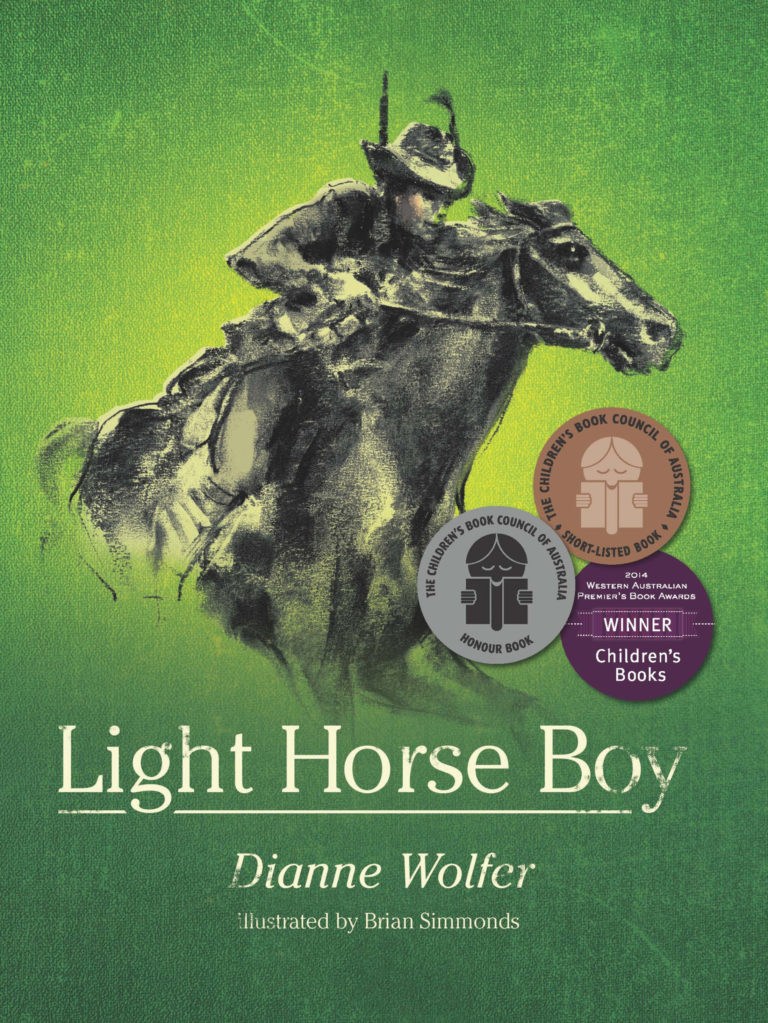
CBCA shortlist 2014: Younger Reader
Teacher notes by Joy Lawn
Readership Middle school
Genre Historical
Setting World War I – Australia, Middle East and Gallipoli
Language Literary recount interspersed with letters and other text types such as newspaper clippings and a telegram
Illustration Media: charcoal drawings; historical photos
Themes WWI; horses at war; consequences of war
Synopsis Jim and Charlie sign up for the Light Horse Regiment in 1914. Jim develops a special bond with Breaker, his horse. They are separated when Jim is offered a role as a farrier on the officers’ ship but Jim cares for the General’s horse, Sandy, instead. They are diverted to Egypt and then reach Anzac Cove, Gallipoli. War conditions in the trenches and injury and death are terrible. Charlie dies at Lone Pine and Jim is injured several times, including with trauma blindness. He is happiest when caring for the horses, although most don’t receive the retirement that they deserve.
Teaching Applications
- Roman à clef This book is a ‘roman à clef’, ‘a novel about real life, overlaid with a facade of fiction’. (Wikipedia) Outline the historical elements. Include the joining-up of young Australian men; the troops’ time in Egypt; the ANZACS at Gallipoli; and the historical character of Major General Bridges. Record these on coloured paper in bold font then describe some of the fictional information, including some characters, or facts about them, and record these on transparent (or light coloured) paper as an overlay. Comment on the difference between factual and fictional details. How has the author incorporated the two? Students then write their own interpretations of some of the fictional aspects, ensuring they correlate with the historical information. (ACELT 1608) http://www.australiancurriculum.edu.au/Search?a=English&q=description
- Point of View Different points of view are given, particularly that of Jim and his sister, Alice, as well as that of the narrator. Find examples of their letters or words and note the font used. Write a dialogue between two of these characters.
- A is for Animals View this website which showcases the importance of animals in war. http://www.awm.gov.au/exhibitions/animals/ It includes some videos of the Australian Light Horse.
- Read The Horses Didn’t Come Home by Pamela Rushby; War Horse by Michael Morpurgo; The Donkey Who Carried the Woundedby Jackie French; Lighthouse Girl by Dianne Wolfer (There is a lovely synergy with Wolfer’s companion book where Charlie signals using semaphore and Jim waves at the lighthouse girl as they sail past.); Gallipoli: Reckless Valour by Nicolas Brasch; An ANZAC TALE by Ruth Starke, illustrated by Greg Holfeld; Archie’s War: My Scrapbook of the First World WarbyMarcia Williams; and ‘The Third Tale’in The Silver Donkey by Sonya Hartnett.
Display
- Graffiti Wall Show Jim’s journey as a story map on a graffiti wall. Attach large and long sheets of paper to the wall. As a joint construction, the students list and sequence the places where Jim travelled. Then a small group maps these places onto the wall. Over time all students have opportunities to add illustrations (preferably in the style of the book), labels and comments to the graffiti wall.
Publisher Teacher Notes http://fremantlepress.wordpress.com/2013/06/21/teacher-feature-on-light-horse-boy/
Author Website http://www.diannewolfer.com/
*****
Granny Grommet and Me by Dianne Wolfer, illustrated by Karen Blair (Walker Books)
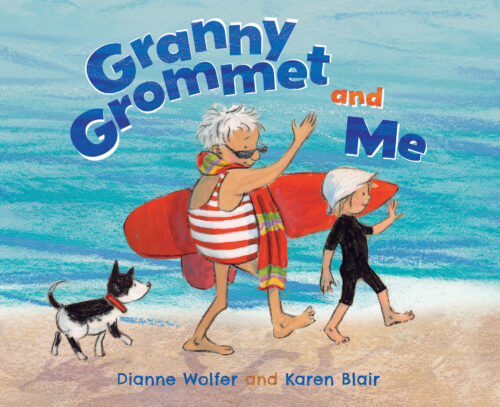
CBCA shortlist 2014: Early Childhood
Teacher notes by Joy Lawn
Readership Before school to junior primary
Genre Message with humour
Setting The beach
Language Told in first person by the child narrator
Illustration Media: mixed media of watercolour paintings on paper
Themes Anxiety; facing new experiences and learning new skills; non-stereotypical grandmothers
Synopsis A child’s granny has grommet friends who demonstrate how to surf. The child is reluctant to enter the water, fearing ‘strange things under the waves’. Trying a small surfboard on the beach edge, discovering ‘wonderfully strange things’ in the rock pool and then snorkelling on the reef, eases fear and brings anticipation of becoming a grommet like granny.
Teaching Applications
- What’s Happening? The story is full of verbs, such as looking, twists, turns, ducks, dives, wade, splash, soak, explore, rocks and peer. Students mime these. The class then uses them in a joint construction on the interactive white board about a child’s time at the beach. Identify the parts of a simple sentence that represent ‘What’s happening?’ (ACELA1451)
- Alliteration The teacher points out the alliteration (repetition of an initial sound in words) in Granny Grommet. Students find other examples from the book. [twists and turns; ducks and dives; Zelda zooms]. Students then select a letter or sound and make a booklet of words beginning with that sound. Use paper or http://bookletcreator.com/, which makes booklets from PDF documents.
- Read A Swim in the Sea by Sue Whiting and Meredith Thomas; Splash, Anna Hibiscus by Atinuke, illustrated by Lauren Tobia; and Grandpa and Thomas and the Green Umbrella by Pamela Allen.
Display
- Beach, Reef and Rock Pool Make a model of the beach, including a rock pool and reef. Use a sandbox for the beach and – to emulate the texture of the book’s illustrations – place torn tissue paper in sea colours to show the ocean; and curled white and blue paper or ribbon, paper doyleys, or cut pieces of white foam for the waves. Small rocks with blue crumpled paper on top can represent the rock pool. The weedy sea dragon, fish, crabs, starfish and seaweed of the reef can be made from coloured modelling clay, laid on blue paper and covered by a layer of clear cellophane. Leave snorkels, flippers and surfboards (also made of coloured clay) on the sand.
Author Website http://www.diannewolfer.com/
*****
The Shark Caller by Dianne Wolfer, Random House
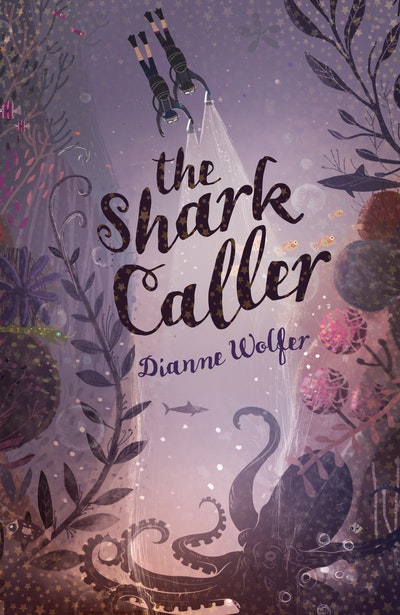
Review by Joy Lawn (originally published by Books + Publishing)
The Shark Caller breaks new ground in junior YA fiction. Dianne Wolfer blends a mystical tale about legends and traditions in Papua New Guinea with issues such as saving a coral reef. Wolfer tells the story through the accessible voice of fourteen-year-old Izzy, whose twin brother Ray has recently died. Izzy and her Islander mother fly to their ancestral home on an island off Kavieng in the province of New Ireland where they release Ray’s ashes into the water. Ray was the last of the shark callers and was expected to take an offering to the shark god in an underwater cave in return for the obsidian that will bring hope to the community. Even though the clan is matrilineal, the shark callers are male and so Izzy is not expected to fulfil Ray’s destiny. But she must try. The underwater scenes are some of the best parts of the novel. Myriad nudibranchs, pygmy seahorses, anglerfish and cuttlefish showcase the abundant sea-life. These scenes also highlight the effect of chemical runoff from logging which contaminate the water and destroy the coral. Issues of conservation and identity told from Izzy’s dual-cultural perspective, with a scattering of “Tok Pisin” words, will intrigue readers.

 paperbarkwords.blog
3 thoughts on “Scout and the Rescue Dogs by Dianne Wolfer ill. Tony Flowers”