
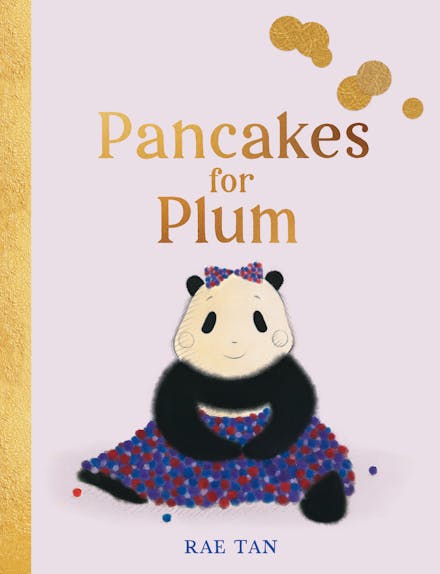
Pancakes for Plum written and illustrated by Rae Tan
Published by Lothian Children’s Books, Hachette Australia
“One morning, Plum wakes up to the sweetest music. It feels cosy and comforting, just like a stack of warm, fluffy pancakes. ‘I must follow this delicious sound!’”
(Pancakes for Plum)
Rae, you have created an imaginative, sensory, layered picture book in Pancakes for Plum. I can see young children pouring over it with delight.
Thank you for speaking to Joy in Books at PaperbarkWords.
Author/Illustrator Interview: Rae Tan
Rae, you are proficient in so many areas, how did you become involved in creating picture books?
My mum fostered my deep interest and love for picture books. When I was a little girl, she bought plenty of picture books and read them to me every night. Till now, I vividly remember the lyrical cadence of her voice and the magic of those beloved stories. Some of my all-time favourites were Doctor De Soto by William Steig, First There Was Frances by Bob Graham, and The Boy Who Was Followed Home by Margaret Mahy. During Covid, I spent many days at home alone while my doctor husband pulled long hours at the hospital. To pass the time, I thought I’d try my hand at writing and illustrating my very own picture book. It took me about six months to complete the first draft of Pancakes for Plum. The process was fraught with frustration and despair, as I was clueless about the creation of picture books! I must have done more than a hundred failed paintings. Sheer stubbornness carried me through this painstaking process and when I was finally done, I submitted the manuscript and illustrations to a few literary agents. Thankfully, Pancakes for Plum managed to capture the interest of Clare Foster at Curtis Brown and everything took off from there.
How have you brought some of your interests into Pancakes for Plum?
I grew up learning both the piano and violin. Practising my instruments and going for weekly music lessons were a huge part of my childhood. I have always felt that learning music is not for the faint-hearted, as the process is gruelling and oftentimes painful for a young child. The violin I played on as a child has my tear stains on it! The agony notwithstanding, I developed a profound love for music and it brings me comfort whenever I am despondent. It is my hope that Pancakes for Plum will gently help children to see that in order to be competent in something, discipline and doggedness are requisite ingredients. Hopefully, this message is delivered tenderly and whimsically through Plum’s journey of self-discovery.
Why is your protagonist named Plum? Please introduce her and her family.
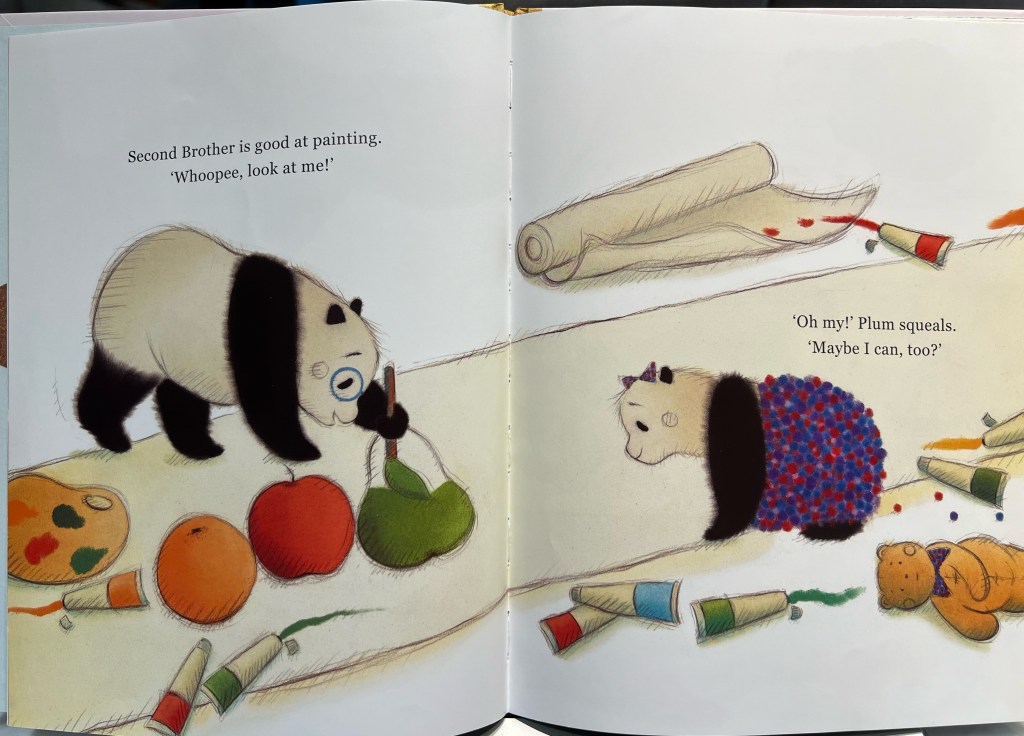
The Chinese characters for little sister (妹) and the fruit, plum (梅), are both romanized as ‘mei’. This inspired me to name my protagonist Plum, as she is the youngest girl in the family with two older brothers. I also love that the keywords in the book – plum, panda, piano, and pancakes – all start with the letter ‘p’.
Plum is an affectionate and excitable little panda who adores her brothers. She is also a worrywart who feels anxious about not being good at anything. Plum’s family, very much like my own in real life, is loving and supportive. Mama is comforting and nurturing, while Big Brother and Second Brother are caring and protective. Pancakes for Plum is a quiet celebration of love and familial bonds, and I hope that it will feel like a big warm hug to little readers.
What tense have you used to tell your story? Why?
I have used the present tense throughout the story. I feel that this is more engaging for the youngest of readers because it depicts the action as it is happening here and now.
What illustrative media and process have you used in this book?
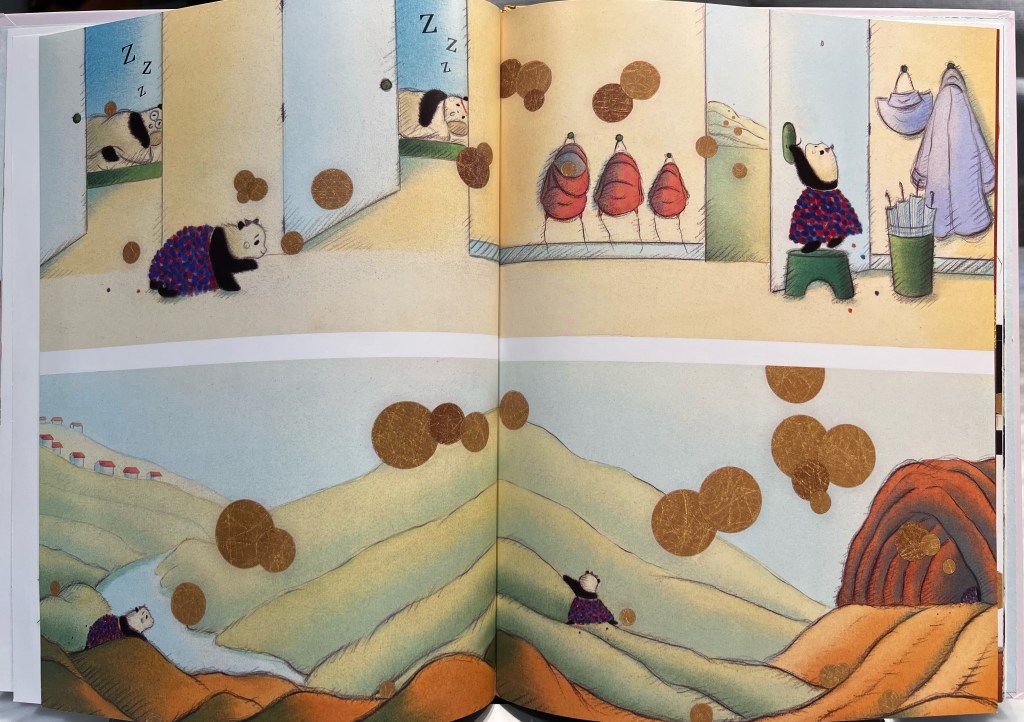
I used watercolour, soft pastels, and coloured pencils on hot pressed 300gsm Saunders Waterford watercolour paper. For the collaged circles, I painted two shades of metallic gold acrylic paint onto large sheets of handmade textured Japanese paper. I then cut out circles of different sizes and grouped them together to represent the pancake-music.
How have you created texture, particularly of the pandas’ fur and Plum’s clothing?
I used black soft pastel for the pandas’ fuzzy fur. For Plum’s pompom skirt, I used soft pastels in shades of purple, blue, red, and light pink. The soft pastels give Plum’s skirt that slightly smooshed, poofy, and textured effect.
What colour palette have you used? Why?
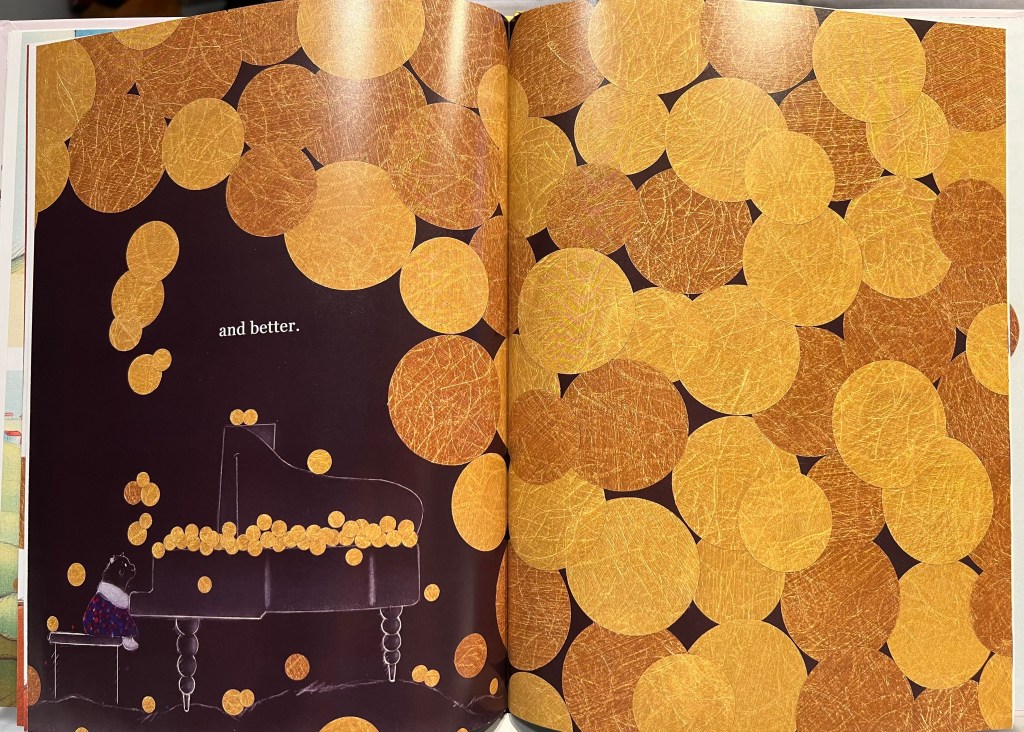
I chose a limited palette with white backgrounds for several spreads. This creates breathing space for the text and allows little readers to focus on the pandas’ facial expressions and body language. I reserved the vibrant pops of colour for Plum’s pompom skirt and the golden pancake-music. This lends significance to the protagonist and the central theme of music.
How you portray music is very clever. Could you please explain what you’ve done here in both words and pictures?
The greatest challenge of this book was how to present something intangible in the most delightful and effective manner. This is a book about music with no music notes! Pancakes represent how Plum feels when she hears music. I hope that the metaphor of warm, fluffy pancakes will be very relatable to little readers. When Plum first learns how to play the piano, her music is discordant. This is represented by plain brown pancakes. As she gains proficiency, the pancakes slowly grow and transform into huge, shimmering golden ones. This culminates in the climactic scene on black paper, which is Plum’s moment of personal triumph.
What do you love about music?
I love how music is a form of communication that transcends cultural barriers, language, time, and space. As my favourite author Madeleine L’Engle says, ‘It may be that when we communicate with life on another planet, it will be through music, not through language or words.’
Which piece of music would you love to share with children?
I would love to share Mozart’s Piano Sonata Number 10 in C Major! The first movement is elegant and exuberant. The melody of the opening bars somehow reminds me of pancakes being flipped on a hot pan. It is the exact piece that I imagine Old Panda to be playing in his cave.
What do you think will most surprise children in your story?
I think Old Panda will surprise them, with his sudden appearance in the middle of the story and his greyish white fur. He is my favourite character in the book! Old Panda is inspired by ancient Chinese folklore, where we often see an ethereal sage-like master imparting his skills to a young disciple. In Pancakes for Plum, I have recreated this idea with a benign Old Panda in polka dot shorts. I hope that children will enjoy this charming master-disciple pair.
******
What are you writing, illustrating or working on now or next?
I am about to start working on my next picture book with Hachette!
How can your readers contact you?
Readers can reach out to me on Instagram @itsraetan
Pancakes for Plum at Hachette Australia
Lights Out, Little Dragon by Debra Tidball and Rae Tan at PaperbarkWords blog

 paperbarkwords.blog