
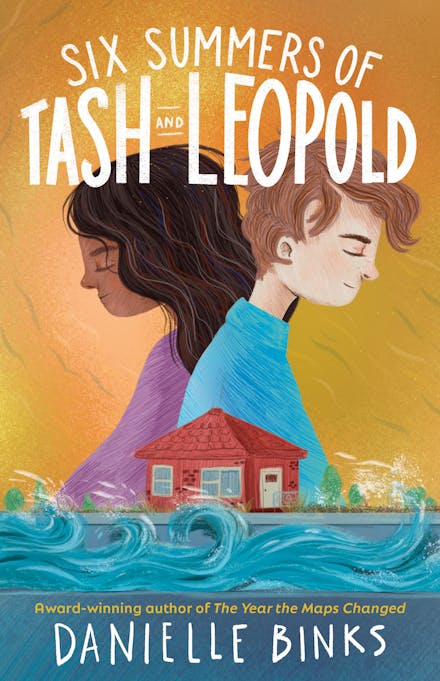
Six Summers of Tash and Leopold by Danielle Binks
Author Interview at PaperbarkWords
“And I stayed on the bridge, watching as she walked back to where she’d dumped her helmet and board outside my house. She gathered her things back up to ride home.
By then I’d gone back to leaning over the railing, looking down at the parched pavement of the spillway below and thinking how memories are a lot like the waterways of Mile Creek … one connects and runs into another, that triggers more and suddenly you’ve got a flood of them …”
(Six Summers of Tash and Leopold )
Six Summers of Tash and Leopold is published by Lothian Children’s Books, Hachette Australia.
******
Thank you for speaking to ‘Joy in Books’ at PaperbarkWords, Danielle.
As well as being an author, it’s heartwarming to read how often you are named by other authors for your help with their books. How are you doing this?
A: Well it’s probably because as well as being an author in my own right (or, write – ha!) I am also a literary agent, with boutique Melbourne agency Jacinta di Mase Management … and I have a particular speciality in representing middle grade, young adult, and graphic novel works. So my whole job is helping to get good books out into the world – and I’m very lucky and honoured that I get to play a small role in so many creator’s journeys!
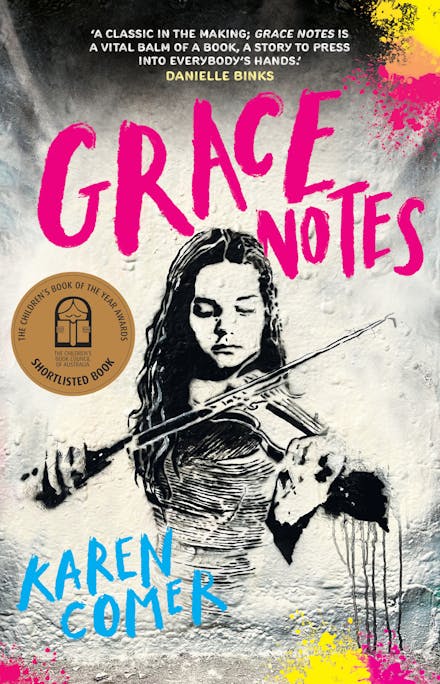
Six Summers of Tash and Leopold is published by Lothian Children’s Books. Something exciting is going on there, with Grace Notes by Karen Comer just winning CBCA Book of the Year: Older Readers and Briony Stewart winning CBCA Book of the Year: Early Childhood with Gymnastica Fantastica. Can you put your finger on what’s behind all these great books, including your own, of course?
A: Ha, well – those two books you named by Karen and Briony are in fact represented by my literary agency! So Karen Comer is my author, I represent her and I pitched her YA and MG verse-novels, and yes Grace Notes just won the CBCA Older Readers award! And my colleague Jacinta is Briony Stewart’s agent, and she’s responsible for the Hachette & Briony pairing, that nabbed Briony the Early Childhood win! So I guess maybe the success is just our Midas touch? I kid, I kid! No; speaking for myself (because I am also a Hachette/Lothian Children’s Book author in their stable!) they’re genuinely a wonderful publisher to work with, they take chances and support their creators enormously. I feel very safe there, but also encouraged to challenge myself with the stories I tell – it’s a really phenomenal team, headed up by Jeanmarie Morosin as head of Children’s Publishing.
Your two protagonists are dealing with a lot. Could you please introduce them, explain something of what they’re facing and also tell us about the significance of their names? What is one way that they each grow or change during your tale?
A: Alytash (Tash) and Leopold (Leo), my titular characters, are in a very weird phase of life when we meet them; they’re in their very last week of Year Six and primary school, about to make the leap into high school. They happen to attend the same Primary School, are also neighbours, and ex-best friends … they had a falling out a couple years ago and haven’t been as close since. But when the book begins they are both experiencing a few upheavals in their lives – to do with personal circumstances, and family drama – and they just so happen to both (for very complicated and legitimate reasons) be refusing to attend school a few weeks into Year Seven and high school. They are each of them, going through what we now call “school refusal,” which is on the rise in Australia and around the world – and again, often for very layered and nuanced reasons … but Tash & Leopold happen to find themselves thrown together again because they’re both going through school refusal, they’re staying home for long stretches and this brings them closer together – as does a small neighbourhood mystery that keeps gnawing at them, and pulling them to dig further into their suburb’s history …
Setting is integral to your stories. What causes unease in your setting in Six Summers of Tash and Leopold?
A: Six Summers is set in Noble Park, which is out my way in the South-Eastern suburbs of Melbourne and this neighbourhood where Tash and Leo live is going through changes … it’s becoming quite gentrified, and a lot of reasonable and public housing, rental properties, are being bought up and sold off to wealthy developers to – potentially – price-out the residents of this suburb from the gated-communities and pricier housing that they’re putting in. This is very much a reflection and commentary, on what I’ve seen happening all over Melbourne – the greed and expansion for profit, and how much further away the dream of access to stable and continual housing (forget home-ownership) is, and how frighteningly precarious, especially for families who are being squeezed out.
What symbol or imagery have you used in the story? How do you use it?
A: I have a few, and they tend to be things I myself am just obsessed with … so concrete spillways are one, and I quite like them (I photograph them a lot, when I’m out and about in suburbia) because they feel like liminal space to me. This in-between; water running through to connect to the larger whole. And I think they act as a symbol of ‘crossing’ for the kids – something they have to move over and through, as they experience their transition out of childhood.
How do you set up a mystery or foreshadowing in this book?
A: I am a big fan of the literary device that involves a character beginning the story at the end – looking back at the events they’ve just lived through, and then rewinding the tape and beginning from the start again (having given a *little* bit of a teaser of what’s to come). I like that in middle grade especially, because I do think that transition from childhood to young adulthood is so wide and once you’ve crossed it, it feels like a chasm – so that framing of looking back from where you’ve just come, feels so weighty and monumental. So there’s a letter from Leo to Tash that acts as a prologue in this book, and that hints at a bit of what they’ve just lived through – and what’s to come as the story then begins, back at the beginning …
How are letters part of your plot?
A: Letters are a big part of it, the archiving of them especially. Tash & Leo’s primary school has an ongoing time-capsule project that each year level at the school participates in; contributing to the capsule, and mostly in the form of letters (like; ‘Write a letter to a friend in the future,’) and that becomes some very important history and clues for the kids as they try to unravel a small mystery to do with a neighbour in their suburb, who has a few urban myths and legends attached to her.
Understanding and learning from history and the past is valued in the book. What is a key point that you hope your readers glean from this?
A: To document your life as it is now – because you’ll miss it, or be curious about it one day. And appreciate that you – your life – is important and worth documenting, worth keeping mementos of! So much of history is documenting and cataloguing royalty and political heavy-weights, that sometimes the regular, normal everyday-people get left out of the memories and don’t have markers of how the majority actually lived and loved and carried on … and that doesn’t give us a full enough picture of humanity, so banish the thought that you’re not worth remembering, and your life as it is now isn’t worth writing down and celebrating – take the photo, write that letter, keep a diary. All of it matters.
On the other hand, you explore the concept of ‘ephemera’ and ‘ephemeral’. How have you used this in your story?
A: Ephemera is the stuff that makes up our true everyday life, but is only meant to last a short while (a concert ticket, movie stub, grocery list) but it perhaps gives us the best insight into everyday lives of regular people. Historians are forever seeking out ephemera – look at them still unearthing Pompeii; the Eruption of Mount Vesuvius happened in 79 AD and archaeologists and historians are still desperate to uncover what remains of the preservation of everyday life in the city (a woman’s pot of blush, ephemera just like we have makeup today, but makes these monuments to history feel real, like people!) Even the various State Libraries around Australia and the world have entire collections of ephemera; “Political ephemera” is always being requested for cataloguing, because it is invaluable to the issues of the day. Tash and Leo grapple with this idea that their lives are big and important enough to document, that this can be the stuff that matters maybe even more than the big moments.

How and why do you mention other books in your novel?
A: Well in this book I do so because the school library kind of becomes a character unto itself – particularly since Leo finds so much solace in his old primary school library, and he keeps craving that safety and comfort that he had there, as he’s trying to fit himself into his shifting young adulthood … so it was just a really fun way for me to shout-out how important I think the school library is, and some of the incredible Australian literature we have in this country in particular. I’ll always take any chance to shout from the roof-tops about those things!
How have you championed libraries and librarians in the novel?
A: I genuinely believe and I shout about them in the acknowledgements that https://studentsneedschoollibraries.org.au/ – the library in the novel is a really central character providing the character’s access to clues of the past, and also a safe space to hang out when their personal lives are in upheaval. The library is a central hub of community and solace, it is truly for everybody – all are welcome, and it’s this glorious sharing of resources and broadening of horizons that I wanted to celebrate both in the book, and my own life where I will talk until I am blue in the face about how a fully-funded school library and trained teacher-librarians are so important to the health and wellbeing of a student body and community.
What is another important idea that you explore in the novel?
A: Empathy is always a big theme in my novels for young people; Tash and Leo are going through a really tumultuous time in their life, and it’s manifesting in very different versions of anxiety and inability to – for instance – attend school. I hope readers coming to their story, recognise that everyone’s life is so complicated and we can never truly know what someone is going through, so we should give them leeway, patience and kindness because it could be so profound and traumatic for them, and they’re just coping as best they can. Partnered up with that empathy is also resilience – a lot of characters in this novel have to do the harder thing of acknowledging that life is unfair, or they’ve been short-changed somehow but they’ve gotta keep showing up and meeting the hard-moments head-on and build up that resilience alongside their kindness and understanding for others. It’s a call for self-belief that they can do hard things.

I reviewed your first novel, The Year the Maps Changed for the Australian in 2020 (see excerpt at the end of this interview). What similarities are there between your two middle-fiction novels? How has your writing developed or changed since then?
A: Gosh, that they’re both middle-grade (so, same age group – readers about 11+) and that I always write about non-conventional family, that transitional period between childhood and young adulthood, friendship, and I do quite like a bit of sadness in my stories … I think I’m becoming more nuanced in how I discuss all these things, but they’ll always be my lodestones.
What are you writing next?
A: Middle Grade again, but … I want to write something shorter (about 40K-words) and funny, but still with a big message. I’m thinking a road-trip novel, watch this space.
What have you enjoyed reading recently?
A: I am currently reading I’m Not Really Here by Gary Lonesborough, a YA novel from Gary who is a Yuin man and this is another brilliant novel from him featuring incredible Aboriginal young people ….
Six Summers of Tash and Leopold at Lothian Children’s Books
******
The Year the Maps Changed by Danielle Binks
Review excerpt by Joy Lawn in the Weekend Australian 2020
Danielle Binks’s debut middle fiction novel The Year the Maps Changed fictionalises a true historical event. In Operation Safe Haven, Kosovo refugees were quarantined at Port Nepean on Mornington Peninsula in 1999.
Binks has shaped a sprawling tale based on local knowledge and extensive research. Depiction of place is a highlight.
Fred’s mother has died and she lives with her stepfather and Anika, his new pregnant partner and her son, Sam. Everyone means well but Fred is unsure of her place in the family.
Mr Khouri, Fred’s year six teacher, is a pivotal character who explains information about maps that also reflect what is happening in the lives of his students and others. Contour lines can ripple and spread to change the landscape and an inner compass can show the right way to think and act.
Along with Fred, Sam, their friends and other community members, Mr Khouri tries to help the refugees.
As well as the lovely map imagery, parallels between Anika’s baby and refugee-in-hiding Nora’s unborn child seem to point to the difference that race and circumstance can make to life and death. But the unexpected is always possible. “Maps lie. Or at least, they don’t always tell the truth.”

 paperbarkwords.blog
One thought on “Six Summers of Tash and Leopold by Danielle Binks”