

The Grown-Up’s Guide to Picture Books
Written by Lara Cain Gray and illustrated by Lorena Carrington and Timothy Ide
Author Interview with DR Lara Cain Gray at PaperbarkWords
Thank you for speaking to ‘Joy in Books’ at PaperbarkWords, Lara.
I’ve seen adult resource books about picture books but nothing like The Grown-Up’s Guide to Picture Book. It’s fabulous and has so much knowledge, careful thought and creativity. How clever having a guide to picture books as a picture book.
Why did you decide to write this book?
I am a book lover from way back, unsurprisingly, and I never really lost my love of picture books. I embraced them anew when I had my own children and started forming stronger opinions about what I considered good/bad/appealing/troubling and so on. But I didn’t fully understand the science behind them. I guess, like a lot of parents, I wanted to help my kids love books, but I still thought of picture books as simplistic, repetitious texts. But the more I read, the more convinced I became that a quality picture book is a work of art with potential appeal for all ages!
I also have a background in research librarianship. I have a PhD in cross-cultural literature and have spent many years working in libraries, museums, universities and publishing houses. So once the picture book bug bit, it’s not surprising that I got a little forensic about it! I became passionately curious about art techniques, word play, symbolism and visual literacy. I began a book review blog and have reviewed regularly now for over 10 years across print and online media.
So, yes, I’m a picture book lover. But the true inspiration for this book came when I realised not everyone felt the same way!
I sent my daughter along to Show and Tell in Year 4 with a picture book we’d acquired over the weekend at a book launch. She loved it and couldn’t wait to share the details with classmates. A child in the class taunted her, saying it was a ‘baby book’; unfortunately the teacher agreed and asked her to bring in something more age appropriate next time – by which she meant a chapter book. This actually put my daughter off reading all together for a while!
Over time, I came across more and more of these contradictory perspectives in the ways people talk about picture books. They are supposed to support literacy, foster a love of reading, even help our children’s moral development – and yet people often downplay the craft of writing them, or refer to glorious illustrations as ‘pretty pictures’. There’s an assumption that they’re easier to write because of short word limits. They’re rarely reviewed in major publications. Creators are seated squarely at the kids’ table when it comes to literary festivals. Teachers insist children ‘move on’ to more worthy reads as soon as they’re able.
How do we expect our children to learn to love books and reading when we show no deep or intentional respect for their books?
I decided to offer a shortcut to deeper understanding for anyone who has ever thought: ‘It’s JUST a picture book’. I hope this book begins a conversation for parents, carers, teachers, educators, and aspiring creators who will come away with a fresh perspective, and deep reading skills to use with kids, or just for their own personal enjoyment.
Why did you choose an alphabetical structure?

There were earlier versions of this book that were far more academic, complete with footnotes and reading samples. I’m sure those versions were interesting in a different way, but they wouldn’t have reached a wide readership. Parents and teachers have enough on their plates without extra homework! I decided I wanted the book to be playful and not overly content-heavy. A is for Animals, C is for Covers, V is for Versions… each one comes with some history, highlights and handy ‘Talking Points’ questions for shared reading. The A to Z format is a nod to one of the most common types of children’s book, but it also means readers can dip in and out, or bookmark certain themes that are most interesting or helpful for them.
How did you collaborate with the illustrators (and how did they work together)? Do you have any favourite illustrations?
I hadn’t met Lorena Carrington or Timothy Ide before this project, though I knew their art from other books. They have vastly different art styles: Lorena is an illustrative photographer, while Tim creates detailed character studies. It was sheer inspiration by MidnightSun publisher Anna Solding to put these two together! At first, I thought they would perhaps alternate, doing one letter each to add variety. In fact, I think that’s what they thought too! But instead they collaborated to create these truly unique creations, full of whimsy and wit, blending conventional storybook tropes and contemporary references.
I had no creative input, other than being wildly impressed each time I had a sneak peek! I think that it is one of the many misconceptions about picture book creation actually, that the author should also dictate the illustration style. I’m not an artist so I was more than happy to hand over my words and let the experts have at them. They are both experienced picture book illustrators, but also exhibiting artists in their own rights.
I have many favourite illustrations from the book. I adore the clever caterpillar who appears in the E for Endpapers spread, and on the actual endpapers of The Grown-Up’s Guide. I see this character as hungry for knowledge (a hungry caterpillar, as it were) who emerges as a transformed and informed butterfly by book’s end. There are many grown-up’s who skip straight past a book’s endpapers and introductory pages to get to the story. I realise this is sometimes to please impatient young readers, but it’s a missed opportunity. Endpapers often carry their own sub-plot or enhance story elements in some way. They definitely deserved a full spread.
I also like the illustration on J for Joy which shows a girl sitting with a book that explodes with colour and curious objects. It’s a reminder that all kinds of things, and all kinds of books, can bring us joy. At any age!
Which sections do you think are the most important and/or most innovative?
The most common piece of feedback I’ve had so far is that there’s nothing else like this in the market, so I guess we’ve done something innovative! There are many other excellent books about picture books, of course, but they’re pitched differently – either more academic, or more focussed on art, or production. Our book blends a little of everything into bite size pieces.
I think all the sections are important for different reasons. For example, U is for Underlying Meanings is an important reminder that picture books often have layers – an obvious narrative, for example, and many possible interpretations and emotional responses to the story. A book read by a thousand readers is a thousand different books!
I also like Y is for Yucky Stuff which is a chance to unpack why children often seem to find humour in bodily functions – much to the dismay of parents or librarians who wish they were reading something more highbrow. The Guide discusses the pleasure of transgressing boundaries as well as a child’s need to make sense of their own bodies.
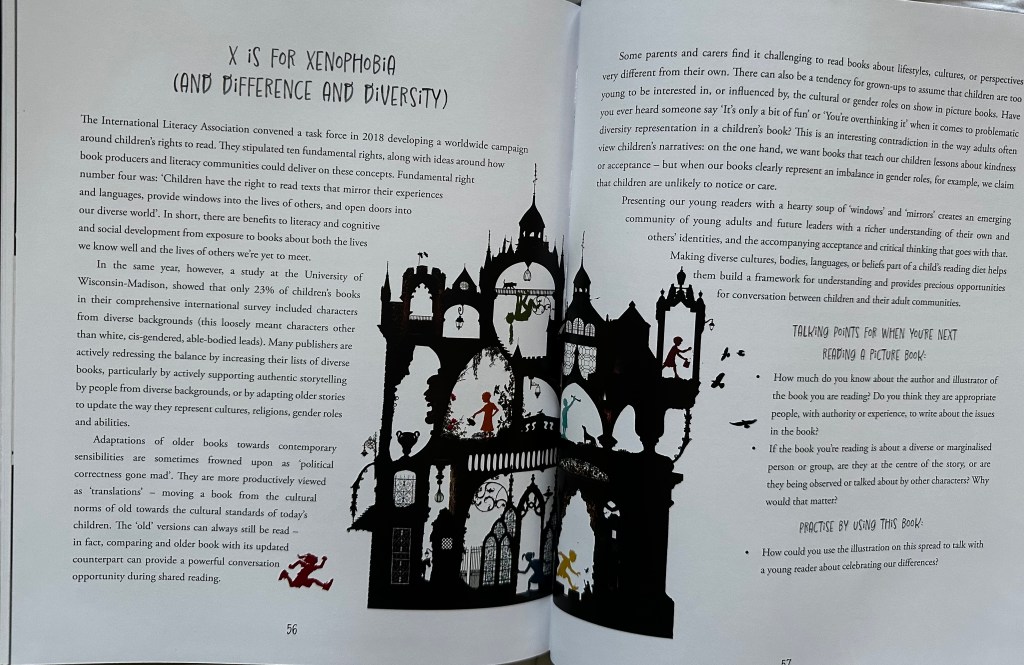
X is for Xenophobia, Diversity and Difference unpacks some of the debates around authentic representation in writing, such as giving traditionally marginalised communities a voice on the page. There is a distinct movement in picture book publishing at the moment to redress some of the imbalances in diverse cultures, gender roles, and abilities so that every reader has a chance to see themselves in stories. I think that is crucial.
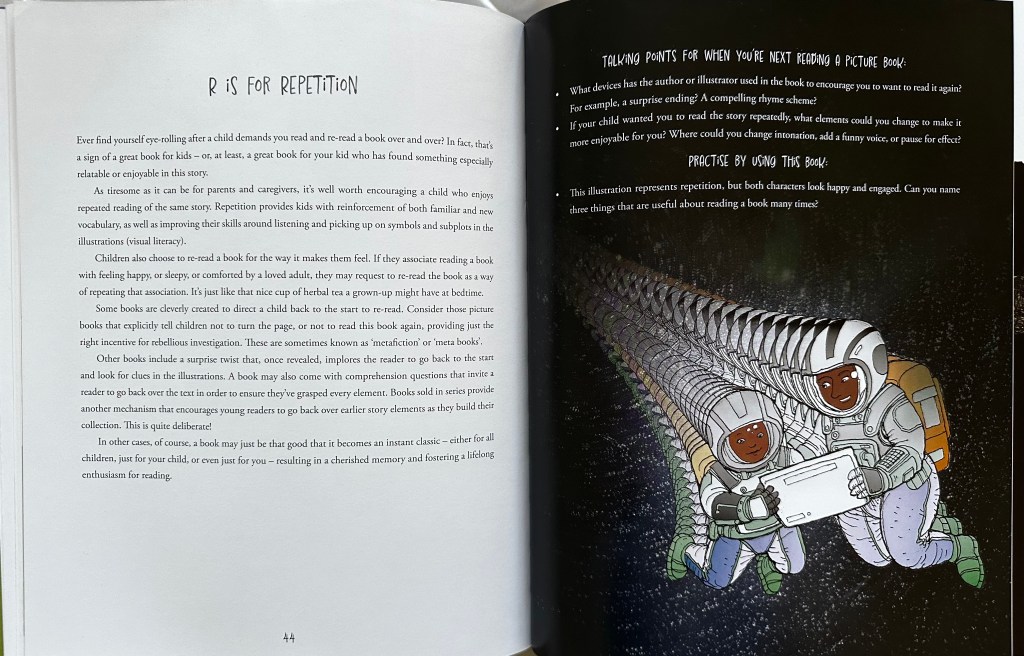
In R for Repetition you suggest a book can become an instant classic. Can you give an example?
That’s a great question! Within a family – yes. A book can quickly become THE book that will be cherished and remembered for the long term. In the wider sense of classic, there do seem to be those that catch the Zeitgeist (see Z for…) such as Scott Stuart’s My Shadow is Pink, or that have fast, broad appeal, like Aaron Blabey’s Pig the Pug series. New works from well-respected creators, such as Freya Blackwood, are spoken about as ‘instant classics’ – though that may be more the perspective of award judges than children in some cases.
What did you have to leave out? What will go in the sequel?
Every section of this book could be many times longer than it is! There are rich examples that could be drawn from all over the world but we’re limited (as is every picture book writer) to a finite number of pages. A few people have asked why we didn’t include a specific reading list of example books. The answer is that we wanted this to be a timeless guide, offering skills that could be deployed anywhere, anytime without pressuring a reader to locate specific reference texts. But a book list or reading guide could be added!
My current WIP looks at illustrative processes and translation of picture books, amongst other things. It is not a sequel, but does continue my desire to elevate appreciation of the skills involved in picture book creation.
How did you find a home for the book at MidnightSun?
I wrote and revised this manuscript for about 2 years before sending it to publishers. I had beta reader feedback, sought opinions from industry experts and had it professionally edited before submitting. A couple of publishers gave positive feedback but said it would be too difficult to market, being a niche topic sitting in between adult non fiction and children’s lit.
MidnightSun was on my radar thanks to having reviewed many of their wonderful titles over the years. I’ve long respected Anna Solding’s willingness to take a chance on unconventional stories – thought provoking, quirky, or controversial. I submitted via their submission portal (slush pile!) and will be forever grateful that Anna took a chance on this one.

 paperbarkwords.blog