

The Robbery
Written and illustrated by Joaquin Camp
Picture book published by Berbay Publishing
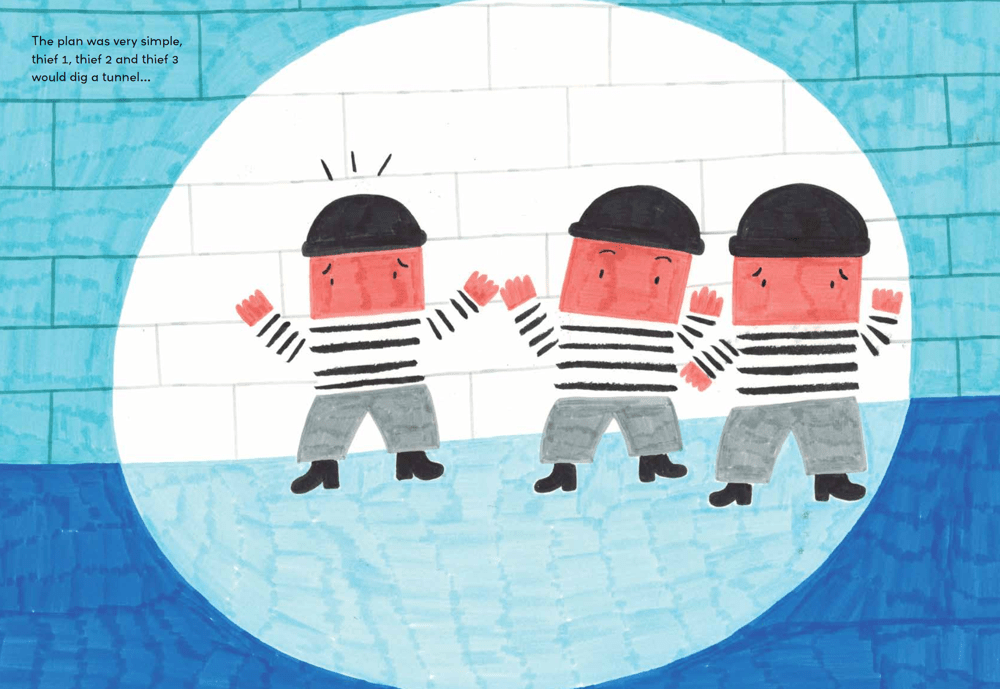
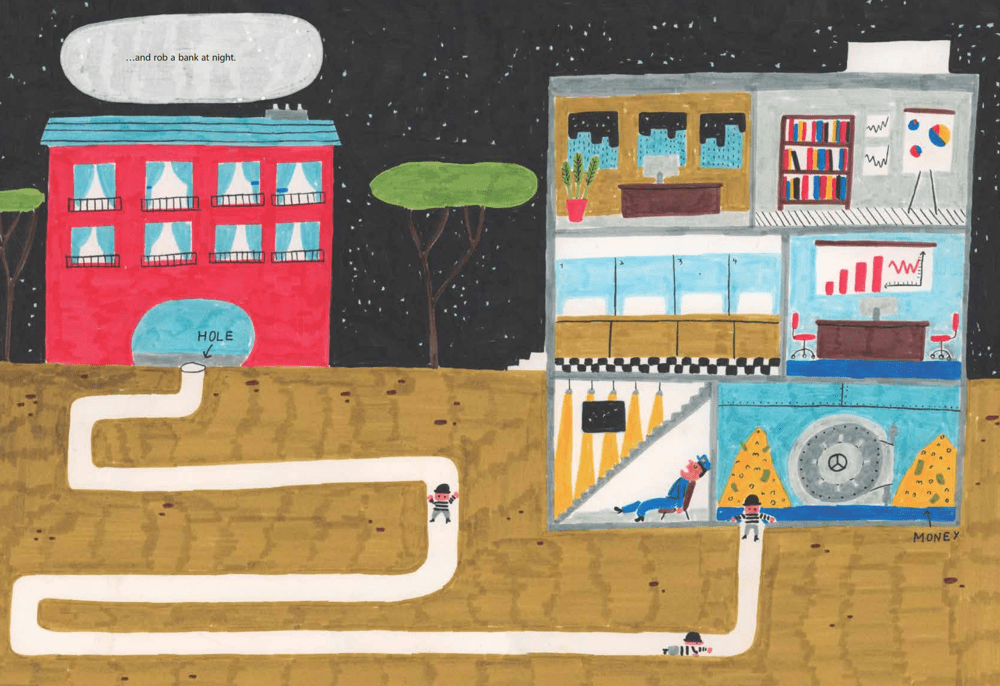
“The plan was very simple: Thief 1, Thief 2 and Thief 3 would dig a tunnel … and rob a bank at night.” (The Robbery)
The Robbery tells a surprising tale about three thieves. They look similar but have distinct personalities and characteristics. They have a plan but keep being thwarted and often seem as surprised as the reader. This book had me laughing out loud – as did Joaquin’s responses below.
Interview with Joaquin Camp about The Robbery
Thank you for speaking to ‘Joy in Books’ at PaperbarkWords, Joaquin.
Where are you based and how do you spend your time? How does this influence your work or art style?
I am Argentine, but I have been living in Madrid, Spain for about 7 years now.
Madrid is a city where no one is really from Madrid. We are a big family of people who come from different places and that creates a lot of brotherhood.
The city is a big blank canvas in which everyone paints whatever they want.
There’s not a great a sense of belonging as in other cities like the Catalans with Barcelona, and that’s very interesting, because you can create your own Madrid.
People in Madrid have a very festive and relaxed mood, and that tranquility and joy is an excellent breeding ground for creating books.
Visually I take many things from this city, in fact many of my books are Frankensteins with pieces of Madrid and Buenos Aires.
Another thing I really like is Cervantes, I think that Don Quixote has a very similar attitude to the people who make picture books, there is something about that craziness, fighting against windmills.
Life also influences me a lot when it comes to writing my books. Anyone who knows my personal life can see small clues about it in every page I draw, even if they are stories about aliens or dinosaurs or robberies (as is the case).
In fact, I often realize that I am talking about myself with my therapist, many months later.
How many books have you written? Why have you now chosen to write about a book surprisingly called The Robbery?
Written and illustrated by me, I must have around 10 or 12, I haven’t counted them.
It’s very interesting to write and draw at the same time because I can create a book that is like a tailor-made suit. Also, since I am the writer and also the illustrator, both people can bother each other most of the time
I wrote this book because I am a thief…. I’m lying, don’t be scared! What really motivated this book happened a few years ago in Argentina… There was a bank robbery there that was a story straight out of a movie, in fact the robbery was called “the robbery of the century” It all begins with a person called Fernando Araujo, a well-off boy who spent the day painting, Fernando was a great lover of art. But one day he realized that painting was not enough to fill him “artistically” and decided that the best way to cover that void was by robbing a bank.
To do this he gets in touch with different accomplices and they end up creating a plan. They dug a tunnel that goes from the bank vaults to a sewer about a kilometer away.
After hearing all this, I knew I had to write something. So I had the idea – what if I did a story about a bank robbery where everything goes wrong all the time? What if the story was more about the journey and all the places the robbers ended up that weren’t the bank. And what if this made them reconsider the idea of robbing the bank altogether? I wanted the story to be more about the relationship between the robbers and all the other kinds of artistic endeavors they could pursue instead. From there I quickly put the book together.
What do you think is the most unlikely place your thieves ended up? If you could have had more pages, where else would you have liked to take them?
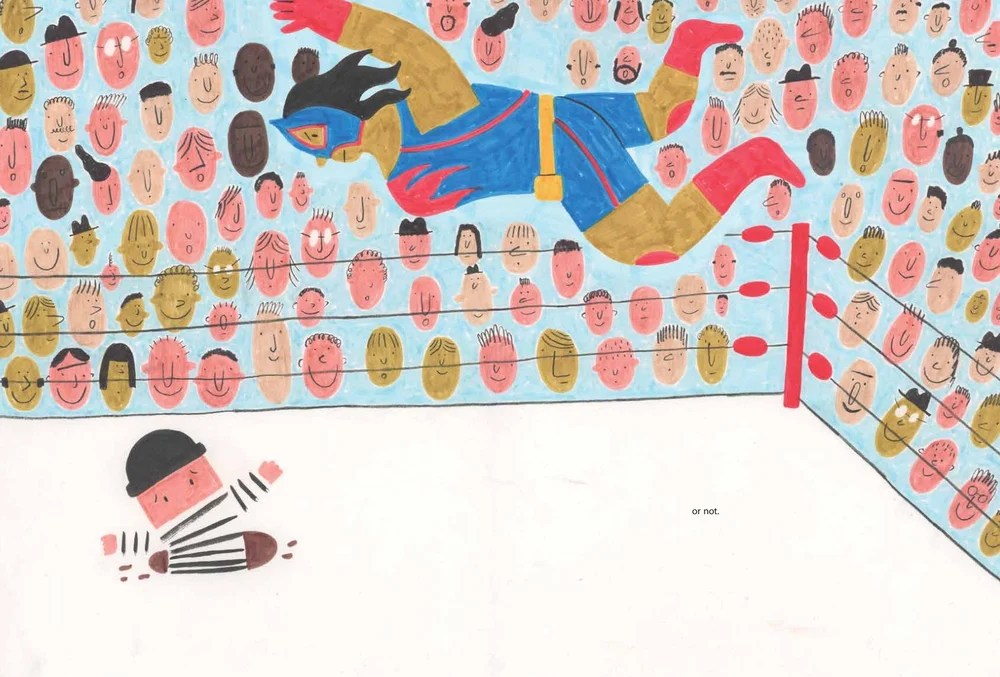
Without a doubt, the Titanic scene (one of my favorite movies) is the strangest.
It’s nice, because if we look at it from a logical point of view, there’s no way for the robbers to get to that scene, since they would have to go through the water first. However, fantasy in a book gives us permission for certain poetic licenses, to generate complicity with the reader, that’s one of the things I like most when writing a book. I really like the unexpected to grow little by little, with the robbers appearing in more “normal” places at first until everything is a total nonsense, like the titanic scene. For me it’s very important to see how far the ridiculous can be taken.
I had more than thirty ideas about where the robbers could appear, but due to an editing issue I had to stick with five so that the narrative rhythm of the book would work. This process is what Billy Wilder calls “kill your darlings” and it’s one of the most difficult parts for me. Some of the situations that were left out were:
– A mime convention (because with the stripes they look very similar)
– A museum
– The head of the Statue of Liberty
– A scene from the movie E.T.
Your story is very funny. How have you created humour?
It’s a very good question and I think the answer is that I have no idea! But let’s talk a little about the subject… Humor is something fundamental in my life. I come from a very complicated country like Argentina and humor is a great ally when it comes to surviving problems. I once heard someone say that humor is like a Trojan horse, I think that theory is great! because humor allows you to talk about topics that are often very complex and difficult.
Chaplin has a very interesting theory about humor. He says that when one experiences a very sad event, life is a zoom in, on a specific event. Humor is when one zooms out and can see things from a more general and lighter place, you start to see the whole picture.
But going back to my way of writing, I think one of the keys to my humor has to do with the fact that I really like to play with the ridiculous, to see how far things can go, like in the case of the Titanic scene. For me, the ridiculous symbolizes being able to do whatever I want, in other words, freedom.
Your endpapers are really good fun. How would you describe them?
Thank you very much, I think the endpapers are great because they only show us part of the story. Them digging. The endpapers tell us a little of what happens but not everything. Another thing is that I tend to use endpapers as if they were patterns, this is done a lot in children’s literature. I would love to see this pattern of the thieves on a t-shirt or dress!
Your portrayal of the thieves is very effective. Why have you left the outlines of their torsos and arms open?
I did a lot of character tests for the thieves until I settled on this final version. As soon as I saw these three characters on paper I knew they had won the casting, there is something about their size and the fact that they are all the same that makes them very likeable. This idea of them being three identical thieves is very inspired by one of my favorite books “The three robbers” by Tomi Ungerer.
But focusing on your question, I think I like the expressiveness they have with so little, in fact it is quite a risky bet that they have neither a mouth nor a nose because they are elements that I can play with. However, this lack of elements means that the robbers have to make a greater physical effort and that makes it very fun. When the action is based on a few elements, such as the look for example, everything is more concentrated and becomes more powerful from my point of view.
What do the lines throughout the book suggest?
I don’t know if I understand this question well, but I’ll venture to say something…
When I draw, I usually do the full color first, then I put the black line with a brush or pen. The moment of the line for me is when the drawing makes the most sense.
I also think that when I draw the line is the moment when I have to feel the most free to be able to create a playful and light stroke, I think that in this book that is achieved quite well, especially in scenes like the one with the orchestra musicians.
How would you describe your illustrative style? What medium and process have you used?
A very simple style, very much based on how I drew when I was a child. I draw more and more directly on paper, I make some small sketches to get an idea of how it will turn out and nothing more. I think that not thinking about it too much gives the drawing a freshness that I love.
What medium and process have you used?
The fact that I use markers for these illustrations is not a coincidence. I think it is a tool that reminds me a lot of when I was a child. In fact, I still use the same brand of markers that I used when I was little, so yes, I recommend them hahaha.
I work more and more by hand, the reason is very simple, being on the computer gives me a huge headache.
The other reason is because I like to go straight to the paper, not having control+z, I think that enlarging, shrinking, going back until it is “perfect” takes away a freshness from the drawing that is never recovered.
You’ve chosen an interesting colour palette. How would you describe it? Why these colours?
There are many theories about color, I studied this topic for years and came to the conclusion that I have no idea!
I usually go to the stationery store and pick the colors I like the most and that’s it, whether it’s pencils or markers, colored paper or furniture in my house, I always tend to choose a similar palette. All these color palette choices are in the unconscious and I think they have to do with thousands of things related to the entire life of a human being. Colors that I saw as a child, where I lived, my mood at that moment and thousands of other reasons. In fact, I find this question very interesting to discuss with my therapist.
What response has the book had so far from young readers?
Well, I’m seeing a lot of bank robberies in Australia, especially by young children… just kidding!! The book is getting a great response from children, in fact something very funny that is happening is that parents are sending me photos of their children dressed as the robbers in the book. If a child is so involved with a book, then we are on the right track.
What is special about being published by Berbay?
I think that as I get to know Nancy and her team better, I realize that Berbay is an excellent publishing house. The job of an editor is more than correct a text or suggest changes to the illustrations.
The job of an editor is to be in every detail, to see how we can make a book shine to the maximum but without losing the soul of the story, this is a very complex task.
I always say that a good editor is like a ghost, they are there fixing things but you don’t notice that, until the book is finally printed, that is when the editor’s hand is clearly seen.
So, returning to my theory, I think that Berbay has excellent ghosts.
Thank you very much Joaquin. All the best with The Robbery. Young readers are obviously having a lot of fun with it, and it will also get them thinking.

 paperbarkwords.blog