

Close to the Subject: Selected Works
by Daniel Browning
(Magabala Books)
Close to the Subject: Selected Works by Daniel Browning is the intelligent, honest WINNER of the 2024 Prime Minister’s Literary award for Non-Fiction.
“My stories are always collaborative, and I try to produce content that represents not simply the who, what and why – but the cultural context in which these dialogues take place. I no longer excise myself from my stories, as I used to do (although I always insist that my team practise a simple rule: you are always the least important person in the room). The process of excavating these stories … crystallised in my mind the kind of journalism I practise. It is one which embeds my blackfella subjectivity. It centres my story, but only to make clear that I am in relationship with the person I am conversing with.” (Close to the Subject)
Author Interview: Daniel Browning
Thank you for speaking to Joy in Books at PaperbarkWords blog, Daniel.
Congratulations on your first book, Close to the Subject: Selected Works being announced as the deserving winner of the 2024 Prime Minister’s Literary Award for Non-Fiction.
How did you react when you heard the exciting news, particularly because you mention in Close to the Subject that you’ve never won or even been nominated for a Walkley Award, and how are you celebrating your win?
I was speechless. To be honest, I still can’t believe it. Being nominated was a real thrill – but I never anticipated that I’d win the category, particularly given the other nominees, all great storytellers and/or national treasures. You know that jibe about never being nominated for a Walkley is a bit of a dig – because mostly, you self-nominate for Walkleys. I always refrained from entering or nominating for awards and prizes as a journalist, I didn’t feel the need. But writers get so little in terms of financial reward for their labour so it seems completely justified. Personally, it’s really satisfying that my work is reaching more people, in a different form.
Your gift is storytelling. Could you share one or more of the qualities of a true storyteller?
A true storyteller is also a great listener. Listening, preferably in silence, is where you serve your apprenticeship as a storyteller. And you must stay there until the time is right.
How has your work in journalism and the arts enhanced or changed your life?
Big question! It’s been my life for 30 years, and I’ve never known – or wanted to do – anything else. I started working in the media to confront shyness that was almost paralysing. I’m still very shy, although I’ve had to manufacture a front – a work persona. But he’s not so different as to be another person. Little by little I forced myself to confront that particular fear, and I’ve minimised it to a point where it no longer paralyses me – it’s barely even there. Art has always been a passion, and its effect on me goes so deep I couldn’t even zoom out to answer the question. I don’t have any perspective on it, it’s so fundamental to who I am. I would say that both art and journalism have been transformative – I’ve learned and gained so much from meeting some extraordinary people in the course of my work. I’m deeply grateful for that.
Thinking back over the conversations, poetry, criticism and other pieces in Close to the Subject, what threads keep appearing?
The mantra, my core beliefs, what makes me tick. It reads like a manifesto actually. The centrality of my family, my need to create a public memory of history that is disremembered, to write restoratively. To tinker at the edges, to beautify what can’t be made beautiful. Or to die trying.
You’ve interviewed many different people, are there any groups who have been harder to interview? Who has surprised and delighted you? How?
I’ve interviewed so many people over the past three decades. I’ve been surprised and delighted by the vast majority. Interviews are only hard if you take an extractive approach, and I try to work with interviewees. The journalism I do isn’t adversarial – it’s collaborative. My favourite guests would have to be the late Archie Roach and Aunty Doris Pilkington, artists like Yhonnie Scarce, Daniel Boyd and Vernon Ah Kee. Richard Bell is heaps fun. Melissa Lucashenko makes me dig deeper as an interviewer, such a powerful intellect – and I’d say the same of Tony Birch. All of them gave or give me something – insight, or insights I don’t already possess. But there really are too many to name!
You pay homage to strong, perceptive women in the book. Among others, Dulcie Cox Archie Roach’s mother, predicted, “I guess Archie will reach the top in whatever he decides to do.” Your own Nan gifted you the Bible verse from the Book of Matthew: “I am sending you out like sheep among wolves. Therefore be as shrewd as snakes and as innocent as doves.”
These words sound like benedictions or blessings. How have these women unleashed son and grandson?
I was lucky to have known two great-grandmothers, as well as both my grandmothers. My Mum also had a profound influence on my life and my writing in that her own thirst for knowledge fed mine. She was, in a word, charismatic. Never a dull moment and when she smiled she could illuminate the entire world. My mob really made me. I knew four of my great-grandmother’s siblings – two aunties and two uncles. I was raised in certain love – by which I mean it was undoubted. And that has an effect – certain aspects of my life and personality are impervious to external threat. My greatest role models were the women in my family; and I have three sisters who I adore, even if I don’t tell them that.
Where do you see or find beauty?
Beauty exists in the word. A word. I find enormous beauty and meaning in the Bundjalung language, at the word level. The beauty is there to be found. One of my favourite words is muguhn – the word in the dialect of Bundjalung spoken around where I come from, the Tweed, for an ornamental crown of feathers. The word is a time machine, that gives so much – it says so much. That we made them, that we loved so much that we made love tokens and crowned our lovers with them, basically that we were so relaxed in our way of life that we made ornamental crowns! I’m all about words, and their power to communicate subjectivity. The Bundjalung language centres a Bundjalung subject in a way that English never could. That’s power.
Your writing in Close to the Subject is authoritative and also engaging. How have you achieved this balance?
I really don’t know – I was never going for authoritative but engaging, yes. I am always writing for a reason. It’s almost compulsive at times. I’m surprisingly unconscious when I write – almost in a parallel universe, with just me and the words and ideas. No wonder I’m single.
You are a leader in your profession and in the First Nations community. Who has mentored or inspired you? How are you mentoring others, or how do you hope to do this?
Too many to name. I’ve been supported and mentored by family, friends, colleagues, lovers. Anyone I’ve ever met has left some trace, however apparently insignificant. Your critics and detractors also mentor you, without meaning to. And I’ve had a few of those. I try to be a good mentor and teacher, but I like to flatten hierarchies at the same time. If someone looks up to me, I – metaphorically speaking – take them by the chin and lower it.
What do you see as your legacy?
That’s a question I need a few more years to answer!
Thank you for your considered, beautifully expressed responses, and congratulations again Daniel. I’m sure that everyone wants to celebrate with you, your publisher Magabala and all who are involved in the creation of Close to the Subject, an urgent, lyrical work that will become part of our conversation and history.
Joy Lawn, in association with Dmcprmedia
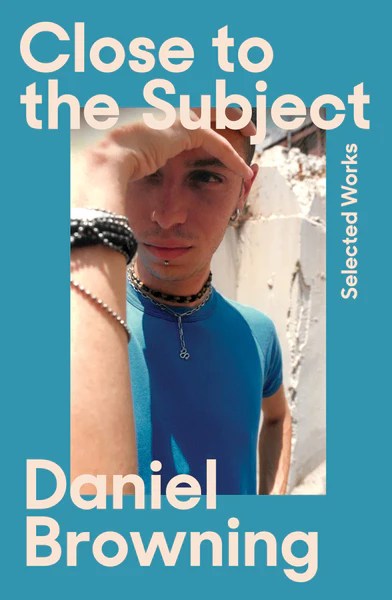
Close to the Subject: Selected Works at Magabala Books
(Thanks to Magabala Books for the review copy.)

 paperbarkwords.blog