
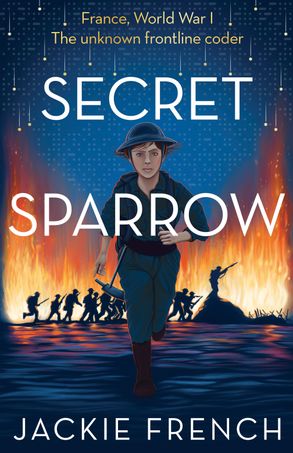
Secret Sparrow
by Jackie French
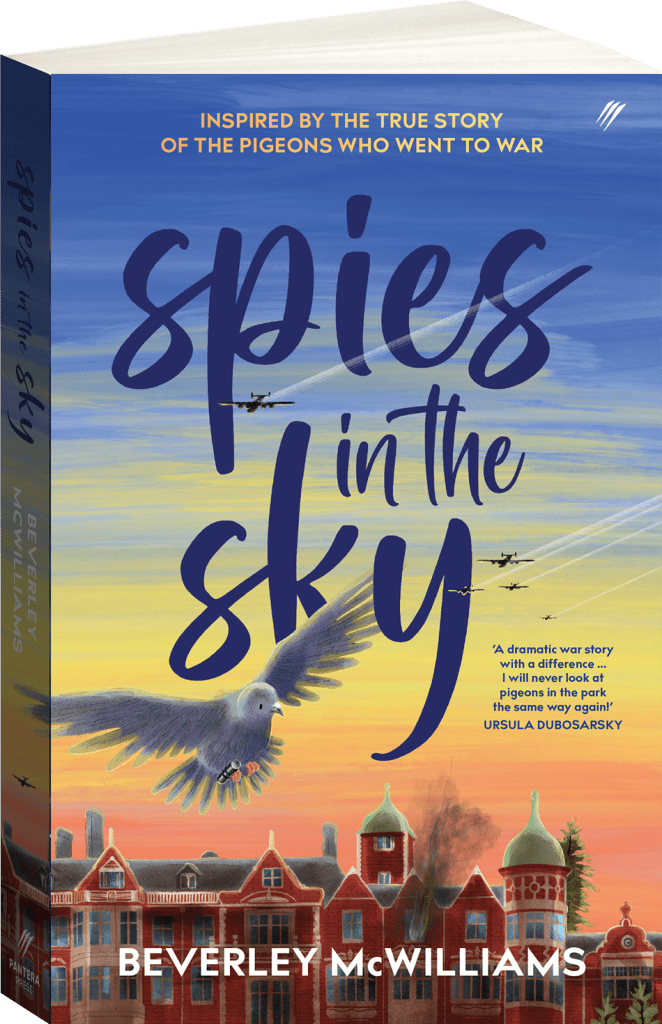
Secret Sparrow by national treasure Jackie French (HarperCollins Australia) has just been shortlisted for the 2024 ARA Historical Prize alongside Two Sparrowhawks in a Lonely Sky by Rebecca Lim(Allen & Unwin) and Spies in the Sky by Beverley McWilliams (Pantera Press) in the Children and Young Adult category. The winner will be announced on 23rd October 2024.
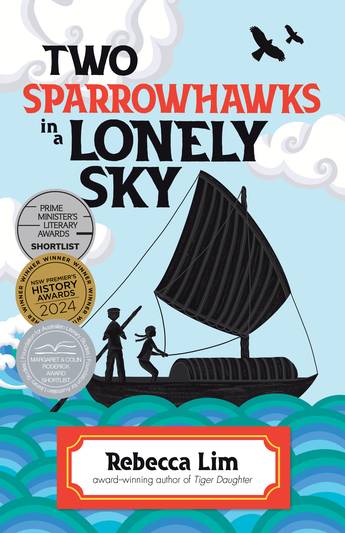
This comparatively new award showcases historical novels where “most of the narrative takes place at least 50 years ago.”
I’m fascinated by the similarity of the three CYA shortlisted titles: coinciding words are ‘sparrow’ and ‘sparrowhawks’ and ‘sky’; with ‘secret’ and ‘spies’ enhancing the ‘flying’ and ‘spying’ connotations.
Anna Ciddor, Chair of the CYA category judging panel, says, “Out of a wonderfully varied long list, the judges felt these three books soared high, not only with gripping and appealing story arcs and strongly relatable characters, but also by achieving great heights in the quality of their research. Each author has seamlessly woven this research into their storytelling, achieving exciting, immersive experiences for young readers.”
Author Interview: Jackie French
Thank you for speaking to Joy in Books at PaperbarkWords blog, Jackie.
(I’ve added some of my reviews of Jackie’s other books at the end of our interview.)
Congratulations on your novel, Secret Sparrow being shortlisted for the 2024 ARA Historical Prize.
What is some of the incredible unknown history behind your novel?
About 15 years ago my brilliant editor and friend, Lisa Berryman, sent me a mid 1920’s question asked in the British Parliament: Why don’t the women who fought in the front line in The Great War and were badly injured get pensions?
The answer: “They were not part of the British army.”
It took me 12 years to prove that answer was a lie.
It had never occurred to me I might find female front line British soldiers in World War one. I’d studied diaries, letters, firsthand descriptions and much else from that era, as well as the work of historians. There was no hint that women had been in the trenches, much less part of a front-line advance.
Why had someone even asked the question? The answer even seemed to admit women had been on the front line.
I had found nurses near the front lines. A few were official, most unofficial and usually self-funded. I’d found thousands of women ambulance drivers and aid workers, mostly unofficial, just behind the front lines, gathering and tending the wounded. I’d found four extraordinary 16-year-old girls running a free canteen for thousands of men near the front lines.
But women fighting on the front lines? The British army wouldn’t even accept female doctors – the British ones near the battlefields were under French or Belgian auspices. There had been no hint of British women soldiers.
I began to hunt.
The research would take a book to describe; a very boring book, as there was nothing to be found in any source, except just once: a hint in a paper given by US historian Barbara Walsh. With incredible generosity she gave me her source: The Irish Postal Workers’ Union Archives.
I hadn’t looked there.
Even more slowly pieces began to fit together, including information I already had, but hadn’t realised the significance. It took five years to piece together enough to write about one young woman, to whom I have given a fictional name in The Secret Sparrow. I won’t write ‘she said, he said’ about a real person, unless I have reasonable proof that is exactly what they said. I don’t have that for ‘Jean’.
This is fact, not fiction: At the beginning of World War One most male postal workers –including those who knew morse code and telegraphy- enlisted in The Postal Workers Rifles. By 1916 most were dead.
Unlike the US army, the British army distrusted new-fangled telephones. Communications were in morse, and coded. Some women, and girls, knew morse, either as a fashionable hobby, or because they worked in post offices sending or downloading telegrams in Morse: tap tap tap tap tap … like a sparrow’s tiny footsteps in the machines used then, though some machines used visual signals, not auditory.
Women’s fingers were often faster than men’s, too.
This is one point I had to fictionalise. How was ‘Jean McLaine’ recruited? I did find a government advertisement in 1916 for women who could ride a horse, shoot, and were prepared to share a tent with men. I have not yet followed this hint up.
And now nonfiction:
‘Jean McLaine’ didn’t need to ride a horse. Although only 16 she had won a morse coding competition. Morse had been a hobby. By 1916 she had voluntarily worked in a post office, to take the place of a man who had enlisted. ‘Jean McLaine’ was also of ‘a good family’. That was important in 1916.
She and hundreds of others of women who were fluent in morse were recruited. They swore the oath as members of His Majesty’s Armed Forces, and trained as soldiers. ‘Jean McLaine’ was legally part of the British army.
Most of the female soldiers seem to have been employed at Rouen and other places behind the front lines, only sometimes under attack. Others, like ‘Jean’, were sent to fill positions in the trenches, spending 24 hours a day at her post in portion of dug out, the only female there, working side by side with men, sending and receiving the morse code, giving information and receiving orders from headquarters.
When the front lines moved, ‘Jean McLaine’ moved from trench to trench, repairing and laying telegraph lines, then hurriedly sending messages.
My husband is fluent in morse code. I know a little. My husband also showed me how to repair and lay a telegraph cable, exactly as it was done in 1916, when his father fought in those trenches. If you leave the tiniest piece of grit, the message doesn’t get through. Accuracy under extreme fire was vital.
Bryan and I played splicing broken cables at home, not under heavy fire, as ‘Jean’ did, in the Battle of Cambrai, where after the first days of incredible advances the British declared they had won the war… just before the Americans arrived. The bells of victory pealed out across Britain.
That mistake has been hidden too. It was not victory, but a German trap, one that could be deduced from any train timetable of the vicinity.
‘Jean McLaine’ was badly injured, but survived.
Like most of the women I’ve been able to trace, ‘Jean McLaine’ was ‘unable to settle’ after the war. Her life was happy, varied, fascinating. She and her husband eventually made their home in Australia, where she was known and loved as volunteer postie who delivered the mail on a motor bike to isolated properties across hundreds of miles of bush. No one knew of her service in the war, except her husband, who had served in the trenches with her.
No one was permitted to know anything. Few women had served on the Front Line, and for less than a year, till the US forces arrived, far better equipped, so it wasn’t surprising that letters written at the time didn’t mention them. At the end of the war the British army burnt over 3,600 reports that mentioned women. It was illegal to speak of any woman’s army service, write it, or keep a record of it. If you broke that law you faced a sentence of 20 years in prison, or even death.
I am Australian, so I haven’t enquired if that law has been repealed. I hope it doesn’t apply to me.
Nor did it apply to the Irish Postal Workers Union. (I have finally returned to them.) Some Irish female postal workers had volunteered. The union fought, and won, better conditions for women soldiers. I don’t know what the Irish union members said when they heard of the orders to destroy any mention of women’s service. I suspect it was not polite. I do know they carefully kept every record they had in their archives.
This is certainly incredible, Jackie, and it’s a testament to your curious mind and fine research skills that you have unearthed these astonishing facts.
How have authorities attempted to erase the role of women and girls in history?
It would take many books to explain ‘how’, and I’ve written some of them. ‘Why’ is harder to answer. To save money in pensions? Probably not, as there were few disabled women entitled to them. To avoid admitting the army had lost highly qualified men early in the war as cannon fodder? Or because ‘I say old chap, we can’t admit the ladies were there’? I’ve seen the results of their mindset but can’t understand it.
Jackie, you write both fiction and nonfictional accounts of history – is one more powerful than the other?
I write fiction, nonfiction, and nonfiction mixed with fiction. The Secret Sparrow is the latter. Humans use stories to exchange information. Sometimes you can tell an excellent story in nonfiction, if you have the information. I knew what ‘Jean McLaine’ ate, and where she slept, and how and where she was trained, but I can only surmise what she thought, or said, or how a love affair with her commanding officer developed. ‘Fraternizing’ with other ranks was illegal, but I’ve found two couples who did just that. In one case – not ‘Jean McLaine’s’- the male officer dressed in women’s uniform for their assignations, but was most correctly dressed for their post war wedding.
How important is historical accuracy in historical novels?
Vital. Non negotiable. But semi historical fantasy, like Bridgerton or the works of Georgette Heyer, can be fun.
What is the importance of awards, such as the ARA Historical Novel Prize, for Australian authors? How shortlists and awards assist readers? Do we underestimate the ability of children and young adults to comprehend, understand and interpret history? And what role does the historical novel play in that?
My news feed this morning was filled with war and politics – and too often incorrect. How can you understand the middle of a story unless you know the beginning?
This is why history matters so deeply, and needs to be in large chunks every day of our lives, as kids and as adults. We can’t understand Chapter 1,829 of world events unless we’ve read Chapter One and Chapter Two and a great many in between.
Of course kids will understand. I’ve been telling kids historical stories since I was six years old, and so were they.
No one ever says to a kid, ‘You can’t watch Game of Thrones because you won’t understand it. We forbid them because they will understand it.
I ask young audiences to put up their hands if they find books boring, while every adult except me keeps their eyes closed. Almost every hand goes up, including at the Melbourne Writer’s Festival where the kids had just heard some exciting authors. (Apologies to a fabulous festival that the kids loved too). The only exceptions were the Byron Bay Writers festival, where I thought a marquee full of kids might lynch me for even suggesting books might be boring, and a single school.
It is so easy to underestimate a child. Kids are bored by simplified books, though they will choose them if someone says they have to read a book, because those are the shortest, easiest books they can find.
A child’s job is working out how the world works. Adults are often too preoccupied paying the rent or working out what’s for dinner to be fascinated by the big questions kids adore. Give kids a book that doesn’t treat them as literary cannon fodder and the book will become part of who they are. A single book can make them readers for life.
It isn’t easy to find the books you’re going to love. I’ve had a book a day habit all my life and it is still difficult to find the next new book to read. Books are boring, unless you are the target audience. I’m not interested in the sex life of cricketers, or the decisions of politicians unless they have been dead at least ten years and the secrets have emerged.
As a reader I wish ever person associated with the ARA awards could be showered with chocolates daily by flocks of cockatoos, and wombats bring them chilled champagne or cabernet sauvignon at the hour of their choice. They have done the hard work so readers like me can find a superb book in 30 seconds at 10 pm.
As a writer my only words are ‘Thank you. It is an honour and a privilege to be among you.’
Joy Lawn, in association with Dmcprmedia
Secret Sparrow at HarperCollins
******
Some of my other pieces about Jackie French’s books:
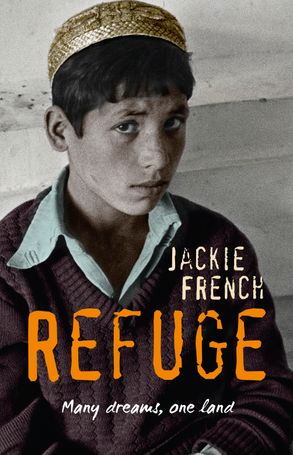
My review of Refuge in the Weekend Australian in 2014
(scroll down to the bolded part
I was also chair of the Qld Literary Awards judging panel in 2014 when Refuge won the Children’s Literature award, alongside Rules of Summer by Shaun Tan; and presented Refuge at international conferences in Athens and Wellington, NA)
Contemporary cool in young adult fiction
- By YOUNG ADULT FICTION: JOY LAWN
- THEAUSTRALIAN
- 11:00PM MARCH 28, 2014
THE finest writers of young adult fiction have a singular perspective and fresh, authentic writing style. Three Australians, including unofficial national treasure Jackie French, have written some of the best YA novels published anywhere in the past 12 months. They are joined in this review by exciting New Zealand author Elizabeth Knox.
Melbourne scriptwriter Fiona Wood has followed her popular 2010 debut Six Impossible Things with a work for older teens, Wildlife (Pan Macmillan, 384pp, $19.99). The two novels are loosely linked by the character of Lou, who is grieving following her boyfriend’s death. At her new school’s wilderness camp, Lou meets Sibylla, one of the best-drawn characters in recent YA fiction. In Sibylla, Wood recasts the mould of teen protagonist. It takes a thoughtful literary talent to create an introverted and awkwardly beautiful yet easygoing character with such clarity and affection. Wood introduces Sibylla with a head-turning billboard guaranteed to grab reader attention and then steadily builds a fascinating, genuine character, one whose personality is partly shown by her frustrating lack of awareness at times.
Popular Ben takes Sibylla as his trophy girlfriend. As a girl who isn’t interested in the camp “sociograph’’ and doesn’t fully understand who she really is or what she wants, Sibylla is pulled into a physical relationship her body desires but her brain warns her against. She is also a caring friend to intelligent, good-looking “loner not loser’’ Michael and, despite her naivety in some ways, appears more appealing in her self-containment and generous trust than most of the other shallow, self-centred campers. The group dynamics ring cringingly true.
Like the work of Simmone Howell, Leanne Hall and Cath Crowley, Wood’s writing is contemporary cool. References to Triple J and retro bands the Smiths and the Go-Betweens add verisimilitude. Music is also used as a shortcut to snapshot Lou when she sings Blackbird at the camp talent night. The others then instantly recognise her as “indie singer geek girl’’ and can code her into their social hierarchy. Allusion to Shakespeare’s Romeo and Juliet and Othello also hint at plot, character and motivations. The writing style has the lucidity and economy of a verse novel, but one set in prose. The dual narrations of Sibylla and Lou reveal different insights into each other as well as into the other characters.
Alternative viewpoints are also a potent element of Zac & Mia, by Perth writer AJ Betts (Text Publishing, 272pp, $19.99). Zac is a long-term hospital patient with leukaemia. The ward routine shifts when a new patient doesn’t follow the usual pattern of unpacking and adapting to newly confined territory, and instead plays bad-taste music loudly. We find out about stunning, volatile Mia through Zac’s point of view in the first part of the book, titled Zac. Here we also have insight into Zac’s fear and longing to be normal and at home despite the laid-back attitude he shows others. He is a considerate ‘‘real’’ 18-year-old trying to get through his last year of school.
The second part of the novel is innovatively titled And. This creates a clever structural device that allows Mia’s voice to share the narration with Zac. We have an inside view into Mia’s character and situation, and are also given her perspective on Zac. The final section, Mia,
again changes the focus until Mia eventually starts to realise that “Before, everything was about her’’ and that’s not how it should be.
Light touches, such as Zac’s crush on Harry Potter actress Emma Watson and the warmth of Zac’s family and other relationships balance the seesawing emotional shades. Despite the themes of cancer and grief, Zac & Mia is warm and uplifting.
The contemporary realism of Wildlife and Zac and Mia is perhaps Australia’s most well-recognised YA genre. In Refuge (HarperCollins, 261pp, $15.99), Braidwood, NSW-based author Jackie French achieves an extraordinary feat. She tackles the contemporary issue of refugees in what seems to be a realist form but then subverts the genre into a groundbreaking alternate reality. The close-up cover shot of a turbaned boy is not representative of the scope of her achievement. Faris’s refugee tale is outlined but that is only the beginning of what becomes a most profound and important story.
When the book begins Faris is already on the refugee boat to Australia. His imagined Australia has streets full of two-storey houses, new cars in garages and lawns dotted with munching kangaroos. This is the place he reaches when his boat is swamped. He plays a free-spirited ballgame with children from different countries but discovers that each child has their own impression of Australia.
The children’s different experiences are sobering. Jamila fled from Afghanistan where her schoolteacher grandmother’s lips, ears and eyes were cut out by the Taliban because she taught girls. Nafeesa escaped from a prison camp in Sri Lanka. Vietnamese Mei Ling arrived after pirates left her boat floating but without water or fuel. These children are the brave survivors who work to cultivate the understanding and courage needed to face adversity and hatred: “We are different, but people who are different can be friends. What makes someone say: ‘Your difference is evil. We will wipe you out forever?’ ’’
The refugee subgenre is popular in YA and children’s books. Novels such as Refuge may well offer the best insight across all media into the plight of refugees because of the power, poignancy and accessibility of the telling. Part of the strength of French’s story of refugees and refuge is that, like Faris, at first we don’t know where the children are.
Kiwi author Elizabeth Knox also establishes an intriguing ambivalence with her breathtaking incursion into an alternate reality in Mortal Fire (Gecko Press, 448pp, $24.99) which has some ties with her two Dreamhunter novels but easily stands alone.
Sixteen-year-old Canny lives in the Pacific Island republic of Southland, which could be part of either a reimagined New Zealand or Australia. She is the force behind her school’s maths team but her uncanny ability with numbers seems to be coupled with its opposite, her ‘‘Extra’’, fragments of writing that no one else seems to notice. She sees patterns in the real and hidden worlds.
Canny’s experiences in the surreal Zarene Valley where she climbs past the illusion of an injured animal to a handsome young prisoner in a hidden house on the hill, and where the people have rhyming names and secrets, are tempered with the harshness of what may be a reinterpretation of the 1929 NZ mine tragedy, or other disasters and their repercussions. Knox’s writing is sensory and lush and her imaginative intensity rivals the best of Diana Wynne Jones’s stories. The characters in Mortal Fire are unique, the plotting is elaborate and the ideas are sophisticated. It is a fine companion to the best of Australia’s recent YA fiction.
ANZAC & Gallipoli Picture Books

I reviewed these books for the SMH/The Age in 2015 – so it is a review of its time.
Thanks to Susan Wyndham for commissioning the review.
Gallipoli books for children open an enlightening window on the reality of war
SYDNEY MORNING HERALD/THE AGE
By Joy Lawn
April 25, 2015
My Gallipoli
RUTH STARKE AND ROBERT HANNAFORD
Working Title Press, $29.99
The Beach They Called Gallipoli
JACKIE FRENCH AND BRUCE WHATLEY
Angus & Robertson, $24.99
And the Band Played Waltzing Matilda
ERIC BOGLE AND BRUCE WHATLEY
Allen & Unwin, $24.99
The Last Anzac
GORDON WINCH AND HARRIET BAILEY
New Frontier Publishing, $24.99
Every year for the past decade or so there’s been a stream of picture books published for children leading up to Anzac Day but this year there’s a torrent because of today’s commemoration of the centenary of the first Anzac landing at Gallipoli.
These impressive new books about the Anzacs should be a potent repellent against war for young people. The horror of past war, portrayed here with power and artistry, could deter readers from ever actively seeking or accepting war, without detracting from the sacrifice of Australians past and present who fight alongside our allies and defend our freedom.
The new Gallipoli books for young readers often build on the archetypal story of a young man, alone or with mates, who joined up in an outbreak of patriotism, trained near the Egyptian pyramids and experienced mateship while enduring the agony of the trenches, injury and death. Many augment this core narrative with the important roles of women’s and ethnic minorities such as Indigenous and Asian-Australians.
Ruth Starke and Robert Hannaford integrate these groups effectively in My Gallipoli. Their real and fictitious characters briefly tell their own stories, such as that of Turkish Lieutenant-Colonel Mustafa Kemal who won the pivotal battle at Chunuk Bair. Turkish viewpoints have been shown in children’s literature in the past but understanding of the “other” point of view is growing. The charcoal, watercolour and gouache illustrations show the chaos of Gallipoli within a chronological timeline, leading us to Lone Pine Cemetery in 1990.
Australian Children’s Laureate Jackie French and artist Bruce Whatley take us further in The Beach They Called Gallipoli. Also structured chronologically, it opens in April 1915 where French eloquently sets the scene: “War snatched and battered many places. One was a Turkish beach.” She finely, yet uncompromisingly, describes the carnage of war until the times when pilgrims start coming to this symbolic place to remember and mourn.
Finally, the book brings us to Anzac Day 2015, when 10,000 stand together in commemoration. Whatley’s digitally manipulated photographs and pen, ink, watercolour and acrylic collages exemplify the outstanding quality of current Australian book illustrations.
Whatley also demonstrates his artistic range in his illustrations for Eric Bogle’s emotive song from 1971, And the Band Played Waltzing Matilda. Whatley’s searing line drawings and allusive blood-splotches bring Bogle’s anti-war tribute to the injured and slain to a new generation. This protest-song, written about Gallipoli to highlight the waste of lives in the Vietnam War, is still relevant today. The lyrics, derived from our unofficial national anthem, Waltzing Matilda, are heartrending.
Even though bands still play Waltzing Matilda, as Bogle predicted, the time has come when “Some day no one will march there at all … And their ghosts may be heard as they march by that billabong. ‘Who’ll come a-waltzing Matilda with me?'”
The last surviving Anzac from Gallipoli, Alec Campbell, died in 2002. In contrast to the sophisticated and explicit artwork of the books reviewed above for older children, Gordon Winch and Harriet Bailey’s The Last Anzac protects its intended younger readers from the worst of war.
The illustrations here are more colourful and conventional, and injuries are appropriately glossed over in this tale based on the true story of a boy who travelled to Tasmania in 2001 to meet 102-year-old Alec Campbell. Their time eating together in warmth and comfort is interspersed with Alec’s memories of bully beef and hard biscuits in the trenches. Reminiscences of Alec’s enlistment at the age of 16 and time at Gallipoli near the end of the campaign in 1915 flow through their conversation.
Like the other, often unknown, soldiers encountered in these picture books, Campbell was a hero who has become part of our folklore and heritage. The Anzacs at Gallipoli created the possibility of victory from defeat. These books open an enlightening window into the sacrifice of war and importance of Anzac Day for children. Adults may also be surprised, sobered and deeply moved by the power of picture books.
******
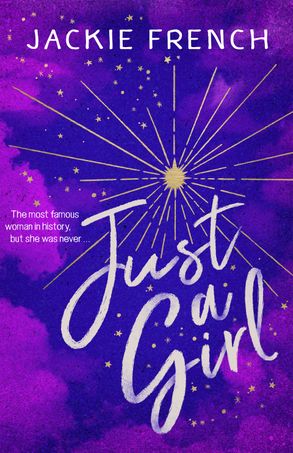
Just a Girl – my review in the Weekend Australian 2019
(scroll down to part in bold)
Young Adult Fiction March 2019
by Joy Lawn
Many novels for young adults are set in difficult, even violent, real-world or speculative circumstances. Most of these describe a fraught coming-of-age experience but are nonetheless enfolded in hope.
Catch a Falling Star (Walker Books, 256pp, $17.99) by Meg McKinlay, winner of the Prime Minister’s Literary Awards for A Single Stone, is one of three middle-fiction novels for younger teens reviewed here.
Frankie’s father shared his love of astronomy with her before he disappeared in 1973 in a plane crash. This coincided with the launch of the Skylab space station, which he had intended to document in a scrapbook with his son Newt (named after Isaac Newton).
The story jumps to 1979 when Skylab is about to return to Earth. In WA, Frankie and her classmates anticipate the descent, planning where they will shelter and fantasising about being astronauts. Frankie cannot bear to reveal her childhood wish to be an astronomer because of her unresolved grief. Newt is now eight and a precocious scientist who finds their father’s notes in the broken-down shed that was their Space Shack. He tracks Skylab’s orbit obsessively and merges scientific facts with the Greek Callisto myth that their father is a bear in the stars and will return with Skylab. Frankie also longs to believe in magical stories.
Their mother works long hours nursing and leaves Frankie with too much responsibility, particularly looking after Newt, because she thinks that Frankie is “fine”. The author is a poet, so she subtly explores the alternative meaning of “fine” to depict Frankie’s fine writing and thinking, and contrasts the “broken” bone of a young patient with Frankie’s broken family in a poignant scene where Frankie finds her mother playing Yahtzee with the girl instead of caring for her own family. Frankie yearns, “I just want my mum for once. I want her here, with us … and not spinning out there in the dark somewhere, in her steady, untouchable orbit”.
Media reports on Skylab’s re-entry change in tone as it becomes a threat. The benign descriptor “tumble” becomes “plummet”. The stars Frankie loved now sicken her but, because her friend’s mother told Newt that their father is a star, he tries to reach him. Frankie feels that she must catch both him and their father as they fall from the stars.
Frankie’s class is reading Colin Thiele’s Storm Boy and she understands that “Storm Boy isn’t about a pelican. It’s about losing something important, something that feels like part of your heart. It’s about things falling from the sky while all you can do is watch. About not being able to save the thing you love no matter how fast you run, no matter how much you hope.”
Frankie finally realises that you “don’t always have to see the stars. Sometimes it’s enough to know they’re there”.
The Slightly Alarming Tale of the Whispering Wars by award-winning author Jaclyn Moriarty (Allen & Unwin, 528pp, $22.99) is a stand-alone companion to The Extremely Inconvenient Adventures of Bronte Mettlestone. It is set in the same fantasy world and Bronte and her friend Alejandro reappear at strategic times to help the protagonists, Findlay of the Orphanage School and Honey Bee from prestigious Brathelthwaite School, solve the mystery of the missing children.
Findlay and Honey Bee are both good athletes who meet at the Spindrift Tournament. They share the narration, often with different and quarrelsome perspectives on the same event. The structure is sophisticated, with parts told retrospectively.
The writing is whimsical, imaginative and humorous with taunting acts of rivalry between the schools and magical inclusions such as Radish Gnomes, Faeries and dragons. It is voiced by real-sounding children who address the reader and annoy and care for each other.
In the story, Whisperers are stealing children from the town of Spindrift and across the Kingdoms and Empires and taking them to the impenetrable Whispering Kingdom. Findlay, Honey Bee and some of their friends allow themselves to be kidnapped so that they can rescue the children. Once there, they are as powerless as the other captives and have to work in the mines plucking strands of thread from rock.
Weighty themes and issues of child slavery, distrust of those who are different, war, expedient alliances, vilification and internment behind barbed wire, and unjust treatment of the poor and refugees are told lightly yet with momentous impact.
Ultimately though, this exceptional novel leaves us with a sense of the power and compassion of young people, and their agency to change the world when they recognise their own strengths and draw on the love of their family and friends.
Bren MacDibble is the author of the multi-awarded novel How to Bee. Her new dystopia The Dog Runner (Allen & Unwin, 248pp, $16.99) echoes Cormac McCarthy’s The Road – but with the help of dogs.
Most of the world is starving because red fungus has destroyed the crops. Food is scarce because it is dependent on plants and grass: bread, rice, corn, meat and dairy products. The government has stopped distributing food packages and people are stealing or trading on the black market.
10-year-old Ella’s mother helps maintain the power grid but has been missing for eight months. When Ella’s father eventually searches for her and doesn’t return, Ella and her 14-year-old part-Aboriginal half-brother Emery know it’s time to leave the city for his mother and grandfather’s farm in the country. Emery exchanges Ella’s precious tin of Anzac biscuits for a cart, dog harnesses and two huskies to help lead-dog Maroochy and their two other malamutes pull the sled on wheels.
They escape the city on moonlit, “white ribbon” bike paths then cross paddocks, creeks, gullies and a rocky hillside through red dust. The NZ-born author has an affinity with the Australian landscape. She sculpts it as familiar but unromanticised.
The pack encounter the vulnerable, the kind, and predators on electric motorbikes who shoot Emery and Wolf, one of the dogs. Ella draws on her quick wits and endurance to keep her tribe safe. She learns that in an upside-down world, survivors must “walk on their heads” and think differently.
The writing in this cautionary, but hopeful, tale is pared and sparse. It is told in an idiosyncratic style (“my stomach is aching of empty”) that brings the characters and setting to life.
For older readers, Angie Thomas’s two acclaimed YA novels The Hate U Give (also a major movie) and On the Come Up (Walker Books, 448pp, $17.99) are authentic, potent representations of a contemporary African-American ghetto experience. They are both narrated by teen girls; set in the fictitious but generic suburb of gang-controlled, drug-fuelled Garden Heights and seeped in distinctive, cadenced, slang.
The community in On the Come Up is reeling and rioting after the police shooting of a young unarmed man. Security guards at 16-year-old Bri’s school are now targeting the “black and Latinx kids”. Bri is caught bringing contraband – candy – to school and is thrown to the ground and handcuffed.
Bri is like her father: smart-mouthed and hot headed. He was an underground rap legend who was murdered when Bri was four. Her mother, a former junkie, is trying to keep food on the table. Her aunt is a drug-dealer.
Bri feels invisible, powerless and “a hoodlum from a bunch of nothing” until she has the chance to rap in a freestyle battle. This and the other rap scenes are electrifying. Bri composes on the spot, turning her aggression and angst into a rhythmic flow of sounds and words. Her song goes viral and she becomes neighbourhood royalty. In “the Garden, we make our own heroes”.
On the Come Up is a brilliant, unflinching exposé of racism and violence and of how strongminded individuals and families in tough, disadvantaged societies can survive and save each other. Told in pain, yet with warmth and love, this story is throbbingly real.
Former Australian Children’s Laureate, Jackie French, writes across genres and eras. Just a Girl (HarperCollins, 256pp, $16.99) is set mainly in 71 AD Judea when the Roman army destroys a Jewish village. Grandmother Rabba orders young narrator Judith to carry her to a cave that the women have secretly stocked with food. Judith also rescues her younger sister Baratha but witnesses the horrific death of her mother and capture of her older sisters.
Judith has been a shepherd since the menfolk went to war so is skilled at hunting with a slingshot. When threatened by a Roman, she hits him in the forehead with a stone and believes she has killed him. Rabba instructs her to honour the dead by burying him, but she finds him alive although badly injured.
Caius is a scribe-slave, now freed because the Romans abandoned him. He helps the cave-dwellers survive cold, flood and wolf-attack. His and Judith’s questions about Rabba’s past friendship with a girl she calls Maryiam and her son Joshua prompt Rabba to gradually reveal fragments of the Christmas and Easter stories. The author draws on her expertise in researching, retelling and linking historical events to outline the tale of Maryiam/Mary, whom she describes as a “dimly seen historical figure”.
French’s writing evokes the village “huddled between lion-coloured hills”, the dank cave and the routine of scavenging and cooking. Themes of war and its aftermath, slaves, refugees and female-worth are both time-specific and universal.
Judith learns that, like Maryiam and Rabba, she is never only “just a girl”. She is curious, intelligent and strong. Despite its violent setting and time, this is ultimately a gentle tale of kindness, joy and hope.
******
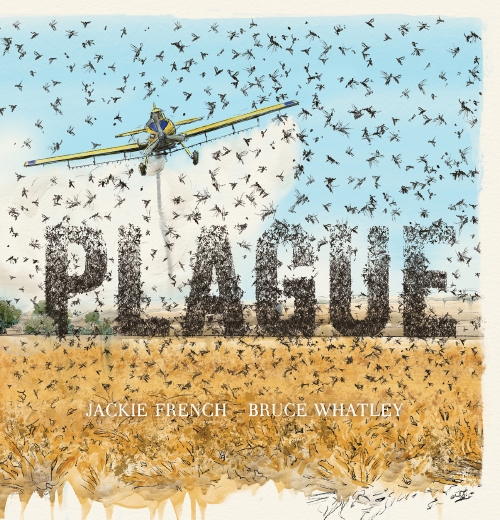
My review of Plague in Magpies magazine
PLAGUE (2023)
Jackie French, ill. Bruce Whatley, Scholastic Press Australia, 32pp.
978 1 74383 482 4 Hb $26.99
Jackie French and Bruce Whatley must be considered one of Australia’s most successful picture book collaborative pairings. They are responsible for the ‘Diary of a Wombat’ and ‘Shaggy Gully’ series as well as the ‘Natural Disaster’ picture books. Books in this series so far are Flood, Fire, Cyclone, Drought, Pandemic and Earthquake. The latest release is Plague. The creators have a clear commitment to producing fine work and their passion is undiminished. Plague is one of the best in the series.
In current times we could assume that a book titled Plague is about sickness or a pandemic but this work is about a locust invasion. Told in first person from an omniscient locust viewpoint, with threatening close-ups of the insects in the foreground, we begin in the past where women ground grass seeds for flour. Men hunted kangaroos and white ibis hunted us. The food chain worked effectively; the world was balanced then. Bruce Whatley’s depictions of First Peoples are sensitive, his unspoiled panoramas are stunning and his locust swarms have an awful beauty.
However, two hundred years ago farmers (shown in drab monochrome) were responsible for changing the ecosystem. They cut down trees and drained the ibis swamps, which caused the ibis to become scavenging ‘bin chickens’. With the migration of their natural predators to the city, the locusts ravage the land. The story today is of poison that not only kills the locusts but is sprayed over the grasslands onto birds, animals and people.
The ancient voices know how Country should be understood and cherished. Jackie French has also been warning us and sharing this message for many years. In the author notes in this sophisticated and timely book, she gives specific solutions to manage locust infestations and to care generally for our planet.
******
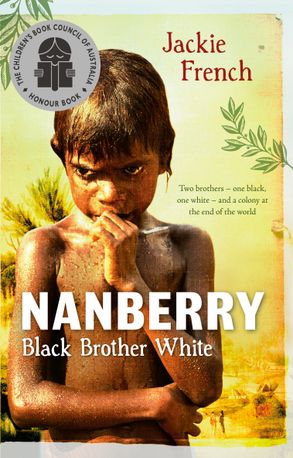
Teacher Notes I wrote for Nanberry in 2012
Nanberry: Black Brother White by Jackie French
Publisher Angus & Robertson, Harper Collins
Readership Middle school
Genre Historical fiction
Setting First Fleet colonisation and Aboriginal nations
Language Historically accurate storytelling
Themes Aboriginal people and European colonists; disease and death; displacement; identity; discrimination; home
Synopsis Nanberry, an Aboriginal boy sees ‘white ghosts’ – European colonists. They don’t leave as expected but instead cause a smallpox epidemic. Nanberry survives and is adopted by Surgeon White. He is used as a translator between the Europeans and Aboriginal people. He realises that he isn’t accepted by the Europeans or by the indigenous warriors, because he hasn’t been initiated, but is able to overcome this and find his ‘place’.
Teaching Applications
- Roman ︡a clef Nanberry is a ‘roman ︡a clef’, ‘a novel about real life, overlaid with a facade of fiction’. (Wikipedia) Outline the historical elements. (Include the setting of the First Fleet colonisation and the historical characters. The Author Notes at the end of the novel will be helpful.) Record these on coloured paper in bold font then describe some of the fictional information, including some characters, or facts about them, and record these on transparent (or light coloured) paper as an overlay. Comment on the difference between factual and fictional details. How has the author incorporated the two? Students then write their own interpretations of some of the fictional aspects, ensuring they correlate with the historical information. (ACELT 1608) http://www.australiancurriculum.edu.au/Search?a=English&q=description
- Sensory and Historical Writing 1. French writes historical fiction but also uses sensory images. Students find examples of these and write onto a Senses Chart under the headings ‘see, hear, touch, smell and taste’. (ACELA 1508) http://www.australiancurriculum.edu.au/Search?a=English&q=description 2. Nanberry sailed with Matthew Flinders, page 289, but this is not included in the novel. Students combine historical records about Flinders with their own sensory writing, as evinced from French’s work, to write an account of Nanberry’s voyage.
- Point of View Different points of view are given: Nanberry, Surgeon White, Maria, Rachel and Andrew. Write a dialogue between a number of these characters.
- Time-Slip French has written a number of time-slips, including Walking the Boundaries, Somewhere Around the Corner and The Night They Stormed Eureka. Students write a scene with a new character from the present who slips into a scene from Nanberry. Or, students slip one of French’s characters into the present.
- Critical Literacy What is the author’s view of marines, page 113, and other groups?
- Local Aboriginal Nations Students research Aboriginal nations in own area.
- Students’ Ancestors French found interesting links in her own family to Australian history (page 294). Students discover some of their own ancestors.
- Cook Prepare and serve some of the European or ‘native’ foods eaten in the novel. [pages 6,12,16-17,65,304, e.g. soda bread, corn cobs] Jackie French often has recipes at the end of her books, although not in Nanberry. Find relevant recipes from her other books or source elsewhere.
- Read Georgiana: Woman of Flowers by Libby Hathorn; Playground by Nadia Wheatley and Ken Searle; Daughter of the Regiment, The Goat Who Sailed the World, Tom Appleby: Convict Boy, The Fascinating History of Your Lunch and How to Guzzle Your Garden by Jackie French. An author study could be undertaken.
Display
- Roman ︡a clef See ‘Teaching Applications’ above.
Publisher Teacher Notes http://www.heds.com.au//images/newsletters/hca_website/teacher_guide_nanberry.pdf
******
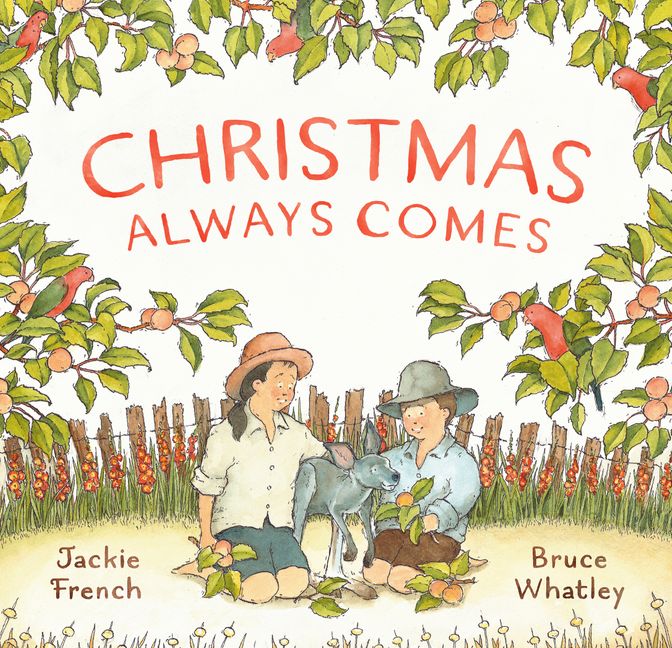
Christmas Always Comes by Jackie French & Bruce Whatley

 paperbarkwords.blog
Such an enlightening interview! I agree. Jackie French is a national treasure. She has such a mind for complexity and such an ambitious work ethic. (And how great that she and her husband practised splicing telegraph cables!)
>
LikeLiked by 1 person
Isn’t Jackie amazing – as you’ve outlined, Judy, and in so many ways. Thanks for your comment.
LikeLiked by 2 people