
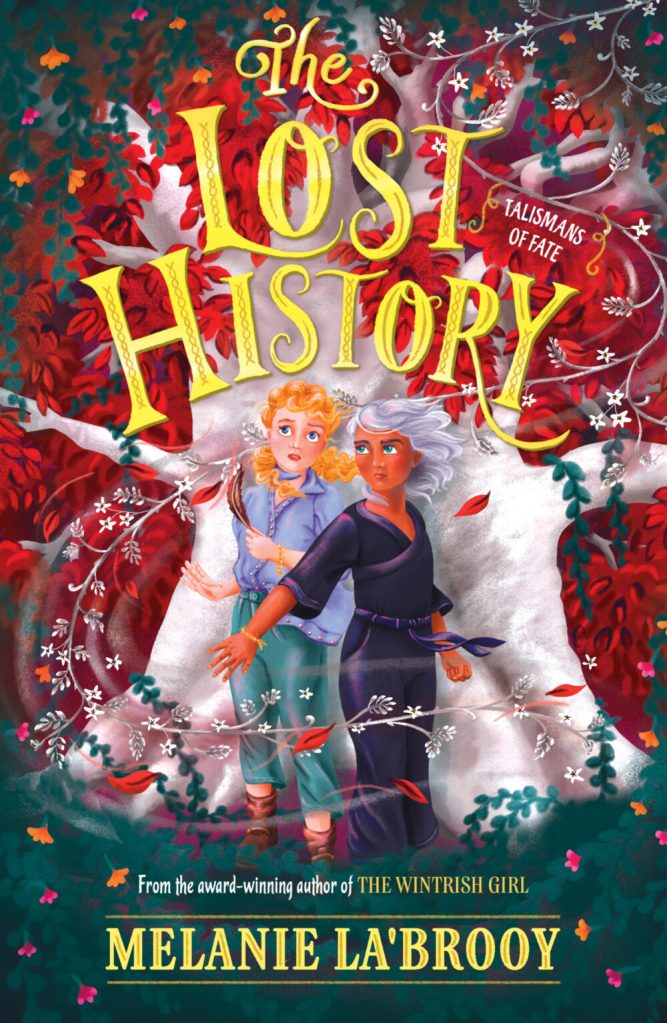
The Lost History
by Melanie La’Brooy
The Lost History follows the The Wintrish Girl in the excellent ‘Talismans of Fate’ middle fiction high fantasy series by Melanie La’Brooy. The series stands out for its beguiling storylines deftly layered with light and dark threads. These are entertaining, intelligent books. Both are published by UQP (University of Queensland Press).
Guest Author post about The Lost History by Melanie La’Brooy for Joy in Books at PaperbarkWords blog
THE SERIOUS BUSINESS OF WRITING FUNNY FANTASY
“My job is to make things up and the best way to make things up is to make them out of real things.”
(I Shall Wear Midnight) Sir Terry Pratchett
It was always my intention with the Talismans of Fate series to write page-turning books that readers would find funny and exciting, but I also very much wanted to make readers think about issues that are important in the real world.
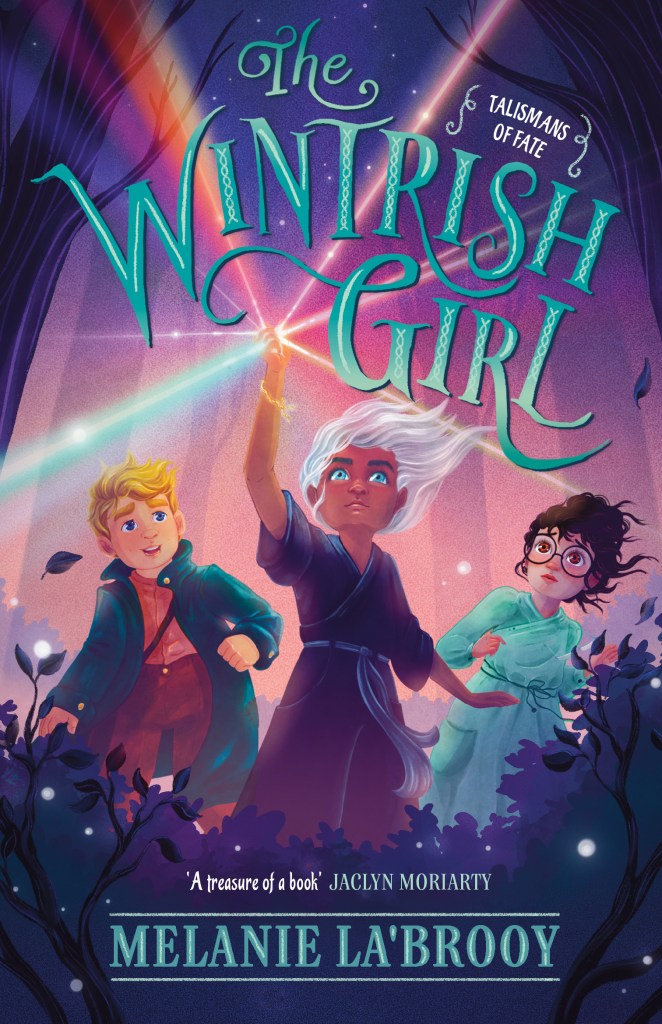
This is why, in both the first book of the series, The Wintrish Girl, and its sequel, The Lost History, you’ll find all the hallmarks of fun fantasy adventures; impossible escapes from terrifying villains, wildly imaginative travel portals, a highly-sensitive dragon and a misbehaving sword. What you’ll also find are real-world issues such as racism, colonialism and book banning. Somehow, (and I’m still not quite sure how I got away with it), I also managed to sneak a discussion of historical methodology into The Lost History, which is a book intended for eight- to twelve-year-olds.
There are two reasons I layer complex ideas and thorny issues throughout my middle-grade books. The first is because I think the role of good fantasy is to hold up a mirror to the real world: reflecting its wonders, like humour and friendship, but also its ugly flaws, like sexism and cruelty, so that when kids encounter these things in the real world, they have a framework for recognising and responding to them.
The second reason is because I think kids are consistently underestimated and that they’re way smarter than they’re often given credit for. I was told several times by well-intentioned adults that the first book in the series, The Wintrish Girl, was too difficult and too complex for kids. Keep the dragons and lose the social commentary, went the advice, which I didn’t take. The Wintrish Girl subsequently ended up on the CBCA longlist for Book of the Year and the Reading’s Children’s Prize shortlist. It won the Aurealis award for Best Children’s Fiction and the inaugural DANZ (Diversity in Australia and Aotearoa New Zealand) award. I was particularly thrilled by the DANZ award as that award was judged by kids, who clearly had no problem understanding the complex issues of colonialism, sexism and racism that The Wintrish Girl delved into.
Like The Wintrish Girl, my new book, The Lost History, is another rollicking adventure in the best high fantasy tradition. There are creepy creatures, thrilling escapes from danger and new and wondrous corners of the Empire of Arylia to be explored. But while I love writing jokes and rapid-fire dialogue and filling my imaginary world with rich details, what mattered to me the most when writing The Lost History was its central theme: When it comes to the history we’re taught, whose stories get told, whose don’t and why?
The Lost History is packed with observations about history: how we study it, how we can reclaim truth from the past and why this is important. I made a very deliberate choice to highlight oral history in this book, for oral history has a far greater significance in indigenous cultures than it does in the Western historical tradition, which is dominated by the written word. It is ultimately a memory, a retold oral history, that is the crucial element in the narrative. Inspired by real-life historical truth-telling commissions, the dramatic climax of The Lost History occurs when a victim of historical injustice, whose voice was taken away at the start of the book and subsequently erased from history, is finally able to tell the truth about what happened to her all those years ago.
Another example of complex layering occurs towards the end of the book. I wrote a scene in which two characters are discussing a horrific crime that took place in my fictional Empire during the last war, when an evil person placed a terrible curse upon the indigenous Wintrish people, stripping them of their humanity. I used this dialogue as a jumping off point to explore collective historical responsibility and the creep of political extremism, as can be seen in this passage:
“When she spoke again it was in a strangely urgent tone. “An atrocity like the mass cursing of the Wintrish people could never be the work of one person! It didn’t just fall from the sky. Things like that happen slowly and then all at once. The conditions for it to happen had to already be in place. And they were.” (The Lost History)
The inspiration for these lines came from a speech given at Auschwitz in 2020 by Polish historian and Holocaust survivor, Marian Turski, who said:
“Auschwitz didn’t suddenly fall from the sky. Auschwitz crept up, tiptoed along with small steps, moved closer and closer, until the things that happened here began.’
There are many more real-life allusions like this one in The Lost History. I gave my Inquisitor the name Lex Talionis, which is a Latin phrase meaning the law of revenge or retaliation. The three terrifying creatures who enforce the Inquisitor’s will are Rack, Drowner and Inferno. Their menacing powers are based on the real instruments of torture that historical Inquisitors used, to extract confessions. Also inspired by real life are my invented despotic rulers of Candlemage, who hold complete sway over their subjects despite their creation of ever more ludicrous laws. I based these characters on the leaders of real-life authoritarian regimes, who are in equal measure terrifying and ridiculous.
I don’t footnote these references or spell them out for readers at the end of the book. So, if no-one will ever pick up on these deeply embedded layers of meaning, why do it?
I do it because I firmly believe that grounding my stories in reality makes them richer and helps to drive home the points I’m trying to make, without being heavy-handed. I do it because even though readers of my books may have no awareness of the global political issues I have in mind while writing my books, I firmly believe that encountering big ideas within the pages of a fantasy novel can be the starting point for thinking analytically about the real world, for both children and adults.

One of my favourite lines from The Lost History is:
“History has an inconvenient habit of refusing to stay in the past.”
I don’t know if every young reader who reads The Lost History will understand this line. I know that some will. But what I hope will stay with them, long after they’ve closed my books, is that feeling of being immersed in an imaginary world full of big ideas; where the excitement and wonder comes as much from the marvellous, funny adventures as it does from the thrill of realising that there is serious thinking to be done.
The Wintrish Girl by Melanie La’Brooy at Paperbark Words blog

 paperbarkwords.blog