

South with the Seabirds
by Jess McGeachin
Author/illustrator Interview at PaperbarkWords
“They came at last to an island at the edge of the world.” (South with the Seabirds)
South with the Seabirds is another excellent book by Jess McGeachin. It tells a surprising tale about Macquarie Island and its history. Distinguished by Jess’s research, which he shares through compelling pictures and words, South with the Seabirds takes the form of a narrative non-fiction picture book.
South with the Seabirds is published by Allen & Unwin.
******
Thank you for speaking to ‘Joy in Books’ at PaperbarkWords, Jess.
You have a fascinating day job designing exhibitions at Melbourne Museum. Could you please tell us about one? And what is something you have found in the museum’s basement?
Thanks for having me, Joy!
As you mentioned, I’m pretty lucky to have a day job at Melbourne Museum. I’ve been involved in designing all sorts of different exhibitions, from microbes in your gut to precious gems, and of course dinosaurs. One of my favourite projects was the recent Triceratops exhibition, in which I helped create a lush Cretaceous world for our new dinosaur fossil. There’s all sorts of things in the museum’s basement, but the room of live spiders is especially fun.
How does this day job tie in with your trip to Macquarie Island and your book South with the Seabirds?
I knew a little bit about one of the protagonists in the story, Hope Macpherson, through my mother. Mum is a scientific illustrator, and also worked for the museum for many years. This inspired me to look for some of Hope’s photos in the collection where I discovered more about the incredible voyage her and the other scientists took to Macquarie Island in the 1950s.

Have you read One Small Island by Alison Lester and Coral Tulloch? It’s also about Macquarie Island. If you’ve read it, how was it helpful for your preparation of South with the Seabirds?
I read One Small Island many years ago, but I actually didn’t pick it up again in preparation for this trip. It’s a gorgeous book but I didn’t want to be too influenced by that story when writing my own. Now that South with the Seabirds is finished though I can see how well they complement each other.
In an innovative storytelling and structural decision, your book follows four female scientists who study Macquarie Island and its wildlife. Why have you focused on four female scientists (assuming they’ve been many more males than females)?
I’ve always been interested in the ‘golden age’ of Antarctic exploration, and it’s fascinating to see how male-focussed it was (and still is). I was stunned to learn that it was only in the late 1950s that female scientists were permitted to join an Antarctic trip, and even then it was seen as a novelty. So I knew there was a story there, but it didn’t seem right to focus on gender as the primary lens – each of the four scientists was incredibly accomplished in their own right so I wanted their area of study to be at the forefront. It lets us see the island through their eyes and learn more about the animals and landscape they found there.
You must have done extensive research about Macquarie Island – its landscape, living creatures, the people and their clothes and equipment, and the Thala Dan, the icebreaking ship – to create this book. Could you give an example of how you’ve shown some of your research via an illustration?
There was a lot of research to do for this book. Luckily I found a trove of photographs, documents and maps from the time. I even discovered a menu from the ship that told me what the expedition ate for Christmas! I was also fortunate enough to visit the island as part of an Australian Antarctic Arts fellowship. I kept a sketchbook with me and was able to draw the same places on the island that the scientists had visited 60 years earlier. This was invaluable to understand the landscape and capture details I never would have known about otherwise. Here are some pictures of my sketchbooks and how they made their way into the finished book.


How do your colours and style reflect the book’s content?
The illustrations are primarily created using watercolour, which is a fairly new medium for me. The island itself feels so raw and alive, and I really wanted to capture how messy and raw nature can be. Visiting the island, I realised how much the colours change depending on the time of day. From dusty pinks at dawn to inky blacks at night, and even a vivid green Aurora Australis. I created some special Macquarie Island colour swatches when I was there too. If you ever want to know what colour seal poo is, here you go.

In your recent guest author post at PaperbarkWords, the highlight was when you talked us through some illustrations in your picture book The Space Between. This gave very interesting insights into what you’d created. Could you please talk us through what you’ve done with an image or spread from South with the Seabirds in a similar way?
I thought this spread of the Thala Dan waiting to depart from Melbourne is a good example of the process behind this book. In this instance I built the scene around a primary source image of the four scientists on the ship.
The photo told me what they were wearing and what time of day it was, but I wanted to extend it to include more details. You can see the crew loading an amphibious vehicle onto the ship (much like they still use today), well-wishers saying goodbye and the newspaper reporters looking for an interesting story.


What most amazes you about Macquarie Island?
The smell! It’s the one thing a picture book can’t quite capture, but to me Macquarie Island smelt like an incredible mix of salt, seaweed and very stinky seals. It felt wild and very wonderful.
What do you hope young readers take away from this book?
I would love it if young readers took away a sense of curiosity about the natural world and learnt a little more about the pioneering scientists who’ve come before them. It’s also a story about ecological hope, because we have been able to remove the feral animals on the island and it’s slowly starting to heal.
2025 is the 80th birthday of CBCA Book Week. Your artwork is being used for the Children’s Book Council campaign, Book an Adventure. https://cbca.org.au/cbca-book-week-resources/
This is a great honour and reflects how well regarded you are in the children’s literature community. How did this commission come about and could you please tell us a little about the art you’ll be contributing?
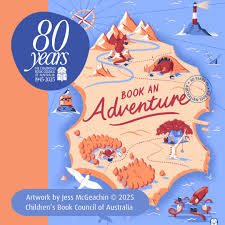
I was absolutely honoured to be chosen as the artist for next year’s CBCA book week!
I was invited to create the artwork after my book Deep won the Eve Pownall award in 2023. Book an Adventure is such a fantastic theme that I had no shortage of ideas, but I settled on creating a map. You can’t go on an adventure without a map, and I thought that mapping a mysterious island of books would be a good way of inspiring some stories in young readers. I can’t wait to see it in school libraries next year.
Your fantastic map of books for Book Week 2025 will, no doubt, inspire many imaginative adventures.
Thanks so much Jess. Your generosity and thoughtfulness in answering these questions when you must be incredibly busy, is greatly appreciated.
As well as being poured over by independent readers, South with the Seabirds will be a great asset in schools and libraries.
South with the Seabirds at Allen & Unwin
The Space Between Guest author post by Jess McGeachin at PaperbarkWords blog

 paperbarkwords.blog
2 thoughts on “South with the Seabirds by Jess McGeachin”