

The Truck Cat by Deborah Frenkel, illustrated by Danny Snell
Published by Bright Light (Hardie Grant Children’s Publishing)
Author/illustrator Interview at PaperbarkWords
“Some cats are house cats. Some are apartment cats. Some cats live on farms. Some live in the city.
But Tinka was a truck cat.”
(The Truck Cat)
Welcome and thank you for speaking to ‘Joy in Books’ at PaperbarkWords, Deborah and Danny.
Deborah, you have made a big impact in a short time in the Australian children’s literature world. I wrote the advance review of your witty and warm The Sydney Harbour Ferry (illustrated by Cate James) for Books + Publishing, and your Naturopolis (illustrated by Ingrid Bartkowiak) achieved plenty of attention in literary awards. I haven’t seen your other books but they look very interesting as well.
Danny, you have a very impressive backlist of picture books. I’ve reviewed The Turtle and the Flood (words by Jackie French) and One Little Duck (words by Katrina Germein) at Paperbark Words blog. Among others, you even illustrated Emily Rodda’s picture book The Long Way Home.
The Truck Cat is an excellent picture book. It combines great storytelling with poignant and heartwarming emotions of loss, companionship and love. It is pitched perfectly to entertain and move young readers, as well as to gently open their hearts and minds.
It’s a great honour that The Truck Cat has been selected for 2025 National Simultaneous Storytime. Congratulations. How did this process come about? What do you think or hope it will mean for your book?
DF Thank you so much. It’s definitely a huge honour. It’s all happened thanks to Hardie Grant – especially our publisher Chren who has championed this book tirelessly. It means this book reaches such a broad audience of readers – a thought that honestly gives me tingles! It’s also something that I didn’t expect at all for this book, which I see as a slightly more ‘quiet’ book rather than an obviously ‘commercial’ one.
DS I just wanted to echo Deborah’s sentiments – it’s such a wonderful honour. We owe a huge thanks to many, but particularly Chren, who as Deb mentioned, has been a Truck Cat champion.

Why a ‘truck cat’?
DF Well, to start with the obvious, the story’s protagonist Tinka is a cat who lives on a truck. Unlike house cats (or apartments cats), he has no fixed residence, but gets to see the whole country (and importantly for him, a wide variety of local insects, rodents and birds.)
As for where the idea of a truck cat came from? The seed was planted when my family adopted an injured cat, and needed to get him to the vet quickly but didn’t own a cat carrier or cage. We had to drive with him loose in the car – which stressed me out a lot (I’m pretty sure it’s illegal), but surprisingly, he loved it! My husband made a throwaway comment – ‘he’s like a cat that belongs to a truck driver’ – and I instantly knew that was a great starting point for a picture book.
Please introduce your protagonists Tinka and Yacoub. Why do you introduce the cat first in the book?
DF I think Tinka, the cat, is the heart of this story. If I were going to get all analytical, I’d say he’s a proxy for the child reader – he’s small and vulnerable in a big and sometimes scary world. But in a very straightforward way, Tinka is the story’s agent of change. He’s obsessed with chasing small insects (like all cats, right?) and his pursuit of a butterfly is what leads to him getting lost, being rescued by Mari, and eventually bringing Yacoub and Mari together.
Yacoub, the truck driver, is a slightly more mysterious character. We know he’s come from somewhere else, with a different first language and different foods, but we don’t find out where (and there are quite a few different places he might have come from, based on his name.) We know he’s isolated, and lonely. We know he’s full of yearning. We know he drives a truck to ‘make a living’ – but I guess the question is, how will he make a life for himself?
What does both ‘family’ and ‘home’ mean to them? And to you?
DF To both Yacoub and Tinka, home turns out to be about relationships, not places. That means home can literally be ‘everywhere’ – as long as you’re with the people (and cats) you love, you’re always home in a sense, no matter where you go.
That’s not to brush over the challenges experienced by migrants and refugees, which are obviously immense. Living in the land you were born in, speaking (or writing in) your mother tongue, is a huge and often invisible privilege. I’m so conscious of my own privilege here, not least because I’m part of the first generation in my own family, on both sides, to be born here in Australia.
What are some other themes or ideas you explore? Which of these was difficult to write for your young readership? How did you accomplish this?
DF I wanted to explore xenophobia, but in an age-appropriate way – something quite tricky. It’s a complicated topic, but I knew too much explanation would make the book feel lecturing or moralistic – never the goal! I kept the text sparse, and as with many aspects of this book, Danny’s wonderful illustrations do the heavy lifting here. They show Yacoub’s isolation at the truck stop, the body language of the other people at his table – it’s all so clear, with hardly any words required. To me, this spread is so heart-breaking.

I also deliberately chose the tricky word ‘interlopers’ to describe the insects Tinka keeps an eye on in the truck’s cabin. I knew this might open a discussion between grown up and child readers about what the term means. What makes something or someone an interloper? What makes them belong or not belong, and who gets to decide?
Deborah, you’ve created a highly satisfying story arc in The Truck Cat. It is both tight and engaging with aptly structured peaks and troughs. Please tell us about some low and high emotional moments that follow or lead into plot highlights or drama.
The emotional low point of this story is probably the moment Tinka runs after a butterfly and finds himself stuck in the middle of a road, surrounded by speeding vehicles. It’s highly dramatic and a bit scary – but we quickly move on to feeling relief as Mari rescues Tinka, sadness as Tinka misses Yacoub through a lonely summer, and then even more relief as Yacoub chances upon the bakery and is reunited with Tinka.
Then it slowly becomes clear that Yacoub and Mari are hitting it off – and the final couple of spreads are best described as just joy, I think. I love how Danny has used the panels here to show the progression of time and the growth of a new family.
You’ve included a few insects and other creatures. Why have you chosen a butterfly to take on such a pivotal plot role?
A butterfly – this isn’t exactly subtle – is a symbol of change, of metamorphosis. It’s also a sign of spring on its way, of growth and renewal, which is exactly where The Truck Cat takes the reader, I think.
Food (and when it’s eaten alone or in companionable or other circumstances) is a feature of the book. What are some of the dishes that you’ve included and why these?
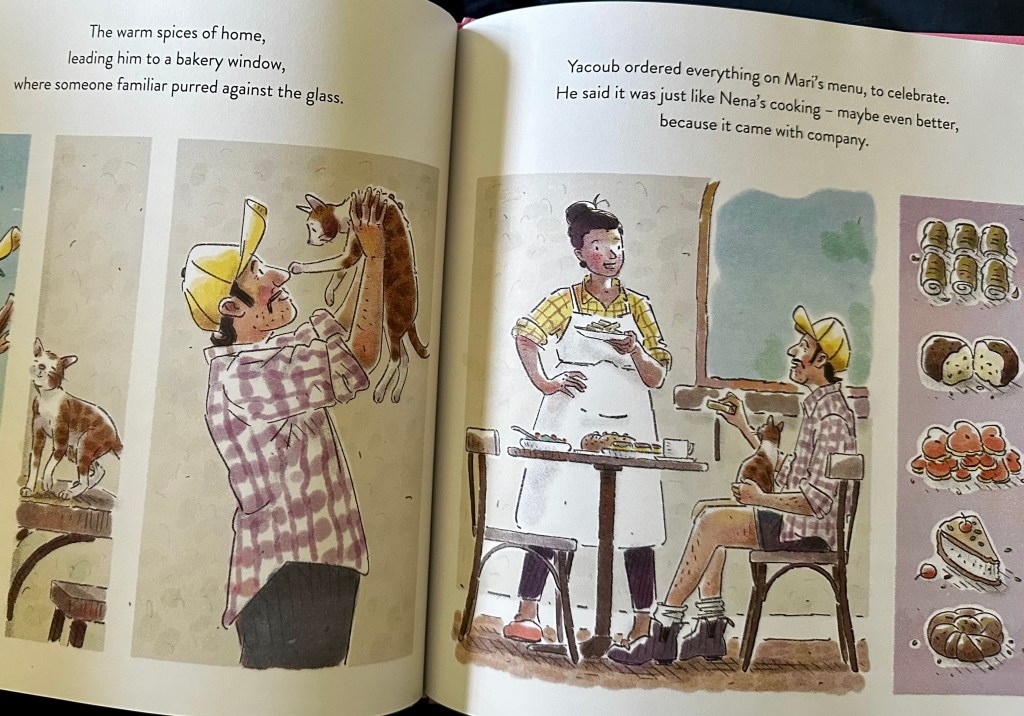
DS I’m thinking mainly about the spread where Yacoub finds Mari’s bakery (and Tinka). In the same way that Yacoub and Mari’s origins aren’t specified, I didn’t want to be too specific with the types of food that I illustrated from Mari’s menu – rather I wanted to hint at food (particularly pastries and cakes) that might come from outside of Australia – with dash of exotic and a pinch of rustic.
How have you stirred and engaged the readers’ senses in your book?
DF Food is a big one. There’s a lot of it in this book – from the produce carried in Yacoub’s truck, to the fish head and yogurt and of course the spread of baked goods at Mari’s bakery, and Yacoub’s memories of cooking with his nena (and its parallel in the final illustration showing Yacoub and Mari’s child stirring the bowl.) So taste is a strong sense throughout – but so is smell, because it’s the smell of warm spices from the bakery that leads Yacoub back to Tinka, and to Mari.
Deborah, which of Danny’s illustrations best captures the essence of your character/s or an emotion you are also creating?
I adore the spread of the truck, Yacoub and Tinka taking a break under the Milky Way. Danny’s use of colour and composition is so clever here – as soon as you turn the page, you feel the shift in mood – it’s dreamy and spacious. We see how Yacoub and Tinka are so alike, both full of memories and hope. We see their loneliness in the big world (even the universe), but also see the power of their togetherness. It’s the perfect set up for the next few spreads when that togetherness comes under threat!

Danny, I love how you’ve created a visual running narrative and interspersed this with important scenes and character development in panels. Could you tell us something about how you’ve composed or structured your illustrations?
DS I’ve always loved (and still do) comics and graphic novels. Their narrative is very visual and filmic, and this is achieved through the use of panels – where the story is divided into illustrated boxes that can be ‘read’ visually. In a number of spreads in The Truck Cat I’ve used this approach, but it evolved gradually while I was working on the roughs. I love Deb’s writing – it’s often quite sparse. Some of my favourite lines are – “Here. There. Over. Under. Here there over under herethereover BEEEEEEEEP! Under!” It’s like a piece of avant-garde poetry. But it’s what’s not said that makes it powerful. And this also gives me an opportunity to contribute some additional layers to the narrative. From those few repeated words we know that Tinka has strayed far from Yacoub while chasing the butterfly, even though it hasn’t been explicitly stated. This is where I felt a series of panels would work well to complement the text and help to build some tension. And the panels are in groups of 4 to mirror the repeated 4 words and hopefully add to the rhythm.

Danny, how would you describe your illustrative style in this book? Why have you used this style?
That’s always a tricky question to answer. I didn’t set out with a particular style in mind. I usually try and draw in a way that comes naturally to me. I draw with a tablet using Photoshop, but try hard to make it not look like I’ve used a computer. I found a digital brush that has quite a soft edge to it, which I’ve used quite extensively in the book. The story is quite soft and tender and I wanted to try and convey some of that through my technique.
Danny, please describe your colour palette and explain why you’ve chosen some of these colours.
I’ve always found the use of colour challenging. I’m not a ‘bright colour’ type of person. But children’s books are so visual and colour plays a very important role. Over the years I’ve built up a palette of colours that I like and that I know will reproduce well when printed – so I tend to stick with those colours. As I’ve got older, I’ve found that I really enjoy using pink, or variations of pink. I made Yacoub’s shirt pink as a way of softening his ‘truckie’ character. This then guided a lot of the colour combinations internally as well as the pink sunset (or early dawn) on the cover.
Danny, what most pleases you about your endpapers in this book?
I love endpapers. But getting them right can be tricky. I tried a number of different ideas, but none quite worked. Then one of the editors at Hardie Grant suggested I look at using the endpapers to introduce and extend the story. I had another play with some ideas and eventually landed on what you see in the book. I like their narrative quality, as well as their simplicity – just simple line work and only one colour used.
What responses to the book about The Truck Cat have you appreciated?
DF So many people have told me it’s made them cry – not that crying was ever the goal, but it’s wonderful to hear that this book has emotionally struck a chord. And what I’ve really loved hearing is that the book has allowed parents and grandparents to talk to kids about their own family stories of immigration. I love that it offers the beginning of a conversation.
DS I love that children’s books in general have the ability to evoke such a strong emotional response. On the surface they’re such a simple art form, but with so much below the surface to discover – and kids respond and pick up on all of those layers.
What do you believe is your finest achievement in this book?
DF Oh gosh, this is tricky. Perhaps the fact that The Truck Cat tells a very common story – because 7.5 million Australians have immigrated from somewhere else – but makes it feel extraordinary. It’s all about the epic achievement of making a life somewhere new, and that’s something I haven’t seen celebrated in many picture books.
What are you working on now or next?
DF We have another picture book coming up together, also with Hardie Grant … and there’s a vehicle involved in that one too! Though I don’t think we can say anything else yet!?
DS I’m really looking forward to illustrating that one, Deb. It gave me tingles when I first read it.
What have you both enjoyed reading recently?
DF I’ve recently been inhaling verse novels (after enrolling myself in a course with the wonderful Karen Comer), and I keep coming back to Zana Fraillon’s The Way of Dog – it’s just so, so good.
DS I’ve just finished reading Tim Winton’s Juice, which was epic in every sense. And for children’s books, I recently found a second-hand copy of Alice in Wonderland, with beautiful illustrations by Lisbeth Zwerger – so I’ve spent a lot of time ‘looking’ at that book.
How would you like readers to contact you?
Either via my website contact form (www.deborahfrenkel.com) or on Instagram (@debdoeswords)
The same – via my website www.dannysnell.com or insta – @dannydsnell
The Truck Cat at Hardie Grant Children’s Publishing
The Truck Cat at 2025 National Simultaneous Storytime

 paperbarkwords.blog
4 thoughts on “The Truck Cat by Deborah Frenkel, illustrated by Danny Snell”