
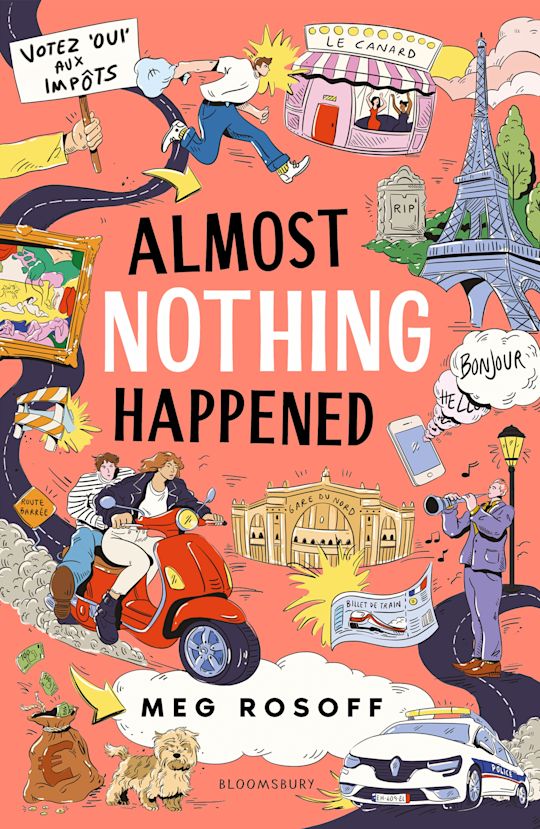
Meg Rosoff and Almost Nothing Happened
Published by Bloomsbury
Author interview with Meg Rosoff
‘Eurostar was showing a twenty-minute delay, which was perfect because if I didn’t get something to eat before I boarded the train I’d have to eat my own liver.
I joined the queue for a sandwich with my mate, Moe, and texted home that we were running late. They were picking me up at St Pancras …’ (Almost Nothing Happened by Meg Rosoff)

Meg Rosoff is a writer of legendary status. She became a cult figure on the publication of her first YA novel How I Live Now in 2004. I think that this work stood out from the books around at the time (and since) because Meg’s storytelling and voice were so original (but also easy to digest) and her plotting was so lateral and audacious. How I Live Now also went on to win practically every major YA literary award around and became a movie.
The closest Australian YA novel to How I Live Now that I have read is Davina Bell’s The End of the World is Bigger Than Love.

I’ve read and enjoyed those of Meg’s books I’ve been able to get my hands on (many of which have also won prestigious awards) and always think of her memorable second novel Just in Case and its protagonist Justin Case whenever I hear the expression ‘just in case’.
And I have the happy memory of lunching with her (and an indie bookstore colleague) in Brisbane in 2007 to talk about her third novel What I Was, other books and life ...
I recently read Meg’s 2024 novel Almost Nothing Happened in one night. It was typically addictive, outrageous and out-there – albeit with a tender soul.
********
Almost Nothing Happened by Meg Rosoff
Thank you for speaking with Joy in Books at PaperbarkWords, Meg.
I’m intrigued by your title, Almost Nothing Happened. Each word is important and can have its own focus and weight. If you had to highlight one, which word do you think is most pivotal, and why?
I guess ‘almost’ is the key word – a book called Nothing Happened would be possible, but probably not very interesting! I’ve been accused many times of not having enough plot in my books, but I don’t think anyone could say that about this one. Also, ‘almost’ is a great word. I “almost” didn’t fall in love. I “almost” didn’t apply for that job. I “almost” didn’t get on that flight. It suggests a near miss – and already puts the reader into a state of dramatic tension.
In an impulse decision, your protagonist Callum doesn’t catch the Eurostar back to London from Paris. What do you think is his best personality trait? How would you like him to ‘pull up his socks’?
Callum is impulsive but very afraid of embarrassment, like so many of us. I’m no longer afraid of embarrassment or speaking out (my husband says I’d be the first person shot in a revolution) but when I was Callum’s age, I was terrified of doing the wrong thing or being the wrong person. It took lots of world experience (and therapy) to realise that just because people say you should tone yourself down, be quieter or more “normal” — doesn’t mean you should.
The only way I’d like Callum to get more together is to have more confidence, to realise that he might be able to make mistakes without them being catastrophic. To speak French with all his errors, to like a woman he has a crush on, to go on a crazy adventure. He’s starting on that journey here, but it will continue throughout his life.
Callum seems to attract chaos. He imagines the worst, second-guesses and elevates the drama of situations.
How does he reflect young people today?
Callum’s early experience on his exchange is very much based on my experience in France when I was 15. Kids are more anxious and fearful now, they’re helicopter parented and trained at school to jump through hoops and always get the right answers. We were mostly neglected (in the best sense of the word) because no one had the time or the inclination to keep track of us.
All the expectations put on kids today is incredibly damaging, and I tried to be the sort of parent who said “Go out and play in traffic. Just try not to get hit by a car.” Which taught my daughter a valuable lesson about a. not necessarily listening to her parents and b. dodging moving objects.
As for the anxiety about how much space you’re “allowed” to occupy in the world, whether people will like you, if you’re smart enough, attractive enough, good enough – those things are universals and I think apply to every generation.
How does being set in a Paris heatwave enhance the atmosphere and high jinks?
Anyone in the world who isn’t worried about climate change at the moment isn’t paying attention. Heat waves, droughts, floods and fires — climate catastrophes, basically – are becoming more and more frequent in the world. We all have to pay attention to climate degradation and the effect it has on the quality of our lives, the economy, immigration, etc. I set the book in a catastrophic heat wave but I tried to say that even in the midst of a crisis life goes on and people still make jokes.
‘For an instant I hesitated, and the world seemed to hesitate with me. All summer I’d failed to put myself on the line, to risk speaking French, failed to join in, make friends – and now I faced robbery, abduction, a strange girl, a man whose motives I didn’t understand, a purloined oboe – all spread at my feet like the detritus of a car crash.’ (Almost Nothing Happened by Meg Rosoff)
From the start of the book you immediately put Callum into an unexpected scenario because although he hasn’t enjoyed his time as an exchange student in France he doesn’t take the train home and stays in Paris for longer. What is an episode or incident that follows that you really enjoyed writing?
I loved learning about and writing about the oboe. I chose the instrument at random based on how funny the word “oboe” sounds, but I know a few classical musicians and they’re the most extraordinarily hard working, talented people. Oboe players have a reputation for being the most miserable members of orchestras, because their instruments are so difficult to play and keep in tune – so having an oboe player for a character was a real gift.
Most writers will throw things into their books and then see where they end up. Sometimes you have to take them out again. But sometimes your brain makes suggestions and you just have to shrug and think, “Ok. An oboe player. Why not?”
One character says about those who aren’t beautiful, ‘The rest of us have to work at life.’ What is one way that Callum accepts who he is or changes?
Callum takes a huge risk by walking away from the train. He has no money, almost no contacts, no safety net. But by taking risks and following where they lead, his life is immeasurably improved. Who wants to have “S/he never did anything risky” written on their gravestone?
Why have you incorporated both music and art thefts into your plot? Why a Matisse and not another artist’s work or something else priceless?
I believe unashamedly in the redemptive power of art. Looking at art, listening to music, playing music, painting, reading, writing – whatever – are all things that can help you understand yourself and understand the world better. I would say ESPECIALLY reading, but then I’m a writer. But getting inside someone else’s story is the best way in the world to build compassion and understanding.
A writer’s job is to think about the world, and to pass that thinking on to the reader. Most people’s jobs are to make the boss like them and get a raise.
If you want to see what a person who has never read a novel looks like, look at Donald Trump.
I chose a Matisse painting because even someone who knows nothing at all about art can look at one of his colourful, energetic paintings and feel pure joy.
Harrison, whose oboe was stolen, describes what happens in the aftermath as a ‘screwball comedy’. Meg, you really have a gift for writing humour and even include actual funny jokes. With which piece of humour in the novel are you particularly pleased?
I think I’m quite a funny person (are you supposed to say that about yourself?) and I answer most grim situations with humour. I prefer funerals to weddings. When nice things happen, I wonder “How long will this last?” It comes from an acceptance that the world can be a really scary horrible place, but we’re here and have to make the best of it!
Humour-wise, I love the mad oboe plot. I kind of grabbed the oboe at random at the beginning of the book, having no idea where it was going to end up, but miraculously, the plot worked out. And when Callum and Lilou figure out what’s happened, it made me laugh, so I figured it might make other people laugh too.
Over your career, apart from Daisy, Edmond and the others in How I LIve Now, which of your characters (or character) do you think are most distinctive or resonate most with your readers? Why?
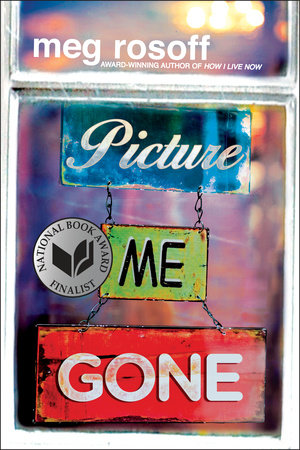
Oh god. Choosing a favourite character is like choosing your favourite child. Impossible to do. I feel protective of almost all of them. (Bob, in There is No Dog, might be an exception, but even he has a few redeeming characteristics.) I’d be torn between Mila in Picture Me Gone because she sees things no one else notices, a bit like Sherlock, and the unnamed Narrator in The Great Godden just because that was such a challenging mysterious character to write. I was never sure if I could pull it off, but in the end I think I did.
Sincere thanks to Meg for taking the time to share her personal and literary insights into Almost Nothing Happened. This YA novel is definitely one to read and think about while laughing along the way.

 paperbarkwords.blog
I really enjoyed this interview. I haven’t read any Meg Rosoff, but I absolutely love Davina Bell’s ‘The End of the World is Bigger Than Love’ so I’ll definitely read a Meg Rosoff now.
>
LikeLiked by 1 person
Thanks for such wonderful feedback, Judy. So glad you’ll discover Meg’s books now.
LikeLike