
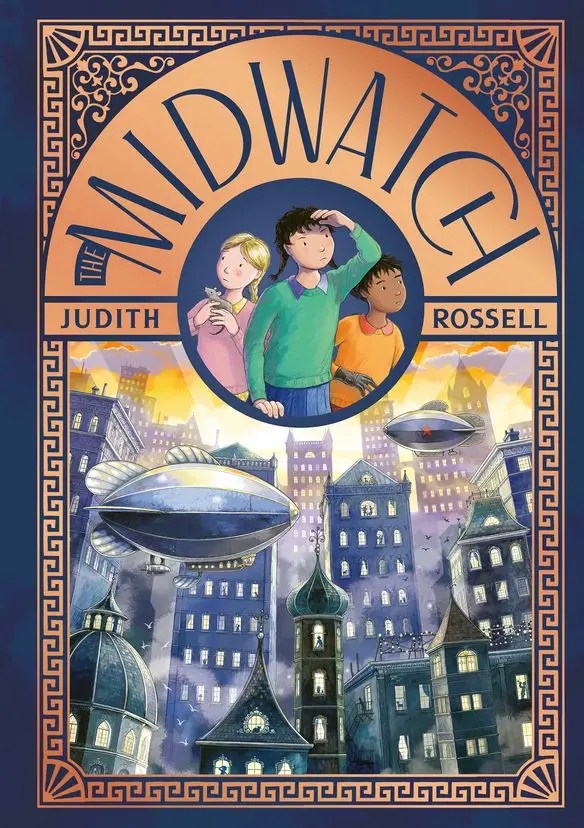
The Midwatch
by Judith Rossell
Hardie Grant Children’s Publishing
Author Interview with Judith Rossell
about The Midwatch
‘Miss Mandelay says we should all learn as many useful things as we possibly can,’ said Harriet, ‘so we’re ready.’
‘Holy mackerel. Ready for what?’ asked Maggie.
Harriet took a bite and said with her mouth full, ‘Ready to solve mysteries and do good deeds and fight bad guys.’ She saw their surprised faces. ‘Didn’t she tell you? This is what we do. We help to keep the city safe. Girls, we’re absolutely the snake’s pyjamas.’ (The Midwatch by Judith Rossell)
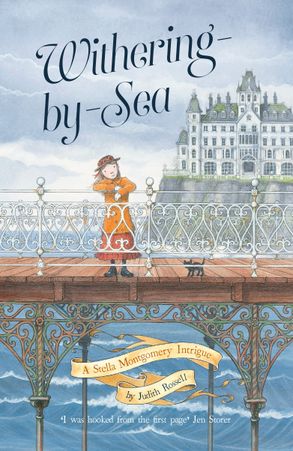
Judith Rossell’s sumptuous middle-fiction novel, The Midwatch evokes the gothic feel of her Stella Montgomery series as well as Karen Foxlee’s A Most Magical Girl and Ophelia and the Marvellous Boy.
Other high quality, companion books are The Museum of Mary Child and other novels by Cassandra Golds; The 113th Assistant Librarian by Stuart Wilson, the Nevermoor series by Jessica Townsend, The Grandest Bookshop in the World trilogy by Amelia Mellor, and some of Allison Rushby ‘s books. Australians are writing in this space incredibly well and The Midwatch could also be recommended for readers of Harry Potter.
The tale opens with orphan Maggie (Magdalena) Fishbone being left at the (deceptively) dire-looking Midwatch Institute for Orphans, Runaways and Unwanted Girls alongside two other new girls, Nell Wozniak (and her pet rat Spike) and Sofie Zarescu (from the circus). The girls are supposed to be tamed but in a glorious turn-around, signalled first to the newcomers by explosive organ playing and fireworks, they are instead valued and trained in useful things like car mechanics, languages, morse code and spycraft. There’s lots of fun to be had in their pretence to be browbeaten when under the scrutiny of outsiders.
Their new friend Harriet explains that they need to be ‘Ready to solve mysteries and do good deeds and fight bad guys … This is what we do. We help to keep the city safe.’
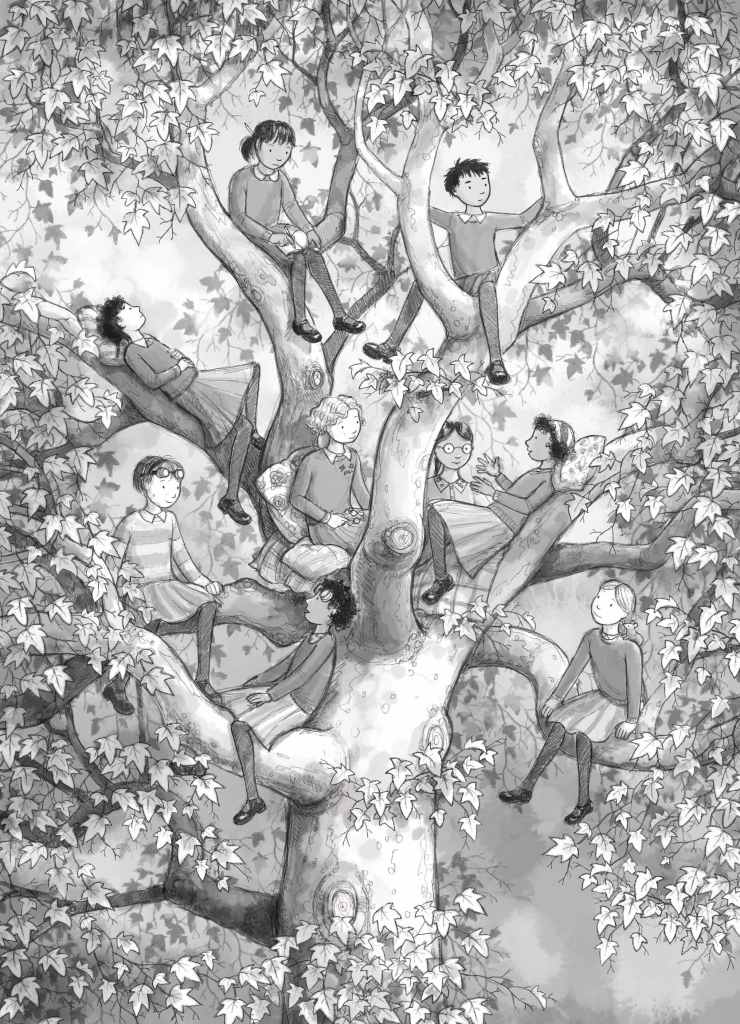
The Midwatch by Judith Rossell
Thank you for speaking with Joy in Books at PaperbarkWords, Judith.
How is The Midwatch similar or different to your awarded Stella Montgomery series?
The Stella Montgomery series was, very Victorian, very English. The Midwatch is set around 40 years later, in an alternative version of America. I think it’s more light-hearted, more of a lively adventure. I was trying to capture some of the optimism of the 1920s. I think poor Stella is so often alone, a bit downtrodden, and dealing with dark and dreadful things. I wanted Maggie to have a more up-beat story where a team of girls solve crime together.
What genre is The Midwatch? When is it set?
It’s a middle-grade adventure story, and it’s set in an alternative version of the 1920s.
I am intrigued by the name of the institute and title as ‘The Midwatch’, but don’t think I’ve grappled with the richness of its full meaning or connotation. Could you tell us more about what ‘Midwatch’ means to you?
The midwatch is the night watch on a ship, traditionally from midnight until 4am. I wanted a name for the Institute that shows the girls are ready for action, looking out for danger, and prepared to keep the city safe. But – obviously – I couldn’t call it something like “The Secret-Danger-Fighting Institute” because the girls are also undercover, and appearing to the outside world to be downtrodden orphans. It took ages to find good name, but Midwatch seemed perfect, giving the impression of being alert and ready, but not giving away any secret activity.
Could you describe your main character in either a couple of words or sentences?
Maggie Fishbone comes from an orphanage in a fishing town. She’s in disgrace for pushing a bigger boy into the harbour, and the nuns have sent her away to the city. At the start of the story, she’s feeling grumpy and rejected, and she’s sure she will never be any good at anything. But by the end, she’s made a bunch of friends, and learned that she is great at decision making and she’s determined and brave.
Which of the girls’ lessons would you like to join? Why?
I think lessons that are practical are always more entertaining, so I’d like to join the Contriving lesson, where the girls make things like traps and tripwires out of wires and toys and springs and bits of wood. I think that would be a fun class. Currently, I’m also learning German, so it would be good for me to join the German class too. I’m not much good at all, (the grammar! Arrgh!) and I need the practice.
Could you whet appetites by giving a hook into your mysterious plot?
When Maggie arrives at the Midwatch Institute for Orphans, Runaways and Unwanted Girls, she is surprised to find it is secretly a crime-fighting organisation. A monster is stalking the city at night, expensive jewels are going missing, a botanist is kidnapped and a librarian is attacked with a soup tureen. Soon Maggie is thrust into an adventure that takes her deep underground, high about the clouds and face to face with danger itself.
You do a great job of giving girls agency as part of the riveting story. Supported by strong women, they are curious, clever, indomitable, plucky, industrious girls who work together.
Could you give an example of their agency?
I think it’s sometimes difficult as writers to put our child characters into danger, because, as adults, we naturally try to protect children. When I take my nephews out into the city, I spend all my time actively preventing them from having dangerous adventures. As a kid, I was a girl guide, and we learned semaphore and bandaging and all kinds of things like that. We heard stories about girls who rescued babies from bandits, or from runaway horses, and I was ready to be the brave girl who steps into danger and saves the day! But, despite all the skills we were learning, the advice was always “call an adult” which I found deeply unsatisfying. So it was very rewarding to send the brave girls of the Midwatch out into the city through secret tunnels, and see them hurling themselves headfirst into exciting and dangerous adventures.
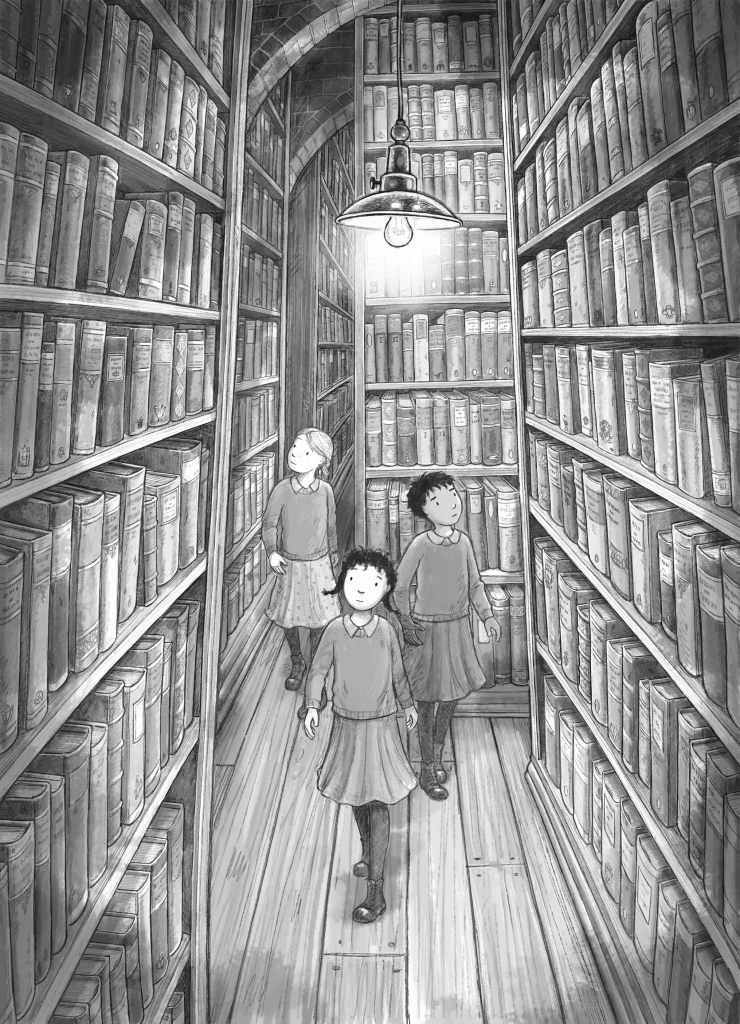
I love the cupboard and the hole in the book. Could you tell us something about one of these.
I loved the idea of something sparkly and precious hidden inside a dusty old book in the library. I wrote that scene mainly because I loved the image so much. It took me ages to figure out what the dragonfly brooch was doing inside the book, and who could have put it there. But what a great metaphor for reading – sparkly precious things are sometimes hidden inside books!
How have you incorporated humour in the book?
I had a lot of fun writing the excerpts from Miss Mandelay’s book ‘Useful Things Every Girl Should Know.’ I think they’re funny, mainly because Miss Mandelay’s ideas of what girls should know are so idiosyncratic and unexpected.
Could you tell us a little about how you craft your extraordinary illustrations?
I drew the pictures for the book using Procreate on the Ipad. I’ve been using it for the last few years, and find it very helpful, mainly because it is so easy to experiment and to make changes.
The cakes offered to the new girls are spectacular. Which one would you choose?
I’d find it difficult to choose! I do love a gorgeous little cake. But how could you pick? I’d have to eat several, I guess.
If you have a favourite illustration, could you tell us which and why?
My favourite is probably the double page picture on pp 60-61. This is the first double page illustration I did for the book, it’s Maggie’s first view of the city in daylight, and I think it shows the setting and mood of the story really well. I’m very happy with it.
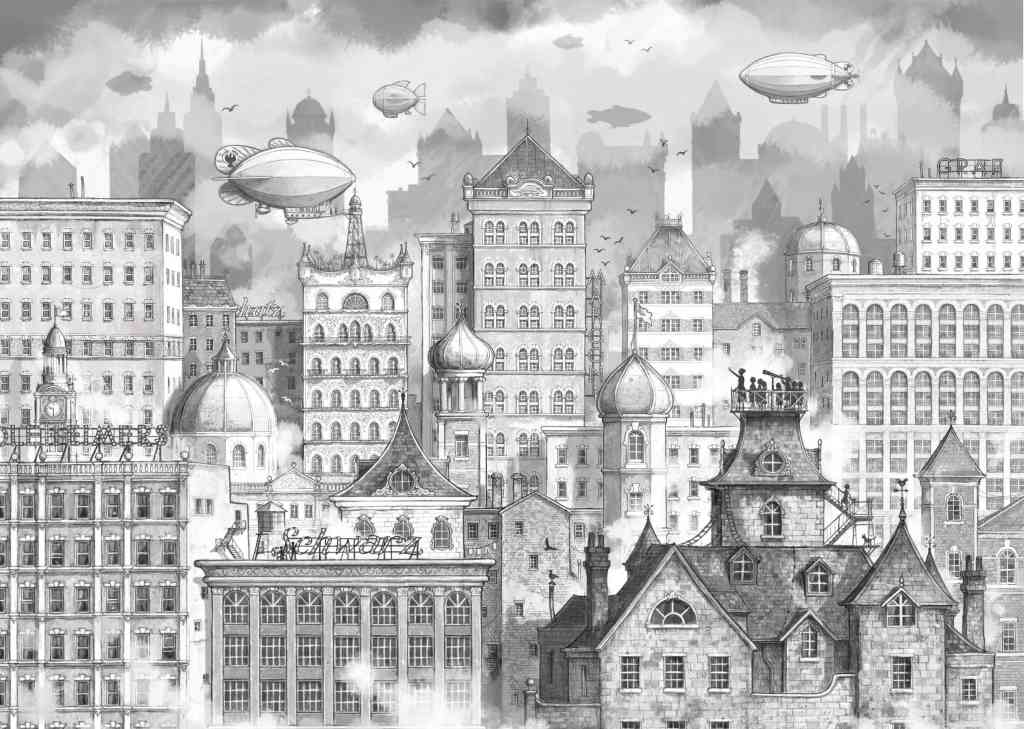
The production of the book is impeccable. One feature is the blue type, and this colour is also used for the illustrations. Please tell us more about this.
I was so lucky to work with a brilliant team on this book, the publisher, Chren Byng, the editor, Luna Soo and the designer, Pooja Desai. They all worked so hard to make the story better, and to get all the pictures and the text working together. (Thank you, clever people!). The decision to print the book in a dark, inky blue was made by these amazing people, and I think it looks really great.
You use the perfect amount of metaphorical language to create some very apt descriptions. Could you give an example or two?
One thing I did try to do in the story was to use language and comparisons that Maggie would think of. Because she comes from a fishing town, she often compared things in the city to fish, or to the sea, so when she’s standing on the lookout at the top of the institute, looking down at the city, she sees “people rushing along the sidewalks like shoals of fish” and when she sees an airship for the first time, it’s “as big as a whale”. I don’t expect people to notice this particularly, but I think it helps us see the story through Maggie’s eyes.
Without giving anything away, how have you used foreshadowing?
The story is set in an alternative version of the 1920s. At that time, real life, there were a few large, famous airships, mainly doing long flights across the Atlantic, but in The Midwatch there are heaps of airships, of all sizes, flying all around the city. I wanted to show these airships early on in the story, so Maggie sees an (ominous!) airship in the first chapter, and when she arrives at the school, two of the other girls are flying a model airship around. This is so that the readers will accept there are airships about, and maybe figure out where the fancy soup tureen that (apparently!) fell from the sky several chapters later might have come from.
What have you enjoyed reading recently?
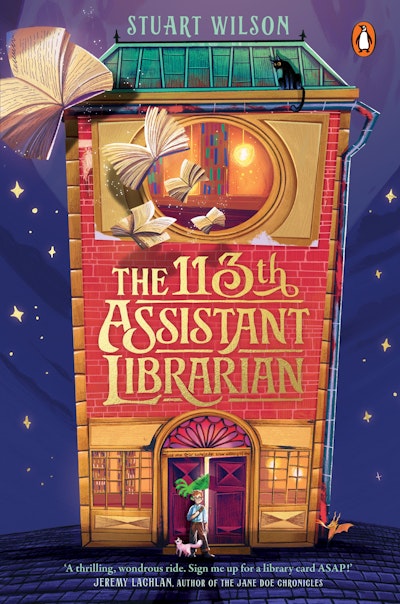
I’ve just finished The 113th Assistant Librarian by Stuart Wilson (heaps of fun, so imaginative and unexpected) and also All The Beautiful Things by Katrina Nannestad (brilliant, like all her books, thought-provoking, very moving) and now I’m slogging my way through East of Eden by John Steinbeck, but I’m not sure I’ll get to the end before it’s due back at the library, and I’m only half way through. Very epic.
How should people contact you?
My website is www.judithrossell.com
and I’m on Instagram as juderossell
The Midwatch is an ideal gift with its fine illustrations and production. As well as being a stunning artefact, it is a story masterfully told and has great application for use in schools. Hopefully a sequel is on the way.

 paperbarkwords.blog