
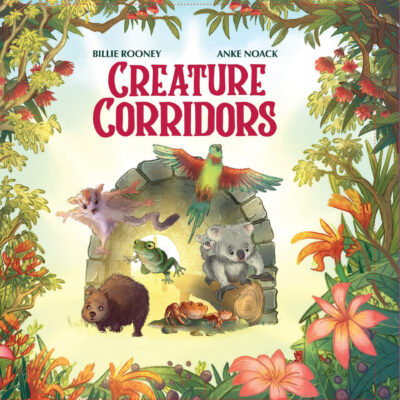
Creature Corridors
Written by Billie Rooney
illustrated by Anke Noack
Publisher: CSIRO Publishing
Author Billie Rooney and illustrator Anke Noack write about Creature Corridors, their important non-fiction picture book for young children for Joy in Books at PaperbarkWords blog
Author Billie Rooney writes about Creature Corridors
I grew up on a small farm in regional NSW, in country scattered with wheat farms. Occasional rows of trees were left as wind breaks, and these gave the birds and native animals a way to travel through the sparse countryside. We planted our own row of trees and shrubs along an old gully. I remember riding around on the back of a truck with a big water tank, and how we would fill up buckets and carry them from tree to tree. It was hot work. It was also what the new plants needed to survive.
Years later, I’m still thinking about the relationship between people, land, water, trees and all the other creatures who live in this world. I think about how the choices we make as humans have an impact on other species of animals, birds and plants. Yes, we still have to grow crops and build houses and roads, but it seems important to find ways to do this that leaves room for other creatures to thrive too.
As I started to think about writing a book that featured native animals, I realised that the story I wanted to write could not just be about wildlife – it would need to include humans as well. The fact that we all inhabit the same shared world, provided the opening idea for my book.
In a world we share with many creatures, some move by day, others by night. Some travel far and wide and others stay closer to home.
As Australian animals move around spaces that are increasingly occupied by humans, it is more important than ever that we make sure there are wildlife corridors; those pathways, flight ways and waterways that animals need to move around safely. Creature Corridors is a book about all different types of wildlife corridors. I wanted to show that these corridors can be both natural and human-made. They can look like saving or restoring natural habitats, or like building new structures such as tunnels or bridges. What they all have in common is that they provide a safe way for animals to get around. They connect places and habitats rather than dividing them.
When I first came up with the idea for this book, it was written around a single animal character (a bandicoot) and a young child living together in the suburbs of a big city. But somehow, I couldn’t get this version to work because it didn’t capture the full variety of wildlife corridors. It was only after attending a non-fiction professional development day with my local SCBWI group, that I brainstormed a new structure that allowed me to incorporate many different creatures and types of corridors. Although there is no bandicoot in Creature Corridors, for me, this curious little creature will always be part of how the book came to life.
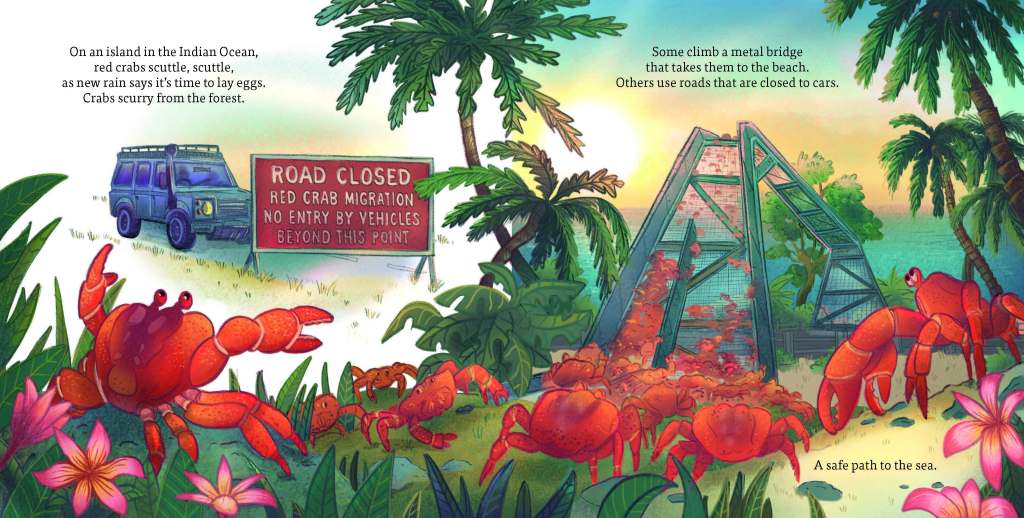
The first thing you notice about the book, is Anke Noack’s amazing illustrations. I adore the vibrancy and liveliness which comes through as soon as you see the front cover. The animals have so much personality, and I’ve noticed how the children really respond to this. What they love most of all is to choose their favourite animal. I think mine is the Christmas Island crab, perhaps because this is the one creature in the book I have never seen in real life. I can only imagine how amazing it must be to see all those thousands of crabs scrabbling to the sea at migration time!
My favourite illustration is the final spread, as Anke has really captured the sense of hope and joy that comes with seeing children and animals sharing the world together.
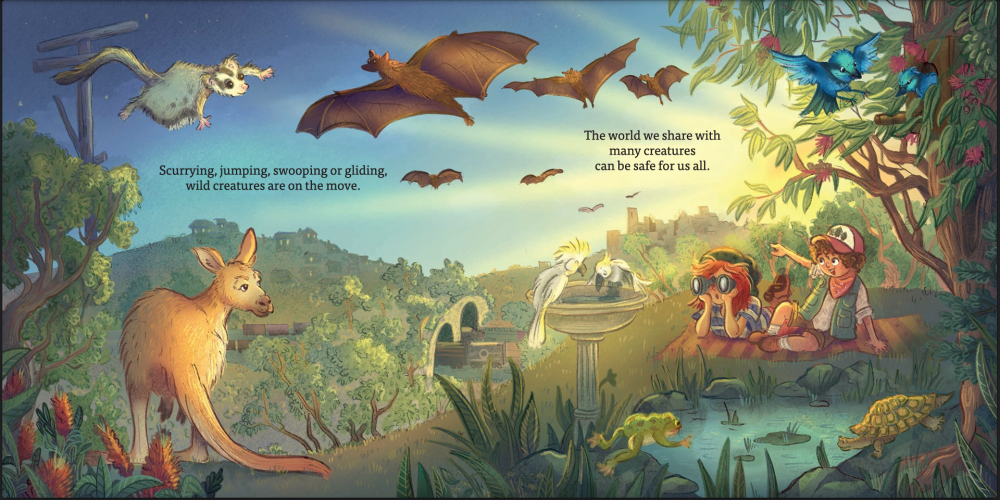
It was hard to write a book about wildlife corridors without thinking about the animals who don’t make it to safety or whose habitats don’t get saved or revived. However, I really wanted to take a hopeful angle. So, as I wrote Creature Corridors, I focused on all the ways that wildlife corridors can make a difference. Each tree or bush we plant, each innovation we come up with, can help to join the dots across the landscape and become part of something much bigger.
One interesting thing I learned while researching for the book, is how new technology is being used to keep animals safe. Trials of digital warning systems for kangaroos and other animals are being installed along roads. These send out a beep when a car is coming and warn the animal not to cross. I wrote about this and other details in the back matter for the book. CSIRO Publishing has done an amazing job with the production and design of the book, and the back matter and glossary provide extra material that allows older readers to go a bit deeper.
Since I watered those eucalypt trees in my childhood, the intrigue of wildlife corridors has stayed with me. I like to think of them as secret paths where animals and other creatures can get on and live their lives, weaving and winding through the same country where we live. Creature Corridors is my wish for a shared world where we look beyond our human needs to remember that other creatures live here too.
Illustrator Anke Noack writes about Creature Corridors
I grew up in Germany during the eighties. When I wasn’t scribbling and sketching all sorts of never-ending adventures in my school notebooks, I’d explore the forest down the street with my neighbourhood friends, just returning home for dinner.
My parents were book lovers and encouraged me to explore and travel. One of my earliest memories is the visits to the local library bus and carrying home bags full of books.
After graduating with a Master’s in Architecture from the University in Berlin, I moved to London.
I kept traveling with a backpack throughout Europe, spending months in Middle and South America, discovering the beauty of African wildlife, and finally finding my new home in Australia after receiving a scholarship at RMIT where I met my partner Stuart.
After living all my adult life in big cities like Berlin, London, and Melbourne, I discovered the Victorian countryside, where our Australian part of the family lives.
My partner grew up on a huge property in Mt Macedon with dams, forests, and wild blackberries…and that’s where our three children and I discovered proper country life with koalas, kangaroos (and snakes) in small cottages amongst the bush.
When our lovely publisher at CSIRO, Briana Melideo, approached me with the manuscript for ‘Creature Corridors,’ I immediately started brainstorming ideas and sketching different scenarios.
I loved Billie’s writing – the rhythm, the poetic language, and the positive, beautiful message of her story. As a visual storyteller, I saw the potential of bringing a non-fiction subject to life in an engaging and enthralling way by using my illustration toolkit: perspective, colour, composition, and pacing.
After spending a lot of time researching the different animals, their habitats, the flora, and of course, the impact of humans on the Australian wildlife’s habitat and the different wildlife corridors, I was ready to bring Billie’s story to life!
Some of the creature crossings are rather subtle and not that eye-catching, while others like the Christmas Island Bridge are quite dramatic. But all of them are incredibly creative, and I found the ingenuity in solving those creature crossings really inspiring.
After I’ve filled my creative tank with as much knowledge and inspiration as possible, I moved on to the storyboard phase.
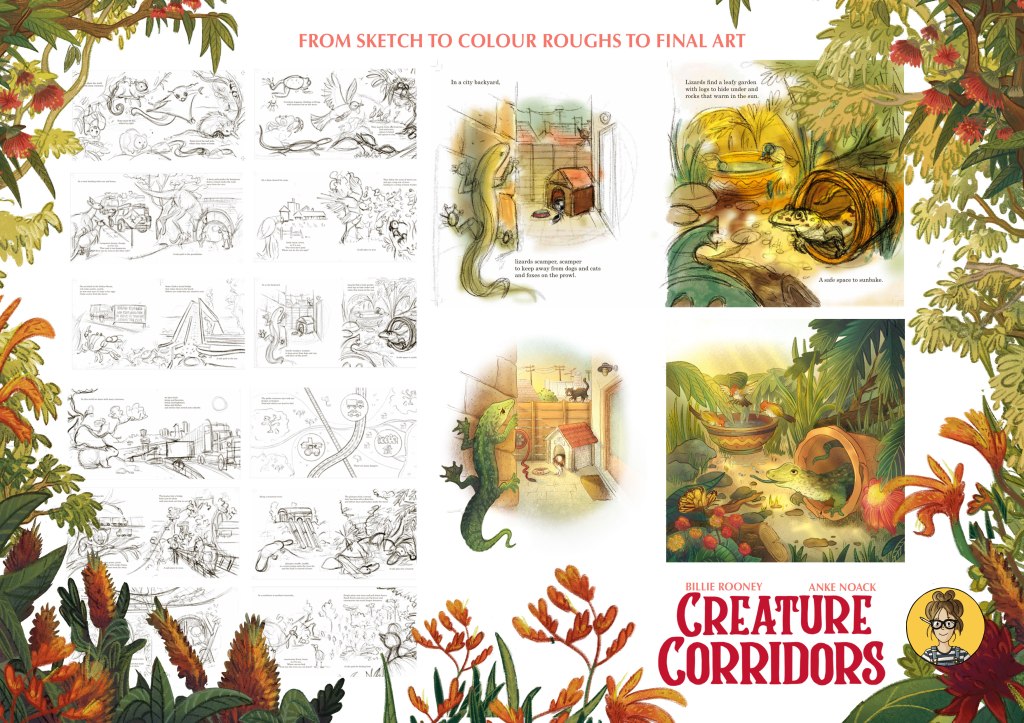
This is where the whole book comes together in terms of composition, pacing, and the overall story arc.
I made a little paper booklet of the sketched pages, and flipping through my black-and-white ‘dummy book’ allowed me to get a good idea of how the final book would work.
A picture book is, in some aspects, like a movie; the page turns are like scene cuts, and you want to make sure that the flow of the story is perfect.
Once the publisher and Billie approved the first stage of the illustrations, I started working on the colour script. This is a rough version of the book that still looks a bit sketchy, but this time with all the different colours in place and an indication of the lighting of the scenes.
Creature Corridors reflects the beautiful, sun-drenched earthy colours of the bush as well as the vibrant, lush colours of the more tropical environments up north. Colour and light are really important in conveying not just the characteristics of the environment but also for subtle storytelling and creating an underlying mood and feeling. I really wanted the readers to be drawn into the story, the habitats, and see the environments through the animal characters’ eyes.
Another flip book later, I was focusing on the final art that you can now see in Billie’s beautiful picture book ‘Creature Corridors’.
Interestingly enough, the finished illustrations are quite close to the first sketches and colour roughs and show how important a clear concept and previsualization are to convey a strong message.
It was an absolute joy to bring Billie’s beautiful manuscript to life and open this important topic about wildlife preservation and how we interact with our environment to the next generation in an approachable, warm, positive, and hopefully exciting and engaging way.

 paperbarkwords.blog