
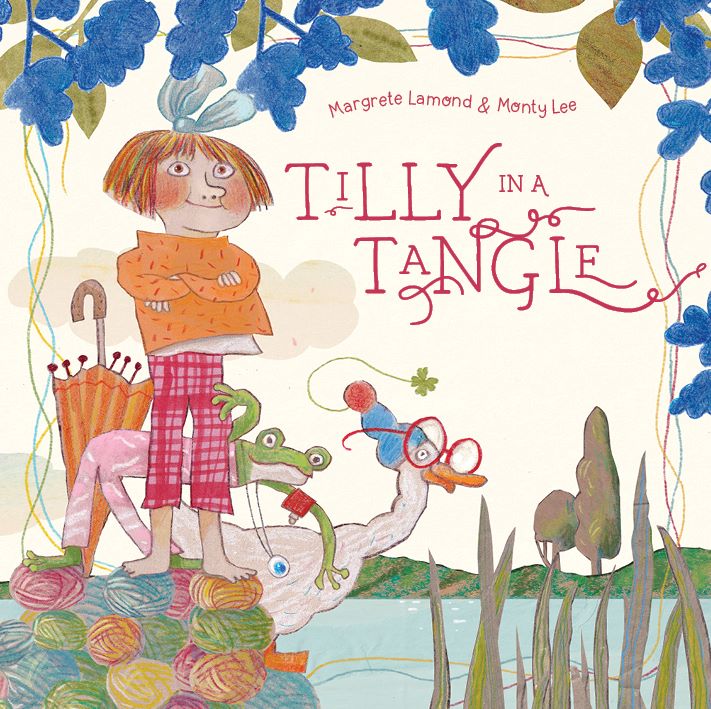
Tilly in a Tangle
by Margrete Lamond illustrated by Monty Lee
Dirt Lane Press, WestWords
‘Tilly’s boat tumbles and jumbles. It muddles and mangles.
Before long, Tilly is tangled inside, all the way to who-knows-where. (Tilly in a Tangle)
Tilly in a Tangle by Margrete Lamond, illustrated by Monty Lee is a 2025 CBCA Notable Picture Book.
Tilly in a Tangle is a picture book to pore over. Children will ponder and wonder. It’s action-packed and reflective, surprising and comforting, unique, intriguing and conceptually exciting.
Author Margrete Lamond and illustrator Monty Lee write about Tilly in a Tangle for Joy in Books at PaperbarkWords blog
Congratulations on your outstanding book and its CBCA Notable award, Margrete and Monty, and thank you for speaking to Joy in Books at Paperbark Words blog.
How does your title Tilly in a Tangle invite your readers into the tale?
Margrete: This is a good question, and I guess something a reader might also be able to help us with! I just like playing with alliteration, and I wanted to include both the name of the character and allude to her problem somehow, in a few simple words.
Please introduce Tilly in three words (or 3 sentences).
Monty: Optimistic, cheerful and sassy.
Margrete: Monty has suggested sassy, and I’d like to add that she’s also a little recalcitrant and original. While writing, I thought of her as eager to please her fussy friends at the same time as rather wishing she could break free of them.
What is unexpected about her boat and journey?
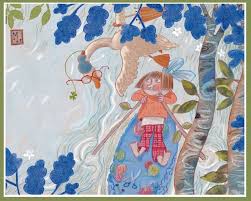
Margrete: my very first thoughts about Tilly and her boat was that it was a knitted boat. It kind of popped into my head. The original text mentioned more about her knitting the boat back together, but once Monty’s illustrations showed the knitting it wasn’t necessary to stress this in the text, and some of it was edited out. A knitted boat is unexpected, and the fact that it stayed afloat for the whole journey despite turning into such a tangle is unexpected too.
Monty: The boat is made out of wool which Tilly can fix by knotting or knitting as she goes. Even whilst the going gets rough in the wild waters, the boat doesn’t fall apart (it just changes shape) during the journey, which in itself is obviously quite unusual. But to me the boat and its journey represent the relationship between the friends. Small arguments can be easily fixed but sometimes things can get tangled up in relationships but with compromise and letting go of too many personal emotions like anxiety or anger, everything will be alright. The boat doesn’t fall apart and neither does their friendship.
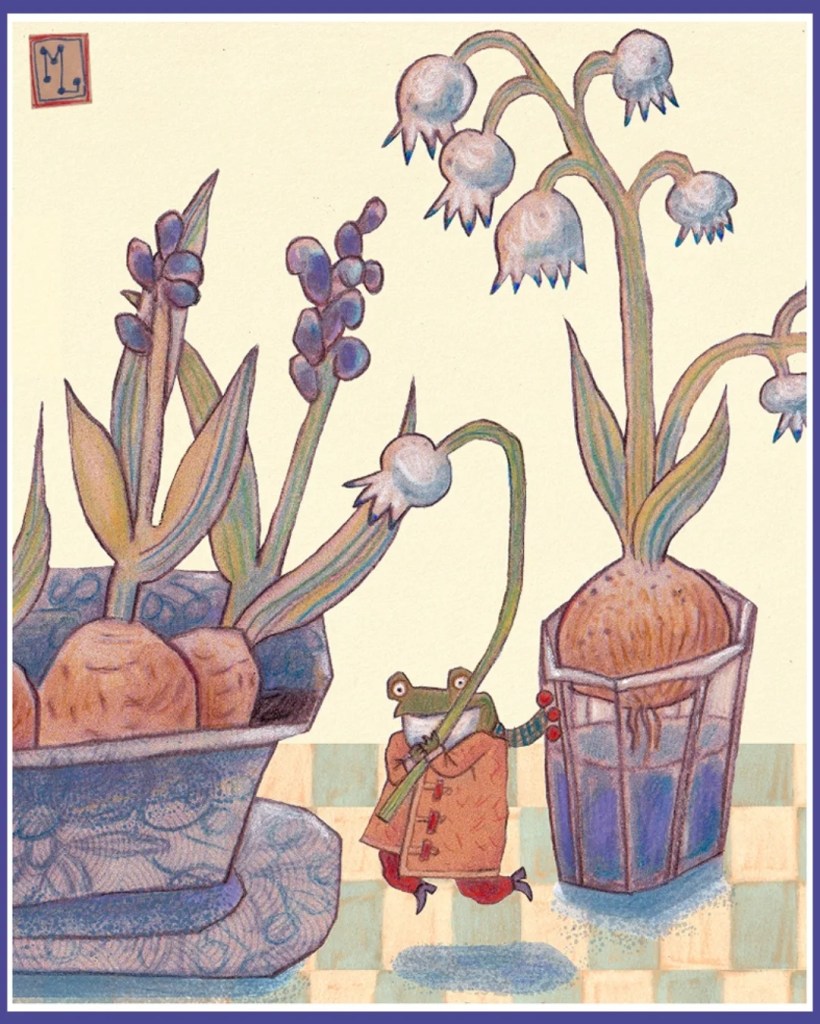
I love the remarkable start that tells us so much in so few well-chosen words to surprise us. Using ‘slime’ and ‘snow-white lilies’ in the same sentence is an astonishing juxtaposition that creates a reaction or response in the reader. What was your intention or hope for this start?
Margrete: I enjoy creating surprises that defamiliarize and create a bit of dissonance. I don’t think or have intentions about this, its just my way of wanting to express myself.
I pored over the pictures and felt I was almost joining the dots to find out about Tilly’s best friends and their personalities. This was a lovely puzzle in itself. Margrete, why a frog and a duck and why have you introduced them through dialogue??
Margrete: I’m not sure why a duck and a frog. I first drafted this story quite quickly early one morning after reading a line from Iris Murdoch, and Duck and Frog simply emerged as I wrote. As for introducing them through dialogue, in a picture book this seems the most vivid and direct way to portray a character. It also engages the reader more closely by inviting them to read between the lines and puzzle over the characters for themselves (as you did!).
Margrete, you’ve done this expertly – where did you leave gaps for Monty to take over the storytelling?
Margrete: it’s always a balancing act leaving space for the illustrator to contribute fully, at the same time as making sure the text makes sense on its own. It’s possible this was a process of gradual trimming back of the text as the illustrations developed and it became clearer what was needed in the text and what was not. The dragonflies are where I left it nearly all up to Monty – I suggested she ‘go for broke’ with the quirkiness, and she certainly did that! They represented a counterpoint to Frog and Duck, but this isn’t explained in the text outside of their repeated ‘zip zap!’.
Margrete, something about your writing here reminds me of Margo Lanagan’s work – the atmosphere you create and possibly the hyphenated words. What are some of your favourite words (hyphenated or not) that you have used?
Margrete: well it certainly is an honour to remind you of someone like Margo’s work, so thank you for that! I think I love ‘quick-fix’ and ‘quick-steer’. I also love ‘who-knows-where’ because it turns nowhere into a somewhere. Best of all is ‘snaggle’, for which I must credit my mother, who used the word snaggle a lot, possibly from her own Scottish mother.
What are some other words where you demonstrate poetic or literary devices to create an effect?
Margrete: I played a lot with alliteration and a bit with assonance, and with repetition, tempo and rhythm. As for the slightly quirky language, I’m indebted to my grandson’s early vocabulary and inventive grammar.
Monty, I wanted to trace the wool drawn on the endpapers with my finger like following a maze on paper. What is your concept for the endpapers?
I wanted to create a feeling of connection between the friends in this story, one that stayed strong despite any twists or misgivings between them, something they could untangle if they just worked together. The string is still strung together as is their friendship.
Who or what is the unusual villain of the story and how have you shown it?
Monty: The river is wild and unpredictable, especially after ditchwater carries them off without direction (which is illustrated with dark, textured flowing waves). However, Tilly, Duck and Frog are actually their own worst enemies which is represented through their struggle with the wooly strings.
Margrete: there’s a villain??? Monty has suggested the river has a character of its own, but it is just responding to the dirty-ditchwater than gushed into the pond early in the story. I confess I didn’t see the water as villainous, as such, but the entire scenario as a natural environmental event they all had to deal with.
How have you incorporated humour into the story?
Margrete: In my experience, it never really works to try and be humorous or deliberately incorporate humour into a story. For me it was more of an initial and overarching narrative mood, which was the energy, so to speak, behind the story and the individual words. And even before I began, I saw Monty’s quirkiest pieces in my mind’s eye and wrote the story in symphony with that vision from the start. I’m so glad she agreed to be the illustrator.
Monty: I have tried to put the emphasis on the expressions of Duck and Frog’s faces as they get more and more anxious.
What is the role of the dragonflies?
Margrete: for me, the dragonflies represent a state of mind above the fussy fastidiousness of Duck and Frog. Really, those two were a pain in the neck, don’t you think? Though Monty also made them endearing. For me, the dragonflies were like: ‘Relax! Get over it! Don’t worry!’ That’s what I intended … not sure if this comes across in the text but I love how that manifests in Monty’s illustrations!
Monty: The dragonflies are a constant in this story and merely observe, they could represent the reader.
What are you suggesting about ‘stillness’ in this story?
Margrete: for me, this is the philosophical part of the story, where the suggestion is that we can’t solve problems using the same techniques that created them in the first place. We have to do the opposite, and here Tilly finally comes into her own and realises that being still is sometimes the best way to unravel a complex problem … letting the answer seep up from the subconscious rather than drowning out subconscious wisdom with ever-increasing struggle and shrillness.
Monty: To see things more clearly, it’s often better to get out of your own head by just taking a deep breath and be still, to let go of all your worries.
Margrete, which illustration do you think best captures the essence of the story? Why or how?
Margrete: I have to say I love the spread “Frog and Duck are still … begin to untangle”. The illustration is as hilariously quirky as all the others with Frog’s feet sticking out of the tangle at every which angle, but there’s such a gentle peacefulness in this picture … it’s the ultimate implication of the story.
Margrete, your picture books have different illustrators. Why did you believe that Monty was the best person to illustrate Tilly in a Tangle?
Margrete: very, very simply, I ‘saw’ her illustrations throughout the writing, but without ‘seeing’ how Monty might do it. I’d long admired Monty on Instagram and assumed she was a remote and famous European illustrator whom we could never sign up in Australia … so it was a thrill and a daring dream to hope she would illustrate this story.
Monty, what genre (if this is the correct term to discuss illustration) are your illustrations in Tilly in a Tangle?
I guess you could describe it as collage as I draw all the backgrounds and characters separately and then collage them together. I used to work completely analogue but nowadays I mostly digitally collage them together as that makes it easier to move things around or edit separate parts of the illustration.
Monty, what colours have you featured, and why?
I usually work with quite muted tones. Tilly is wearing quite bright colours as that fitted her sassy personality. The river changes colour throughout the story, it gets darker, muddier as they get into trouble after the dirty ditchwater sends them on their journey.
Monty, it’s so helpful that your media is described on the imprint page. Could you explain where (and possibly why) you have used any of the following – watercolour, oil crayons, colouring pencils, digital collage?
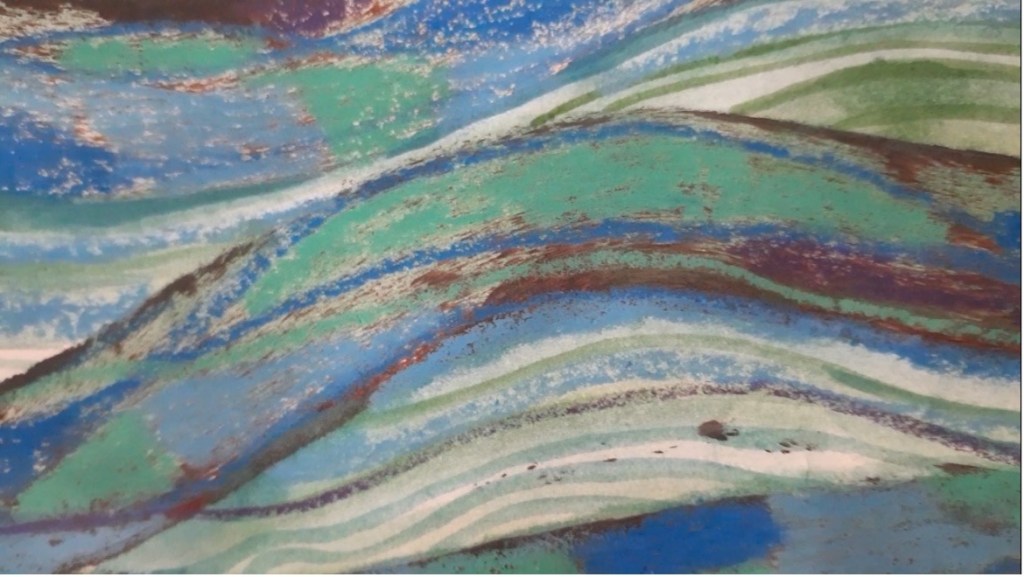
All the pages have all of these elements in them. But I used more crayons for the wild water as the roughness of the texture gives that bit of urgency to the water. Colouring pencils were used for the more precise lines and details
Here’s a detail of the textures the crayons (over watercolour) create:
To you both, what do you hope children take from your book?
Margrete: just fun, and a little bit of insight.
Monty: To trust their own intuition and to be able to take a step back and to take a deep breath when needed to clear their heads.
It’s recent news, but what impact has being a Notable CBCA Picture Book this year had on you or this book?
Margrete: it’s always a thrill and relief to be included on the Notable list. I’m super happy it’s there and always love having a sticker on the front of the book.
Monty: It is too early to tell but I do know it made me very happy!
Margrete, you continue to astound readers with your exceptional picture books, creating as well as publishing them. Could you tell us about one or more of the recent books that you have published and are particularly proud of?
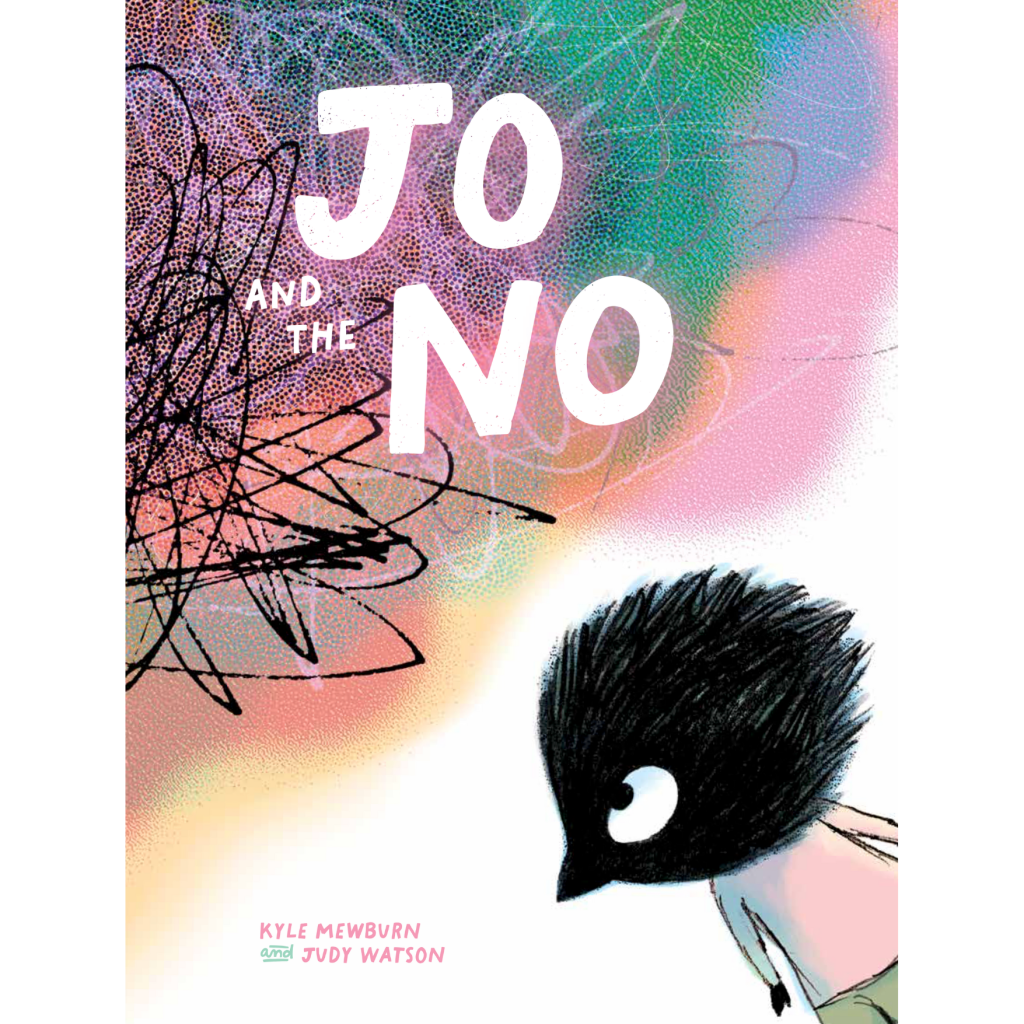
Margrete: I’ve now left Dirt Lane Press, but the two final Dirt Lane books I worked on were projects that had been with me for many years. Both Tiny Dancer and Jo and the No came to me from their authors when I was working with Little Hare. Finding the right illustrators was tricky, so years passed without them going any further. When I finished at Little Hare and founded Dirt Lane Press, both Patrick Guest (Tiny Dancer) and Kyle Mewburn (Jo and the No) followed me there, where again we all waited patiently for the right illustrators to appear. Then along came Mateja Jager for Tiny Dancer, and Judy Watson for Jo and the No and lo! two outstandingly astonishingly beautiful books that I am tremendously proud of having been involved with, and that perfectly round out the Dirt Lane Press list.
Monty, you are a new talent to me and someone whose work I am keen to follow, how else do you spend your time?
At the moment I am focused on printmaking, in particular Tetrapak Prints (great for the environment to be reusing these plates instead of traditional printing plates). I have just finished a course in printmaking and am astounded by the many possibilities this art has to offer. I’m quite keen to tryout some of these newly learned techniques in a picture book. In the meantime, I have a few ideas for children’s books on the table which I will be working on for the next few months. I’m also running a few illustration challenges on Instagram in order to support other artists and to inspire those who are taking their first steps or who are in a bit of a creative dip. If I’m not at my table when I’m home, I’m in the garden pottering away, best relaxation time ever (apart from reading).
What are you writing or working on now?
Margrete: not able to walk away from publishing marginal and risky books, I’m now finalising a title for print that will be the inaugural title for Gilded Snail, a teeny-tiny press I’ve set up for truly edgy books. Look out for Gilbert’s Cake in August.
What have you been reading that you would like to recommend?
Margrete: I’ve been reading widely for a Doctorate of Creative Arts, but for my own pleasure I’m reading The Artist’s Way.
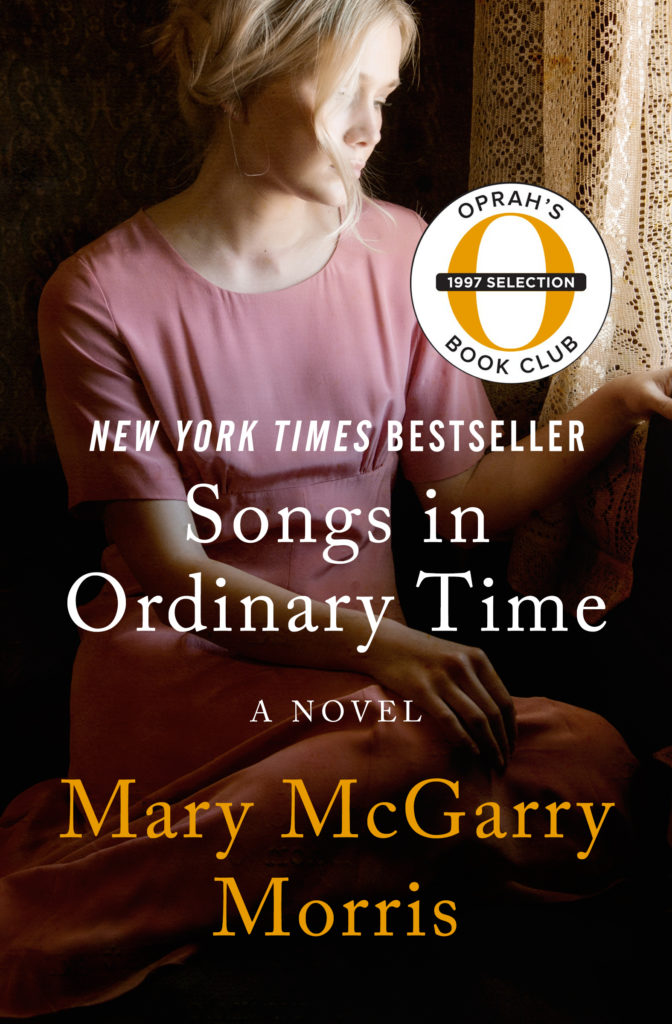
Monty: Mary McGarry Morris – Songs in Ordinary time
How can your readers contact you?
Tilly in a Tangle at Dirt Lane Press
Interview about Paper-flower Girl (written by Margrete Lamond, illustrated by Mateja Jager at Paperbark Words blog

 paperbarkwords.blog