
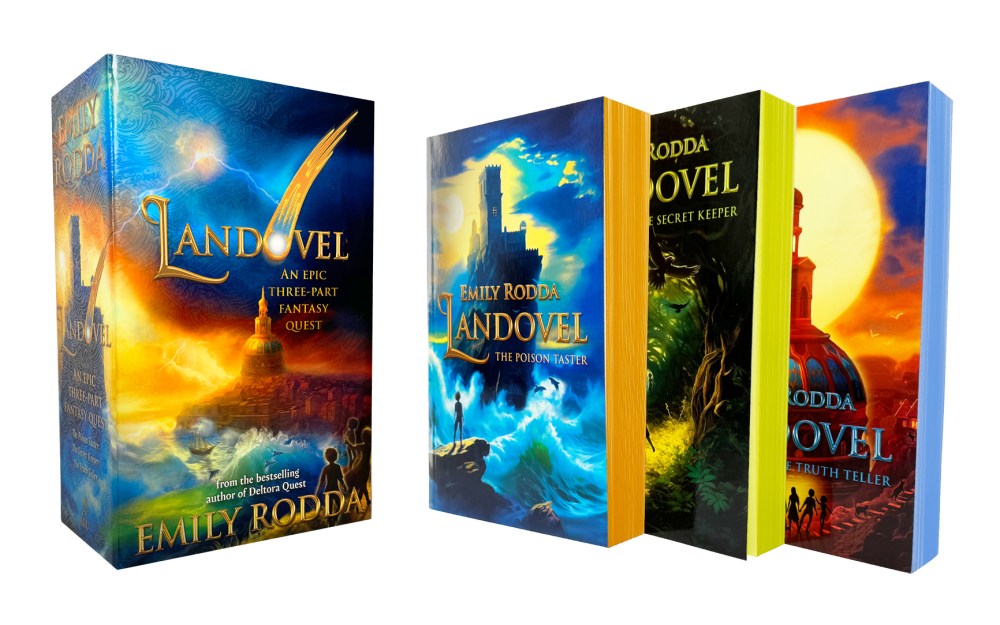
Emily Rodda Interview: Landovel & other books
Landovel is published by Allen & Unwin
“There’s more than one way to be a hero”. (Landovel: The Truth Teller)
Congratulations on Landovel, your three-book fantasy masterwork, being announced as a 2025 CBCA Notable and thank you for speaking with me, Emily.
I’ve read most of your books on publication and have promoted them in my former role as consultant for indie bookstores in Sydney and Brisbane, and since as a freelancer.
Like everyone, I’ve been riveted, amazed and delighted by your perfectly formed, often metaphorical stories, wondrous settings, quests (that often incorporate puzzles and prophecies) and memorable characters who grow and change.
You share big themes and ideas (including that of good versus evil through the symbols of light versus dark, alongside hope, kindness and truth) as exciting adventures. Your fantasy worlds span the domestic to epic, quest fantasies. These are epitomised by Something Special (your first book that has celebrated its 40th Anniversary) to your most recent work, Landovel.
Your books give such delight and affirmation of children. Your stories and characters show that “There’s more than one way to be a hero”. (Landovel: The Truth Teller)
I (and no doubt many others) cherish the worlds my shelf full of your books has taken me to.

Questions & Answers with Emily Rodda
I always learn something about myself in your books. For example, Derry learns to speak up in The Secret Keeper, book 2 of Landovel. This is something I was reminded to put into practice as soon as I read it.
Have you learned something from any of your characters in Landovel or elsewhere? If so, could you please briefly share it with us?
ER: It’s more that I’ve learned from the act of writing itself. To make a character believable you have to put yourself imaginatively in that person’s shoes, so you know instinctively how they will feel, how they will act, what pressures they will respond to, and what they will say, in any situation. Sometimes this takes discipline, especially if the person seems generally unlikeable or even hateful, like Cram in Landovel. This process helps me to keep remembering that people are more complicated than they seem, and that empathy promotes understanding.
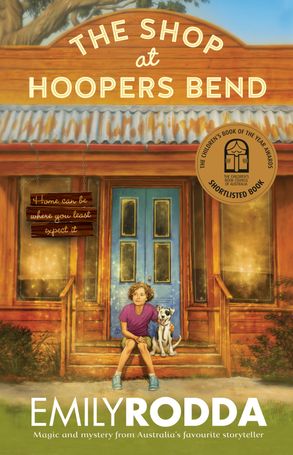
Some of your major characters in Landovel and Quil in The Shop at Hoopers Bend (through her Stardust game) have an instant attraction or affinity with others. How rare or common do you think this is in real life?
ER: Judging by my own experience, it’s fairly rare in its strongest form. It’s not the same as the more usual feeling of goodwill you might have when meeting someone new and likeable. Wondering about this over the years, I developed the ‘stardust theory’ that forms the basis of Quil’s game.
Your child characters often have worries or troubles or injuries or wounds e.g. Derry’s weak arm – but you give them agency.
Who is one of your characters who stands out as overcoming adversity?

ER: Rowan, in Rowan of Rin, was my first main character to suffer more than a temporary problem. He’s quiet, shy and physically weak. His quest to return water to his village by climbing the feared mountain and facing the dragon at the top is the best and simplest example of someone who overcomes adversity not by changing himself, but by admitting his fear and facing it, by keeping faith and using the strengths he has—strengths that the people around him don’t respect or even recognise. The same thing applies to Derry in Landovel.
What attributes or characteristics do you see as being hero-like?
ER: Standing up for your beliefs, standing up for others who are in trouble, seeking out and speaking the truth.
Some of your books, including Landovel and His Name was Walter are highly metaphorical and allegorical.
How do you think Landovel represents our world?
ER: Landovel reflects our world in many ways. One of the most important is that most citizens of both True Landovel and Free Landovel tend to believe what they are told about divisive issues without thinking very much about them or enquiring into them more deeply. For these people, one side of the argument is all bad and the other is all good. This makes them prey to propaganda, prejudice, intolerance, superstition and ill-founded rumour.
The sea features in many of your books including as part of journeys, escapes and healing. What do you love about the sea?
ER: For me the sea is vast and mysterious, beautiful and dangerous. It’s the source of life. It has its own rules, and humans can only visit it, can never own it or be completely part of it.
You write so many wonderful fantasy settings. Which would you like to visit or live in?
ER: I’ve been asked this before, and have never been able to decide for sure—keep changing my mind. All I can really say is that while I’m actually writing about a world, that’s the world I’m living in, and one I’m reluctant to leave.
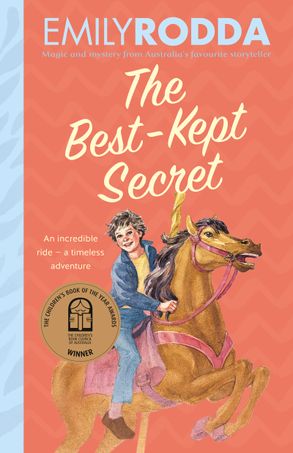
Like many, I love carousels. The carousel is obviously integral to The Best-Kept Secret and there is a merry-go-round musical box in Finders Keepers. Why do you feature carousels in some of your stories?
ER: I once went past a corner, a familiar vacant block, where a full-sized merry-go-round had been erected overnight. The sudden transformation from drab emptiness to colour, sparkle, sound and movement seemed like magic. And as I watched the horses, the swan, the central fantasy scenes, the brass poles and the flashing mirrors making their endless circles, and listened to the haunting, slightly other-worldly music, I felt what other writers had felt before me—the carousel is a metaphor for time passing, and for things changing yet in their essence remaining the same.
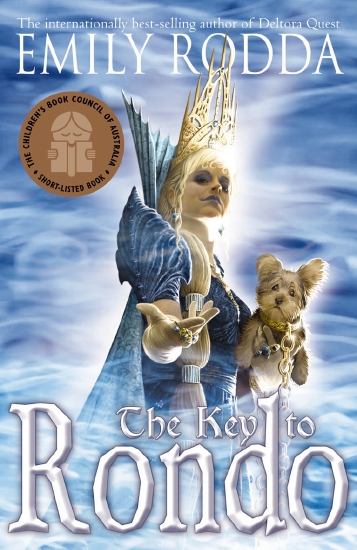
In my review of The Key to Rondo for Books + Publishing, I described the book as a ‘literary symphony’ (as well as a ‘contemporary classic’). Jo plays piano music in The Best-Kept Secret and the carousel music is integral to the atmosphere of this tale. Why do you often incorporate music into your stories?
ER: It happened naturally because to me music can have magic in it. It can be strongly evocative. And, of course, it’s part of life. Where humans are, music exists also.
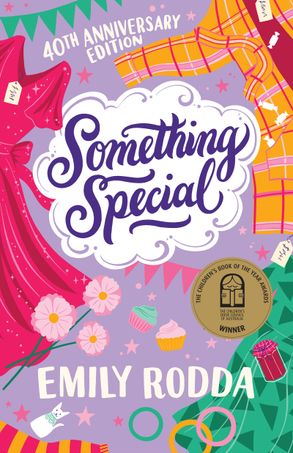
In Something Special the old man says, ‘at my age you just take miracles in your stride, and you don’t ask too many questions. You’re just grateful when things pan out. It’s a funny old world.’
How does that reflect your view on life?
ER: I was in my thirties when I wrote Something Special, but I had heard a few older people say similar things, and I strongly identified with them. I’m in my seventies myself now, but my belief that the world is a strange and wonderful place where miracles can happen hasn’t changed.
Who are some of your literary heroes?
ER: Charles Dickens, Emily Dickinson, Margaret Atwood, Robin Hobb . . . such amazing imaginations.
Your career in books is amazing and gives such happiness and delight. What do you see as a highlight? What do you see as your legacy?
ER: Thank you for saying my books give happiness. That’s what I hoped they’d do. There have been many highlights over forty years of writing, but it’s not the honours and awards that I remember most, however thrilling it’s been to receive them. It’s not even the rushes of pure joy I’ve felt when I’ve been writing this book or that, and the work is going well. It’s the moving things some readers have said in their letters, or face to face at book signings, that stand out when I think back. It’s wonderful to know that my books have made a difference—have helped readers through hard times, have kept them company when they’ve been lonely, have made them think, or have simply turned them on to reading. If I have a legacy, that’s it.
Books cited are published by Allen & Unwin, Scholastic Australia and HarperCollins Australia
******
Other resources about Emily Rodda
Scroll down for interviews and book reviews by Joy Lawn
And a link to Jon Appleton’s free book about Emily Rodda
Interview with Emily Rodda about The Shop at Hooper’s Bend and other books by Joy Lawn (2017)
Emily Rodda is indisputably one of Australia’s best writers and is also acclaimed around the globe.
Many of her works, of which I have a large collection in my bookshelf, are contemporary classics where she conjures magical worlds based in both reality and fantasy that resonate with all young people and kindle their imaginations.
I can’t overstate her gifts and importance to the lives of countless children (and adults).
I have heard you say that some of your characters have been based on your own children. Have you written a character based on yourself? If so, who?
A: It’s fairly common for writers to draw on autobiographical material in their early books, and I was no exception. Lizzie, the mother of the main character in my first book, Something Special, is a light but quite faithful sketch of me—as I was at that time, anyway. Normally I don’t base characters on real people, though. It’s more interesting to let characters grow into themselves as the book develops.
How do you create a magical element in a realist setting? How do you know how much magic to include?
A: I’ve always seen the potential for magic in ordinary things, people and places. Most people have experienced odd things at one time or another—a weird string of coincidences, maybe, or time apparently going faster or slower than usual, or a strange feeling in an old house, or a flicker of shadow seen out of the corner of an eye … I’ve written stories based on all these things. Writing magical reality is just a matter of giving your imagination full play, letting it lead you, allowing yourself to believe, and then writing the story accordingly.
Which of your settings would you like to visit or live in?
A: Well, I actually do live in the Blue Mountains, where The Shop at Hoopers Bend is set. It’s a beautiful place, and I’ve always felt very much at home here, as Quil feels at Hoopers Bend. The ten Fairy Realm books are also set in the Mountains.
But in fact I actually feel as if I have lived in all my other worlds as well. While I was writing Deltora Quest, part of my mind was living in Deltora all the time. It was the same with Rondo, with the world of the Three Doors, and of course with Rowan of Rin. I know them all as well as I know my home place, and I can revisit them any time I like. Rowan’s world is the one I find the most appealing, I think, but this could be because it was the one I wrote about first.
What is your favourite nursery rhyme or fairy tale and have you included it in your work in any way?
A: I can’t say I have an absolute favourite, really, though Little Red Riding Hood has always appealed to me because I like the idea of the big bad wolf impersonating the Granny. I put legendary, fairytale and nursery rhyme characters into the world of Rondo because I see Rondo is a sort of metaphor for the imagination, and of course the tales we’ve heard and read are part of that, all jumbled up in our minds with the things we’ve thought up for ourselves.
The Shop at Hooper’s Bend (Angus&Robertson, HarperCollins) is a transcendent tale that made me cry both times I’ve read it but also lifted my heart.
A: Thank you! That’s a wonderful compliment.
You’ve named your main character, Quil (from Jonquil). Why have you chosen this name rather than another winter bulb or flower?
A: I always try to give my characters names that somehow suit their personalities. We have a lot of jonquils in our garden. They aren’t flamboyant and bright. They don’t make big, happy, dancing statements, like daffodils. They’re unobtrusive, but when you get close to them you can see their delicate beauty, and you realise that they have the most beautiful scent. So to me the jonquil was a good symbol for a reserved and sensitive person like Quil.
Could you tell us a little about Quil’s game, ‘Stardust’?
What type of person are you from this game?
A: Having learned that everything on earth contains the dust of long-dead stars, Quil decides that this is the answer to the vexed question of why we are instantly attracted to some people—even feeling as if we have met them before—but are left unsure or even wary about others, however nice they are, till we know them much better. Quil believes we recognise and feel we ‘know’ people whose stardust most exactly matches our own.
This has been an idea of mine for a long time. It applies to places as well as people. Quil takes the theory further by dividing people she meets into types and giving those types star names of her own invention. This helps her to feel in control of her world, to some extent. Her stardust types are very personal to her. I wouldn’t dare say which type she might decide I am. A bit of a mixture, I suspect.
The setting around the character-filled shop at Hooper’s Bend is distinctly Australian. How do you create this or other scenes with a minimum of description?
A: That’s quite a hard question to answer, because when I’m writing I don’t think specifically about which words to use. I just put myself into the scene and say what I’m seeing, hearing and smelling. I don’t like to stop the story dead with great slabs of description, preferring to give the atmosphere and appearance of any setting come out through the eyes of the characters as the story moves on.
What did you enjoy reading as a girl?
A: In early primary school I read all the usual Australian children’s classics, The Wind in the Willows, Alice in Wonderland, Peter Pan and lots of Enid Blyton and LM Montgomery books among many others. By the end of primary school I had discovered the Brontes, and after that I read books for adults almost exclusively.
What have you enjoyed reading recently?
A: I’m just reading Hag-Seed, Margaret Atwood’s take on The Tempest, and am enjoying it immensely. Margaret Atwood never fails to amaze me.
Thank you, Emily, and all the best with your wonderful books and their important legacy.
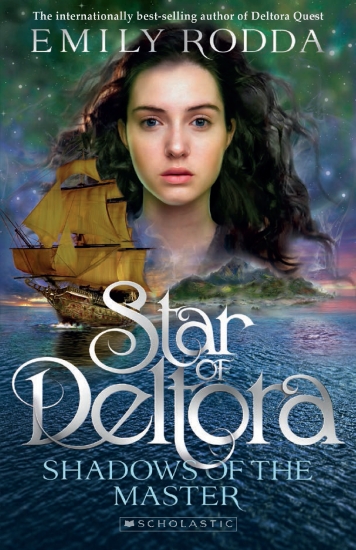
Book Review: Shadows of the Master in the ‘Star of Deltora’ series by Emily Rodda, reviewed by Joy Lawn (2015)
How many Australians under the age of 30 have not read a story by Emily Rodda? I feel sorry for anyone who hasn’t. She is an icon of Australian (and international) children’s literature, a master storyteller, a living imaginarium.
A litany of Rodda’s stories fly into my head:
Pigs Might Fly
Finders, Keepers
The Best-Kept Secret, with its alluring carousel
Bob the Builder and the Elves
Bungawitta, set in a country town
Teen Power Inc series
Fairy Realm series
Rowan of Rin, with dear, unforgettable Rowan
The Three Door trilogy
Deltora Quest, from which I remember the names and characters of Jasmine and Lief years after reading about them
The Rondo Trilogy, the first book of which Emily Rodda wrote in secret, and which I reviewed with the rare, squeezed-out words, ‘a contemporary classic’. I am thrilled that these words are still used to endorse the series.
Her latest series, Star of Deltora (Omnibus, Scholastic Australia) sits alongside her best titles. This series ingeniously links her fantasy islands of Deltora, Maris from ‘Rowan of Rin’and Dorne from the ‘Three Doors’ trilogy. Rodda is an exemplary world-builder.
The first book in this new series is Shadows of the Master. Rodda’s structure here is captivating. The tale of the mysterious King of Tier enshrouds the major narrative about Britta, daughter of acclaimed former trader, Dare Larsett. Britta is a strong girl who seems to resemble her father but is now making her own choices for her future.
When Captain Gripp nominates Britta in the competition to be Apprentice to Mab, the Trader Rosalyn, she grabs the opportunity. This could be her one chance to sail on her family’s lost ship ‘Star of Deltora’. Other girls seem to be much better reared and prepared to become one of the three finalists, particularly local Del girl, Vashti. Two strangers, Jewel of Broome and Sky of Rithmere, while exotic and ‘different’ also may be frontrunners in the adventure.
Britta must demonstrate her trading facility even though she has little experience and mentorship and is given one gold coin to make a valuable trade. With her natural talent and some luck, she seems to be well-placed but is attacked and imprisoned before she can show her trade. Rodda plots skilfully and swiftly to keep Britta in the race.
The female characters are sketched well in this introductory volume. Britta is determined to change her circumstances but is torn by those she loves. Minor characters here such as legendary Mab and Lean Alice intrigue. No doubt they will all be coloured and textured over time.
Rodda will not sacrifice her fast-paced action and plot twists and turns for unnecessary description that alienates any reader. Despite this, Britta is already a heroine with depth who we want to explore and know and she and the others will become three-dimensional portraits under Rodda’s expert hand and timing.
Another fantasy adventure in Emily Rodda’s inimitable world begins in ‘Star of Deltora’. Enjoy it most by reading it as each instalment is published.
I can see that the ‘Emily Rodda shelf’ in my bookcase will need to be expanded.
Review of His Name Was Walter at PaperbarkWords blog (2019)
Snippet about series fiction from my article in The Australian (2024)
Australian children’s book legend Emily Rodda moved from writing lyrical critically acclaimed books (Rowan of Rin, The Best-Kept Secret, Pigs Might Fly) to books for struggling, disengaged or reluctant readers (Deltora Quest series) when her son was hooked on computer games. Both Rodda and (Sally) Rippin write quality books across the gamut of literary and series fiction (the latter is not always known for its literary merit) but there is no doubt that once a children’s series takes off, it has a better chance of selling well because of pre-established marketing, bookstore shelf-space and repeat buyers and borrowers through ease of choice, familiarity and anticipation.
*****
Out of the Box: the Art and Life of Emily Rodda Free book by Jon Appleton

 paperbarkwords.blog