
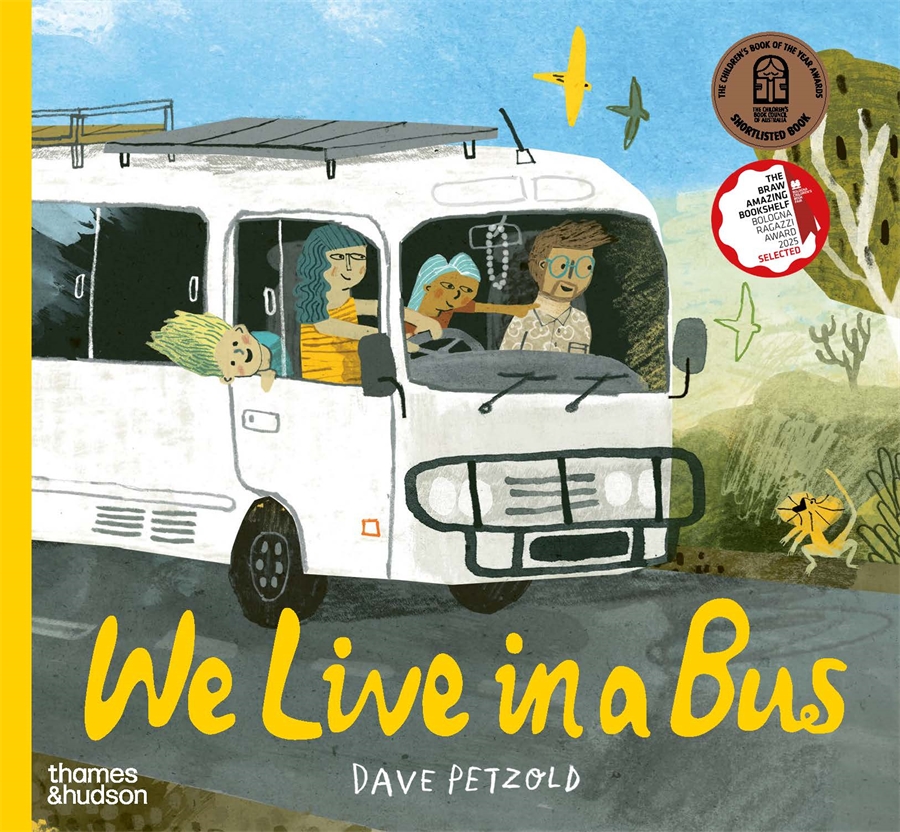
We Live in a Bus
by Dave Petzold
Thames & Hudson
“We live in a bus and we stop whenever we like.” (We Live in a Bus)
We Live in a Bus by Dave Petzold is a 2025 CBCA shortlisted Picture Book of the Year.
Congratulations on your warm, joyous book and its CBCA shortlisting, Dave. We Live in a Bus epitomises family love and freedom.
Thank you for speaking to Joy in Books at Paperbark Words blog.
Author/Illustrator Interview: Dave Petzold
Where are you based and what else, apart from illustrating picture books, do you enjoy doing?
I live on Bundjalung Country in a town called Newrybar, not far from Byron Bay.
Outside of creating books I like to paint, play guitar and get out on my mountain bike occasionally. I also love making bird nest boxes for all the wonderful birds we have here.
The seemingly simple but profound concept behind We Live in a Bus, as well as your visually informative and interesting illustrations make it a standout. What emotion are you sharing with your readers? How are you doing this?
I’m mostly trying to convey a sense of curiosity about the world and a connection with nature and people. I think there’s an amazing tapestry of life happening right in front of us, but most of us don’t take the time to look.
We Live in a Bus is, for me, a celebration of the land and all the creatures that live on it, and I hope that kids get a sense of that, too.
How do you bring your readers on the journey alongside the family?
I think everyone can relate to being on a road trip and seeing things you haven’t seen before, so I just tried to create a story that I thought was fun and engaging.
Most of the adventures in the book, by the way, were inspired by a trip I did through North West Queensland in my own bus. So when I came to write the story, all of the material was already there; flat tyres, swimming in water holes, chittering budgies, and frog symphonies. I just had to create the characters and weave some sort of story around them.
Could you please introduce your characters (including the bus)?
There’s the boy, who narrates the story. He’s curious, adventurous and a little bit cheeky. Suzy is the older sister. She loves collecting shells. And then there’s Mum and Dad. The bus is called Gracie Joy Rufus Bean. She’s roughly based on my old Toyota Coaster bus, with a few artistic changes here and there.
How do they interrelate as a family?
I’m not really sure to be honest. I’ll leave that for the reader to decide.
How would you describe your illustrative style in this book?
I would say warm and textured with just the right amount of wonkiness.
What media and process have you used (including how you build dimension, possibly through layers on top of each other)?
I use a mixture of traditional and digital when creating my illustrations. I work initially with graphite pencil, ink or oil paint to create the line work and textures. Then I scan everything and assemble and colour it in Photoshop.
I draw each piece, scan it, add colour and texture and repeat again and again until the scene is built up. It can be a long, drawn-out process sometimes, but I feel like I have a lot of freedom working in this way.
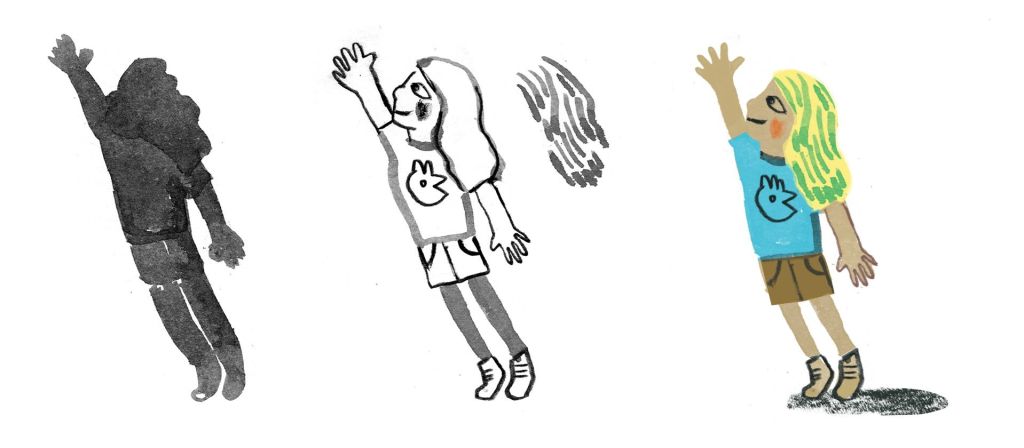
Could you give an example of texture that you are particularly pleased with?
I tend to reuse a lot of my textures, mostly because of time constraints, so it’s hard to say. I think the red-tailed black cockatoo and musical fence spreads have some nice textures.
Which colours have you featured, and why?
I seem to gravitate towards using blue and yellow in all of my books. I’m not sure why, it’s just a personal preference that dominates my illustrative work. It might not seem that apparent on some spreads. Sometimes there’s more green or red on the page but those colours always compliment the blues and yellows. There are rare occasions when I’ll use, say, pink or green instead.
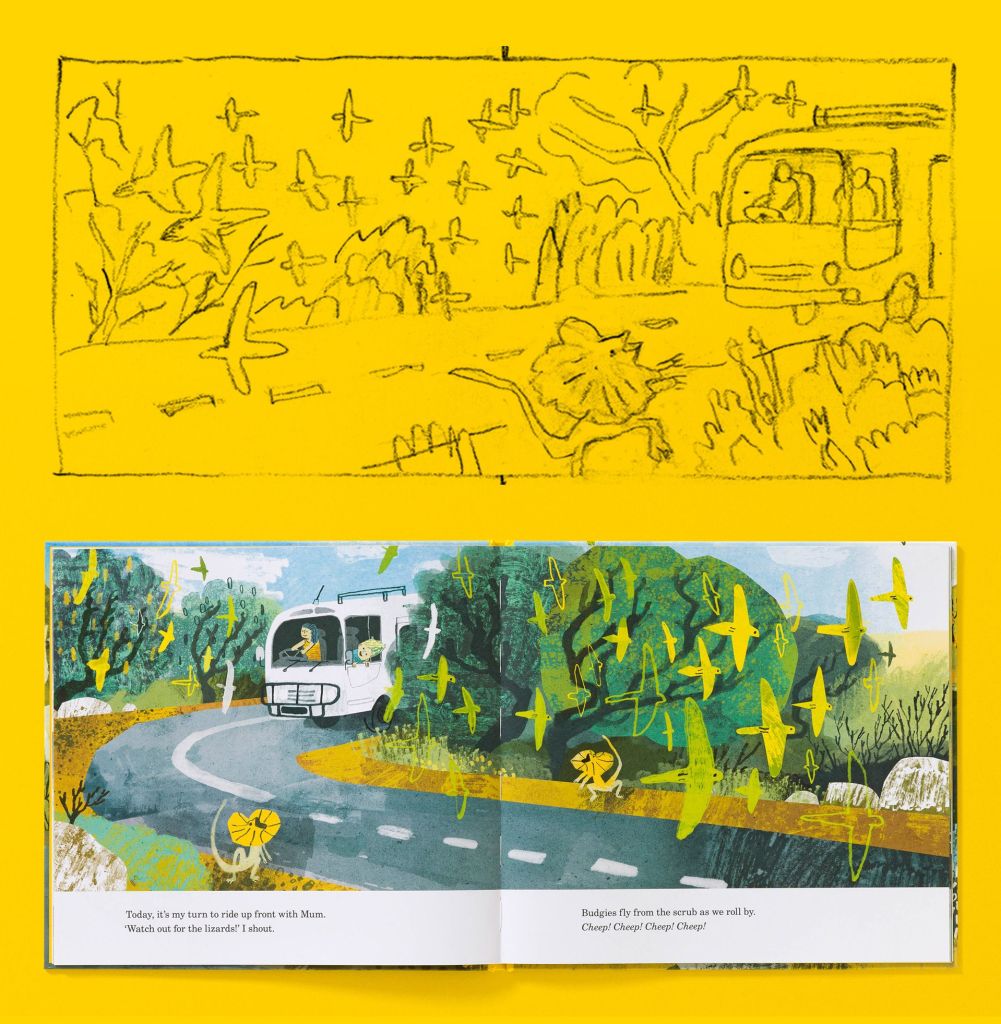
What was a technical difficulty in illustrating this book? How did you solve it?
The spread with all the budgies was quite tricky to get right mostly because I wanted the road, the bus and the budgies to be travelling across the page from left to right, and I also wanted the boy to be in the passenger seat hanging out the window, which meant that the bus would have to be facing in the opposite direction.
I eventually realised that adding a bend in the road would solve this problem. So that’s why that spread looks the way it does, and I actually think it turned out for the better. It’s interesting how problems usually turn out to be a blessing in disguise.
How have you shown space?
I’m glad you mentioned space because that’s something I tried to convey throughout the book—that sense of wide open spaces that you get when you travel in the outback. I think it’s a theme that runs through the book, too—slowing down, being present and creating space.
I tried to show big skies and large open areas of land, and I tried to not fill those areas with anything in particular—maybe just a few birds—as I wanted to it to be sparse.
The book design was also integral in allowing space. I talked with Clair, my publisher at Thames & Hudson, about it and we agreed on a landscape format that would give me the freedom to illustrate the landscapes that feature in the book.
Why have you changed from double-page spreads to four oval panels on the page “… and all the things in-between”?
Mostly, to show all the action on one spread. Using vignettes allows you to get a lot of information across when you don’t have much room, and with picture books you only have around 12 spreads to work with, so you have use the space wisely.
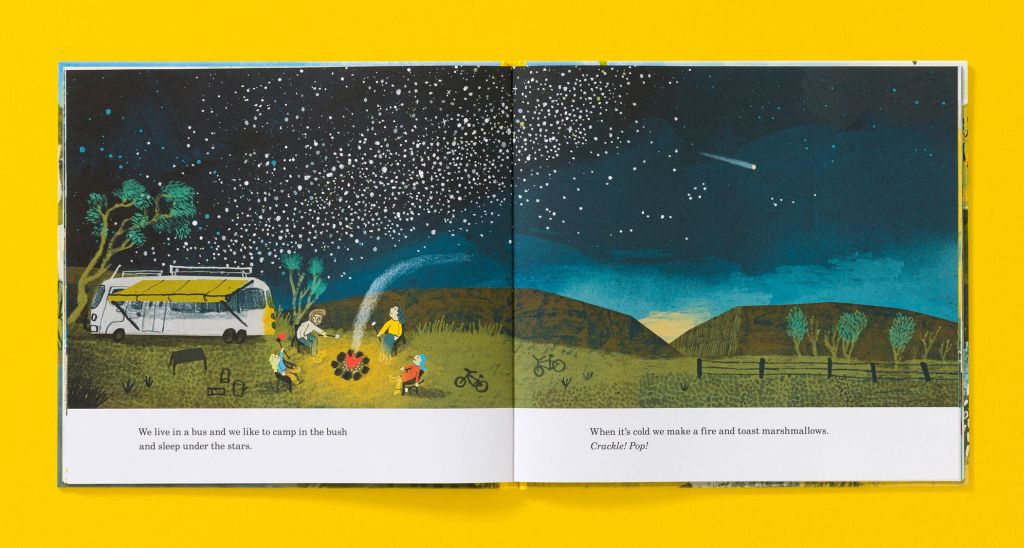
Which illustration do you think best captures the essence of the story? Why or how?
There’s a few, but I think it would have to be the one where the family are toasting marshmallows under a huge star-filled sky. For me, this spread captures that sense of spaciousness, togetherness and wanderlust.
It also embodies the cheeky and playful tone that runs through the book—if you look closely you’ll notice the boy is making an offering to the crispy marshmallow gods.
What impact has being shortlisted for the 2025 CBCA Picture Book this year had on you or the book?
It’s pretty special to have been shortlisted and I’m happy that what I’m doing resonates with people. As well as that, lot’s of friends and family have said that they have seen We Live in a Bus at their local library or school, which is really cool.
What is one way you would suggest using We Live in a Bus in schools?
I made a conscious effort to shine a light on some of the more overlooked but interesting creatures in Australia, creatures that you discover in the outback like frill-neck lizards, iridescent dragonflies and budgerigars. So my hope is that kids become interested in all sorts of animals, not just the cuddly ones, and maybe that’s something that could be talked about in schools.
What are you writing or working on now?
I’m currently working on another book with T&H. It will be out next year.
How can your readers contact you?
My website has some behind-the-scenes process of making my books, but Instagram is probably best if you want to say hi.

 paperbarkwords.blog
One thought on “We Live in a Bus by Dave Petzold”