
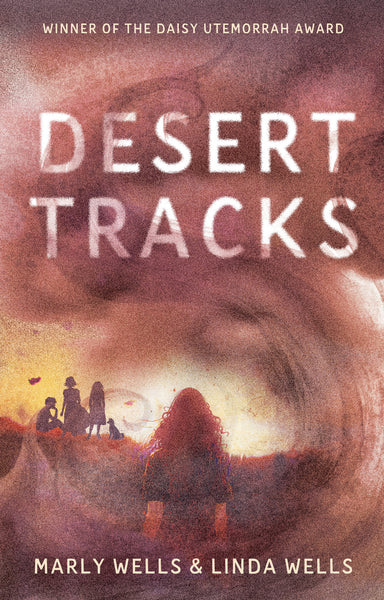
Desert Tracks
by Marly & Linda Wells
(Magabala Books)
Desert Tracks is co-written by mother-daughter duo Linda and Marly Wells. It won the Daisy Utemorrah Award in 2024.
The Authors

Marly Wells is a proud Warlpiri woman who grew up between Alice Springs and Melbourne. She has worked in social services and the creative art sectors, and cares about equity, community, and decolonisation. Other written works include Girls Can Boys Can! The Adventures of Cody and Casey, coauthored with Shirleen Campbell, and various pieces in newspapers, magazines and blogs.

Linda Wells is of white settler descent. She is a teacher and writer. Linda lived in Central Australia for more than 30 years and worked as a teacher on desert communities as well as in Alice Springs. For over ten years Linda also ran a small business, conducting guided walking tours of Alice Springs. In 2024 she was awarded the NT Chief Minister’s Literary Award for non-fiction for her book Living in Tin. Linda has a PhD in creative, post-colonial possibilities for writing Australian history.
Guest author post by Linda and Marly Wells about Desert Tracks for Paperbark Words
Desert Tracks is based on our experiences of living and growing up in Alice Springs. It is a love letter to the town and region, and the people who make it special and unique.
[Marly] We started working on it when I was the same age as the main character Millie, eighteen years ago. We used to talk it up, develop it as an oral story. We started writing segments, reading each other’s work, making editorial suggestions and collating. Then we got distracted by other things for a few years and the story sat as an unopened file, percolating.
I have always enjoyed sci-fi and the mystical/ fantastical in stories. It is second nature to me. I also ponder how the dominant ways of measuring and perceiving time are artificial constructs.
[Linda] I have studied the history of Central Australia and am passionate about sharing understandings of how the colonial past exists in the present and plays such a strong part in shaping the lives of people in contemporary Alice Springs. These are two of the dominant forces that merge in this novel.
One day after I had finished my PhD, I was wondering about what to write next. I opened the document that was the bones of the Desert Tracks manuscript and got excited about the story and its potential. What I had learnt about early frontier times in Central Australia, through my PhD research, confirmed what we had already written.
I contacted Marly and asked her if she was interested in working together on the story with the aim of publication. Marly was in Alice Springs and I was in Melbourne, so we had some very long phone calls reacquainting ourselves with the characters, working up the plot. Then we went off and wrote and edited sections, how we had done previously.
[Linda and Marly] The book is like an extension of us both. We see ourselves particularly reflected in two of the central characters however our experiences and perspectives are woven into the characters and events of the story.
We would like our book to contribute, in general, to the wonder and joy of reading and stories. We hope it can provide an appreciation for and understanding of the town of Alice Springs that has grown up on Arrernte land.
Some central themes are that the social situations of the present are rooted in the colonial past and the present is a direct result of the past; that colonisation has been cruel and brutal to Indigenous people. Nevertheless, Indigenous Australians – along with their languages and cultures – go on surviving and thriving.
Although there is so much change between past and present in terms of ways of living, ways of learning and technology, in some ways things haven’t changed very much, for example how people are, what we need and the ways we treat each other.
Although this story is set in Central Australia, the themes can be extrapolated more broadly, to Australian colonisation in general. Young Australians today are developing deeper and more honest understandings of Australia and its colonial past as well as the lives of First Nations people both pre- and post-colonisation. There is a need for material to enrich such truth-telling and we hope that our book can make a worthwhile contribution.
Desert Tracks at Magabala Books
Desert Tracks reference in interview with Lilly Brown, CEO Magabala Books, at Paperbark Words blog

 paperbarkwords.blog