
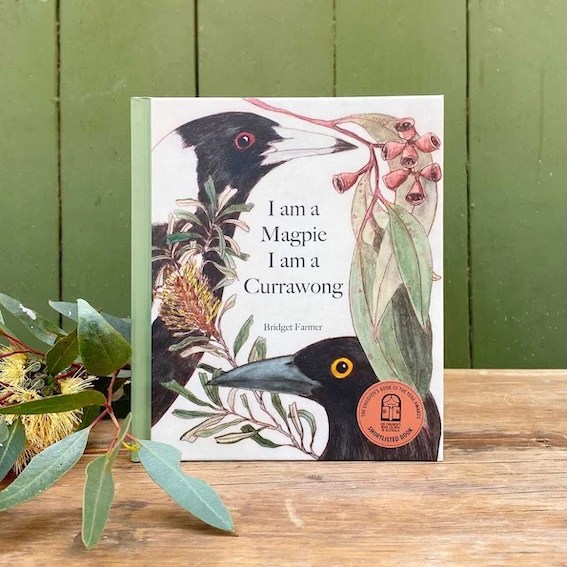
I am a Magpie, I am a Currawong
by Bridget Farmer
(Black Cockatoo Books)
I am a Magpie, I am a Currawong, written and illustrated by Bridget Farmer, is shortlisted for the 2025 CBCA Book of the Year: Eve Pownall Award.
Congratulations on I am a Magpie, I am a Currawong being shortlisted by the CBCA, Bridget, and thank you for speaking to Joy in Books at Paperbark Words blog.
Author Interview: Bridget Farmer
Why have you branched into making children’s books?
I’ve been making children’s books since 2016. In fact, before that! I made books for my post graduate diploma in Edinburgh back in 2004. I studied jewellery and silversmithing, but my post grad show was pretty much all books! I started my first proper children’s book, Kookaburra Kookaburra, shortly after my first son was born in 2015. I remember saying to a fellow parent at children’s rhyme time in the local library “I’m going to make an Australian bird book for my son.” And so I did. It took me until the birth of my second son to complete it, I even went into labour while making the endpapers! I self published Kookaburra initially, then it got picked up by a publisher, but I’ve gone back to self publishing again. I think it suits me better.
I enjoy the challenge of making a book. I feel I sometimes struggle with completing tasks, especially long projects. With my first book, I nearly gave up a hundred times. I was full of doubt, and constantly asking myself ‘is it any good? Am I wasting all this time?’ But I persevered and it’s a wonderful feeling to hold the completed project in your hands. Then, it’s even better when people tell me how much they enjoy my books.
Now I continue to make children’s books because I feel I am making a difference. I care deeply about wildlife and the environment and I believe that the more we all know about nature, the more we’ll look after it. I want my books to help children (and parents) notice the birdlife around them. One very memorable message I got from an excited parent simply said, “We had a spotted pardalote in our garden the other day. I wouldn’t have know what it was if it wasn’t for your book!” And that is 100% why I make my books!
I am a Magpie I am Currawong – what’s the difference between a magpie and currawong? Which song do you prefer?
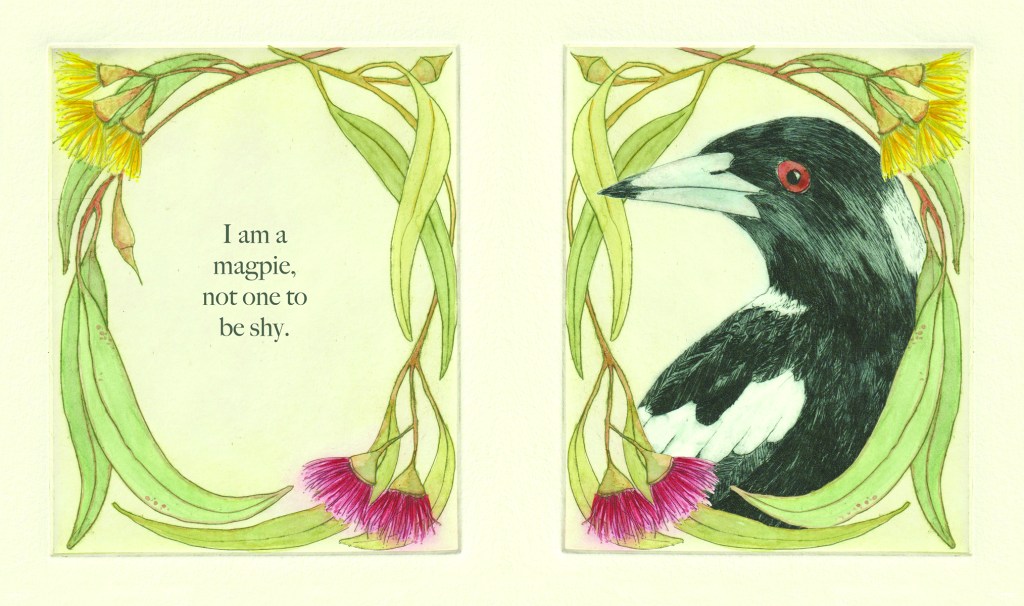
Well, Magpies have more white on them. They also have browny red eyes whereas currawongs have yellow eyes. Currawongs also have dark beaks but Magpies have whitish beaks with black tips. I’m talking of the pied currawong here, but there are also grey currawongs and black currawongs. I think most confusion between magpies and currawongs arises simply because people don’t know about currawongs, so they are just presumed to be magpies which far more people know about.
I don’t think I have a preference when it comes to their song. They are just different and I like them both in their own ways.
I am a Magpie is illustrated using hand coloured drypoint etchings. What does that involve? Why do you use this technique?
There are easier ways to illustrate a book, and potentially much faster ways with less processes involved. I’ve tried digital drawing, and I’ve tried pen and ink. I just didn’t like my results. So I go back to this centuries old technique for all of my illustrations.
My process, called drypoint, goes as follows – I scratch the image into a metal plate (I like to use aluminium as it is quite a soft metal) with an etching needle. I sometimes use sandpaper to make tonal marks in the surface of the plate as well. I then ink up the plate by applying the thick butter-like ink to the surface of the plate. This then gets rubbed into all the lines and marks with a cloth called tarlatan, then the excess ink is wiped back with that same tarlatan cloth, leaving the ink only in the lines. This is all done by hand. The inked up plate gets placed on the printing press bed with damp paper on top and felt blankets on top of that. It then gets ‘pulled’ through the press. Imagine clothing getting pulled through an old mangle. The press has a big heavy roller which puts a lot of pressure on the plate and the paper, so the ink is transferred from the plate onto the paper.
The resulting print then sits between drying boards for a few day so it dries flat. Then I add colour with water colour paints.
I love the printmaking process, and I love the fuzzy lines that result with drypoint. I love the happy accidents that happen with this process and the limitations that you have to work with.
How is this book similar or different to your others?
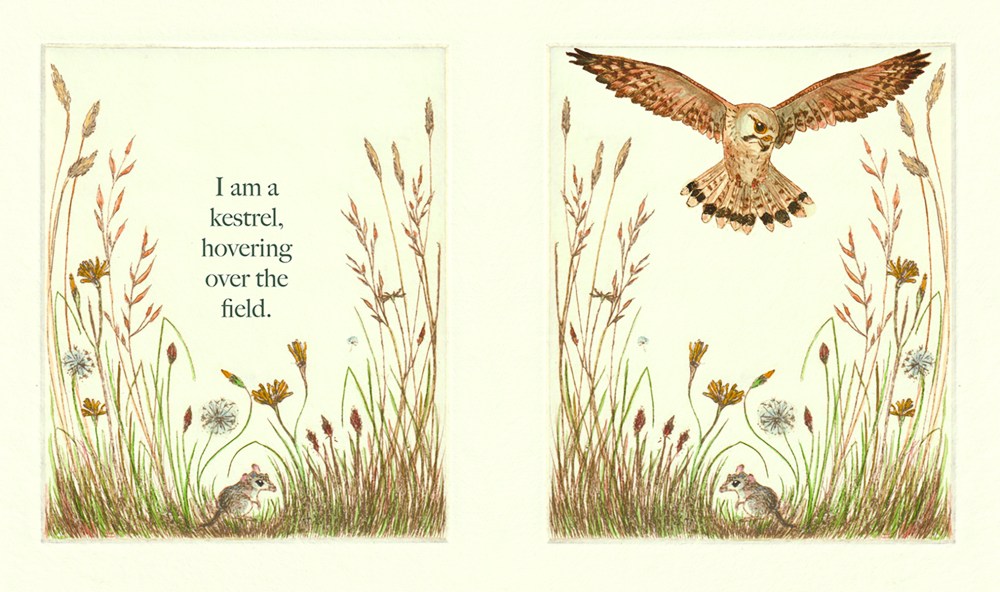
This book is aimed at a slightly younger audience. I have simplified the bird names to not be as specific as in previous books. I have written ‘heron’ instead of ‘white faced heron’ or ‘currawong’ instead of ‘pied currawong.’ This book is meant to be the first steps to noticing nature: Seeing a hovering bird and being able to recognise that it could be a kestrel, or seeing that a bird on the beach that looks a little different from the gulls is possibly a tern instead. Noticing that some birds stand very still, and so could be a heron. Or, if they are located in the tree tops that they could be a type of thornbill.
The writing is in simple rhymes and could be a good book for beginner readers. I wanted to make a book that parents enjoy reading to their children, possibly over and over. Then, as the child grows, maybe they will reach for my other books with slightly more information in them.
With all my books I want to make objects of beauty. I don’t want to use bright loud colours, I want them to be soft and atmospheric. I still remember the feeling of looking through my favourite books as a child. It is thought that children need lots of bright colours to grab their attention, but I disagree, my favourite books were always the ones with softer, gentler tones.
What is the name of the soothing green colour you feature in the book?
I have no idea! I often end up finding those design choice colours by using the eyedropper tool (in photoshop) on some of my illustrations and seeing what comes up. I can’t remember if that’s how I found this colour, but more than likely. I do like green though, I choose greens for a lot of things.
How many drafts did you do to get your text so simple and appropriate for very young children?
In all honesty I kind of had a moment of inspiration one afternoon and it sort of all just came out. I maybe changed a few words here and there along the way, but it mostly came out like that.
I think in my head I had the aim of pointing out differences in birds in as simple a way as possible. I think also I’d read one too many comments on a bird identification page on Facebook saying ‘this is a strange looking magpie’ (because it was a currawong) and I HAD to fix this issue – I HAD to educate the next generation!
I’m not very good at going over and over drafts. I don’t feel I’m a natural writer. I always say ‘I write so I can illustrate.’ I struggled a bit with essays etc. at school, or maybe it was just getting down to starting them that I found difficult. I find changing what I’ve written even harder, like opening a can of worms! Once I’ve done something, however good or bad it is, I move on to the next thing. I’ve never worked with an editor, although I think it’s something I should probably do. I think it could really help me, but I’ve always just worked mostly on my own with my books and I’m not sure how to move away from that. So, if there are any editors out there who would like to work with me and show me the way please get in touch!
Which page was most difficult to get right? Which one flowed easily?
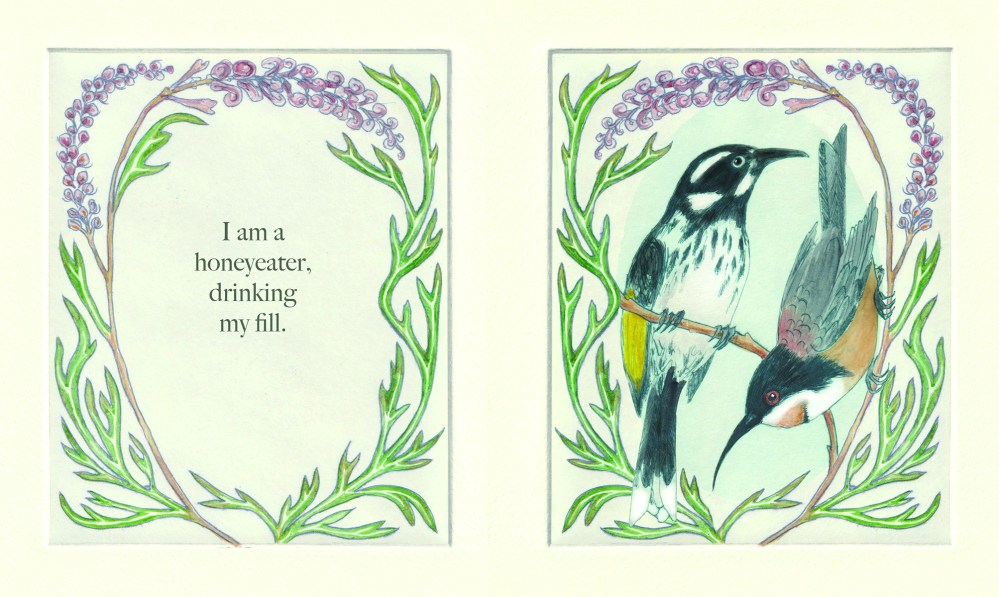
Do you mean in terms of writing or illustrating? For writing it was the honeyeaters, I had initially written about their long curved bill, but then I realised not ALL honeyeaters have curved bills so I decided to change it.
As for illustrations, I always find the first illustration I make is the most difficult and then it doesn’t always gel with the rest. Once I get the 1st illustration done the rest flow better and I figure out what I’m doing as I do it. (I’m not really a planner.) I then look at the first illustration and see that it doesn’t 100% fit. Sometimes I change it and other times I’m just so impatient about handing in the files to the printers I keep it the way it is. I’m not going to say which was the first, but I’m still not entirely happy with it. I think the illustration I’m happiest with is the magpie though, it was the final illustration, so that makes sense. I knew what I was doing by then!
I also really like the kestrel page. I knew I wanted to include a little dunnart (native mouse) hiding in the grasses. I often try and imagine what the hovering kestrels can see from their vantage points!
Why have you used borders around every page?
Its due to Beatrix Potter mostly, although when I actually look at her illustrations they aren’t bordered like I imagined. I’ve always loved her end papers though and maybe thats what I had in mind. I think I just had that victorian/edwardian aesthetic in my head. I wanted to create something beautiful and decorative. I wanted the borders to say something about the birds that the writing didn’t. I’ve chosen all Australian flora in the borders, just to make sure this book gives that Australian atmosphere.
What bird did you have to leave out?
Every single other bird other than the 12 in the book! They’re all possible inclusions. Its always so so hard choosing just 12. But sometimes it just comes down to what rhymes with what that makes the decision for me.
What response have you had from a child about this book?
I mostly hear responses from parents or grandparents about their children or grandchildren. I had one grandparent tell me their 16 month old grandchild who has the book read to her regularly, opened up the playing cards (which also have the illustrations on them) and pointed to a card and declared quite clearly “currawong!” I really love hearing these stories. There’s someone who will grow up knowing the difference between a magpie and a currawong!
What made you enter I am a Magpie in the CBCA awards?
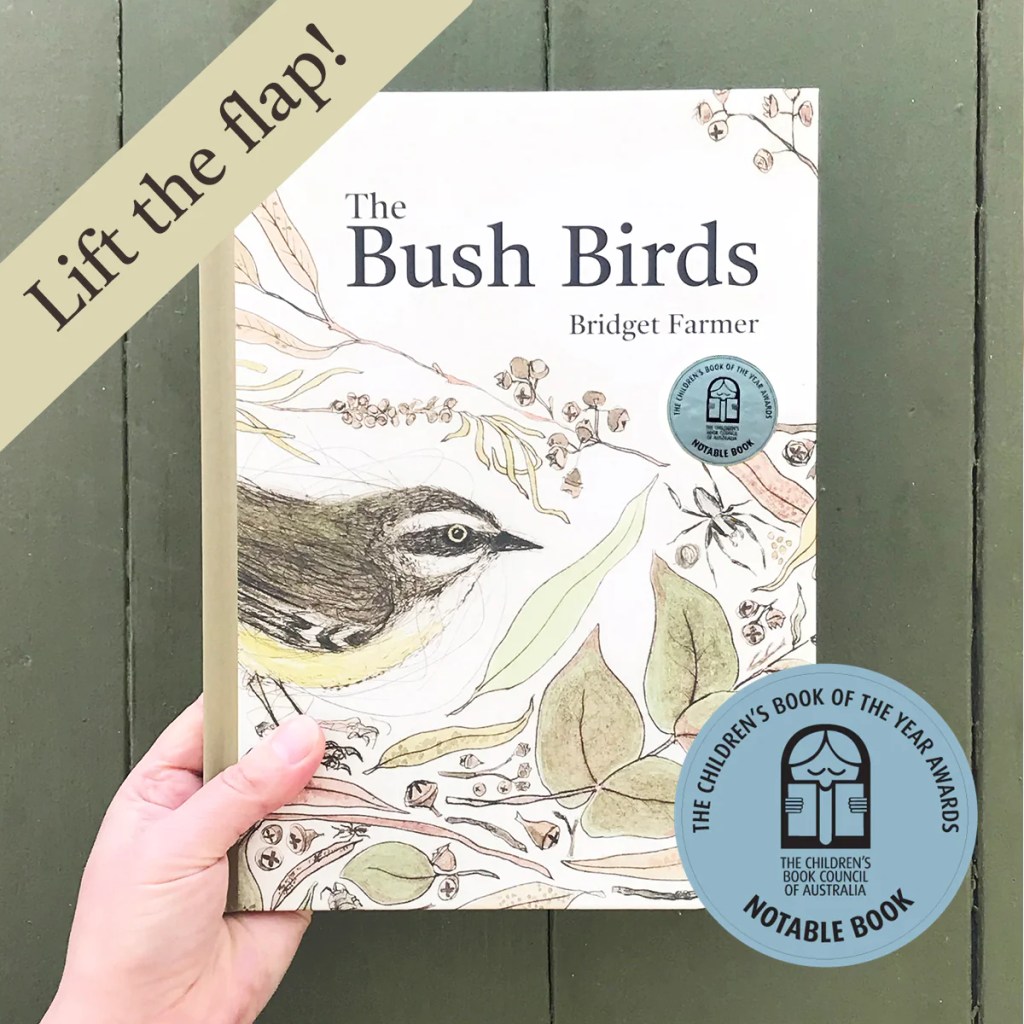
I enter all my books into the CBCA awards. I didn’t enter my first book because I didn’t know about it, but since then I make sure to send off each title. My second book The Bush Birds got onto the notable list in 2022 so that encouraged me to keep sending them in.
What impact has being CBCA shortlisted made on you or the book?
I honestly didn’t think it would have had such an impact but the response has been huge! I’ve had so many bookstores and new stockists get in touch. I’ve sold almost 10,000 books already, I really wasn’t expecting it!
What is one way you would use the book in a school?
Definitely by inspiring children to get outside and noticing the birds for themselves! Its surprising how many birds you see when you start looking and noticing. Australia is especially good for this. I grew up in Northern Ireland and the birds there are small and shy in comparison. The birds here are there in front of you, some are large and noisy, some small but fearless. And I find if you’re excited about the birds, the children will be too. And also, children make the best drawings of birds. So read the book, go on a bird walk and then draw the birds you saw and maybe make your own book from the drawings!

 paperbarkwords.blog
One thought on “I am a Magpie, I am a Currawong by Bridget Farmer”