
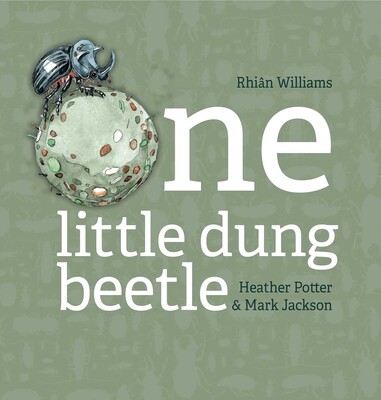
One Little Dung Beetle by Rhiân Williams, illustrated by Heather Potter
& Mark Jackson
(Wild Dog Books)
One Little Dung Beetle, written by Rhiân Williams and illustrated by Heather Potter & Mark Jackson, is shortlisted for the 2025 CBCA Book of the Year: Early Childhood.
Congratulations on One Little Dung Beetle being shortlisted by the CBCA, Rhiân, and thank you for speaking to Joy in Books at Paperbark Words blog.
Author Interview: Rhiân Williams
The Inspiration
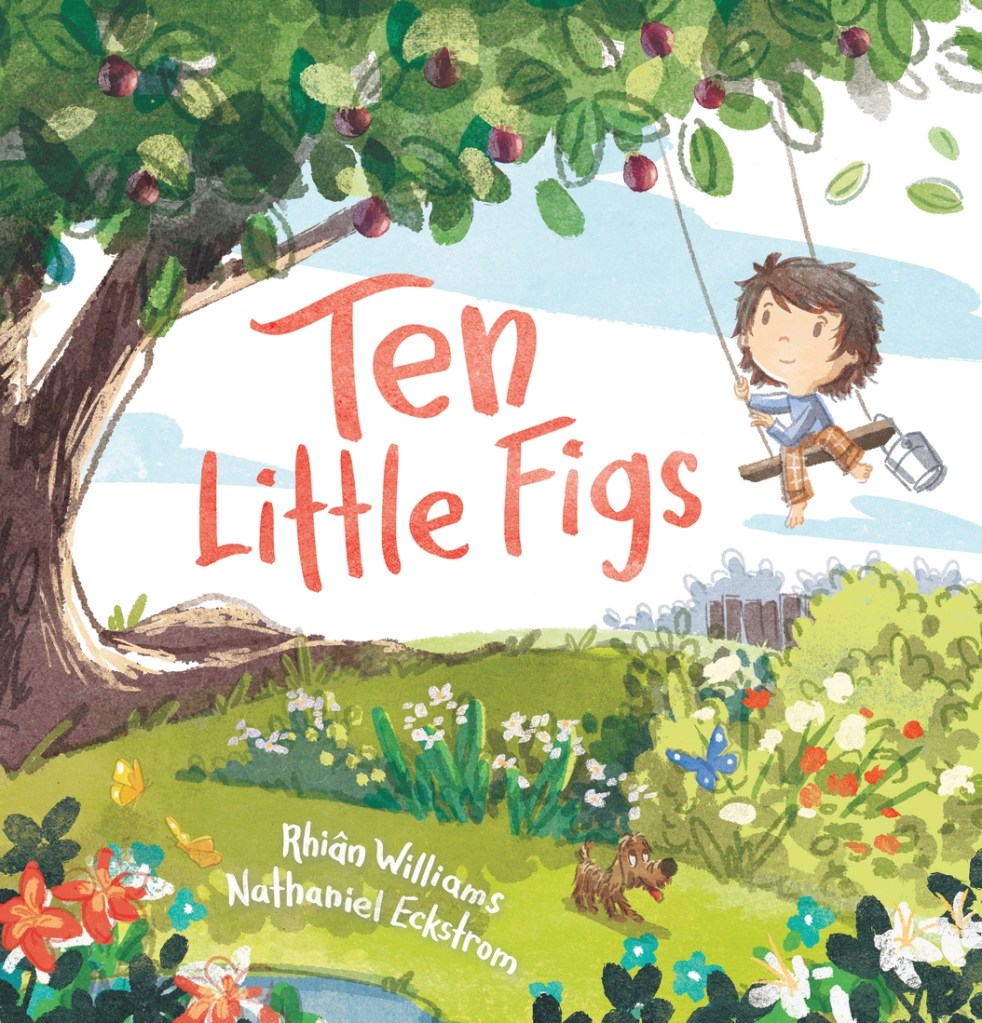
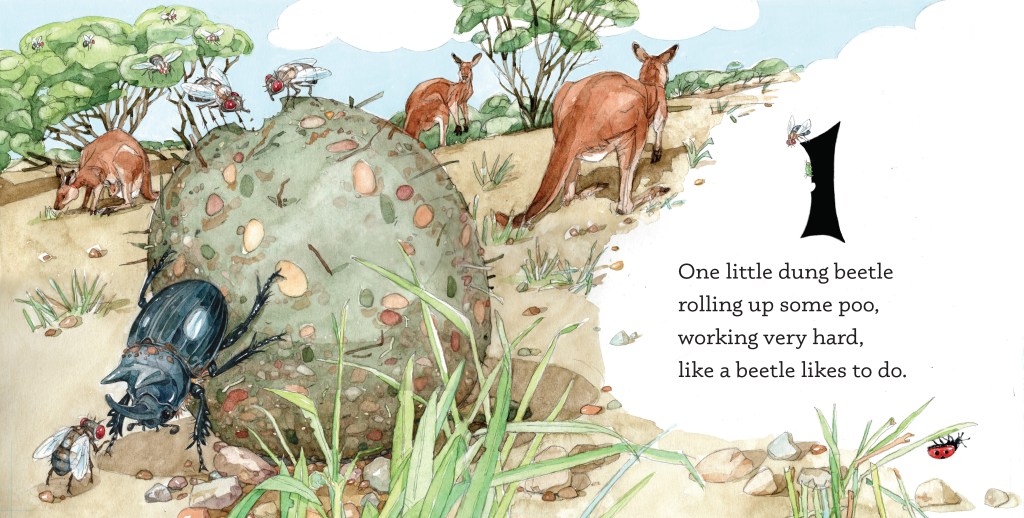
Lots of the inspiration for my books come from the things I see around me. My first book ‘Ten Little Figs’ was inspired when I spotted the first figs on my own fig tree. There just happened to be ten of them and out popped the words: Ten little figs are on my tree. I love figs and they’re all for me. With ‘One Little Dung Beetle’ I was out walking my lovely dog Gidi and we spotted some beetles. And even though they weren’t dung beetles, another quite delightful rhyming couplet – One little dung beetle rolling up some poo. Working very hard like a beetle likes to do – just popped out. Then all these other beetles scuttled into my head, clamouring for rhymes of their own. And it seemed a lot of fun to count them! I grew up in Queensland and my garden was home to lots of different beetles. I was particularly intrigued by the fiddler beetles and rhinoceros beetles and both of them can be spotted in the book.
The Writing Process
When I am working on a book I like to go for long walks in the paddocks near where I live. I sing out the rhymes that I am wrestling with, as that helps me get the sense of how the rhythm is working. I often spot lots of different birds, kangaroos and turtles and I always keep my eyes peeled for beetles. I love the puzzle of writing – which beetle, which words best describe them and what aspect of their behaviour is most fascinating and can be woven into the story. Scientists used to think that beetles laid their eggs and then left them to look after themselves. We now know that some beetles are social and look after their young. Peg Beetles live in rotting wood and the adult beetles chew the wood to make it easier for their larvae to eat. That’s why in the book you will find: Six shiny peg beetles nesting in a stump, feeding all their babies, until they’re round and plump. I really love discovering new ideas and scientific facts and am excited to figure out which ones might be the most enthralling for readers. I am currently writing a picture book about Australia’s freshwater fish. Did you know that some Australian fish build stone nest for their eggs and the fathers guard their eggs and once they hatch, they will mind their babies until they can safely look after themselves? Fish are as fabulously interesting as beetles and also really important to the health of our environment,
First impressions of the Illustrations
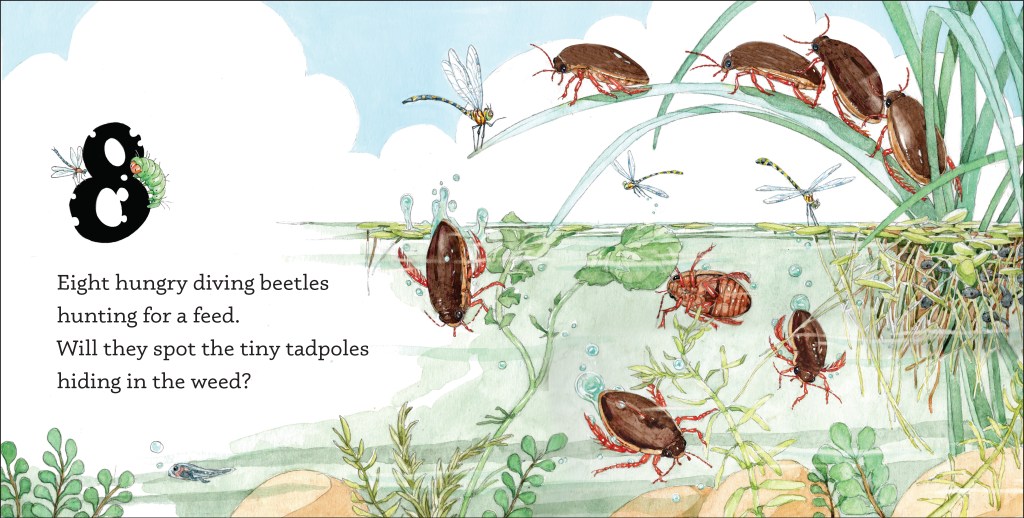
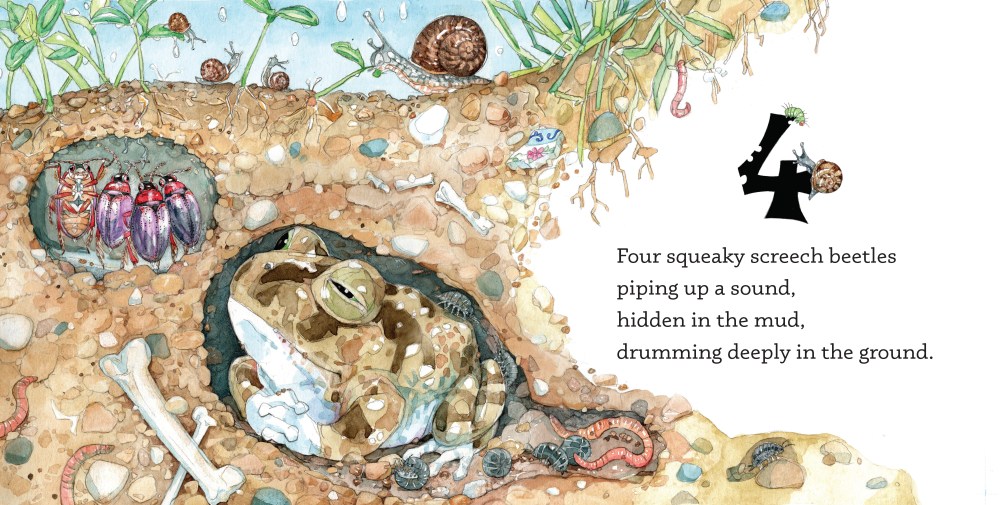
I love the illustrations that Heather Potter and Mark Jackson have done. They are very beautiful! One of the first things I saw was the title page with a big capital letter ‘O’ with a little dung beetle sitting on ball of dung, next to a tiny daisy flower. It is such an exquisite image and seeing it made me so happy. I love that the little dung beetle sitting on a ball of dung is also the image on the cover. I think it makes you want to rush to see what is inside the book. One of my favourite pages is the one with: Eight hungry diving beetles hunting for a feed. Will they spot the tiny tadpoles hiding in the weed? Diving beetles really do hunt for tadpoles! What I love about this illustration is how Heather and Mark show the beetles ‘diving’ from a blade of grass into the water below with a dragonfly lifeguard making sure the beetles wait their turn. It also always reminds me that the first place I ever saw diving beetles was at my local swimming pool. I feel so very lucky to have Heather and Mark illustrate the book, and they have brought the text to life with such loveliness. I also love how Donna Rawlins, the book designer, has added such gorgeous elements to the book – like the little larvae that grows bigger with each new illustration and how the number of ‘bites’ taken out of the number on each page matches that number. I also adore how the now very plump little larvae falls asleep in the zero of number 10. Oh, and the end papers with all the different beetles looks like this astonishing collection of jewels to me!
Hopes for this book
I love this book so much and hope little readers will too! Beetles are amazing ecosystem engineers. I hope this book sparks lots of conversations about why beetles are important and why we need to do all we can to take care of them and their environments. Anything we do to look after these marvellous little mini-beasties will also help all the plants and animals in our environments. I also hope to get lots of people talking about beetles. I was very excited to chat with ABC Science Show presenter Robyn Williams about the book. He loved it and said Heather and Mark’s illustrations are wonderful. He even said it would make a perfect present for Sir David Attenborough for his recent 99th birthday! You can listen to the interview herehttps://www.abc.net.au/listen/programs/scienceshow/the-amazing-work-of-dung-beetles/105255618 You will discover all about Australia’s very own Ironclad beetle, affectionately known as the TimTam bug, the fog harvesting beetles in Namibia who use their elytra – or wing coverings – to capture water droplets from the fog and how this might lead to self filling water bottles. You will even discover why I took dung with me when I went to chat with Robyn. Most of all I hope little readers will enjoy the book and it will inspire them to see what amazing things they can spot in their own gardens and beyond!
About the author
I was almost three when I came to Australia – from Wales, a place of songs and dragons. But it is here – home to the world’s longest continuing storytelling tradition where my imagination and my heart have grown up. I have wanted to be a writer since I was eight years old. I believe in the power of stories – beautifully told and in our own extraordinary and diverse voices – to change the world, for the better, for us all! In between reading books I have earned a living doing all kinds of thing. I drove a Mr Whippy van and discovered that soft serve ice cream likes to imagine it is a volcano and will – under certain conditions – explode, leaving delighted children covered in ice cream snow. I worked as a tour guide on boats cruising the Great Barrier Reef where I could sail through the tail end of cyclones and keep my sea legs steady but salt and vinegar chips made me seasick. When not wrestling with rhymes and stories that aren’t completely certain of how they want to be told, you might find me helping turtles cross the road, trying to film endangered freshwater fish or singing sea shanties. And just like my little fig tree that grew a fig that grew into a book I am always waiting to be surprised by what comes next.
You can also find me here: https://www.rhianwilliamsauthor.com.au/
Illustrator Interview: Heather Potter & Mark Jackson
First Impressions of the Manuscript
Rhian’s book, One Little Dung Beetle, was very different from the stories we’d illustrated over the past few years. For starters, the delightful rhyming text was for a much younger audience, and we weren’t having to draw another ‘family situation’ or event. We liked it straight up and just thought at the time that it would be fun to work on, and it was, mostly. It wasn’t an easy book to do—far from it. Animating beetles, with their segmented bodies, spikey jointed legs, tiny heads and weird looking mouth parts, is actually harder to do than you’d think. We bought some plastic toy insects that we could hold and sketch from any angle, and these were extremely useful when trying out compositions and new ideas. Not so useful for accuracy and detail. I’m thinking there wouldn’t be a person alive who doesn’t have their own story about a beetle or some other insect they encountered; whether they’ve swallowed one accidentally; found one in their clothing, on a garden bed, in an old newspaper; or seen one fluttering against a window or light on a warm evening. Insects are so interesting, and I’ve spent a lot of time watching them up close; caterpillars munching on leaves and shedding skin, spiders with their small round egg sacs, thirsty butterflies and bees drinking sugared water. I once rescued a cicada from a magpie, and it remained clinging to the front of my jacket as I walked home. When I placed it on our old apple tree, it started to buzz within minutes. So, as you can imagine, we were thrilled to be given the opportunity to draw all of the amazing looking beetles (some we have never seen or heard of before). We drew them with as much realism that we felt was necessary to convey something about all the colour variations, the countless textures, the endless nuances that you see in nature, without being too silly or too serious either.
The Illustration Process
Whenever we’re given a new story, we read it aloud a few times, then point out the things we each like, dislike, find interesting, amusing, etc. We make a copy for each of us before disappearing into our work rooms to read it again on our own and sit with it for a while before starting to sketch out a few rough impressions of the main characters or anything else that takes our interest. There’s no right way or wrong way to begin, you open your sketchpad and start scribbling down anything you can think of relating to the story and because no one will ever see these it doesn’t matter how terrible the drawings are, or how awful your ideas and characters look at this stage. They are just your first impressions, that’s all. We often don’t show each other what we’ve done for days on end. And we’re not allowed to go sneaking a look at each other’s work either, but of course we do when given the chance. We’ll keep our opinions to ourselves because an offhanded remark or criticism could discourage the other from trying out something that might be of some use later on. You never know, so at this point we leave each other alone to get on with what we’re each doing with our doors firmly closed. When we are finally ready to come together, there’s always enough rough working drawings of characters, interiors, situations, scenery and lots more that will enable us to start making clear decisions as to what seems to work, what doesn’t, and which direction is best to go in. There may be something that’s just right for endpapers, a title page and if you’re lucky, a cover too. We both will have done a lot of drawings of our main character/s and out of them all there’s bound to be a few that stand out that we both like and will further develop. We make photocopies of one another’s work and it’s there to be drawn over, to be cut up and rearranged, to be reference material, to be used in whatever way you want. It’s interesting when we come together to see what new possibilities emerge. Nothing is fixed and whatever new ideas we come up with will still need a lot more work. By now we are starting to lay the book out, and we have a much clearer idea of what goes where. It would have taken us about 3 – 3.5 weeks of hard work to reach this point where you have something ready to send off to the publisher and author for approval. Any discrepancies, oversights, corrections, etc are discussed and resolved before you begin the more definitive roughs, then finished artwork. People are sometimes curious, often surprised, that we work collaboratively on books and it surprises us too because our individual styles of drawing and line work are very different. Therefore, we need to blend the work we each do to the extent where it is neither one or the other’s. It becomes ours. For our books, and especially one on beetles, we’ll do some research, then start collecting reference material which we source from libraries. We have never owned a computer and are just learning to use a mobile phone.
About the Illustrators
There is another side to illustrating a children’s book that mostly goes unseen, and that is sketchpads filled with all the working drawings that you’ve done along the way. Often, you’ll do too many ideas, as good as each other and you can’t then decide which you like best. It’s been said that I do this too often, and it’s true. Mark draws and sketches every day and carries a pen and small sketchpad wherever he goes, so there’ll be sketches of people in trains, sitting and standing in groups, buildings, landscapes and whatever else that’s taken his interest on one of his long walks. When I go walking, I’m usually trying to finish a simple rhyme that I’ve started, then left. It doesn’t worry me that they may not be very good because I love trying to write things regardless, and I don’t think that I could stop. I enjoy browsing in op shops and Sunday markets and I enjoy repairing many of the interesting items that I find. I was the fifth child of seven and grew up in dusty, bushy Eltham, while Mark, being the youngest of four boys, grew up in the suburb of Cheltenham. After completing a commercial art course, Mark worked for World Record Club for a few years designing catalogues and record covers, then went on to complete a Bachelor of Arts, majoring in drawing. Being dyslexic, with considerable reading and writing problems, he felt proud of this achievement. Both our early illustrations work was for educational readers, which was often the case for someone starting out. We worked individually at first, then together and Mark’s commercial art skills were invaluable, particularly when laying out texts and dummying up entire books. I doubt whether I could have done something like this on my own, so it just seemed logical that we’d work together, and over the years we’ve been lucky indeed to have collaborated with a number of children’s authors, and to do a series of stamps with author, John Marsden, for Australia Post. I did the same drawing course as Mark a few years earlier and then worked for some years in an antique print ship, hand colouring old maps and engravings using watercolours, day after day. I remember colouring a lot of small, humorous lithographs, depicting day to day life on Victorian goldfields by S.T. Gill, whose work I had never encountered before. After I left, I did a lot of illustration work for school readers, before being given my first trade book. We were involved with the first ‘Map of Melbourne’, have done greeting cards, book covers and have work purchased by The Museum of Childhood, NSW and private collectors. We have shown both drawings and illustrations in group shows, have illustrated over twenty books and have been shortlisted for various awards up to eight times. We have another book coming out in a month or so.

 paperbarkwords.blog
One thought on “One Little Dung Beetle by Rhiân Williams, ill. Heather Potter & Mark Jackson”