
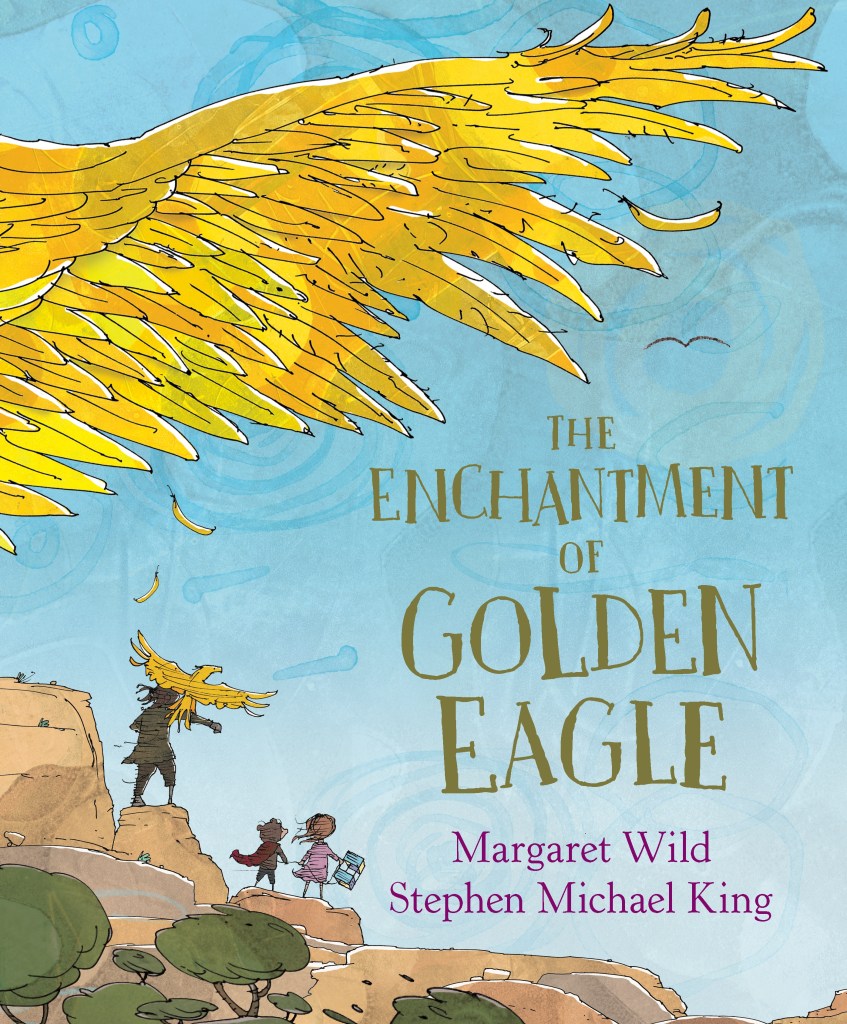
The Enchantment of Golden Eagle by Margaret Wild & Stephen Michael King
Allen & Unwin
Interview with Margaret Wild about The Enchantment of Golden Eagle
Thank you for speaking with Paperbark Words, Margaret.
Your career in children’s books is highly illustrious and it is a career that continues to exceed expectations. You have stepped out bravely and with understanding through your work. Additionally, the illustrators of your books read like a who’s who of Australian children’s literature.
I have collected your books for many years. Some personal favourites (and there are so many to choose from) are The Treasure Box, ill. Freya Blackwood (2013), Puffling, ill. Julie Vivas (2009), Woolvs in the Sitee, ill Anne Spudvilas (2006), The House of Narcissus, ill. Wayne Harris (2001), Fox, ill. Ron Brooks (2000), Bim Bam Boom!, ill. Wayne Harris (1998), The Midnight Gang, ill. Ann James (1997), Going Home, ill. Wayne Harris (1994), Let the Celebrations Begin!, ill. Julie Vivas (1991),The Very Best of Friends, ill. Julie Vivas (1990) and There’s a Sea in My Bedroom, ill. Jane Tanner (1984).
Like everyone, I’ve been delighted by your ideas, perfectly formed stories and memorable characters. I cherish the experiences that my shelf full of your books have taken me to.
Could you please mention one or a couple of books and collaborations that have meant a lot to you?
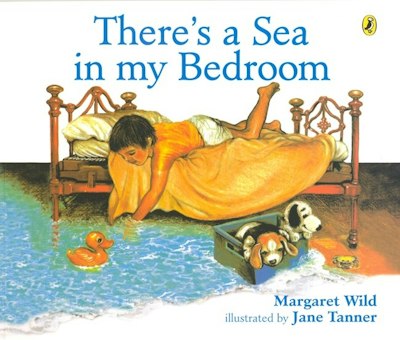
This is like picking a favourite child – which is impossible! However, There’s a Sea in My Bedroom, illustrated by Jane Tanner, holds a special part in my heart because it was my one of my first books to be published. As it was shortlisted for the CBCA awards, readers and publishers started to take an interest in my work, and the book is still in print today which is wonderful.
All my collaborations with illustrators are cherished in their own way. Sometimes I worked very closely with illustrators such as Wayne Harris, Donna Rawlins and Julie Vivas because they lived close by and we became friends as well as colleagues.
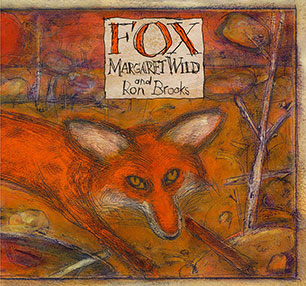
One of my favourite books has always been John Brown, Rose and the Midnight Cat by Ron Brooks and Jenny Wagner, so I was thrilled when Ron agreed to illustrate Old Pig, and, later, Fox. I was blown away by Ron’s masterful pictures and vision for Fox, which turned my story into a truly beautiful work of art.
Why have you focused on mainly writing picture books rather than other forms?
I started writing picture books because I enjoyed reading them to my young children and I thought, maybe this is something I can do. Because I was working fulltime for many years, the short picture book format was ideal – I could think of ideas and words before work, while I was driving, when I was in the bath, while I was cooking!
I also love the form of a picture book. For me, the structure is generally simple – beginning, middle, ending. I think it needs to have one idea (though this can be a big idea) and it needs to be sparely written with scope for illustrations to extend and interpret the text.
I have written a couple of novels (Beast and The Vanishing Moment) and two verse novels, Jinx and One Night, but I enjoy writing picture book texts most of all. I still get a thrill when I have the glimmerings of a new idea. I never rush this process – sometimes it can take weeks, months, even years before I am ready to write the story.
What are some recurring themes or concerns across your body of work? Do any of these appear in your new picture book, The Enchantment of Golden Eagle?
Many of my texts have some recurring themes such as love, loss, grief, loyalty, joy and hope. In The Enchantment of Golden Eagle, atonement, consequences, love and, especially, forgiveness, predominate. I see it as a hopeful story because at the end Golden Eagle is able have the love of the family, as well as the freedom to explore his nature as a wild bird.

In The Enchantment of Golden Eagle, Golden Eagle is a potent character and symbol. The golden eagle appears throughout mythology and traditional literature and is adopted as a talisman, emblem or icon by wide-ranging communities and countries.
In your book, Golden Eagle could be understood and accepted almost at face-value (particularly by young readers) but, as well as being a significant character with an important role, he is also a sophisticated metaphor.
How does your story allude to fairy tale or fable?
I think my story has some fairy tale elements – a talking bird who can communicate with humans, a curse that has dire consequences, a dark forest, howling wolves, a main character who has to undergo a trial, and, of course, there is the traditional happy ending.
‘Enchantment’ is an evocative word. Why have you used it in your title? How are you leading or guiding your readers into your story through this word?
I love the word “enchantment”. As you say, it is so evocative. With its associations of spells, magic and mystery, I hope it will spark a reader’s curiosity to open the book and read on. It may not be the story they are expecting, but I hope it will provoke discussion and, perhaps, even lead them to read some of the great fairy tales written in the past.
Who or what is enchanted?
Golden Eagle is ostensibly put under a spell that compels him to fly for a year and a day without stopping. It is only towards the end of the story that the reader finds out that the curse is not real and that the bird has chosen to do this penance because he’d promised to look after the children but had broken this promise.
How have you created an atmosphere of disquiet?
I think the words “dark forest” and the threat of the wolves creates a feel of disquiet.
Freedom, promise, responsibility, forgiveness and atonement are some central themes in the story. Which are particularly on your heart? Why?
I think forgiveness is really the most important element in the story. If you can forgive someone for hurting you in some way, there is always hope for understanding and reconciliation.
You care for and respect your readers. What are you relying on or assuming that they bring to this story? How do you show that you have high expectations of them as readers of this book? What responses are you receiving from them?
It is too soon for me to know how children will react to this story. But just as my book Fox leads to discussions about the virtues of kindness and loyalty, I hope readers will find much to think about in this book, too.
Is there a hero of this tale? If so, who? If not, why not?
For me, Golden Eagle is the hero of this story. Although he is a bird and it is natural he wants to fly, he takes responsibility for his actions and is willing to try to make amends, even if it is painful for him to do so.
You have previously collaborated with Stephen Michael King on The Pocket Dogs books and Piglet and Papa, Piglet and Mama and The Man Who Loved Boxes (the latter as publisher or editor).
How has Stephen Michael King surprised you with any of his illustrations for The Enchantment of Golden Eagle? How have his illustrations as a whole in this book or in one image enhanced or transformed your tale?
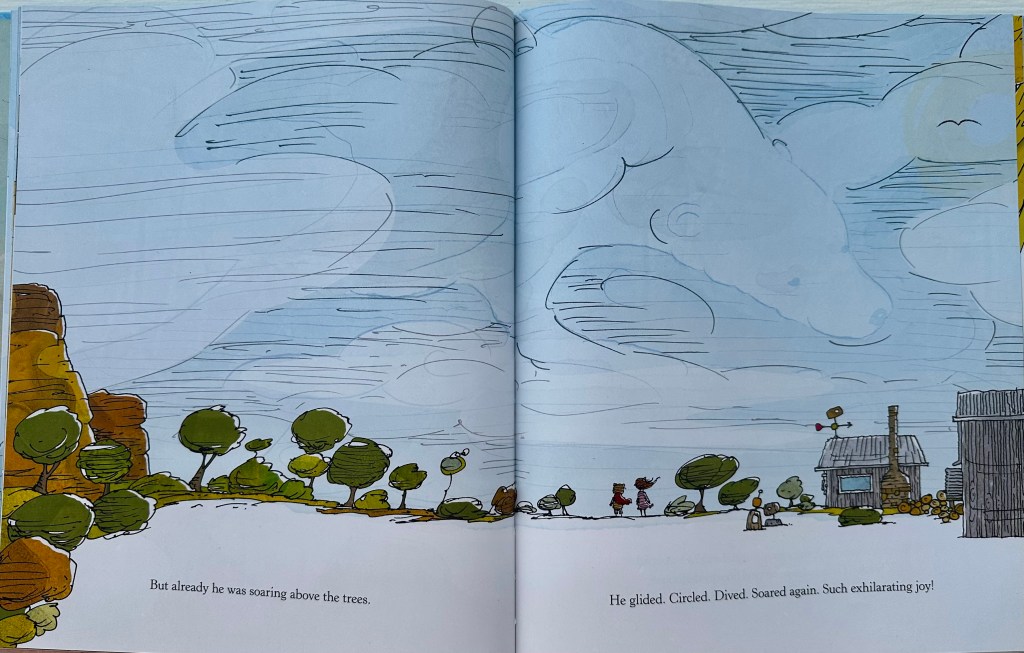
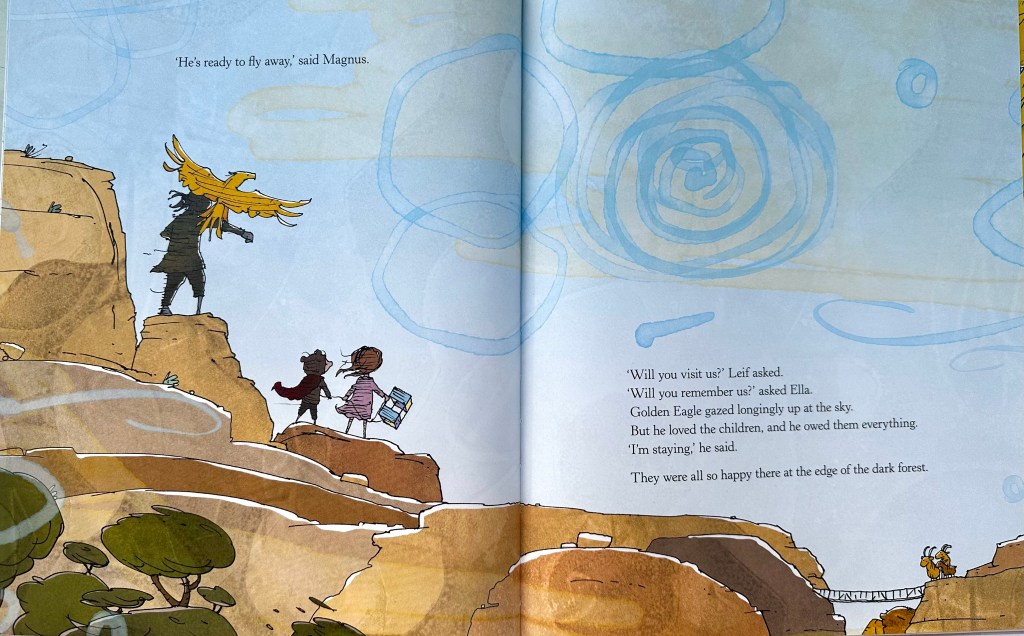
Stephen Michael King was free to approach this story the way he wished. The result was surprising and lovely. He chose to use whimsy and magical imagery such as clouds in the shape of bears and winged horses which help to give the story a mythological feeling. And there are lots of small details in the pictures for readers to discover.
The Enchantment of Golden Eagle at Allen & Unwin
********
OTHER RESOURCES
Most recent review and teacher notes about Margaret Wild’s books by Joy Lawn
REVIEW
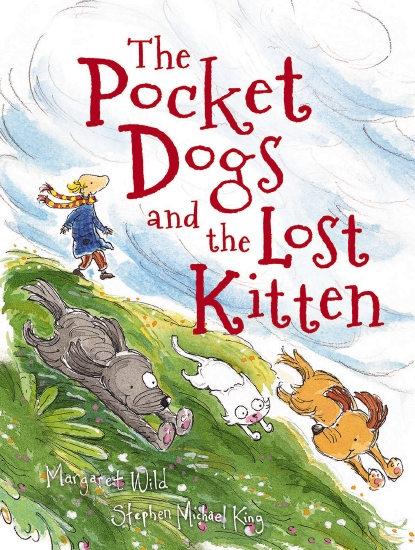
THE POCKET DOGS and the LOST KITTEN
Margaret Wild, ill. Stephen Michael King, Allen & Unwin, 32pp. 2016
(Magpies magazine, reproduced with permission)
The Pocket Dogs and the Lost Kitten is the third endearing ‘pocket dogs’ picture book, following The Pocket Dogs and The Pocket Dogs Go on Holiday. Mr Pockets is a genial man who carries the tiny dogs Biff and Buff in his coat pockets. Margaret Wild and Stephen Michael King re-establish the cosy relationship between man and dogs in this story before introducing the complication of a fourth character, a wet, lost kitten. At first the dogs are welcoming and kind but when they sense that the kitten may be displacing them in Mr Pockets’ affections, they become less friendly and so the kitten disappears. Mr Pockets explains that the dogs are very special to me, and you always will be … But the kitten also needs love and a home. The dogs feel ashamed and find the kitten before it leaves, and it negotiates how they can share and live together compatibly.
There is depth and detail in Wild’s seemingly simple tale. King visually opens and closes with double-page spreads and condenses the description and action into unframed panels: six panels on one page introduce the kitten and its amusing actions; and the dogs’ bad dreams and search are told in half-page spreads. The body language and facial expressions are lively and the colours blue and yellow feature. The ink and pencil-coloured shades of night and day and weather are also important in this tale of displacement and reconciliation for young readers.
Review by Joy Lawn
******
TEACHER NOTES by JOY LAWN
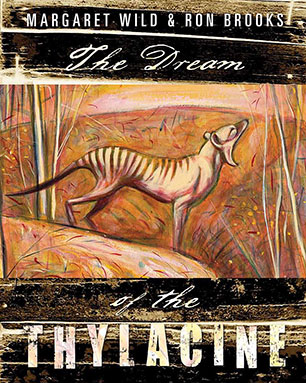
The Dream of the Thylacine by Margaret Wild and Ron Brooks
Teacher Notes by Joy Lawn
Publisher Allen & Unwin
Readership Mid primary to mid secondary
Genre Cautionary tale
Setting Hobart Zoo and Tasmanian wilderness
Language Emotive and spare, in poetic form
Illustration Media: acrylic on board and mixed media
Themes Animals in captivity; endangered and extinct animals Symbols Thylacine; cage; wilderness
Synopsis The last thylacine is trapped in a cage, howling and mourning. Its voice is full of aggressive anguish as it dreams of its lost freedom in the bush. As the thylacine weakens, its dream replaces the cruel reality of careless imprisonment.
Teaching Applications
- Written and Illustrative Texts The reader is very conscious of the thylacine’s pain, even when it remembers freedom. How do the author and illustrator show both captivity and freedom? Which parts of the story are told without written text? What is the impact of this? Where is the text placed on the page? [on lines of the boards] How does this change after the picture of the rainbow? [as if released from the boards and set free on white space] What has happened? [assume thylacine has now died] The text reads like poetry. Re-format the text as a poem and read aloud.
- Cover The cover design is powerful, as is the design of the whole book. Comment on the following about the front and back cover: font/typeface; colours; lines in different directions [causing foreboding; disquiet]; textures; boards or part of the cage as part-frame around the illustration and words; head and tail cropped in photo.
- Visual Literacy 1. Page Layout The illustration on the first double page is monochromic (one colour) and placed inside an irregular white frame; the second double page is in colour and ‘bleeds’ to the edge of the cover (without a border). Look at other examples throughout the book. What are the different effects of these? Which is preferred? 2. Lines Find horizontal, vertical and diagonal lines. What effect does each type have? Do any dominate? If so, which? 3. Photos Why are the photos of the thylacine blurred? [old; but also imply the ailing animal] 4. Artist Heroes In Drawn From the Heart, Ron Brooks mentions some of his artistic influences, which include Australian artists Boyd, Nolan, Blackman, Dickerson and Roberts. Research some of their works to see which have had influence here. 5. Last Illustration What does this show? [Open to interpretation but could be an abstract picture of the thylacine body returned to its home, its body elementally forming the landscape.]
- Virtual Museum Webpage Research thylacines’ appearance, life and habitat. What happened to them, and why? http://australianmuseum.net.au/The-Thylacine How can other animals be kept safe from extinction? Which Australian animals are endangered now? [e.g.koala] Find out more about the last thylacine which died in the Hobart Zoo. View videos of it, e.g. http://www.youtube.com/watch?v=6vqCCI1ZF7o Display findings as a virtual museum webpage.
- Read I Saw Nothing: the Extinction of the Thylacine by Gary Crew and Mark Wilson; Fox by Margaret Wild and Ron Brooks; Vampyre by Wild and Andrew Yeo; Drawn from the Heart by Ron Brooks; One Small Island by Alison Lester and Coral Tulloch; or Endangered: Working to Save Animals at Risk by Rick Wilkinson.
Display
- Montage Create two montages, one inspired by the endpapers at the start of the book (daylight and straight trees) and the other by the end (night-time and obscured twisted trees or plants). Wire could be attached to boards or a wire pattern screen-printed onto cardboard. Enlarge a photo of a thylacine to attach to the background.
- Publisher Teacher Notes http://www.allenandunwin.com/_uploads/BookPdf/TeachersNotes/9781742373836.pdf
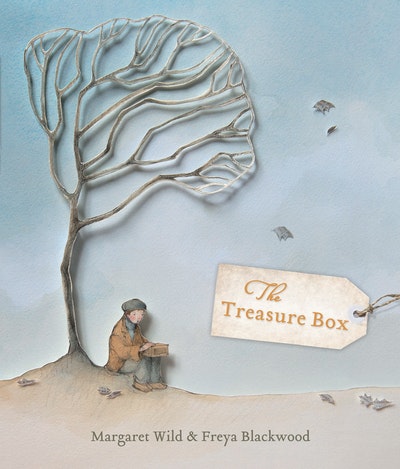
The Treasure Box by Margaret Wild and Freya Blackwood (Puffin)
Teacher Notes by Joy Lawn
Readership Junior primary to mid secondary
Award Shortlisted 2014 INDIE Book of the Year: Children; shortlisted 2013 Qld Literary Awards
Genre Metaphorical war tale
Setting Not explicit, but could be an occupied town in WWII, and the refugee’s subsequent flight. It could represent any place that has been invaded.
Language Sparse but rich in imagery
Illustration Freya Blackwood states on her blog: It wasn’t the easiest book I’ve worked on, mostly because I decided to create each illustration in layers, cut out and stuck one upon the other like a paper diorama. This meant the illustrations had to be lit and photographed rather than scanned.
Themes Importance and value of books and words; war and escape; resilience
Synopsis Only one book survives when the enemy destroys the library. Peter and his father escape with other refugees and protect the book as treasure inside a box. When he can carry the box no further, Peter buries it under an ancient linden tree. Many years later he returns to claim and share this treasure.
Teaching Applications
- Visual Literacy 1.Torn Paper What does the torn paper represent? [important destroyed library books which represent a race’s heritage]
2. Panels There are some square panels which look set into the paper from underneath in a 3-dimensional framing technique. This is a very innovative effect. A doorwayalso forms a panel; a technique that Freya Blackwood uses to great effect in Maudie and Bear. Students view these panels.
3. Colours Book illustrations can be more powerful when a limited colour palette is used. What are the predominate colours here and what effect do they have? The tones are quite muted. When do they become brighter? What effect does this have? How is the colour red used?
Identify the effect on audiences of techniques, for example in picture books (ACELA1483)
- Read Look, A BOOK! by Libby Gleeson and Freya Blackwood, which has a similar theme about the importance of books (and features another red book). Older students can read The Silver Donkey by Sonya Hartnett and Once and Then by Morris Gleitzman, whose foreign edition text forms part of the illustrations in The Treasure Box. Why might these books have been chosen?
Display
- Three Dimensional Effects: Bas and Paper Reliefs It appears that the book illustrations have been drawn and coloured, then cut out and positioned on scenic backgrounds. This paper collage resembles ‘bas relief’, a type of sculpture where the carved shapes are only slightly higher than the flat background, or ‘paper relief’ – paper sculptures. To create these effects, students mould a low treasure of their choice from brown clay. This could be jewels, coins or something else. Place onto a blue board or surface to create a bas relief. Then draw a simple, repetitive pattern onto a piece of light-coloured paper – choose a colour from the book. Cut some lines and fold, curl or raise the paper upwards. Attach to a piece of paper in a contrasting colour from the book to create a paper relief.
- Book Remnants Create a scene with torn remnants from old books.
Publisher Teacher Notes http://www.penguin.com.au/educationcentre/pdf/teachers_notes/PDF/9780670073658.pdf
Illustrator Website http://www.freyablackwood.com.au/
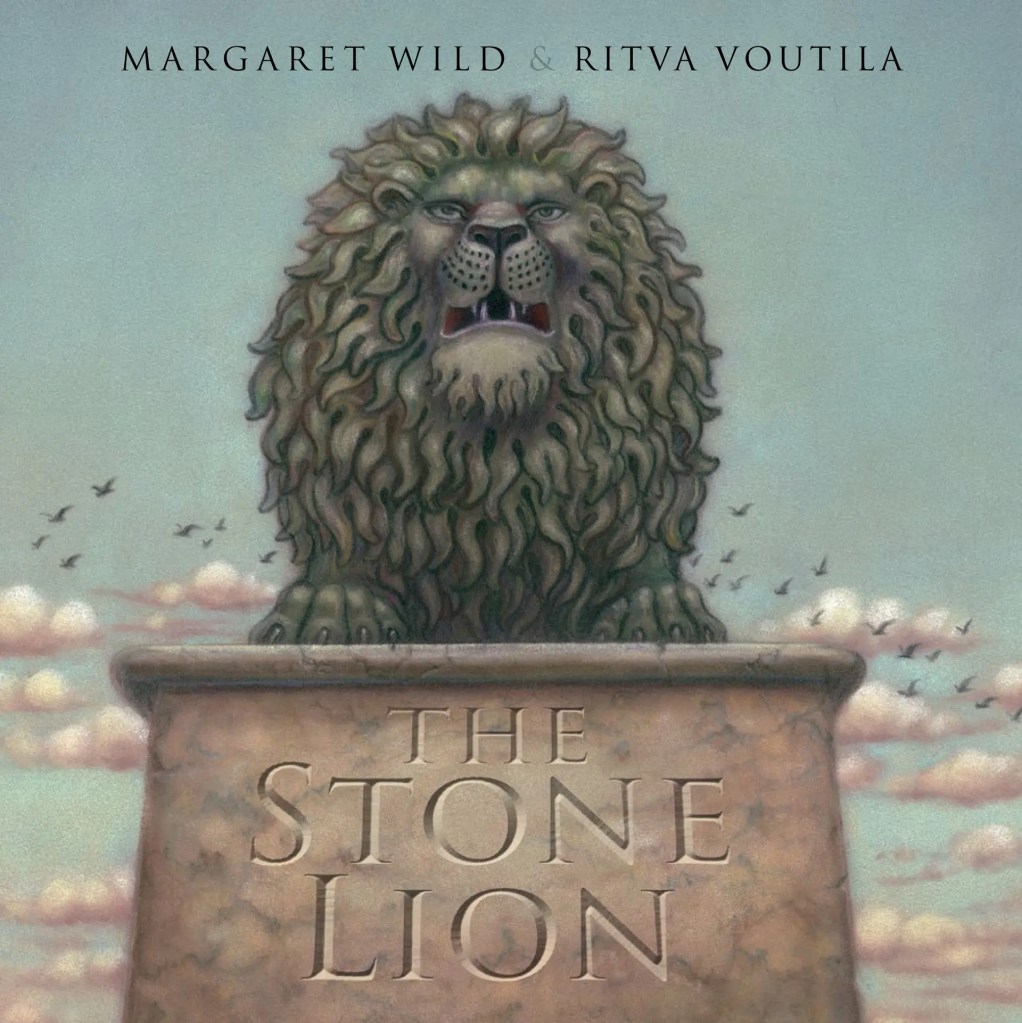
The Stone Lion by Margaret Wild, illustrated by Ritva Voutila
(Little Hare, Hardie Grant Egmont) 2015
Teacher Notes by Joy Lawn
Readership Primary
Genre Traditional literature style
Setting Wintry European or other city
Language Classic style
Illustrations Soft, muted pastels
Themes Feelings and caring; homeless children; books and library
Synopsis A homeless girl, Sara, and her baby brother huddle against the stone lion outside the library. Even though the gargoyle explains why Sara weeps, the lion’s heart is hard because he doesn’t understand. When the lion has the chance to live because he feels pity for Sara and her brother, he only has a short time to save them. Ben, who works at the library, reads books about living creatures who feel happy or sad, despairing or hopeful while leaning against the lion.
Teaching Applications
- Library This book celebrates libraries and books. Read books while leaning or sitting outside the school library like the librarian Ben does; get involved with a Book Week or other activity at the local library and explain that you are doing this after reading The Stone Lion; and find out what’s happening for children in major and city libraries such as the National Library of Australia (which published the Eve Pownall shortlisted book, Tea and Sugar Christmas).
- Peer Beneath the Cracks Students think about the gaps in the story, particularly why stone animals are sometimes given the chance to become alive.
Think about, and write explanations for, this and other gaps in the story.
Creating literature
Create literary texts that adapt or combine aspects of texts students have experienced in innovative ways (ACELT1618)
- Visual Literacy 1. White Space Students compare the lack of white space in this book with the white space in some other shortlisted picture books. Why isn’t white space a feature here? Where could it be included? 2. Full Bleed The colours ‘bleed’ or run to the edge of every page. Students discuss the purpose of this after framing some pages with white borders as a contrast (strips of white paper could be placed around the pictures). [bleeding to the page edge can help viewers ‘go into’ the picture without being ‘barricaded’ by a frame] Then students draw wintry city scenes in pastels. Bleed the colour to the edge of the page. Compare how these pictures look with a white or coloured cardboard frame.
- Read The Library Lion by Michelle Knudsen and Kevin Hawkes; Way Home by Libby Hathorn and Gregory Rogers; The Little Match Girl by Hans Christian Andersen; other books by Margaret Wild such as Vampyre, The Treasure Box and The House of Narcissus; and The Selfish Giant illustrated by Ritva Voutila.
Display
- Kinetic Sand Model Make or buy kinetic sand to model the stone lion on its plinth. (Damp sand or clay could alternatively be used.) Include details of textures such as the mane.
http://www.growingajeweledrose.com/2015/01/homemade-kinetic-sand.html
- Wintry City Scene Illustrate a wintry city scene in pastels and hang (see ‘Full Bleed’ above). Note the difference a frame makes to a stand-alone picture.
Publisher Teacher Notes http://www.hardiegrant.com.au/egmont/resources/teachers-resources/picture-books
Illustrator Website http://www.ritvavoutila.com
The Feather by Margaret Wild, illustrated by Freya Blackwood
Teacher Notes by Joy Lawn
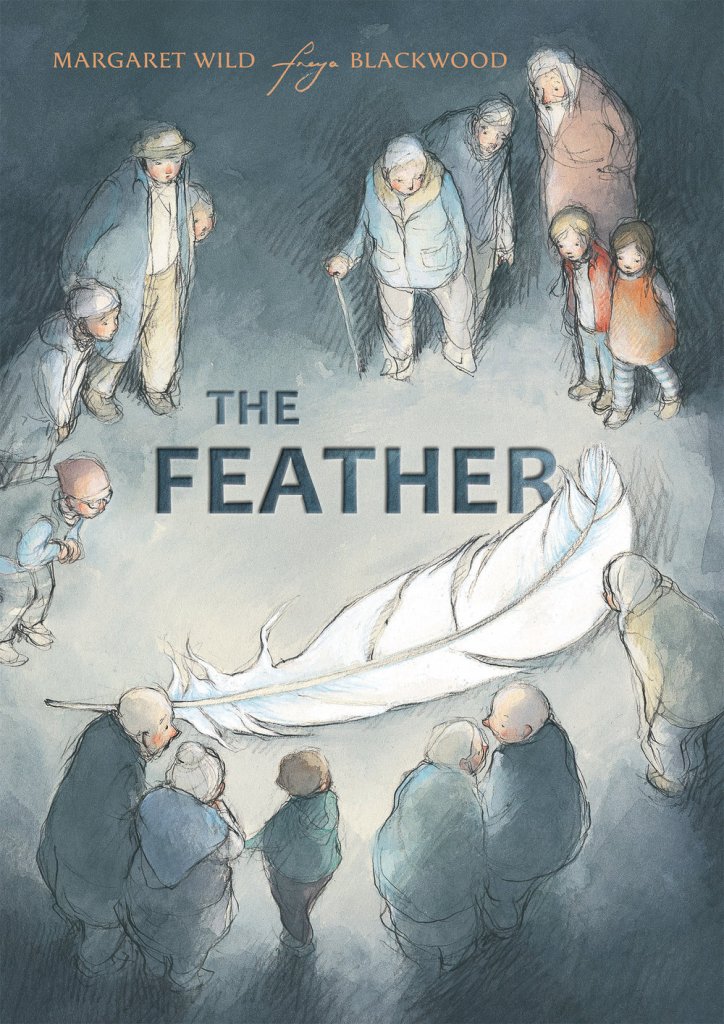
The Feather is an allegorical, allusive tale. When the feather falls Maria and Nico are curious. They take it to the villagers who want to preserve it because of the memories it brings. Maria knows that the feather needs to fly and feel the sun, wind and rain but it is already trapped. It becomes stained and discoloured and the villagers reject it. The children treasure it and let it fly free.
Feather Symbol The book leaves us with the question, What might the feather symbolise? Students suggest answers.
Fore-edge/Fourth-edge Painting Fore-edge painting is a traditional form of painting on the fanned or slanted pages of a book. The picture is hidden when the book is closed. Students view examples of fore-edge painting, e.g. https://en.wikipedia.org/wiki/Fore-edge_painting and images online. This technique is difficult to replicate in a school setting but students, instead, paint the fourth-edge (outside of the pages opposite the spine) of a book.
The feather an ideal motif for fourth-edge painting.
Students first practise painting a feather on paper. When proficient they could first sketch and then paint the feather onto the outside pages of an old novel-sized book – the fourth-edge. The book could be ready to be recycled from the library, donated from home, or bought cheaply from a second-hand bookstore.
Optional: to hide the existing book cover and complete the feather design, students sketch or screen print feathers onto a blank paper dustjacket. Display these around the picture book The Feather.
Read the shortlisted picture book, Cicada. How does the ending of The Feather resemble the ending of Cicada? Read
Look, a Book! illustrated by Freya Blackwood. How are the characters in these books similar? Read other books by Freya Blackwood and Margaret Wild, particularly The Treasure Box. Read Feathers by Phil Cummings & Phil Lesnie.
Chalk Boy by Margaret Wild, illustrated by Mandy Ord
Teacher Notes by Joy Lawn
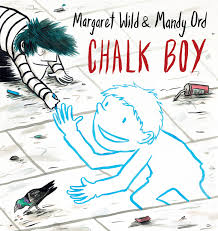
Barnaby is a pavement artist who drew a boy in blue chalk. Chalk Boy has senses, a head that can think, legs that can run and a heart that feels. He narrates the story and, early on, reaches out of the pavement to hold Barnaby’s hand. Chillingly Barnaby warns him, “when the rains come you will wash away and be no more”. Chalk Boy says he understands, “But right now I don’t care.” He lives in the moment: juggling, reading, swimming, playing guitar and rowing a boat. Life is wonderful until the “cold, cold night” when he stares at the moon. Rain starts to fall and he begins to smudge. He cries for help, “I don’t want to wash away on my own.” Only Barnaby hears his cries and covers him with plastic. In the morning Barnaby tells Chalk Boy that he is not alone and draws one last picture – Barnaby is now in the picture with Chalk Boy.
Chalk Boy is a poignant story with themes of creating, imagination, being alone, fear (possibly of death) and being a friend.
This picture book is distinctive because of its use of a chalk boy to suggest or represent a human child.
Its layout incudes some wordless pages.
Using the book with children:
Chalk Figures Children could draw chalk figures on the ground or on paper. They could choose only one colour, like the illustrator has done with blue.
Like her, they could draw the outlines only, except for the heart, which can be coloured in.
Friends Barnaby is a good friend to Chalk Boy. Children decide how they could be a good friend to someone by thinking of a way they could spend time with them. Then they should act on their idea.
Watch An iconic chalk picture scene is in the movie, Mary Poppins. Children could watch this scene using the following or another link. https://www.youtube.com/watch?v=8fHppd_KtP4
Read I Want to be in a Book by Narelle Oliver, another metafictive book (metafiction draws attention to the book as an artefact) or The Three Pigs by David Wiesner.

 paperbarkwords.blog