“Somewhere, towards the beginning of time … a mountain rose from the ocean and came to rest above the clouds. Life sang a lullaby, and the mountain slept for many millions of years. Until one day … ” (When the Mountain Wakes)
When the Mountain Wakes by Matt Shanks
When the Mountain Wakes is an environmental cautionary tale of hope. Told as a exemplary graphic novel in picture book form, Matt Shanks brilliantly shares environmental concerns while offering a way forward.
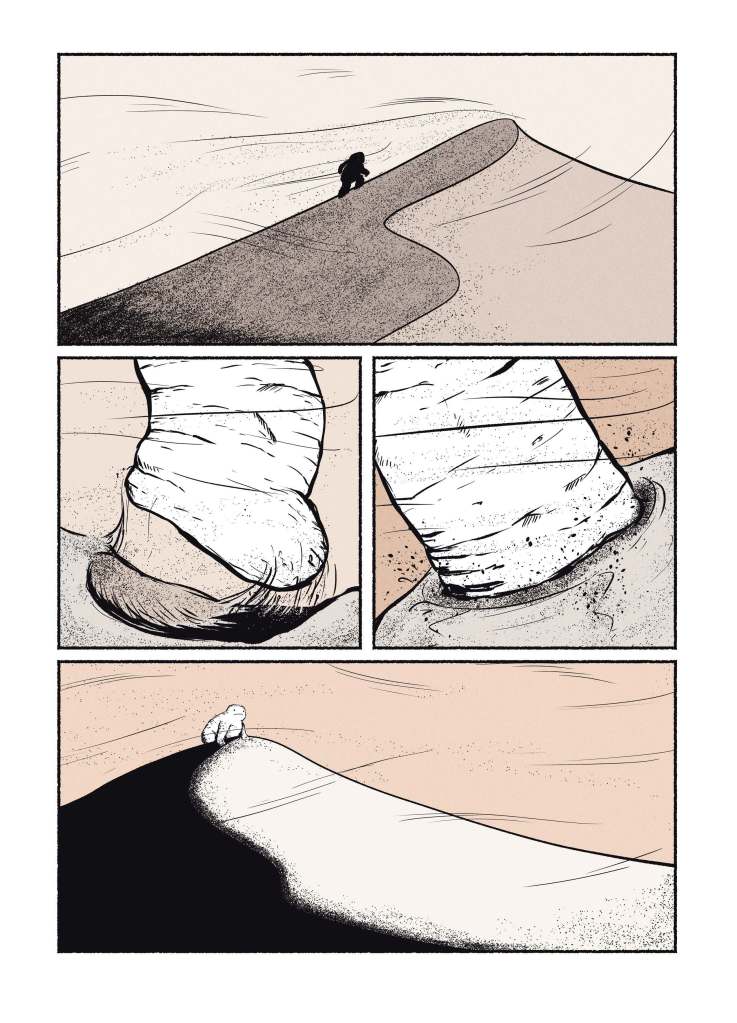
Shanks personifies the mountain that wakes “when the world became too silent for sleep … So the mountain went searching for a song.” The mountain is benevolent yet lonely and disturbed about the arid wasteland it traverses. Until it finds an ephemeral symbol of beauty and possibility.
The writing is simple and profound and the images help tell and extend the story. The page compositions and panels are a masterclass in how to create a graphic novel.
As an adjunct to his book, When the Mountain Wakes, Matt Shanks writes about Mt Rothwell Biodiversity Centre, which he recommends for school group and other tours, for Paperbark Words blog.
When the Mountain Wakes by Matt Shanks
Matt Shanks writes about land conservation and species
Mt Rothwell Biodiversity Interpretation Centre, Victoria, Australia
A beginning for our kids, not nearly an end
by Matt Shanks
I plug the address into my GPS and it doesn’t really know what to do with it: “Mt Rothwell, VIC”. A pin drops on a road called “Mt Rothwell Road”. That doesn’t look correct. I zoom out a little to try to get some more context. It looks like the middle of nowhere. I zoom out a little more, “Oh, I see, it’s not far from Werribee Zoo.”
I text my contact at the Odonata Foundation who runs Mt Rothwell Biodiversity Interpretation Centre, Victoria’s second largest feral predator-free ecosystem, “Um, have you got better directions? It’s dropping me in the middle of nowhere.” They text back, “Put in Mt Rothwell Biodiversity Interpretation Centre.”
Ah, great, got it. We’re on our way.
And, in about an hour from Melbourne, we’re driving along a stretch of the sanctuary’s specially designed feral predator-proof fence line. On the other side of that fence, there are 473 hectares of sanctuary for some of Australia’s most precious native animal species including 80% of the mainland Eastern Barred Bandicoot population – the only recognised stable self-sustaining population left.
“How did we not know about this?” I ask my wife, who’s busy looking for the end of the fence line and the way to get to our meeting point.
That’s right, just down the road from a sanctuary for African animals that attracts over 700,000 visitors annually, is a place that almost no one has ever heard of, almost no one ever visits, but gives those in-the-know a taste of what our own landscapes were like before European settlement. A time before deforestation, before cats, foxes and rabbits – a woodland, a grassland, and a granite outcrop and it is teeming with native animals and plant species.
The property was purchased back in 2000 by John Wamsley, and was fenced off in its entirety. Foxes and cats were removed and, over time, a group of kind, smart, and generous humans have done over 2 decades of intergenerational work to create a sanctuary for some of our most critical, endangered, and beloved species.
As we arrive for our evening tour and the sun begins to set, small ground creatures start to scurry in the leaves around us – curious but cautious – bettongs, bandicoots, potaroos. On our way to the loo we’re told to be careful, “there’s a giant huntsman in the far cubicle, better to stick to the closest one for now.” A chorus of cockatoos settle in the tree branches above and screech so loudly that it’s difficult to hear our guide who assures us, “we’ll just give those ladies in the tree a minute, they’ll quieten down soon.” She’s not wrong. It was like clockwork.
After a short introduction about the place, our guide lights a path for us with her red, critter-friendly torch and we set off on the 45-min walk around the property. We’re not on the other side of a fence looking in like a zoo – we’re inside the enclosure, all 473 ha of it.
Within a few footsteps, our guide spots a small mob of brush-tailed rock wallabies looking curiously back at our small group. Mt Rothwell has the most successful breeding program for them in a semi-wild environment. They are also translocating them back into the wild. Not how you imagine though – they aren’t able to drive them in to their remote wild habitats on the back of utes. They are backpacking them in! Yes, that’s right, wallabies in backpacks, on foot.
With every bandicoot, quoll, and bush stone curlew, we see and hear I keep thinking to myself, “How do people not know about this?” And I’m torn. At once wanting to share this incredible story of human kindness, empathy, planning and patience with as many people as possible but also aware that by sharing it, I risk a human invasion of tourism and commercialisation. What, here, is the greater good?
Most of my work as a picture book author and illustrator has been about highlighting the incredible species and ecosystems of a land I was lucky to be born on. I am deeply thankful to our First Peoples for the care and stewardship they provided so that people like me could experience it.
Now, in the middle of the tour, as I stand on Mt Rothwell’s ancient Granite Outcrop overlooking the glittering lights of a cosmopolitan Melbourne back across the bay, I find myself also thankful for science, engineering, and those who value long-term thinking and patient capital; all the stuff that makes a place like this possible in our modern world. I can’t help but think, on balance, more people need to know about this place despite the risk of inundation from humans looking to post the next thing to social media.
The more time I spend around ecologists and policymakers in the climate, restoration and conservation space the more I realise that there’s a distinct difference between nature time and human time.
I, like many who are climate-anxious, catch myself waiting for a Hollywood-style catastrophic ‘collapse’ – here today, gone tomorrow. But the reality of this change is evolutionary and generational. It’s not ‘coming’ in human time, it’s ‘happening’ in nature time. It’s not about tomorrow, it’s about 200, 300, 1000+ years from now. It’s about millennia before now, too. We like to think we’re at the end of a story, but we’re probably somewhere in the middle, maybe even closer to the beginning.
Me? I’ve got, in a best-case scenario, 90-100 years of existence and I’m almost halfway through. The granite outcrop at Mt Rothwell that likely formed in the Devonian period (~400 million years ago) will still be there when I’m gone. 400 million isn’t easy to grasp when your biological limit is just 100. A speck of dust in the huge timeline that is our Earth.
So, how do I use the remaining 50 years? How might any of us? Because, for our kids, it’s just a beginning, not nearly an end.



 paperbarkwords.blog