

Confessions of a Minor Poet by Phil Brown
(Transit Lounge)
“I was transplanted from a school like the one in Goodbye, Mr. Chips to one more akin to Lord of the Flies. But while my outward life tended to be surfing, partying and reading Tracks magazine, I retained a rather bookish inner life. I was a Hemingway buff, regularly read C. S. Lewis and Tolkien, and in Grade 11 I don’t think anyone else in my circle was burying his head in the latest Patrick White.
Even stranger, I thought I understood it.”
(Confessions of a Minor Poet)
Author Interview: Phil Brown
Thank you for speaking to Joy in Books at PaperbarkWords blog, Phil.
You are well known in literary circles, perhaps particularly through your arts journalism and editorships of major arts publications. Where are you based now and what are you doing?
I am based in Brisbane’s relatively inner north. I left The Courier-Mail two years ago where I was the Arts Editor. I am now the editor of the independent arts website InReview Queensland which is part of InDaily Queensland. So I basically cover the arts in Queensland. I work from home and in between stints of work I do washing and hose the garden or write poems. I should start another book soon.
What do you love about Queensland and what do you think it has to offer the rest of Australia?
I have lived in Queensland since I was 13. I have also lived in Sydney and Melbourne in adult life. We moved to Queensland from Hong Kong which was quite a change. My father was born in London but my mum was a Queenslander and I have become one too. I support the Maroons and the North Queensland Cowboys rugby league teams and it doesn’t get much more Queensland than that! Queensland has a lot to offer as a tourist destination and now more than ever Brisbane is an arts capital. It has a wonderful lifestyle and I am will live out my days here.

The title of your new book, Confessions of a Minor Poet, hints at your self-deprecating voice and style, despite your impressive life and career. I enjoyed interviewing you on a panel at Brisbane Writers Festival, where you were obviously a crowd favourite, about The Kowloon Kid: A Hong Kong Childhood. Could you briefly share how Hong Kong was formative?
My Hong Kong childhood has informed my whole life. We were spoilt rotten and had to acclimatise coming home to Australia. Hong Kong was where I developed my love of music and reading. We lived there from 1963 to 1970 and it was a colonial idyll back then and a fascinating place that I still regularly visit.
In Confessions of a Minor Poet, you continue your life story as a young man, poet and more. Could you give a couple of highlights or low points?
What would (or should) you have done differently?
I would have done everything differently! But I guess my experiences have shaped me. I’ve had many personal existential struggles which I write about in my new book. It’s quite revealing. My highlights include marrying my wife Sandra McLean and having a son, Hamish, who is the apple of our eyes. My family life is everything to me and literature and journalism come second to that. I guess the low point was the untimely death of my dad who was 55 when he died.
You seemed like a pretty wild young man. How much of that was circumstantial and how much was your disposition? How did you get from being in quite a bad space to becoming a revered literary editor? How are you still that young man? How are you different?
You mention your lifestyle possibly affecting your spiritual quandary. What was that about?
I may seem urbane to some but inside me is an 18-year-old Gold Coast surfie trying to get out. On the inside I am also still that bookish kid going to an international British school in Hong Kong. I was badly behaved at school and a bit of a rebel for various reasons. Insubordinate would describe me perfectly. But I have slowly changed over the decades although the recalcitrant youth is still there just under the surface. My spiritual quest has been long and complicated but I try to keep it simple nowadays and live one day at a time.
What is a favourite interview you’ve had? Why?
Oh gosh I have done some many interviews it’s hard to say. Willem Dafoe was a highlight – he’s a great actor and a lovely bloke. I always enjoyed my chats with the late great John Marsden who was so down to earth but inspiring. Kathy Lette was good fun and I have spoken to many great authors. I had a fleeting John Cleese interview as a youngster and a very memorable if strange encounter with the historian Professor Manning Clarke and I write about that in my new book.

Could you give some insider information on Michael Hutchence, Oodgeroo Noonuccal, Eric Bana, Bruce Dawe, Les Murray (who we were honoured to have speak in our home as part of our ‘Be Inspired’ series for family and friends), David Malouf (another luminary who inspired us) or Trent Dalton?
Oh Gosh well Michael Hutchence was a neighbour in Hong Kong and I knew him as a boy and have written about that in The Kowloon Kid. I feel very sad about his early death. Bruce Dawe was my literary mentor and I tell a funny story about him choking on a peppermint in my new book. Les Murray also gets a chapter and Eric Bana makes an appearance which will amuse you. But you’ll have to buy the book or come to the book launch at Brisbane Writers Festival to find out more.
The chapter headings in your book are entertaining. Could you choose one and tell us something about that chapter or the incident to which it refers?
As a journo I guess I have a knack for chapter titles. Let’s mention the first which I think is probably inspired by Richard Brautigan. It’s called How To Read a Disguised Watermelon and is set in the surfing scene on the Gold Coast in the mid 1970s. The watermelon in question was my surfboard (that was the label name) and that board had a poem of mine on the undercarriage.
You had a bit of a wrangle with someone about poetry having to be true or not. What’s your stance?
Poetry has to ring true but it doesn’t have to be actually true. I mean there is no J. Alfred Prufrock (is there?) but T. S. Eliot made us think there is. People who tell you what a poem should be are suspect and should be ignored. In recent years I had a poetry editor question whether a poem I sent in was even a poem. I can confirm it was!
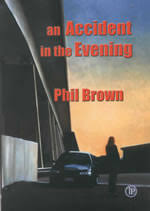
Could you give a sample of one of your poems that you’re particularly happy with? Where has it been published?
My poem In a Kowloon Garden is a favourite and features in my book An Accident in the Evening. This poem evokes the exotic Orient of my childhood and in my head I still live in that world.
Any advice for aspiring poets?
Read as much as you can and write like mad. Don’t get it right, get it written, as a friend of mine says. Poetry is like virtue, it is its own reward.
What is your tip to being a super quick writer with a speedy turn-around time?
That is something I picked up as a former advertising copywriter and then a journalist for four decades. I think just let it rip is my advice and then you can go over and over it later. Having an editor demanding your story is what makes us journos write quickly.
Journalism, book writing or poetry? Which is your favourite? Why?
I love them all. Writing a book is daunting and poetry, well you should set aside an hour a day to attend to that and see what happens. I write journalism every day and I love being in the writing zone. All the troubles of the world disappear when I am engrossed in writing.
Around the time I moved to Brisbane, BWF had publicity signage, including enormous posters on the side of the road, of three people wearing black turtlenecks – your signature clothing, as told in the book. Were you one of those people? If so, what was the idea behind the campaign? Who were the others?
I have no recollection of that but a black turtleneck is my uniform.
You’ve written several well-received books now. What’s coming next?
I am thinking about writing a novella about a man looking into his father’s past. Was his father a spy or not in Hong Kong in the 1960s.
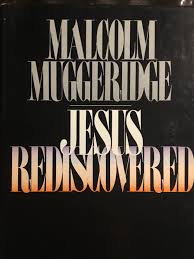
Thanks very much Phil, and could you leave us with a few favourite book recommendations?
The Razor’s Edge by W. Somerset Maugham, Malgudi Days by R.K. Naryan, The Quiet American by Graham Greene, A Moveable Feast by Ernest Hemingway, Jesus Rediscovered by Malcolm Muggeridge, Moravagine by Blaise Cendrars, She by H. Rider Haggard …
“Poetry is such a subjective business, though. Poems that have been dismissed as piffle by one editor can be embraced by another.” (Confessions of a Minor Poet)
PS Confessions of a Minor Poet will be launched at the Brisbane Writers Festival on October the 9th . More details at https://bwf.org.au/

 paperbarkwords.blog