

Adventures on the Dreaming Path by Paul Callaghan, illustrated by Dylan Finney
Pantera Press
Paul writes about the creation of his children’s book, Adventures of the Dreaming Path, a follow up to his ABIA Award winning and best-selling adult book, The Dreaming Path for PaperbarkWords blog:
Introduction
I belong to Worimi/Birpai Country – saltwater country, which begins just north of Newcastle and covers an array of golden beaches, meandering water ways, towering forests and sacred mountains that make my spirit soar. My mother grew up on Karuah Mission, a place of nostalgia and fond memories – kids laughing as we ran barefoot through paspalum grass in summer, and the smell of the old iron stove where Granny’s kettle was always on the boil.
I have four grandchildren these days (all under three). Through the sharing of story and culture (as has been our way since the Dreamtime), I hope to connect them, other young people, parents, teachers and others with the world’s oldest living culture and the special gifts culture can give all of us.

What is the Dreaming Path?
The Old People say ‘when we leave this world behind, all we leave behind is our story. So, make it the best story possible.’ When we are living the best story possible, we are on our Dreaming Path, we are fulfilling our purpose in life. Following our Dreaming Path is about embracing our uniqueness, but in a way that embraces an overarching responsibility to care for our place and all things in our place.
Traditionally, children were told many stories as they grew that would give them the knowledge, values and ability to be their true selves, care for others and care for the environment. By viewing the learning process as a sacred responsibility, children were given all they needed to live a life of gratitude, joy and contentment.
Through this book, I hope to reflect the beauty of our old ways, and inspire young and old to continue their learning with local custodians, to find their Dreaming Path, and to live the best story possible.

The Writing Process
Given Adventures on the Dreaming Path targets such a different audience to The Dreaming Path, I decided it would be better to start this book from scratch rather than try and modify what had been so successful in the adult market.
My lived experience in terms of the challenges I have faced in my life (including many scars from my teenage years) and in fulfilling my parental responsibilities, has shown me the value Aboriginal culture has in supporting parents and teachers to prepare young people for the road ahead.
Before commencing the writing process, I researched the things that eight-and-nine-year-olds stress about and how traditional knowledge can assist in alleviating those fears. This process of reflection enabled me to identify several key themes including:
- being yourself,
- loving your body the way it is,
- caring for the land,
- learning from your hard times,
- following your dreams,
- what to do when you are sad,
- knowing you are never alone,
- knowing you are special, and
- doing what you love but doing it safely.
These themes are covered in several animal-based Dreamtime stories and connected through an overarching storyline that involves Elder, Uncle Rolly spending time with young people, Emily and Jacob.
Each chapter includes a ‘Having a Yarn’ section where Uncle Rolly and the children reflect on what they learned from the Dreamtime story he has just shared. Each chapter concludes with a ‘Conversation Point’ that facilitates a discussion between adults and children in a strength-based and safe space and an ‘Activity’ that reinforces the learning of that chapter.

Key characters
Uncle Rolly is a fictional Elder who is both funny and wise. Emily and Jacob are eight-year-old children at Milroy Public School who have asked their teacher (Ms Green) if they could meet an Aboriginal Elder as a class project.
‘Do you know when I was your age, there were still dinosaurs around?’
‘Really?’ Jacob’s eyes were almost popping out of his head.
‘Yep.’ There’s even one named after me, Rollasaurus Rex.’
There was silence.
Then Uncle Rolly laughed so loud that Emily and Jacob jumped. ‘Naah. Just joking’.
Uncle Rolly meets with the children on a regular basis in different settings (classroom, where he grew up, in the bush). During these catchups, Uncle Rolly shares insights into his life, including how his brothers and sisters were taken away when he was young and how he stays positive despite the many hardships he has faced in his life.
There was a moment of silence, broken by the twitter of fairy wrens. Uncle Rolly turned to a bush and pointed at the darting brown shapes.
‘There you go.’ He clapped his hands. ‘They’re reminding us that there’s still lots to be happy for’. He smiled. ‘Now, are you ready for today’s story?’
Highlight of the book
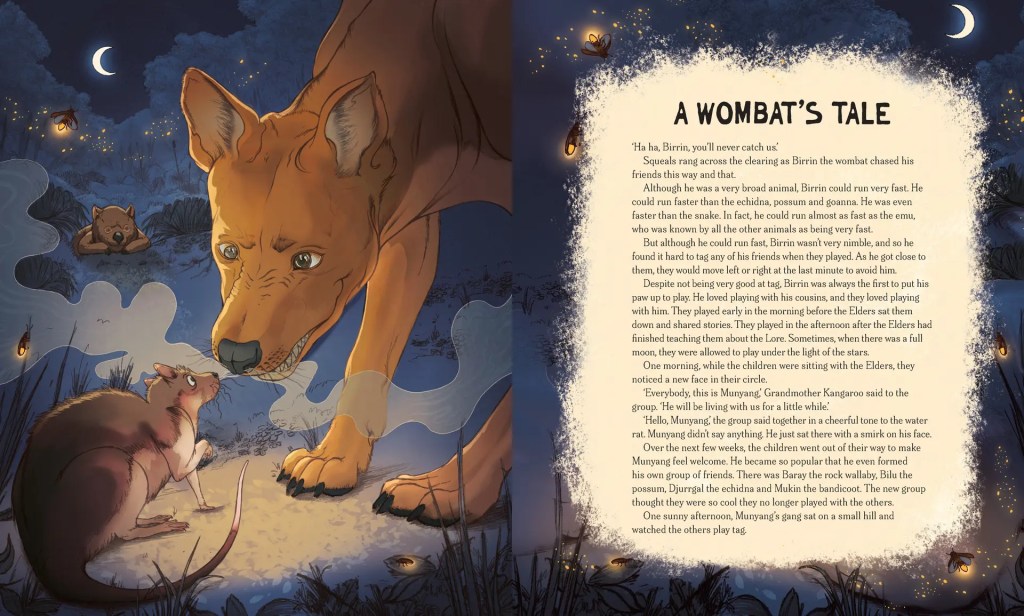
In some ways each of the Dreamtime stories is a highlight of the book, with one of my favourite stories being ‘A Wombat’s Tale’ which is essentially about Birrin the wombat being bullied by a group of children and how Birrin saves the group from being eaten by a pack of dingoes.
The wombat could hear the group crying. ‘Don’t worry, you fullas. I’ve got this,’ he said as he wedged himself into the hole and used his bottom to close the entrance.
Growls turned to howls as the dingoes bit and scratched at Birrin’s exposed backside. No matter what they did, the wombat didn’t move. The dingoes yelled nasty things at Birrin, but Birrin ignored them.
‘They can carry on as much as they want,’ he said to the animals huddled below him. His voice was very calm. ‘Wombat bums are not only big, they’re also as solid as tree trunks.’
The highlight of the book, however, is towards the end when Uncle Rolly catches up with Emily and Jacob accompanied by a woman wearing a bright orange dress.
Emily and Jacob glanced at each other. They had no idea who she might be.
Tears were now running down Uncle Rolly’s wrinkled cheeks, and the woman was crying as well. ‘This is my sister, Carol’.
Book’s vision
It is my hope that children will identify with the stories and themes in Adventures on the Dreaming Path and use the learning they gain to better navigate the challenges they will face in their high school years and later life.
I also aim to provide children with a better understanding of the hardships many Aboriginal people have faced in the past, and in so doing, shift the assumptions and mindsets that underpin racism and create greater opportunity for unity and genuine reconciliation for all Australians.
In terms of the adult reader, in addition to being positive mentors and role models for the children they share the book with, I am hoping they can reflect on their own life and, if appropriate, identify changes they need to make to find their Dreaming Path and live the best story possible.
In terms of the adult reader and child dynamic, I am confident this book will create a special place for discussion, understanding, and getting to know each other, that will ultimately lead to better relationships.
On a bigger scale, I have a vision that Adventures on the Dreaming Path will be a catalyst for increased curiosity and continuous learning that will ultimately create closer communities and a better world.

 paperbarkwords.blog