
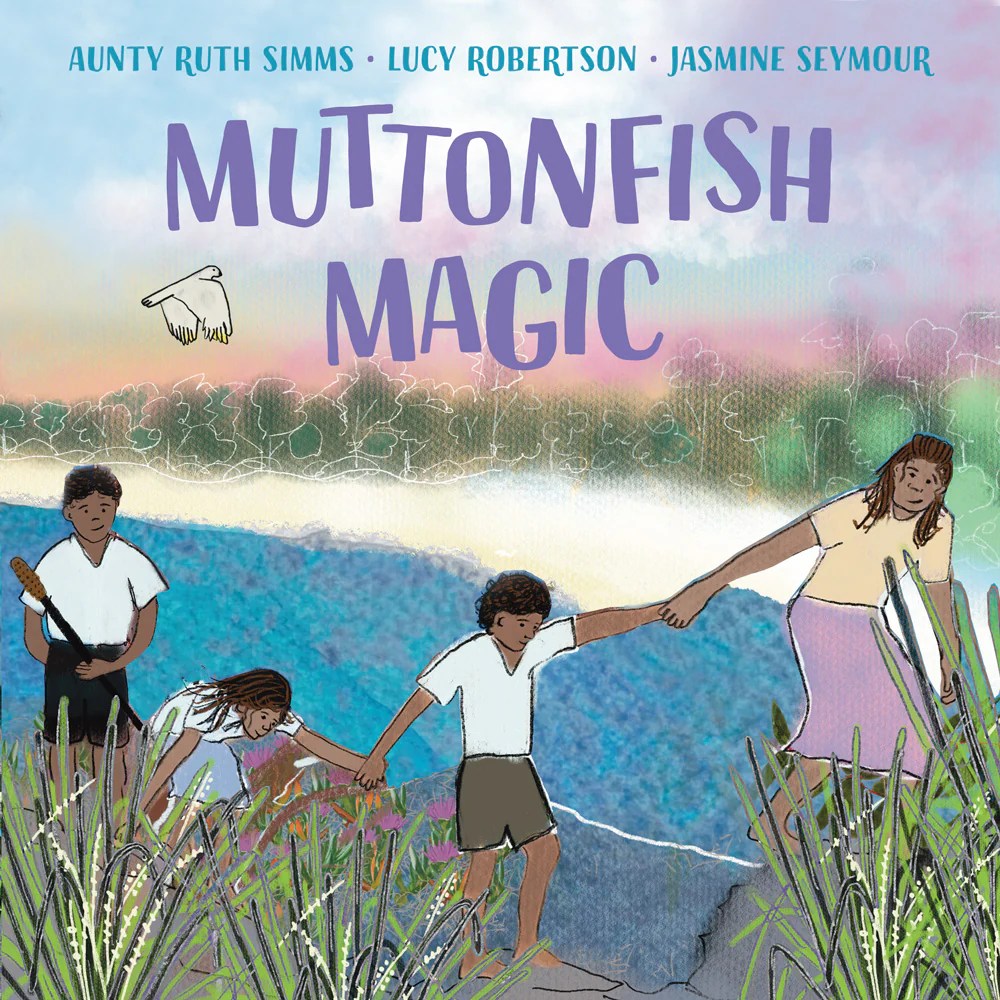
Muttonfish Magic
by Aunty Ruth Simms
& Lucy Robertson
ill. by Jasmine Seymour
Published by Magabala Books
“Muttonfish Magic honours the Kameragyl and Bidjigal people, the traditional custodians of the land around Kamay (Botany Bay) and Guriwal (La Perouse). With sensory lyricism, Bidjigal Elder Ruth Simms and Lucy Robertson depict a loving First Nations family inspired by Simms’s own childhood in the area…” (from the introduction to my review of Muttonfish Magic in Books + Publishing, see link at the end of our interview below)
Interview with Aunty Ruth Simms about Muttonfish Magic at Paperbark Words blog
Thank you for speaking to PaperbarkWords, Aunty Ruth.
An absolute pleasure! I don’t know if I have ever been in a blog before!
Both the words in your title Muttonfish Magic are important to the story. Could you please briefly explain the significance of each.
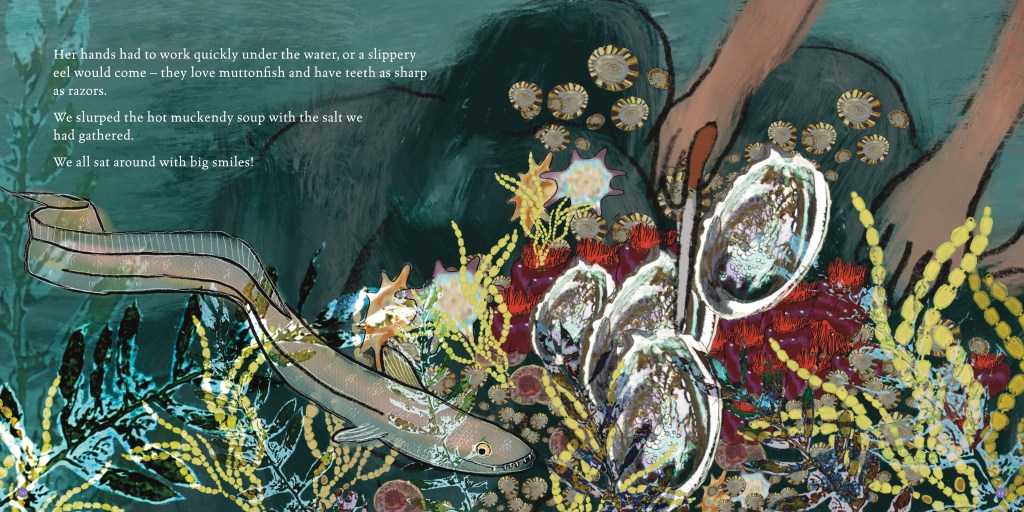
Well, you see, muttonfish was a staple food for my family when we were growing up. It was significant because it was good tucker for all of us Kooris living on Saltwater Country. It was certainly very important to my family at La Perouse, because it was cultural knowledge right there. It’s knowing the tides, knowing the right rocks that face the right way, knowing how to get them off and rub their bellies on the barnacles. It was knowing you had to tenderise the meat before you eat it. These days, you buy muttonfish at a shop for $90 a kilo and it’s a multibillion-dollar industry, but back then it was just what we knew and what we had access to. The magic of knowing about muttonfish is what the title is all about.
What do you love about the place where your story is set? You live away from the area now, but what is something you do when you visit?
I love La Perouse and I have very strong memories of growing up there with all my sisters and brothers, my mummy and daddy, my aunties and uncles. I also spent a lot of time down the South Coast when I was young, always on saltwater country. I still have sisters on The Reserve so I come back all the time, and I’m very sad to see what the country around Pussycat Bay is like now. It’s not the same as I remember it 72 years ago; now it’s full of bitou bush and lantana. There used to be wildflowers as far as the eye could see along that long walk, and many many important cultural species called ‘Five Corners’, which produced a lovely little berry that was like eating a sweet lolly. We would pick some of these on our way to school and keep them in a paper bag if we were lucky enough to have our lunch in one, and they were so wonderful to eat, but now they are an endangered species. I love La Perouse and it’s an important place for all Australians to learn about – I can still sing the French national anthem, ‘La Marseillaise’ from school there! – but it’s not the same as when we used to live there 70 years ago.
You have shared many evocative childhood memories with us in Muttonfish Magic. What is a highlight?
It’s all a highlight! I couldn’t pick one part of the story because it was all lived experience and all cultural knowledge. I had the great fortune of having two parents who valued education and advocacy, and showed it in different ways. I was one of the eldest girls in my family, and I loved going out with mummy and my aunties and my big brothers into the bay and the bush. My younger sisters couldn’t always come because it was a long way so it was often just my brothers and me. We were very poor and it was a time in our history where Indigenous people were not recognised or respected or even understood, so it was very hard, but it was still a wonderful time and I am very lucky to have been able to get a good education and also learn culture at the same time. That’s the highlight.
Which of Jasmine Seymour’s wonderful illustrations captures your childhood particularly well? Why or how?
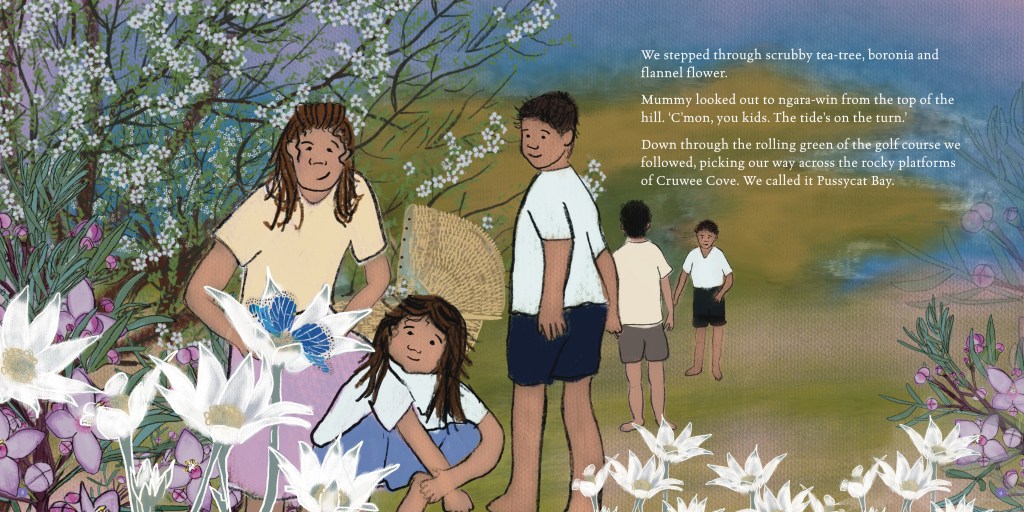
The image of us starting the long walk from the Reserve to Pussycat with all the wildflowers is very good, because Jasmine has done an amazing job of illustrating the plants and the sea life in the book. I love the flannel flowers and tea tree especially! It was funny, when we received some early drawings from Jasmine, her landscapes were exactly right but I laughed at the images of us kids because we had collared shirts and we looked dressed up compared to what it was actually like! I mean, this was a time of depression and post-war era food coupons for basics like bread and milk. We were very, very poor and so the collars had to come off in those beautiful illustrations!
I love your depiction of your mother. What are some of her most memorable qualities?
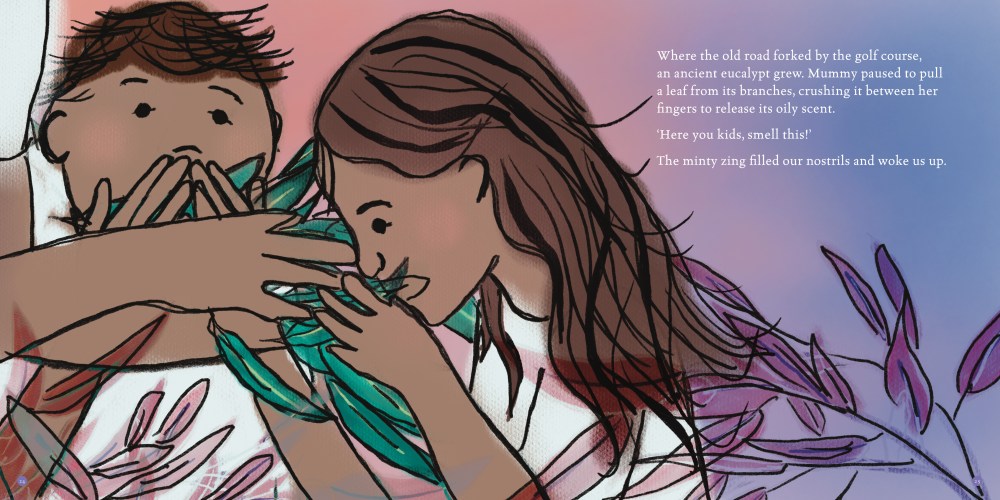
Everything. She was proud and resourceful and knowledgeable. When she was in the bush she was strong, when she was on the rocks she was so quick, and she was so proud of her own mother’s culture, too. She was also brave because it was a time when Aboriginal people weren’t allowed to speak in their own language, and she would get in trouble if she was caught, but she always spoke to us in language anyway, because that’s what her mother had done. She taught all us kids about goonjarn stories (ancient spirit stories) and ‘clevermen’ (an initiated elder who holds a lot of knowledge and can punish people for not following lore). She taught us the rules of being Koori and gave us pride and belief in our culture; that is what I remember about her. She also taught us kids respect. For our teachers, our Elders, our land, our resources. What she taught me and my brothers and sisters when we were kids is still a big part of my belief system today.
What is your favourite humorous childhood memory – either captured in the book or otherwise?
My brother Vic (Bunno in the book) was a very intelligent and creative song man but he was always impatient when it came to waiting for his tucker. Once I remember we had collected a feed of pippis from the beach and they were being cooked up on the fire. He didn’t want to wait for them to cook properly so he ate one too early and he got so sick! He didn’t eat a pippi for many many years after that – maybe 20 or 30 years! My other brother Sonny had the same problem with a friend’s stonefruit tree. I can’t remember if it was a nectarine or a plum tree but he ate some before they were fully ripe and he got sick too. They both learnt their lessons.
You have incorporated some words from Language seamlessly. Could you please tell us a little more about one of these words, or one that you would have liked to include in the book?
Language is a funny thing because it’s a bit of a hot topic at the moment, especially in education. But back when the story from the book was happening in the 40s and 50s we didn’t have words for the language we were speaking; we just spoke it! I just knew it as my mummy’s language. Now I know it’s the language of the Bidjigal people, but back then it didn’t have a name. It’s also hard to record some of these words because we never wrote it down; it was an oral language. Dart-Barrie, for example, can’t be found in any traditional language dictionaries but it lives on very strongly in my memories and those of my family. It was a way of fishing for muckendy, using the fish gut and shell or metal hook, in between rocky crevices. It required patience and knowledge and skill. I remember my mummy’s hands were like quicksilver when she worked that hook on and a little stone sinker. Lucy’s words have captured exactly what it was like when she did this, and I remember this part of writing the story was very easy for us because it is such a strong memory. Dart-Barrie; the lovely old word for our old way of fishing at Pussycat Bay.
What do you hope children learn or remember about Muttonfish Magic?
Any parts and all of it! Right from the start, this story was always going to be written down for children. Because Lucy is a Teacher Librarian who knows a lot of picturebooks, and because I still work with children in schools, it was important that the book speak to them and be read aloud in the very places on the coast where the story can be best understood.
We are very lucky that we are both able to read it to many children ourselves and already we have noticed that young students ask a lot of very different and excellent questions. Things like, ‘Why the pram?’, ‘What did muttonfish taste like?’, ‘Do you mean a muttonfish isn’t actually a fish?’ or ‘Why did you have the sugar biscuits?’ – We love questions!
We hope something resonates with all the children who read Muttonfish Magic – something that makes them wonder, or learn, or just feel seen because maybe they have gone for muttonfish with their family on the rocks before, too. Whatever it is, we hope they find a love of culture and connection and sharing on Saltwater Country.
Thank you so much for sharing your childhood through your beautiful book and by answering these questions, Aunty Ruth. We are privileged to learn from you.
Muttonfish Magic at Magabala Books

 paperbarkwords.blog