
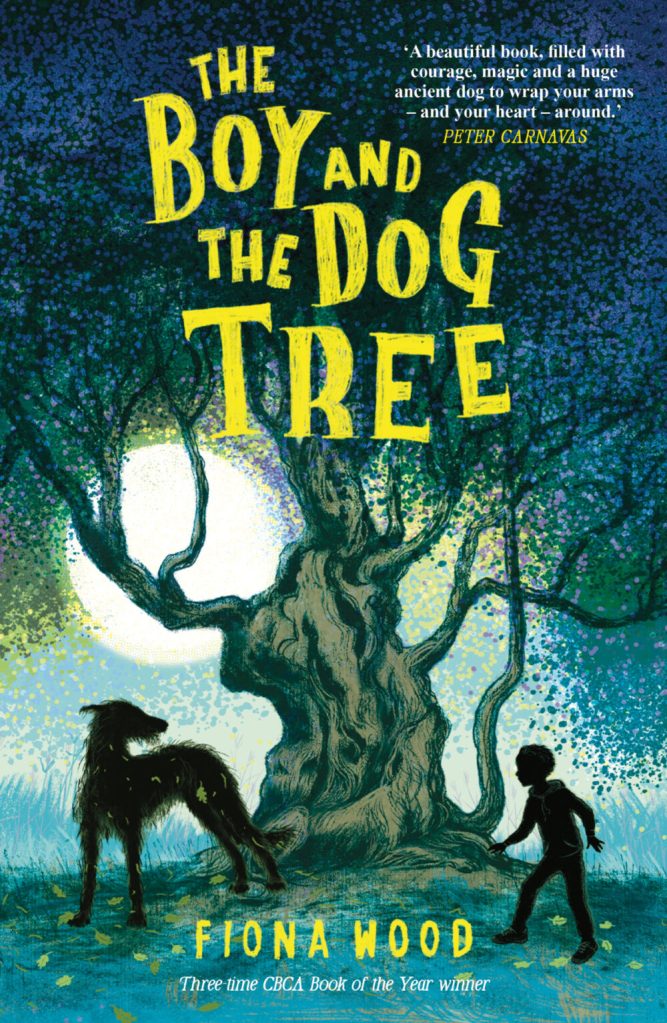
The Boy and the Dog Tree
Written by Fiona Wood
Illustrated by Judy Watson
Published by University of Queensland Press
Interview with Fiona Wood
Argos had said, ‘Quests do not always announce themselves.’
There was no dragon or treasure or lost kingdom but Mitch had discovered the world anew with Argos.
Quests were exhausting. He shut his eyes and fell into fathoms-deep sleep.
(The Boy and the Dog Tree)
Fiona Wood writes in response to the above quote for Joy in Books at Paperbark Words blog:
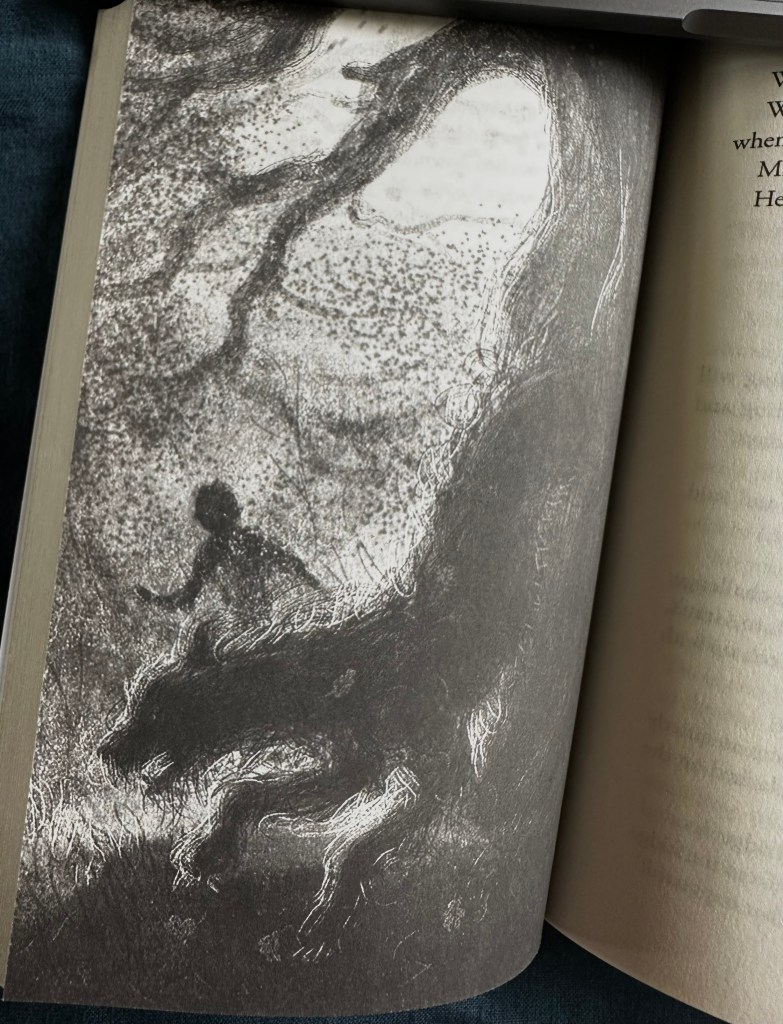
Towards the end of the book, Mitch is remembering his first days with the strange, ancient Argos, a dog who has appeared to him from within a tree. When his lifelong quest to get a dog is fulfilled, it immediately springboards him into a new world of challenges.
…Mitch’s heart thudded – was Argos here with some greater purpose? On official business? Was there a quest, after all?
Confronted by the majestic Argos, it feels logical that Mitch would immediately think that some quest might be in train and worry that he’d be called on to take part in it.
‘Is there a quest?’ Mitch blurted it out, then looked down, embarrassed. ‘Because the tree said You are the boy, but I don’t have any questing skills…’ Mitch knew nothing about weapons, for example. ‘But if that’s why you’ve come, I’d go with you. I’d do what I can.’
‘Would you, indeed?’ said Argos.
Mitch nodded. His heart swelled as he realised he was telling the truth.
This is an early moment in which we see the impact of Argos on Mitch’s understanding of himself: he is someone willing to support Argos, to take a risk on his behalf.
Quests on a grand scale do not typically feature in the life of an average primary school student – with exceptions such as the experience of being an asylum seeker, or dealing with serious illness, for example – but children are searching for important things in the everyday. These quests might revolve around things like identity and friendship and family.
When Argos talks about a quest not announcing itself, he is saying that a quest doesn’t have to look like scaling a mighty mountain; it can be more like finding your way along a winding path, responding to a series of challenges. It can contain elements of serendipity.
In this way a destination, an understanding, may be reached: for example, oh, right, this is how I show up for a friend.
Argos is not just a much longed-for dog, but also, Mitch hopes, a defender, someone to help him stand up to the class bully, Seb, and Argos does this.
But I wanted to look at the idea of being a defender from both sides of the relationship. Mitch must also help Argos when he captured and vulnerable.
Doing this, rising to the challenge, is what allows Mitch to find his strength, find his voice and be as good a friend to Argos as Argos has been to him.
One of Mitch’s early challenges with Argos is learning about the power balance in their relationship. Mitch’s initial hope of training Argos is quickly quashed when he broaches the subject.
‘I see no need for training, boy. You have a good heart and a sound mind. I will give you simple instructions and you will follow them.’
‘Oh. Okay, good, good, yep,’ said Mitch.
Earlier, Argos has said, ‘Boy, I go wherever I wish, whenever I wish.’
Trying to control Argos is a particular challenge when it comes to dealing with Seb, whose punishment Argos envisages with a violence disproportionate to the crime and abhorrent to modern sensibility.
‘Shall I take him by the throat, dash his brains out upon these rocks and be done with it?’
Mitch successfully steers Argos away from this and a much more benign, fitting and funny punishment awaits Seb.
When Argos initially explains that, ‘when called upon by a child in need, I emerge from the tree,’Mitch doubts that his needs warrant Argos’s help, saying ‘…there are heaps of kids worse off than me.’
Mitch knows his problems are not life or death matters, but Argos gives him permission to drop the relativity.
‘And yet these are your troubles and you may take them seriously, boy. Even a king may be heartsore and afraid.’
I want young readers to feel that this applies to them, too. Worries might not always be high on the official significance scale, but they can still make daily life a misery and certainly warrant being heard and understood. I clearly remember my own worries in grade six, and although I see them as tiny with the perspective of time, they loomed large and filled me with dread.
The idea of discovering the world anew with Argos happens throughout the story as Mitch grows in confidence and understanding, and as he stands up for himself and for Argos.
If Argos were less enigmatic, he might say that being truly yourself is the quest, and that’s made up of a thousand daily choices – to be kind, to be loyal, to be brave. Many small challenges – no dragons or treasure or lost kingdoms but still, a worthy quest.
Being invited to respond to the quote at the head of this post also makes me think about my quest in writing books for young readers. It’s the same for each book: I want readers to think, to laugh and to cry. And I hope the experience of reading my book prompts readers to pick up another book and another, and keeps them on the winding reading path.

Quests in The Boy and the Dog Tree
The quest to get a dog
The quest to stand up to the bully at his new school
The quest to keep Argos’s presence a secret from Gran
The quest to provide meaty bones for Argos
The quest to control Argos’s roaming, howling and snitching picnic food at the park
The quest to put a stop to fake news rumours about Argos
The quest to persuade Argos to attend a pet parade
The quest to rescue Argos from the dog pound
The quest to protect Argos from being recaptured
The quest to persuade Argos to stay and be a regular family pet
The Boy and the Dog Tree at UQP
How to Spell Catastrophe Interview with Fiona Wood at PaperbarkWords
JO and the NO Interview with Judy Watson at Paperbark Words
Reviews by Joy Lawn of YA novels by Fiona Wood for the Weekend Australian
What I wrote about Fiona’s novel Wildlife in the Weekend Australian in 2014:
Melbourne scriptwriter Fiona Wood has followed her popular 2010 debut Six Impossible Things with a work for older teens, Wildlife (Pan Macmillan, 384pp, $19.99). The two novels are loosely linked by the character of Lou, who is grieving following her boyfriend’s death. At her new school’s wilderness camp, Lou meets Sibylla, one of the best-drawn characters in recent YA fiction. In Sibylla, Wood recasts the mould of teen protagonist. It takes a thoughtful literary talent to create an introverted and awkwardly beautiful yet easygoing character with such clarity and affection. Wood introduces Sibylla with a head-turning billboard guaranteed to grab reader attention and then steadily builds a fascinating, genuine character, one whose personality is partly shown by her frustrating lack of awareness at times.
Popular Ben takes Sibylla as his trophy girlfriend. As a girl who isn’t interested in the camp “sociograph’’ and doesn’t fully understand who she really is or what she wants, Sibylla is pulled into a physical relationship her body desires but her brain warns her against. She is also a caring friend to intelligent, good-looking “loner not loser’’ Michael and, despite her naivety in some ways, appears more appealing in her self-containment and generous trust than most of the other shallow, self-centred campers. The group dynamics ring cringingly true.
Like the work of Simmone Howell, Leanne Hall and Cath Crowley, Wood’s writing is contemporary cool. References to Triple J and retro bands the Smiths and the Go-Betweens add verisimilitude. Music is also used as a shortcut to snapshot Lou when she sings Blackbird at the camp talent night. The others then instantly recognise her as “indie singer geek girl’’ and can code her into their social hierarchy. Allusion to Shakespeare’s Romeo and Juliet and Othello also hint at plot, character and motivations. The writing style has the lucidity and economy of a verse novel, but one set in prose. The dual narrations of Sibylla and Lou reveal different insights into each other as well as into the other characters.
What I wrote about Fiona’s novel Cloudwish in the Weekend Australian in 2016:
Melbourne-based scriptwriter Fiona Wood crafts achingly real characters: vulnerable, reserved, loud. Her three novels for young adults, Six Impossible Things, Wildlife and Cloudwish (Pan Macmillan, 288pp, $19.99) emulate reality through the unfolding personalities and rhythms of the characters’ lives.
Sibylla and Lou, major characters in Wood’s earlier work, reappear in Cloudwish as concerned potential friends of Vietnamese-Australian scholarship girl Van Uoc Phan. Van Uoc tries to keep a low profile but she daydreams about “hot dickhead” Billy Gardiner who only goes out with “foreground, high-resolution girls”. When she makes a wish on an elusive glass vial that Billy would find her “fascinating”, her fantasy seems to come true.
The style is contemporary realism, but it is realism with a slice of surrealism and imperceptible magic. When Van Uoc’s clothes aren’t warm enough she finds a cardigan with rainbow-coloured wing-petals, as if from a fairytale, in Melbourne’s Royal Botanic Gardens. Narrative tension stems from Van Uoc’s doubts about the cause of Billy’s interest. “She felt the tangle of sex and longing and fairytales with handsome boys and happy endings. She was peering into the well, ready to tumble in, and what then? These stories with enchantments and wishes weren’t her stories. She was smarter than that. She was nobody’s Cinderella.”
“Cloudwish” is also the ethereal meaning of Van Uoc’s name. Although a successful student and photographer, she prefers to be invisible at school and “the shape of not fitting in was almost comfortably familiar”. However her inner resolve and love of Charlotte Bronte’s Jane Eyre give her enough confidence to challenge injustice and constantly ask herself, “What would Jane do?”
Van Uoc feels set apart from the non-Asian scholarship kids and vents her anger against disempowerment of women and racist views on boatpeople, asylum-seekers and minority groups in free writing she then usually deletes.
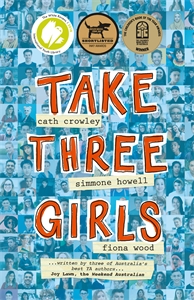
My review of Take Three Girls in the Weekend Australian, January 2018.
Take Three Girls (Pan Macmillan, 439pp, $18.99) is written by three of Australia’s best YA authors: Cath Crowley, Simmone Howell and Fiona Wood. They have each integrated a character into this story, which is for mature readers.
Their characters are brought together by the teacher of the new wellness program set up for Year 10 students at a prestigious private school to help them deal with misogynistic online bullying. Clem, Kate and Ady are randomly put into the same group because they have the longest thumbs.
An elite swimmer, Clem naturally has large hands but she is avoiding training and feels “the future is just like a white blur of skywriting that time has made unreadable”. She’s losing her identity and putting on weight. She is yearning for a physical encounter with older Stu but also feels unsure.
Kate is a talented cellist, passionate but not competitive, who experiments with recording sounds and looping and layering tracks. She’s been “slotted into the box of quiet, studious, geek” who’s good with computers. She works hard to win a scholarship for the sake of her parents’ farm but is pulled between schoolwork and music.
Unlike the other girls, tall, popular Ady isn’t a boarder. She lives at home but her father’s addictions are rattling the family. Ady’s affinity with fabrics, clothes and beauty is rendered in sensory language. She’s unsure why she’s not interested in handsome Rupert and surprises herself by becoming protective of her new friends.
One of the skills of this collaboration is that each character offers insight into the others. Ady, for example, recognises Clem’s confidence to “explore who she might be” and sees Kate as a “quiet musician [who] breaks the rules to walk on the wild side”. The three writers develop and enrich each other’s creations. Take Three Girls deserves a second read to fully appreciate the fine writing and the seeded threads which lead to the denouement.

 paperbarkwords.blog
One thought on “The Boy and the Dog Tree by Fiona Wood”