
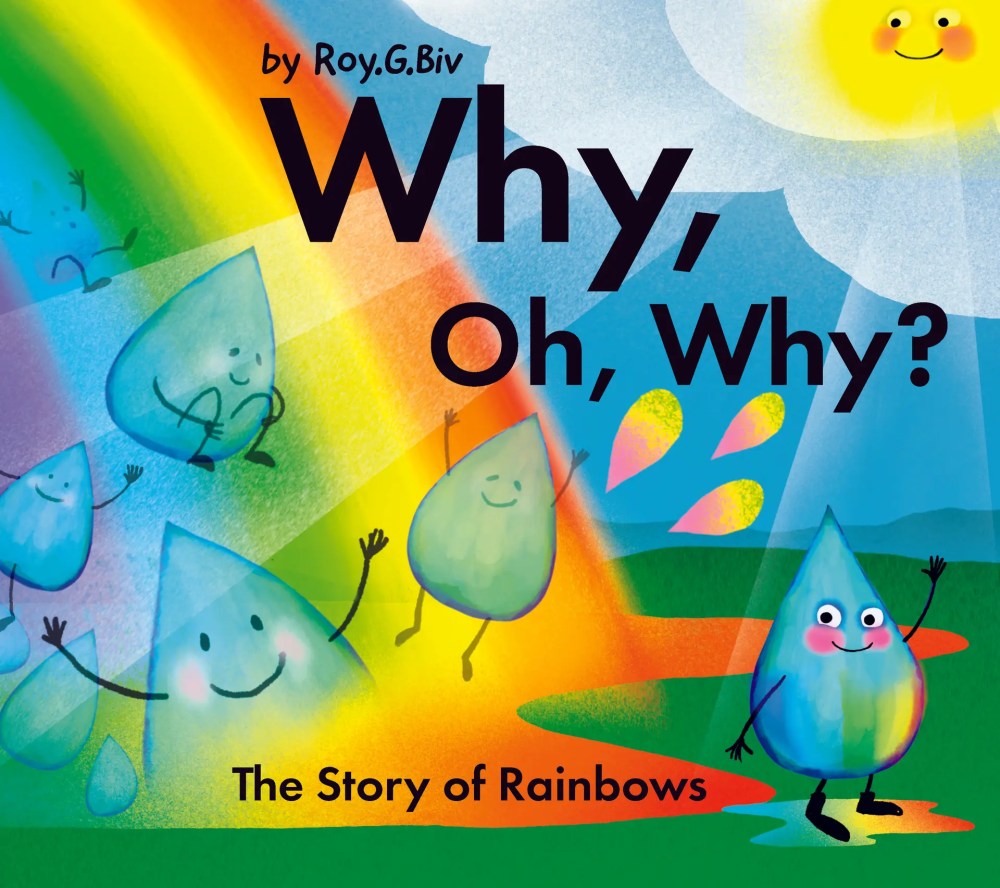
Why, Oh Why? The Story of Rainbows, by Roy G. Biv
(Tim Hurburgh)
Hardie Grant Custom
Roy G. Biv (Tim Hurburgh) writes about his picture book The Story of Rainbows for Paperbark Word blog.
Growing up outside Hobart on the River Derwent, life was full of wonder. We were endlessly curious about the natural world and the everyday people and sights around us. Our world was small; the only places we had been were into Hobart and Rosetta, opposite what is now MONA. Everything else was a mystery.
We noticed things closely and often wondered about them. The young woman who sometimes helped my mother spoke with an unfamiliar accent (many people having arrived from overseas after the war). The old man who did some gardening, and who we were told came from somewhere deep in the bush, and the Chinese family who market gardened next door all made Rosetta a fascinating place for us to grow up.
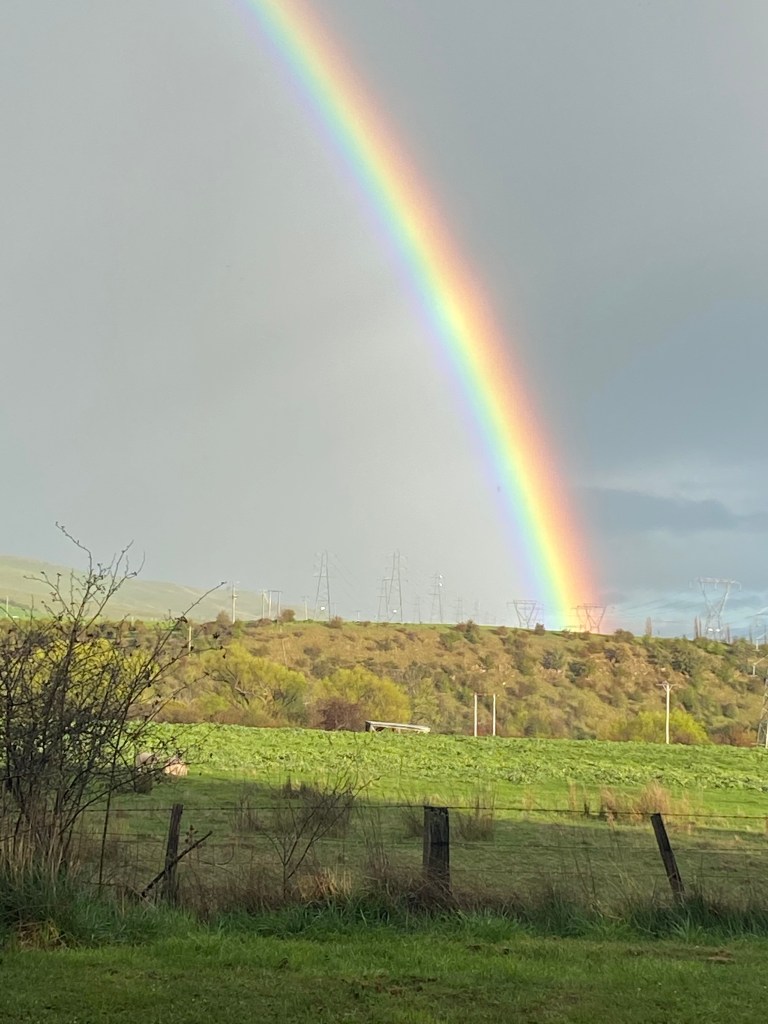
We were intrigued by nature. Why was the river sometimes flat and sometimes choppy? Why were there plovers under the trees? Why did it get so cold in winter that we had to light the fire? And we loved wondering about the extraordinary rainbows in the sky. So big, so colourful, and such a perfect shape, they seemed to appear quite regularly where we lived.
Opposite us, across the river, was Mt. Direction, on the land of the Mumirimina people. When the rainbows came shining over the top of the mountain and their big, curved arcs crashed into the water, did they make a splash? Did they disappear underneath, and was the water stirred up in all its bright colours? Why did they sometimes shine brilliantly and at other times appear much paler, sometimes short, and other times long, occasionally so long they came right across the river, as though they might land near our garden. Once in a while we would even see a double rainbow!
So many questions, but whatever answers given, we were too young to understand.
It was not until senior school, knowing something of science and of maths, that we could appreciate the concepts of rainbows. Most importantly, we learned that you could only see rainbows when the sun is low and behind you, and the rain or water is in front. We understood that when light enters a raindrop it bends at 42 degrees, and as it bends it spreads, and on leaving the raindrop we see an array of spectral colours that make up light – R O Y G B I V (red orange yellow green blue indigo and violet), as we knew them back in the day.
We learned about refraction of light, and that rainbows always appear as a perfect arc because they actually form in full circles, as we see when we blow bubbles or hold a finger over the end of a garden hose. From the ground, however, we only see part of them, as the rest is hidden by hills, mountains and the horizon. We were thrilled to learn of double rainbows and even rainbows at night, called moonbows, seen when it’s showery and very dark.
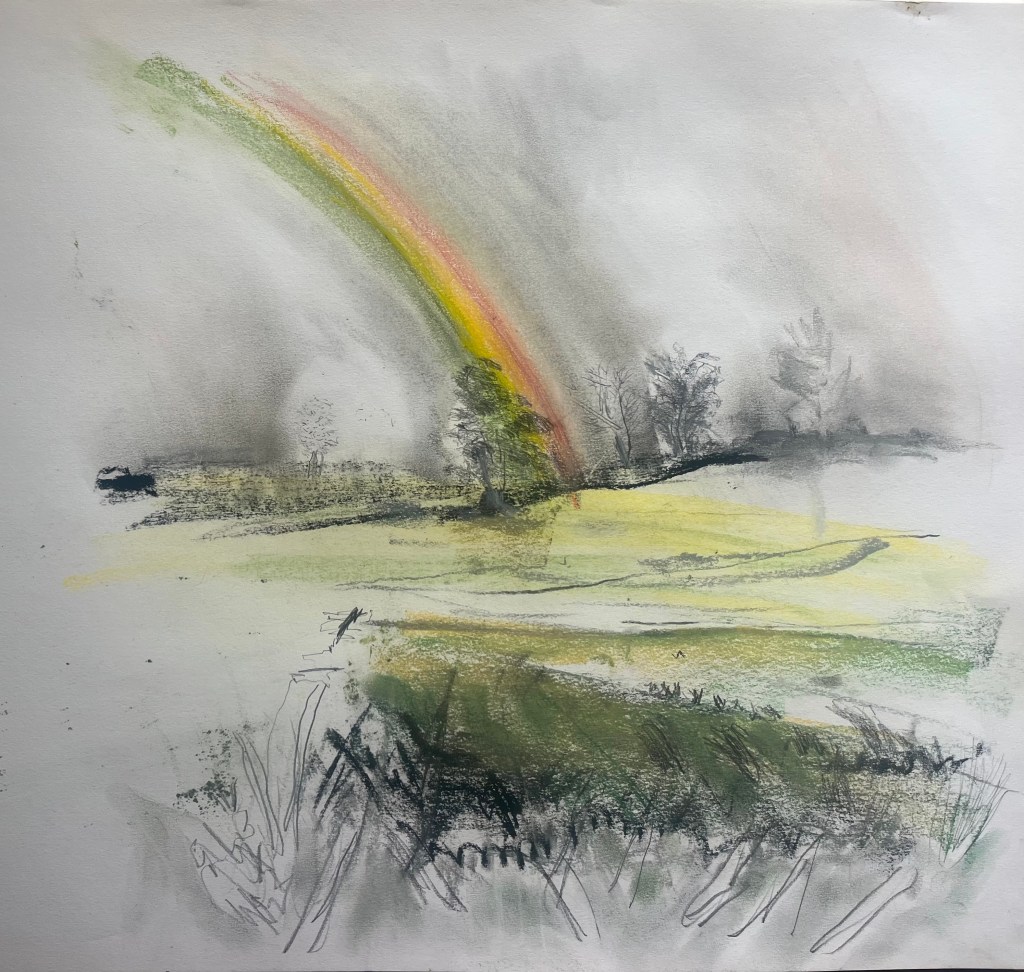
Recently my family returned to Tasmania after living on the mainland, settling on a farm near Ouse, coincidentally also on the River Derwent. Ouse is about an hour and a half from Hobart on the Lyell Highway, running north–south through the Derwent Valley. Driving to town on a sunny day, the sun sits behind us, while rain from the southwest gathers ahead. Rainbows seem ever present, which is surprising, as apart from the west coast, Tasmania has relatively low rainfall for Australia, yet its mountainous landscape brings those brief sun showers that so often give rise to them.
Inspired by their constant presence, and having recently become interested in writing poetry (I published a book – Disruptions – Tasmania in Poetry) I thought they would be a perfect poetic subject, particularly in explaining how they work. But thinking of a mature readership, I couldn’t get them together at all; too pompous, not appropriately descriptive, not scientifically complete. Then, sitting in a pub in Melbourne one night, I had a moment of inspiration: I would write them for kids!
Three or four lines of poetry, some gentle rhyme to assist memory, clever illustrations, and content that was educational, filling that gap in my own childhood experience (and the dearth then of books available for children with any scientific intent). Soon I had sketched four or five ideas: the familiar pots of gold, the spectrum, refraction, First Nations serpents. Then, as people encouraged me to look further, I researched what ancient people had made of rainbows, and how different communities, including the LGBTI community, have embraced them. Someone said, ‘what about moonlight rainbows’? I thought of the garden hose and kid’s bubbles mix, and remembered the most famous rainbow reference of all from ’The Wizard of Oz.’
Until finally I had 12 poems. Enough for an illustrated book designed to satisfy children’s curiosities about the natural world and to encourage engagement with science and language.
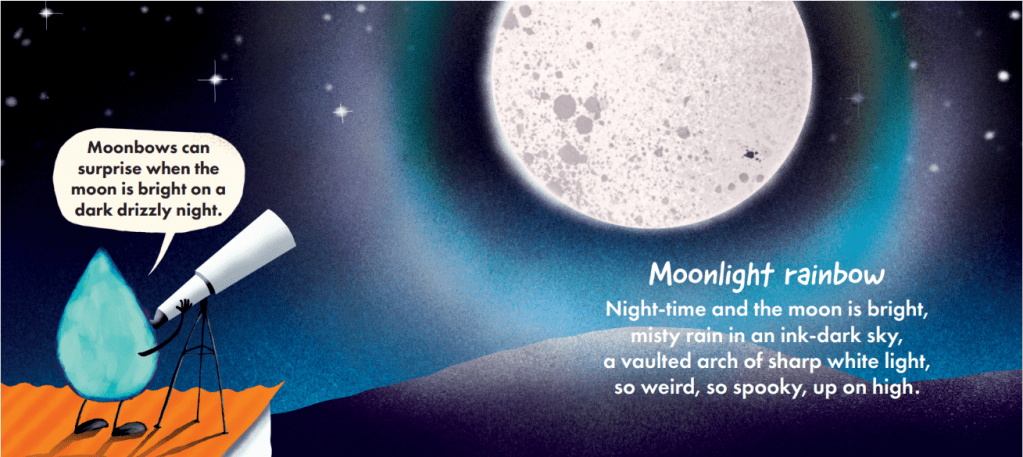
Working on the book with Hardie Grant Custom, we realised it could be structured in two parts: childlike illustrations by Aldous Kelly at Futago Hobart, appealing to 3–6-year-olds, and the poems for 6–11-year-olds. The illustrations were given simple one-line descriptions, which became speech bubbles from the book’s ‘narrator’, Roy (who ultimately also became the author’s nom- de- plume). During its development, we decided to include a page of constellations reflecting the first poem, Cosmos, and a simple activity at the end to keep young readers thinking beyond the final page. And running it past my 4 year old grandson, fascinated with smiley faces at the time, created an imaginary Bee Deedle (his nick name) constellation to join the more notable others on the book’s last page.
The book became Why, Oh, Why’? The Story of Rainbows.

 paperbarkwords.blog