
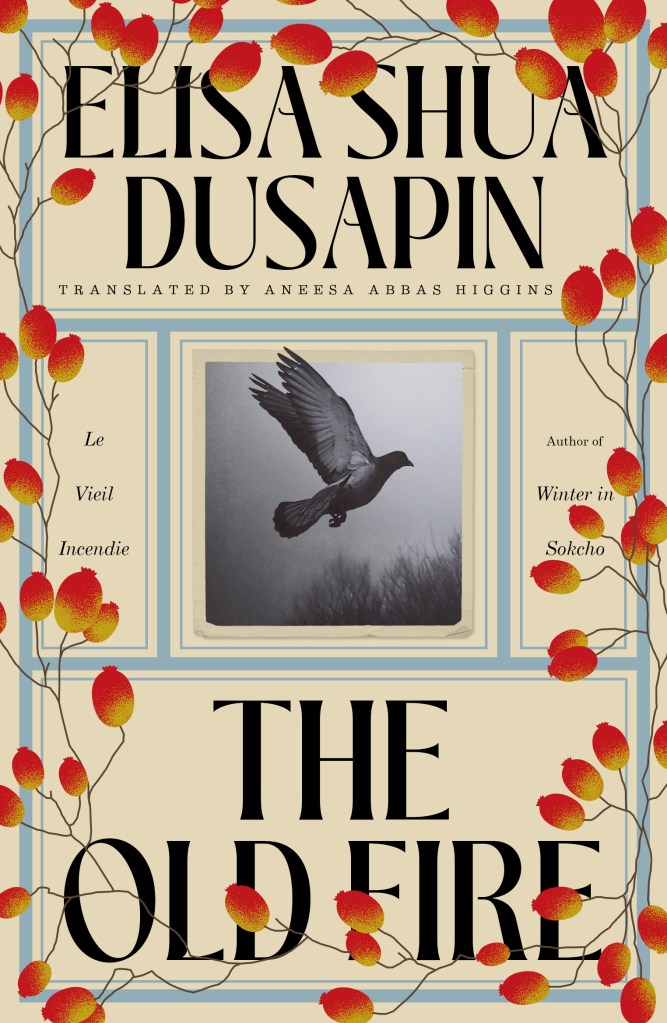
The Old Fire
by Elisa Shua Dusapin
(Scribe Publications)
I was transfixed while reading Elisa Shua Dusapin’s new literary novel, The Old Fire. Translated from the French by Aneesa Abbas Higgins, the author disrupts what seems to be a cosy, country atmosphere with discordant layers between sisters, who haven’t seen each other for years, waiting to unfold.
Screenwriter Agathe has travelled from New York to the French countryside to help Véra empty their parents’ home. Beautifully and knowingly written, will the possibility of a nostalgic reunion be overthrown by unresolved tensions and secrets?
The Old Fire is an exemplary novel by a fine writer.
extract from The Old Fire at PaperbarkWords blog:
(used with permission)
The Old Fire by Elisa Shua Dusapin
The dim lighting makes the space in the room around
Véra seem smaller. She’s taken down some of the
posters from the wall to draw on them with my father’s
charcoal crayons, the ones he used in his talks explain-
ing cave art. The sight of Véra with that wall full of holes
behind her upsets me. The patches of bare brick remind
me of the eerie ghost rocks I’ve seen in underground
caves, phantom-like holes formed in thick subterranean
rock by mineral dissolution. She’s drawing mandalas
on a poster for a 1999 production of Three Sisters at the
theatre in Brive. She says she wants to use up the colour
pencils so they don’t go to waste. And how is using
them like this not wasting them? I ask her. She gives me
a wide-eyed look. I press the point, she shrugs, picks up
another poster and carries on drawing. It’s two o’clock
in New York, I say. I have a video conference call. Véra
says she doesn’t mind. She never seems to mind, I think
to myself as I turn on the computer in the bedroom.
Nothing bothers her. It’s not human, not my sister.
Feedback on episode four. Questions about the por-
trayal of the Second World War in light of the current
situation in Europe. The people I’m speaking to have all
blurred their background. Every time they move, their
outlines wobble. One colleague reminds us that we’re
not making a documentary. But still, we can’t sacrifice
the complexity of reality to fiction. Someone says we
should get back to the characters, we need to be more
efficient, time is money. I don’t make much of a con-
tribution, I’m having problems with my microphone.
I jump when I hear my name. One of the producers is
suggesting that as a European, like Perec, I ought to
have more of a personal connection to the project. I’m
not sure I understand, I say. I peer closer to the camera,
I don’t think she can hear me. Their voices break up.
I’m bored, start browsing. My recent searches pop up.
‘Before and after pregnancy’, ‘video Perec’, ‘weather
Périgord’, ‘does he still love me’. I type in ‘can you eat
tripe’ keeping one eye on the call. People’s names are
displayed as they speak, Laeticia’s the most frequent.
I’ve always liked the name Laeticia, it’s soft and sharp
at the same time. I hate my name, Agathe. It makes me
think of an old lady with pointy glasses. Bitter. It sounds
dry. It’s softer in English, but I still don’t like it. Agathe
sounds like agace, irritate, annoy. I won’t let Irvin say it.
There was a Laeticia in the skating group above
mine. We’d run into each other in the changing rooms.
She wasn’t particularly talkative, but the other girls all
fought for her attention. I’d heard about the parties she
had at her parents’ château, where there were always
dozens of guests. I was amazed by the number of people
she had in her circle. She had a boyfriend too. That left
us all speechless. It didn’t bother me that she didn’t
invite me. I had Véra for company, that was all I needed.
But it was hard work communicating with my sister,
I had to make most of the effort. I read something about
sign language once and thought it might help, at least
Véra would have a proper language. I mentioned it to
my father and he took us to a talk about it. But Véra was
|adamantly against it. She refused to learn it, she wasn’t
deaf, she said.
The year I turned fourteen, I left our training session early
one day to go to the toilet. When I came back I found
Véra on the ice with my skates on. Laeticia’s group was
warming up. From where I was standing, Véra looked
comical, like a drunken child. She was hanging onto
Chloé, one of Laeticia’s followers. I watched her fall,
dragging Chloé down with her. Everyone froze. Véra let
out a wail. Raw, animal-like, her cry amplified by the
domed ceiling. Chloé got back up on her feet, rather exag-
geratedly I thought, overplaying the effects of the fall.
‘Idiot!’ she spat out.
I said that Véra was sorry. Chloé said she wanted
to hear Véra say it herself.
‘She doesn’t speak,’ I replied.
‘She can shout, can’t she? So she must be able to
speak.’
Chloé was standing with me at the edge of the ice
rink. Véra was crawling towards us. I held out my hand
to her. Laeticia skated over to Véra to help her reach me.
‘Why doesn’t she speak?’ Chloé asked.

 paperbarkwords.blog