
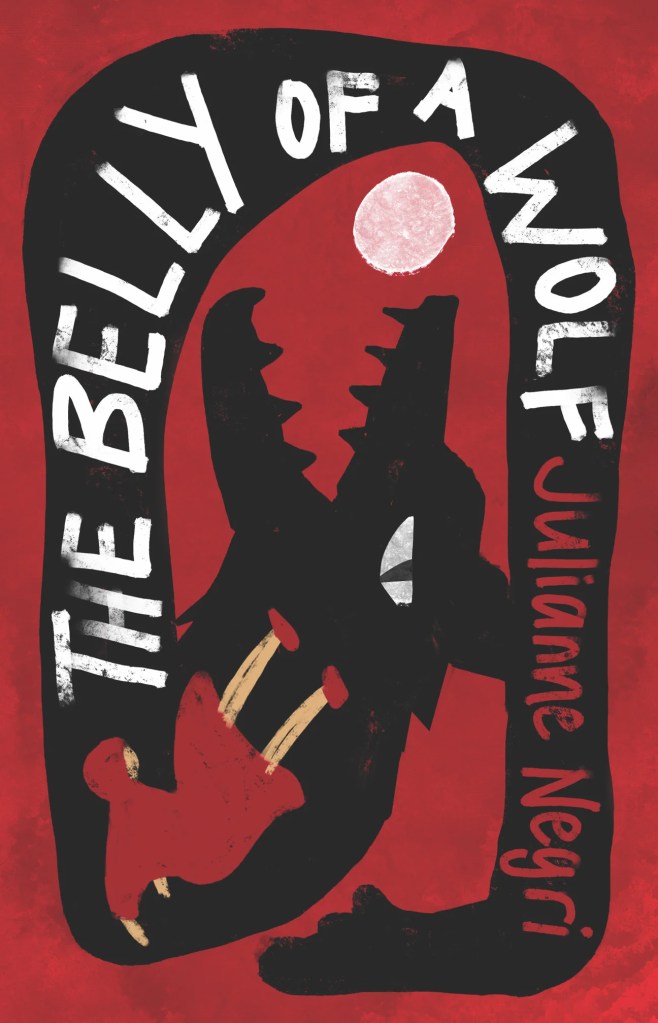
The Belly of a Wolf by Julianne Negri
(UWA Publishing)
“Musty books,
ink-scratched drawings
black and white with gashes of red.
Look, it’s us, Wolf gasped.
inhaling the pages.
Hunting
different versions of the story.
Rummaging
dog-eared collections of fairytales.
Searching
columns on contents pages,
hungry for our title.
In op shops, secondhand bookshops,
the mobile library truck …
she would borrow anything with wolves,
any angle of herself she could find.”
(The Belly of a Wolf)
Author Interview: Julianne Negri
Congratulations on your fine YA verse The Belly of a Wolf, Julianne, and thank you for speaking to Joy in Books at Paperbark Words blog.
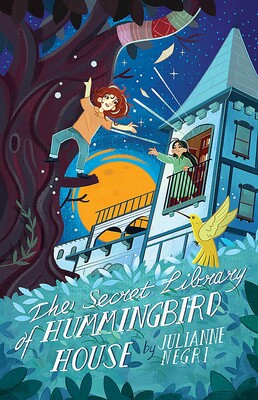
I was first aware of your work as an author through your wonderful children’s novel, The Secret Library of Hummingbird House (Affirm Press). I was on the judging panel that shortlisted it in the Children’s Crime Book and Debut Author categories of the 2021 Davitt Crime Awards.
The Belly of a Wolf showcases more of your superb writing.
What’s been happening professionally for you between the two books?
It’s my nature to seek out new ventures, so with that in mind, I wrote a non-fiction science biography, Veena Sahajwalla; ‘Green’ engineer and recycling champion as part of the Aussies Stem Star series with Wild Dingo Press, published in 2022.
After that I was a fulltime carer for one of my children who was unwell and writing had to be on the back burner. My first picture book Almost a Fish was published in 2024 with the amazing illustrator Evie Barrow and was also a judge for the Victorian Premier’s Literary Awards in 2023 and 2024 – thinking that I might not be able to write but I can read! (So I can appreciate your judging experience with the Davitt Awards, Joy!) Fortunately, my child has recovered and I’m back at the writing desk. And thank you for the compliments for my writing. Like most of us, I struggle to fully identify myself as a writer but I can’t imagine being me without writing.
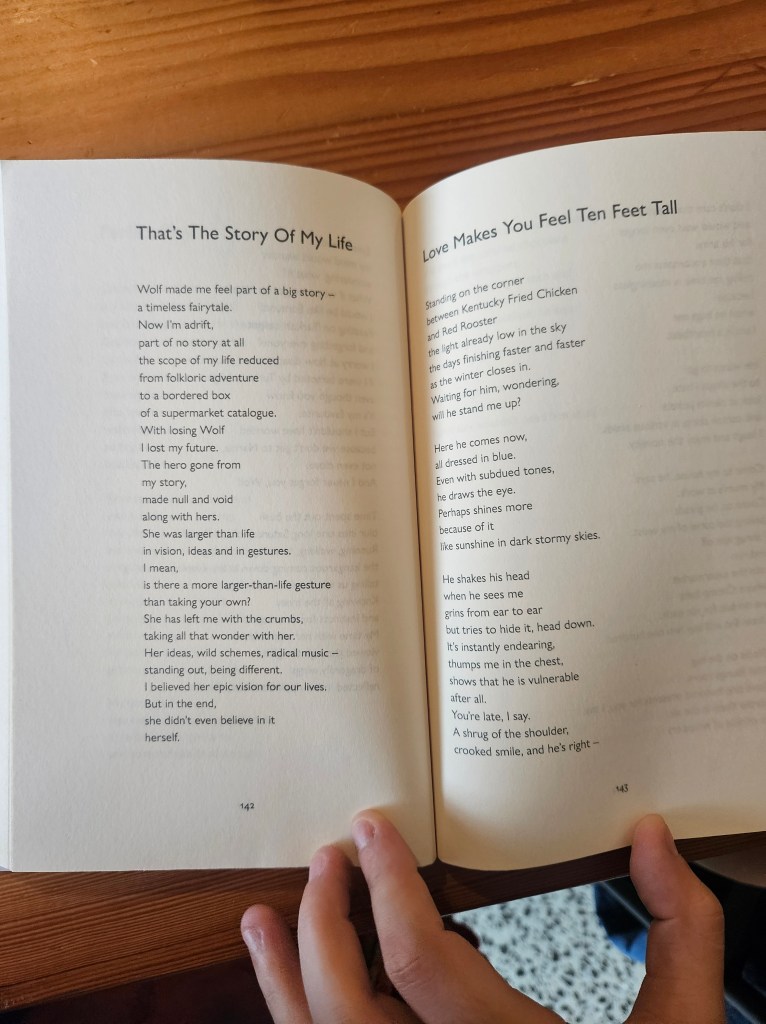
Your title The Belly of a Wolf captures the dark tone of your story while also hinting at its fairytale allusions. Could you please tell us about what has happened to Red and Wolf, and how you have integrated Little Red Riding Hood?
The book is about Red returning to school six months after her best friend, Wolf, has died by suicide and I wanted to capture how hard that is to deal with at fifteen years old. They had been friends for 10 years – which is the majority of your life at that age. As teenagers, we understand the world through the lens of what is behind us – our childhood – and that childhood is structured around stories, games, songs and friendships. But as teenagers, those structures are taken away from us, as we are considered too old for those things. A classic fairytale was a way to encapsulate that.
The Little Red Riding Hood fairytale reference does a few things within the narrative. One is to demonstrate the idea of two people being entwined in the same story, with identities dependent on each other. In the book, Red and Wolf are best friends, but Wolf is more discontent and bold. Our identities are forming during childhood and I wanted the reader to understand the intrinsic importance of this friendship and why it was so devastating that Red has lost Wolf.
After Wolf is gone, for Red, in hindsight, the fairytale takes on a darker tone of a predestined downfall for Wolf, of Wolf being too much for this world. It also serves as a metaphor for Red’s need to stay close to Wolf, even if it means being swallowed into her darkness, through self-destructive actions.
What other literary or intertextual references have you used?
The novel has layers of references. There are song titles as chapter headings and Red is studying Medea at school. There are also references to the Chronicles of Narnia. And Older Sister is studying Richard the Second. I’ve always been a huge reader and I find it unrealistic to not include other books and reading experiences in my own stories.
Could you tell about one of these in more detail?
Medea is the Greek play by Euripides, the story of a witch who helps Jason attain the golden fleece. He marries her and has two children but then rejects her for a princess. Medea kills the princess and then to punish Jason, she kills her children, a trauma that transforms her into a goddess and she transcends life and death. In the novel, I use the betrayal of Medea by Jason to parallel the betrayal of Red by her first boyfriend, Popular Boy. Again, showing how teenagers incorporate stories to help them understand the world and need new stories as they encounter more adult parts of life. The character Red also feels rejected and betrayed by her best friend Wolf, so there is a parallel to the dark side of this friendship and the love relationship in the book. Medea, when you think about it, is also a classic tale that to overcome grief and death involves losing your humanity and therefore an impossibility for us mere mortals.

Why Narnia?
Classic books such asThe Chronicles of Narnia are shared by so many that their elements become a code in friendships and infiltrates a child’s play world. Wolf’s attempts to get to Narnia show her unrealistic, discontented nature, her desperation for escape and her capacity to imagine – which turns out to be a dangerous combination as she grows older.
Could you introduce some of your other characters and their role in the narrative? Why do you label rather than name them, e.g. Next-Older-Sister, Music Girl, Bank Boy and Popular Boy?
I’m not sure I can answer this one Joy. I’m not sure why I did that! It just felt right. Perhaps it is to show the distance that Red feels from being part of the real world? For Red, grief is a force field that distances her from others. So perhaps that’s why those people don’t have names? That they are archetypes in her fairytale? Like ‘The Woodcutter’, ‘The Grandmother’ etc. in her story.
You show Red as a teen, and as a child with Wolf through her memories. What do you find poignant about their early years?
I think what I find most poignant is the shared culture Red and Wolf build together through made up landmarks, songs, stories and special rules to games. So when Wolf dies, a whole world is taken from Red.
How have you used music, particularly the piano, which is described wonderfully, in the tale?
I am one of eight children. When I was little, Grandma gave Dad money to buy us all new shoes. Dad came home with a piano! It was a marvel to me! Pianos are so big and have so many keys – and this was a pianola with levers and pedals and mechanisms like the console or a TARDIS! Pianos represent a world of possibility for me. At four years old, I began playing it by ear. I can barely remember a time in my life where music wasn’t prominent.
Almost each chapter/poem title is a song title. Like classic novels in childhood, music that is shared fortifies friendships. It’s a code for who to connect with and how. Especially as teenagers when we discover pop culture. This works for Red and Wolf and then for Music Girl and Red. Music Girl’s ability and knowledge of the piano is something Red longs for and I describe it as ‘an aural rope thrown from the window, for escape or rescue’ as a hint that it is through music that Red might find a way through her grief. Discovering Bach is another new thing for Red and the complexity and concentration it requires ‘presses pause’ on her tumult. Again, the power of music to heal her…if she lets it.
How have you used art?
Red has an ongoing art project at school, to paint a self-portrait. The self examination involved requires Red to look at who she is, who she wants to be, who she is without Wolf, and is also an outlet for her turbulent emotions. It is a challenge she finds difficult to face. Again I am suggesting that through art, Red may find healing and a way to contain her grief. One quote I reflected on while writing was by the poet Carolyn Kizer: “Perhaps the only way to deal with sorrow is to find a form in which to contain it”
Why have you used the verse novel form?
The book was written in poetic fragments that I built into a book. I’m not sure I had any choice with the form, it is simply how it came out. While the book is fiction, it is based on my own experiences, and writing in a fragmentary way was less traumatising than having to stay in the space in a sustained way.
What was a technical difficulty that it caused?
Keeping a narrative drive through fragmentary poems was a concern as I was piecing the book together. Conjuring time and place had to be done deftly and I was always trying to reduce and re-express ideas with poetic mechanisms while not being so obtuse the reader can’t understand what is happening. Because the narrative jumps around in time, the designer came up with the different margins in the typesetting, described by Lara Cain Gray as ‘meta punctuation’. The narrative is on the left, the past is further across the page and the grief poems are even further across the page. In this way it shows when Red is disconnected from her current life, moving away from it, when consumed by memories and grieving.
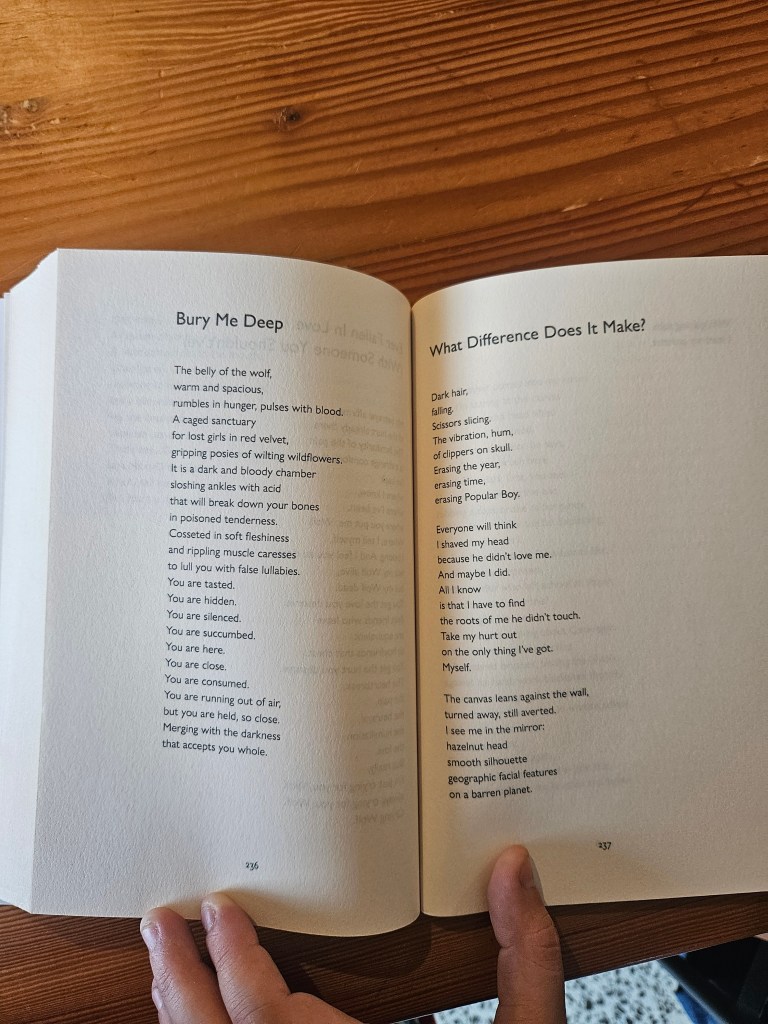
You use interesting chapter headings. Could you choose a favourite and explain more about it?
All the chapter headings are songs that I listened to while writing. They are a way I got into the atmosphere of the book, returning to write through listening to the songs. Pop music that is experimental, cool (to me), and takes me to the time in my life where I was drawing inspiration. Many of them are Velvet Underground songs and I love I’ll Be Your Mirror because the song encapsulates the gap between how we see ourselves and how others see us, especially as teenagers. It’s a song professing to reflect the light and love and beauty they see in someone back to them. It’s a song I’d like to sing to all those young people out there who are being unkind to themselves.
I’ll be your mirror
Reflect what you are, in case you don’t know
I’ll be the wind, the rain, and the sunset
The light on your door to show that you’re home
When you think the night has seen your mind
That inside you’re twisted and unkind
Let me stand to show that you are blind
Please, put down your hands
‘Cause I see you
I find it hard to believe you don’t know
The beauty you are
But if you don’t, let me be your eyes
A hand to your darkness so you won’t be afraid.
What hope do you see for young people dealing with the threat or consequences of suicide?
Suicide is the number one killer of young people in Australia and by the age of 25, one in two will have been affected by it. That’s a devastating statistic, isn’t it?
I hope that those who have gone through this would find comfort in being seen in the pages of The Belly of a Wolf and know they are not alone. It is a terrible thing to go through. The grief around suicide is complicated, often because the person who has died is not memorialised and celebrated like those who die in other ways. Speaking about them and the way they died is often taboo and unspoken which means it is hard to process what has happened. There needs to be more openness and a destigmatisation about suicide and suicidal thoughts so that it is easier for young people to talk about it and easier seek help for themselves and their friends. I also hope that anyone dealing with suicidal thoughts who read this book would realise the enormity of the action and the devastation it creates, and that they can seek help and hold on.
What are you writing or working on now or next?
My writing practise is sporadic and I work on several projects at once. At the moment there is another YA verse novel and a couple of middle grade novels on the go.
What have you been reading that you would like to recommend?
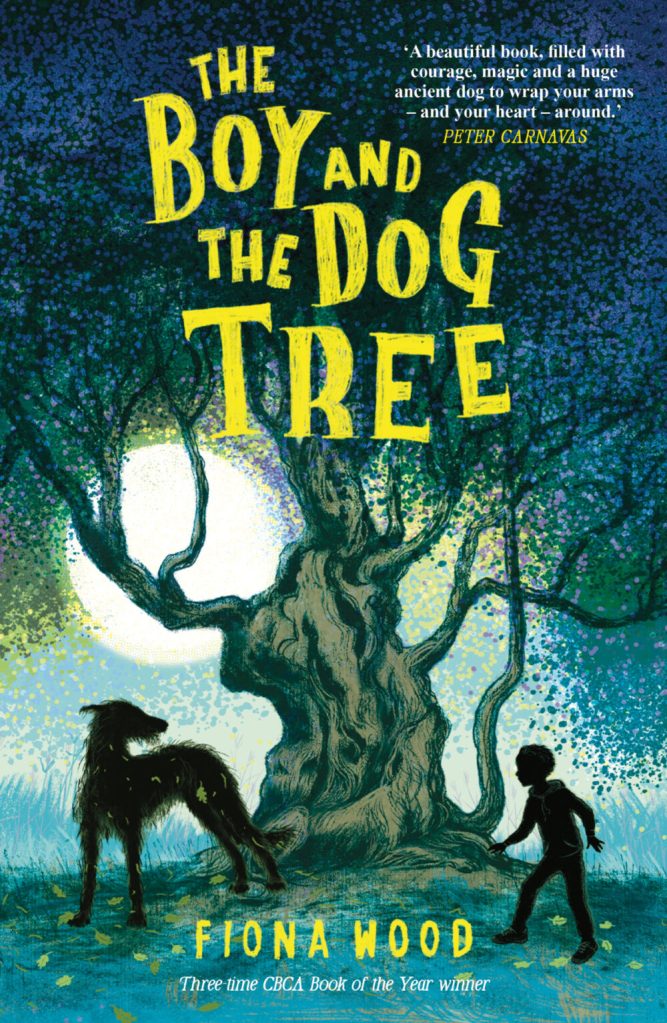
The Boy and the Dog Tree by Fiona Wood is an instant classic and I wish I had read it as a child. It has this wonderful combination of real life and deep magic that I always love in a book, and a strong warm authorial voice that fosters a bravery in the reader to follow wherever it leads.
How can your readers contact you?
There is a link through my website – info@juliannenegri.com

 paperbarkwords.blog