
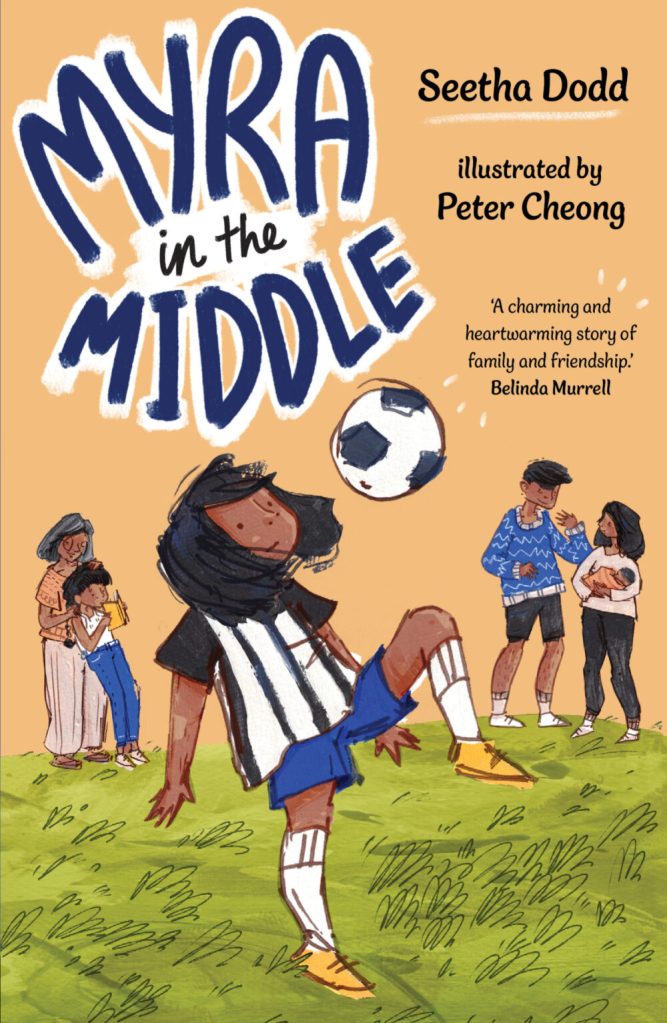
Myra in the Middle by Seetha Dodd, illustrated by Peter Cheong
Published by UQP
Seetha Dodd writes a guest author post about her impressive debut children’s novel, Myra in the Middle for ‘Joy in Books’ at Paperbark Words.
When my sister was born, I was exactly three years and eleven months old. I had been perfectly comfortable with my ‘status’ as the youngest child in the family. Her arrival made me apprehensive. I was, admittedly, a little jealous of this cute, chubby-cheeked creature who demanded all my mother’s attention.
But being a middle child has its perks. I eventually realised the privilege of my position – I was both an older sibling and a younger sibling. I got to ‘level up’ when I played with my older sister, and then I got to indulge my more childish side when joining in with my younger sister’s games. I could be guided by one and be a guide to the other.
Finding your place in the middle
Writing Myra in the Middle was cathartic in a sense. I could make Myra a ‘better’ middle sister than I had been. Kinder, more considerate, more analytical. Myra’s initial feelings about being in the middle lean towards the negative – squashed in the middle of the car’s back seat, ignored like piggy in the middle, invisible like the hole of a doughnut. As the novel progresses she learns to accept her new place in the family. Her grandmother (Muthashi) reminds her of the important role she plays and helps her think of the middle as a good place to be. After all, surely the best part of a custard cream biscuit is the middle!
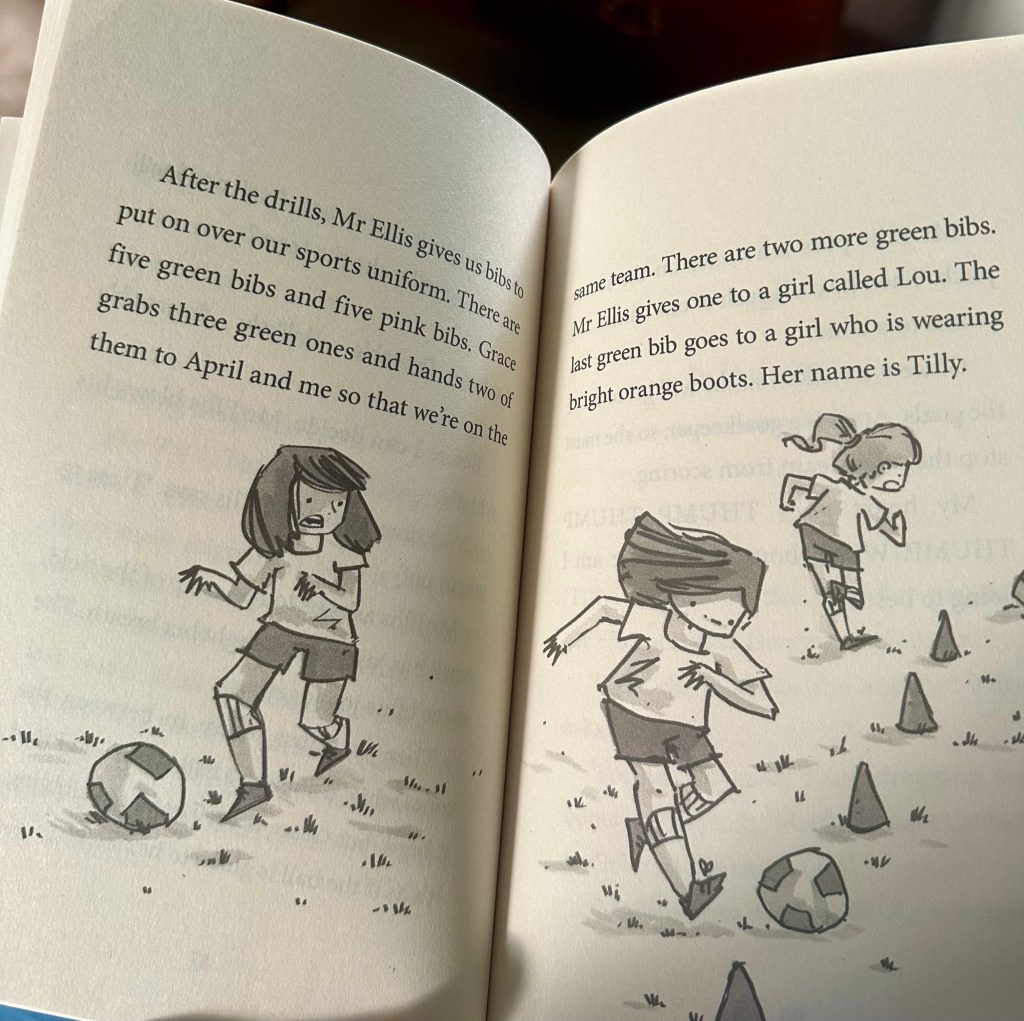
Myra’s experience of being placed in the midfield on the soccer pitch adds to her frustration. As a new soccer player, she wants the glory of scoring goals or saving them. Once again, being thrust into the middle feels like a disappointment. She feels lost and insignificant. But Muthashi knows exactly what to say. The middle is a bridge, connecting two things and offering the benefit of different perspectives.
Myra just needs to see herself as a playmaker on the pitch – she is the link between the defenders and the strikers, the creator of opportunities due to her unique vantage point. The middle is a position that requires awareness, composure and the ability to connect players; by the end, Myra recognises this as being crucial to her contribution as a teammate in the match, and as a sibling in her family.
Mathematics to make sense of the world
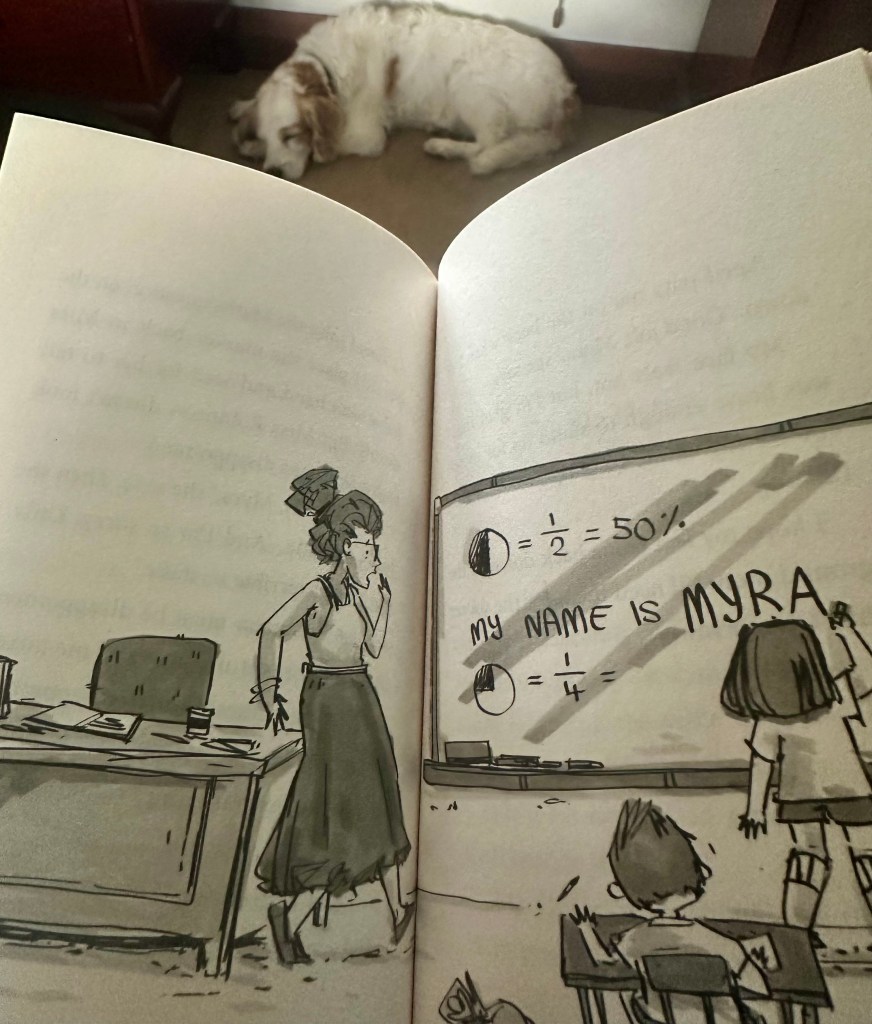
Myra is a thinker, and she uses Mathematics and logic to make sense of the changes in her life. I wanted these elements to be relevant and interesting to readers, so I did some research to ensure my examples aligned with the Australian Mathematics syllabus for a seven- or eight-year-old student in Year 3.
I think this aspect of the novel could be useful in a classroom setting, and the excellent teachers’ notes prepared by Christina Wheeler suggest engaging with parts of Myra in the Middle to practise mathematical concepts. For example, Myra uses fractions to describe the special way Muthashi makes jelly slice (because she “knows my favourite layer is the biscuit base”). She considers the probability of all her friends getting picked for the school soccer team (“certain, probable, unlikely or impossible”), and she estimates – with percentages and pie charts – how often she is called the wrong name by her teacher. When Myra feels left out, she describes herself as an outsider with a Venn diagram depicting two connected circles for her siblings, and Myra as a separate circle. Towards the end of the novel, when Myra bonds with her siblings, we are shown a three-circle Venn diagram, symbolising their interconnectedness.
As a thematic device, the use of Mathematics and logic gives readers an insight into Myra’s character – her analytical mind and the way she processes information. It also allows for breaks in the text, along with the illustrations, that not only add an element of fun, but also support visual literacy and enhance comprehension.
A celebration of Indian culture
I had the character of Myra in my head long before the first words were written. Growing up in Malaysia, most of the books I read were from the UK or the US and none had characters who looked like me. So, as an adult, I am writing the stories I would have loved as a child. I hope children, regardless of their background, will enjoy Myra in the Middle, and perhaps also come away with a deeper understanding of what it means to belong.
My own Muthashi and I had a strong bond – she lived with us when I was growing up, and her influence on my life is immeasurable. Her hugs and her chicken curry were legendary, and I wanted to honour her memory in this book. The food in the story is very much inspired by Muthashi. Murukku, coconut candy, idlis and potato stew were all her specialities.
But Myra’s family also enjoys treats like jelly slice, custard creams, and Fish and Chips on Fridays. This was a deliberate choice, to paint a realistic picture of an Australian family of Indian heritage and the cultural synthesis this involves. The middle ground, perhaps, with multi-faceted characters who don’t fit into a stereotypical mould. An intergenerational family where the dad might be the one heating leftovers for dinner. A grandmother who listens to traditional Indian music but also sings along to an Australian talent show, and who played football as a child.
My hope for Myra in the Middle
Myra in the Middle is my love letter to many things – middle children, grandmothers, soccer, Indian culture and self-advocacy. And, of course, siblings. My sisters and I don’t meet as a trio often, as both live in the UK, but when we do, my favourite three-circle Venn diagram comes together again. That precious intersection at the centre is our common ground, and we guide – and are guided by – one another.
I think it’s important for children’s books to provide a window to different perspectives, or a springboard for discussion. I hope Myra in the Middle encourages reflection and empathy. I would love for readers to connect with Myra’s character, to warm to her voice and her sense of humour, and to cheer her on as she finds her place in the world when everything feels muddled. At its core, it is a book that reminds us that change can be hard, but is made easier with the support and love of family and friends.

 paperbarkwords.blog