
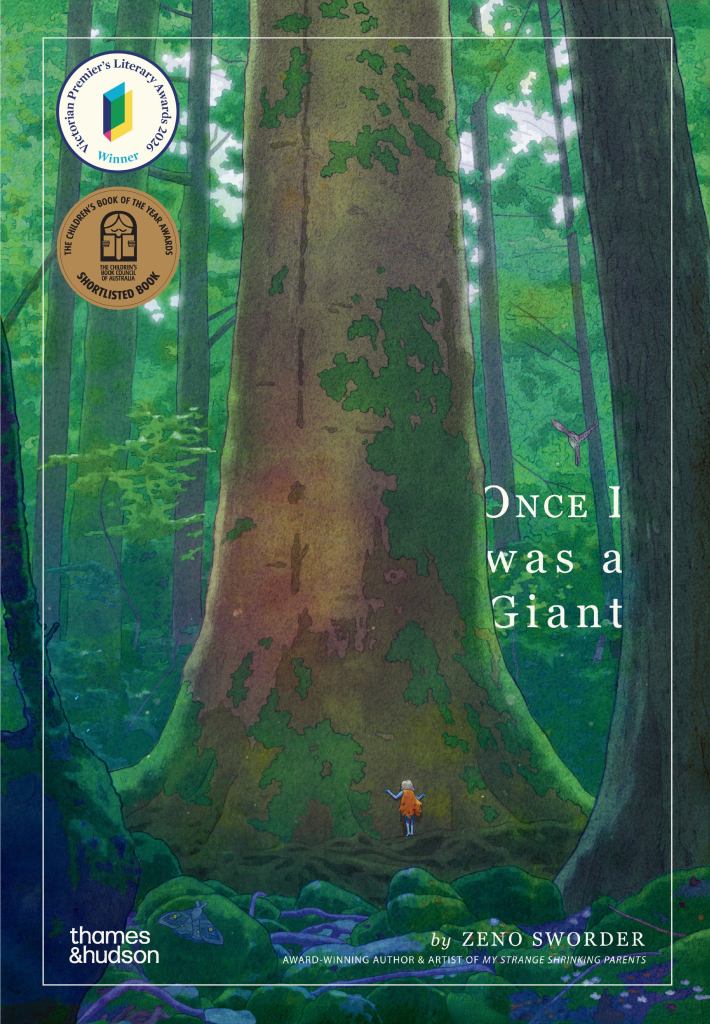
Once I was a Giant
by Zeno Sworder
Published by Thames & Hudson Australia
“At daybreak the wanderer scrambled through my branches to warn the birds and tunnelled underneath my roots to warn the insects.
Before leaving they called out goodbye.
‘Sun seeker. Sky dancer. Life maker.
Thank you.’”
(Once I was a Giant by Zeno Sworder)
Once I was a Giant follows Zeno Sworder’s awarded picture books My Strange Shrinking Parents and This Small Blue Dot.
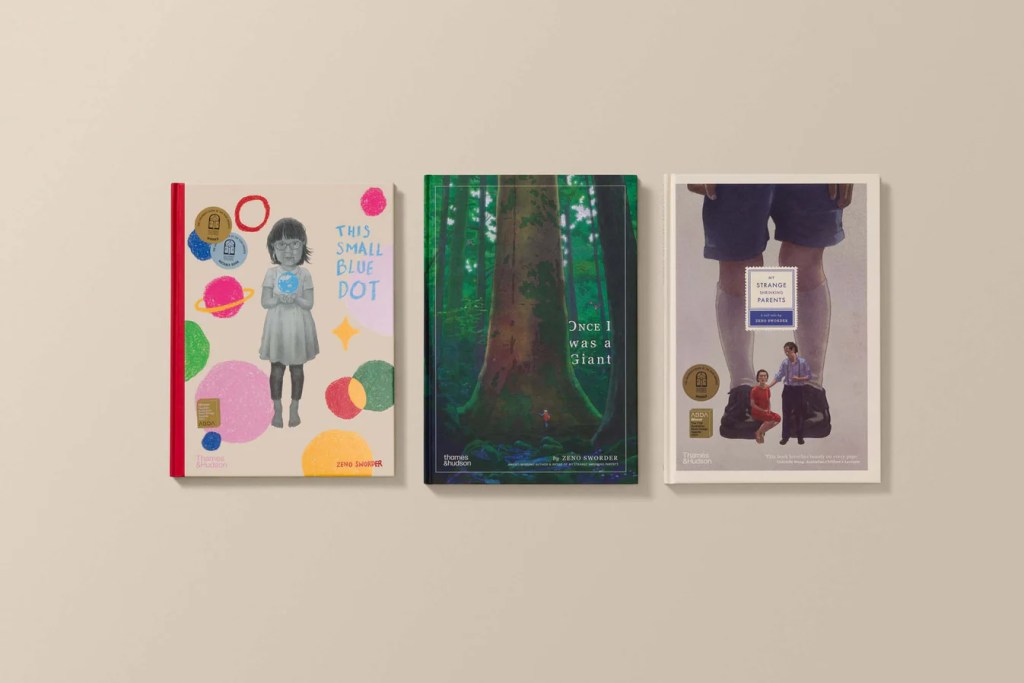
Once I was a Giant is a superlative picture book. The principle of appreciating, caring for and saving the natural world is elemental and profound, and should be part of everyday life.
I savour this book (as have those I have shared it with). All have viewed it with wonder and delight.
Zeno aptly describes himself as author and artist.
My first viewings focused on the illustrations only because they are so compelling. The artwork is exceptional, with its meticulous composition, perspective, viewpoint, panels and full-size spreads, shadows, colours (the colour choice – specifically green, purple and orange – create atmosphere and elicit an emotional response), and generous detail.
They tell a story themselves.
The writing is also exemplary. The story flows, and the language is poetic and sensory. The author uses well-chosen active and descriptive words. He uses repetition judiciously to great effect.
Once I was a Giant invites and takes readers on an emotional and metaphorical journey.
Interview with Zeno Sworder about Once I was a Giant
Congratulations on Once I was a Giant being a 2026 CBCA Shortlisted Book, Zeno. It is a masterful, imaginative picture book.
Thank you for speaking to PaperbarkWords blog.
What is the significance of the title, Once I was a Giant? Why are some letters hidden? Why is the title in past tense?
The title appeared very early on while making of the book. Once it was in place it wasn’t questioned. The essential theme of the book is the idea of transformation and metamorphosis; of a living world with no beginning or ending. I wanted that to be reflected in not only the story itself but also the design of the book as an object. It was important that the title of the book also be the first sentence of the story and that the cover would also work as the first illustration or the first page of the book. Similarly the back cover is also meant to work as a final illustration of the story.
Beyond all that, when it comes to a title I’m often reaching for something that works on more than one level. So with this title in particular, tonally I wanted there to be a sense of something lost; of a natural world that is diminished. The story also incorporates elements from folklore and fairytales and so the use of the word ‘giant’ helps orient the reader in terms of the type of book they are opening.
Once I was a Giant is metafictive (where attention is drawn to story itself as a work of art/fiction, while exposing the “truth” of a story), particularly here with the author/artist being placed inside the book … What challenge did you face in bringing these metafictional elements into the story?
The metafictive aspect of the story was born out of early drafts which were more concerned with the distinction between the human-made, urban world and the natural world. I was fascinated by the idea of the pencil being able to observe the human world from its unique perspective of being a tree. For a long time the book started with the pencil’s observations of this strange world where the pencil was living in a box which existed inside the box of the apartment and then the even larger box of the building. The pencil noted that the picture-book maker travelled around in a box on wheels to go to other boxes. There was this idea of the human world being built around separation and compartmentalisation.
In the final version of the book, a lot of thought was put into how to depict these two different realities; the natural world and the human-made world. I leaned very heavily on colour with the urban world using non-spectral colours that are not seen in nature such as highly saturated purples and blues. The urban world is also depicted very close-up with clear boundaries and walls whereas the natural world is usually shown from a more distant perspective to show the openness and variety of that environment.
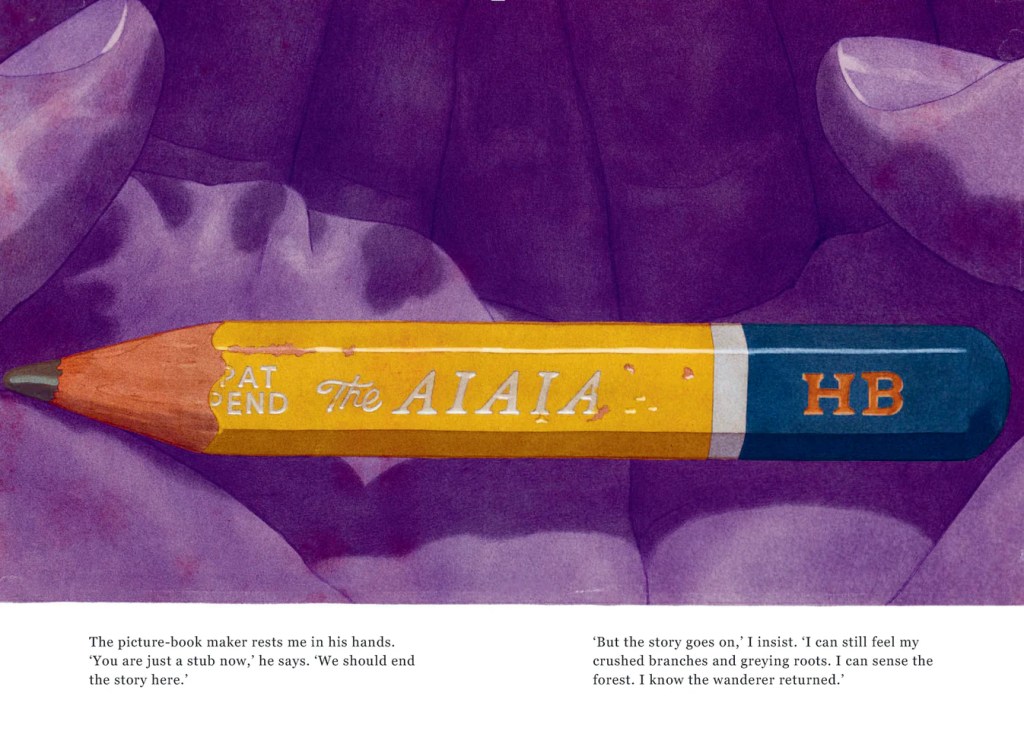
The artist’s pencil is a key part of the story. What is special about the type of pencil shown?
The pencil in this book is very close to my heart and is a great example of the dumb luck that sometimes emerges when you’re working as both writer and illustrator.
I stumbled across the name of the pencil, AIAIA, through dumb luck. It was initially just a placeholder name (because of the ease of writing it) but later I realised it was the name of a very special forest island that I had been told about when I was a child. My father was a teacher and the book that he loved teaching most was Homer’s Odyssey. In the Odyssey, Odysseus and his men come across an island that has one inhabitant – the Goddess-Sorceress Circe. She is the Greek goddess of transformation and metamorphosis. She famously turns Odysseus’s men into pigs when they misbehave.
I was very grateful that Circe and her forest had woven themselves into the story in this way. I imagine that the pencil is from Circe’s island of metamorphosis, Aiaia and this is the place where the story begins.
Please tell us something about the art on the picture-book maker’s walls.
The art on the picture-book makers walls is meant to refer to other stories and works of art that relate to metamorphosis and the natural world. In one of the very first illustrations there is a painting by Piero del Pollaiuolo of the moment that the God Apollo captures the nymph Daphne and she transforms herself into a tree. Other artworks include Primavera by Botticelli and Circe Invidiosa by John William Waterhouse.
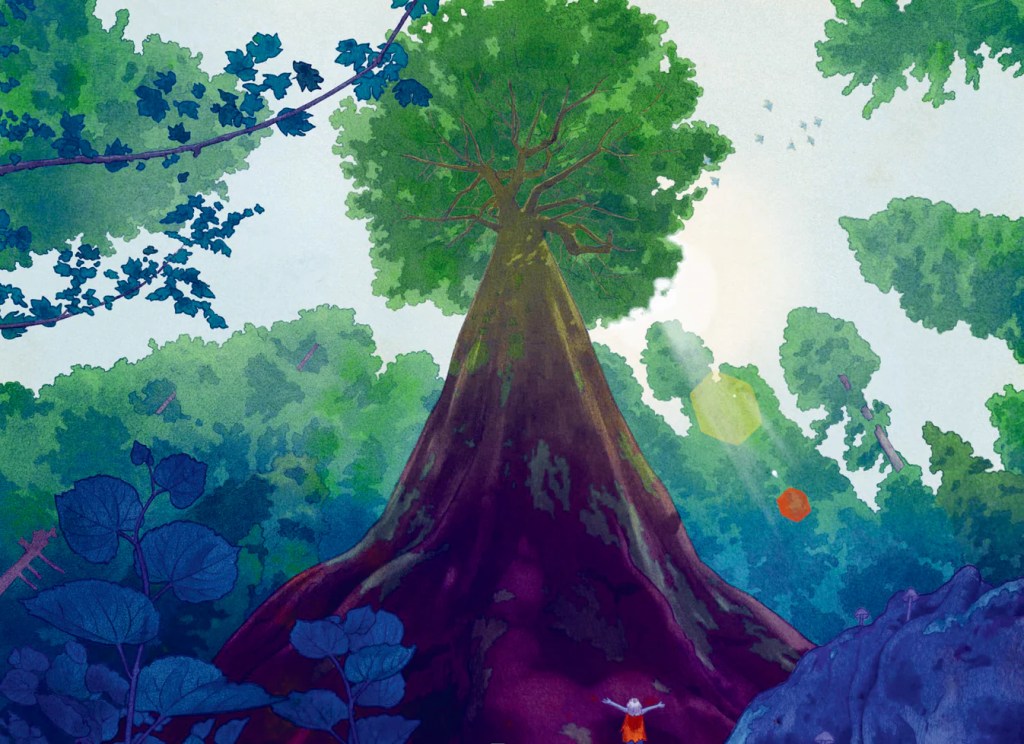
What do you treasure about trees?
I’ve always loved Khalil Gibran‘s observation that ‘trees are poems that the Earth writes upon the sky’. But I also think it goes deeper than that.I grew up in a small country town without a lot to do, so I spent an incredible amount of time climbing trees. Like most children I had this sense that when I was high up in the arms of a tree, I wasn’t only standing in the arms of something that was alive but was also awake. I find the relationships that people have with trees and plants fascinating, how they talk and sing to them – they continue to recognise this inherent awareness. And of course there is this immense gratitude that we carry around for trees because of how interwoven our lives are; We would not be able to breathe in if trees did not breathe out.
Who is the Wanderer?
The natural world is mysterious, vast and magical and I wanted that spirit to inform the character of the Wanderer. I wanted to avoid readers being able to immediately categorise him as a fairy or forest spirit though he has elements of both. In his design I hoped to emphasise his closeness to trees so his skin is covered in lichen and he has branches growing from his head rather than antlers. Like a tree he also wears a leaf. The name comes from the idea that he finds companionship with trees and ages on a long time scale much like a tree. But the thing that sets him apart is the fact that he can wander about.
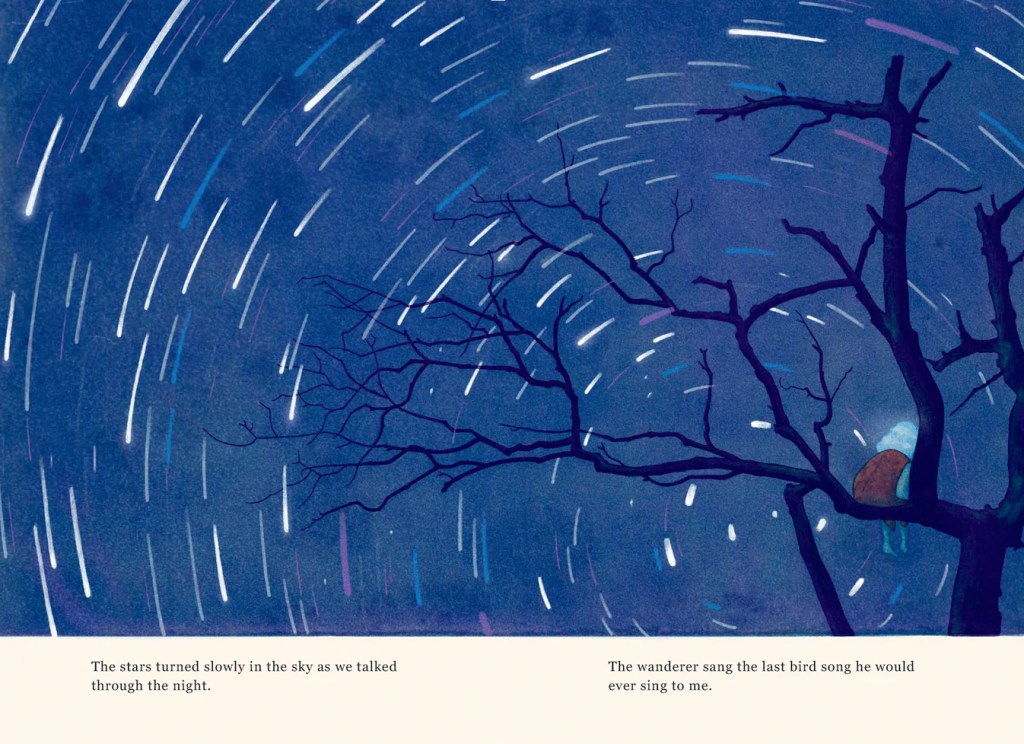
What media or process do you use in the book? How have you created the splatter and splodge techniques?
The illustrations for the book took roughly a year to complete. They are the most difficult but also the most joyful part of the bookmaking process for me. Each illustration starts with graphite powder which I lay down with cotton wool to create a base mid tone to work from. I then go in with kneaded eraser and pencils of different hardnesses (anywhere between 2B up to 6H). The final stage is a watercolour painting which I do on a separate layer of acetate paper. Using a computer, I will layer the pencil drawing and the painting on top of each other in a process that’s similar to wood block printing. The thing I enjoy about this process is that it opens itself up to many happy accidents which I wholeheartedly embrace.
The illustrations are informed by Asian traditions of nature art which value the feeling, spirit and atmosphere of their subjects over photorealism. In this work, blemishes, stains and smudges were left in the illustrations because they honour the handmade nature of the book and, perhaps more importantly, because there is beauty in the unplanned interaction of things just as there is in nature.
Your work generates strong emotional responses from the reader throughout the story. They include awe and wonder, empathy, fear, anger, sorrow, love and hope. Which of these are you particularly proud of creating? How have you achieved this?
This is a question that has fascinated me for a long time. My mother is a pianist and I’ve always admired the fact that when she is playing a piece of music she is able to communicate the emotion through not only technique and physicality but also by the way she experiences the emotion in real time as she plays the music. Like most authors when I am writing or drawing a story I am often deeply affected by the emotion of fictional moments. It is quite embarrassing to say, but I have often cried while drawing a particularly sad illustration. I always wonder whether the artist experiencing these emotions at the time of making the work imbue it with that particular resonance or whether it is imagined.
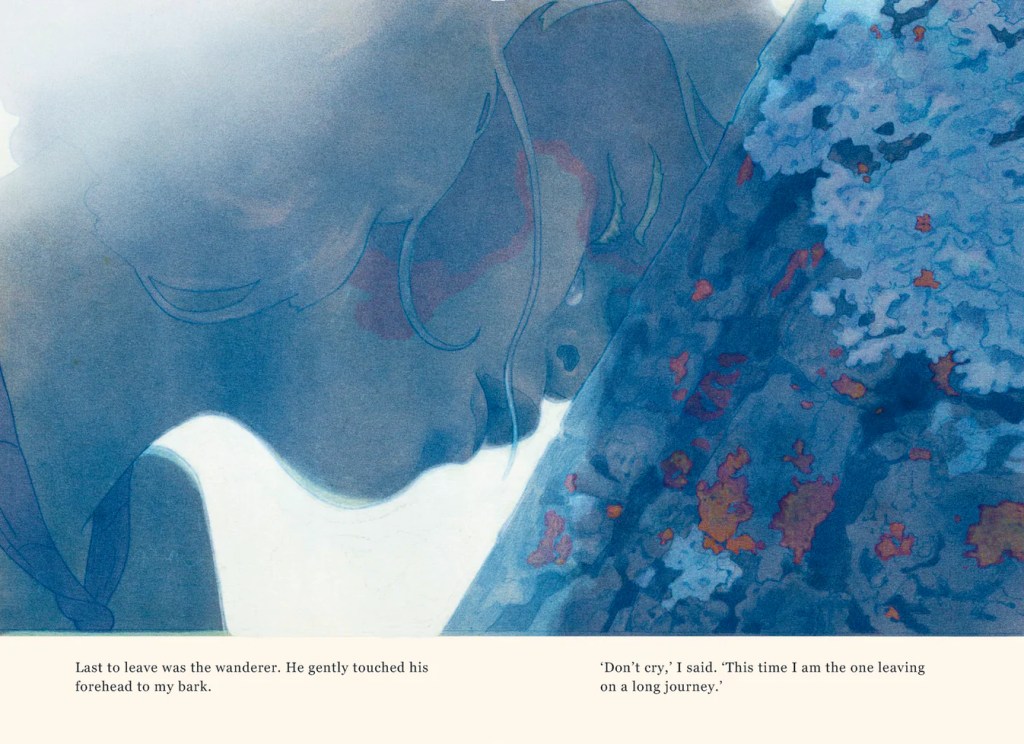
One of the earliest images that came to me is the illustration of the wanderer saying goodbye to the tree and touching his forehead to the tree’s bark. It is one of the first illustrations I completed for the story and still one of my favourites. Looking at it now from a distance I can see some of what I have done but have to admit they weren’t all conscious decisions. It was more of a case of working on an intuitive level to capture a particular feeling.
Looking at the image now I can see that a lot of the colour has been stripped out and the colours that remain show that the tree and the wanderer are almost a continuous entity – that they are very much part of each other. I can see that the patterns of the tree are reflected on the skin of the wanderer. I can also see that the part of the tree in the illustration is not vertical. It is sloped which gives it a feeling of resignation or surrender. This also allows the wanderer to be pressing his forehead downwards which shows his love and commitment to the tree and also the defiant hope that he holds onto. The background has also been taken out of the image and replaced with light, which suggests to the reader that this is a moment which is taking place on a heightened emotional plane where reality has receded for the wanderer and the tree.
You create ‘home’ in this story. What does ‘home’ mean for you?
What a great question to close out the interview. Home to me has always been a place where you are able to flourish.

 paperbarkwords.blog
One thought on “Once I was a Giant by Zeno Sworder”