
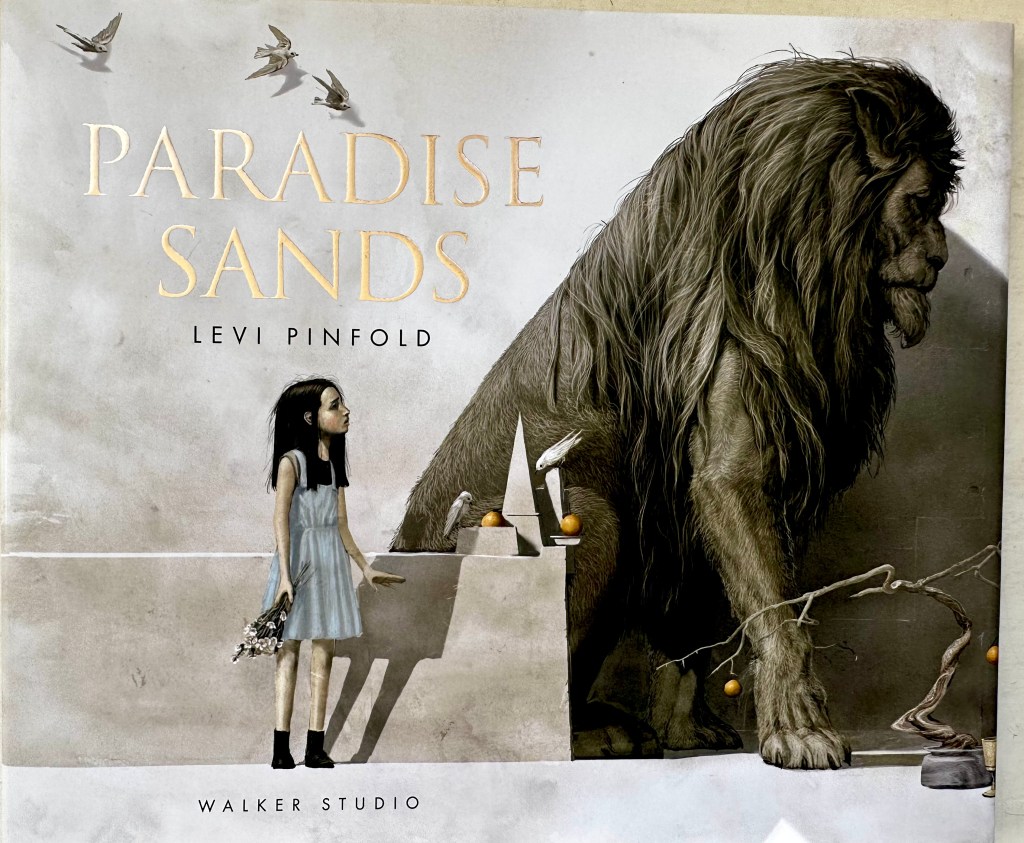
Paradise Sands: A Story of Enchantment
by Levi Pinfold
(Published by Walker Books)
Book review and suggested activities by Joy Lawn (Joy in Books) at PaperbarkWords blog
‘White roses we follow, towards Teller’s Hollow
Dead earth to a spring, the house of a King
A sip from the chalice, we enter his palace
Break bread for the Keeper now we descend deeper
Washed clean in his pool we fall under his rule
Away from what is, we all are now his‘
(poem from Paradise Sands)
Inside the CBCA Shortlist
Inside the 2023 CBCA Shortlist
Levi Pinfold’s book Paradise Sands: A Story of Enchantment is shortlisted in the Picture Book category of the 2023 CBCA awards. It is an imaginative and intriguing picture book for mature readers who can interpret the surreal, allusive layers of the written and visual text.
Three older brothers and a sister are on a road trip through the hot, desolate desert to visit their mother in hospital. They refer flippantly to a poem that may be part of their family lore but it foreshadows the threat they are about to encounter.
Leaving the road to pick wildflowers for their mother, the brothers drink deeply from a spring outside an imposing yet oddly silent white hotel. The brothers become entranced and ensnared and enter the building to seek food. After eating, they immerse themselves in the cool water of the pool. Looking into the water, their sister sees only her own reflection and three sea creatures in the place of her brothers.
In panic she runs through the building until she meets a grand lion. He introduces himself as the Teller and explains that her brothers have made their own decision. They belong to the place now. We wonder what they have chosen – entrapment rather than free-will, death rather than life, limbo or paradise? The lion tempts the girl with food and drink – and a place for herself in paradise. She refuses to leave her brothers but she is given the opportunity to save them: she must endure a three-day banquet without eating or drinking.
The banquets are held at a long stone table in an ancient otherworldly temple portico with columns under an entablature or lintel. It has echoes of Greek, Roman, Egyptian or Renaissance periods.
On the first day, the banquet feast is orderly and refined, with the “residents” (animals) sitting and eating in a dignified manner. (We wonder if these creatures were formerly human after having witnessed the brothers’ transformation from young men into sea creatures.)
On the second day the residents are more relaxed and uninhibited. There is less food and more movement by the larger creatures. Some of the animals are ‘frame-breaking’ (a device used by other metafictional illustrators such as David Wiesner in The Three Pigs where his pigs escape from the page) through and above the temple.
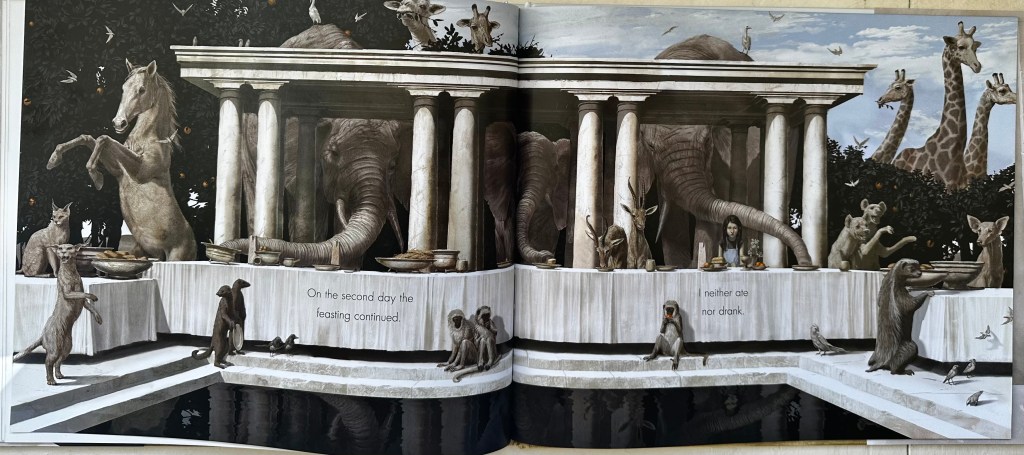
On the third day there is “only heat and the sun”. Instead of a courtyard garden the backdrop is now a vast landscape. The banquet has become a scene of disorder and dereliction. The portico looks more like the Greek (or other) temple that we see in ruins today – a relic without life. The food is finished. The animals have left, replaced by crows. The girl has not eaten or drunk but, to keep them alive, she waters the wildflowers they picked earlier.
The Teller is impressed with her fortitude and honours their agreement but leaves the girl with the warning that, because she took water for the flowers, one day her own children will “visit me here and, if they choose to stay, they are mine.”
The siblings leave, with the brothers oblivious to what has happened. When they reach the hospital, their mother recognises the flowers as coming from Teller’s Hollow and shares a look of understanding with her daughter. In a final vignette, a scene of some hope, the mother is able to leave with her children, although supported by her daughter.
This cyclic tale may imply intergenerational mental or other illness or trauma. It ultimately upholds the importance of family love and support.
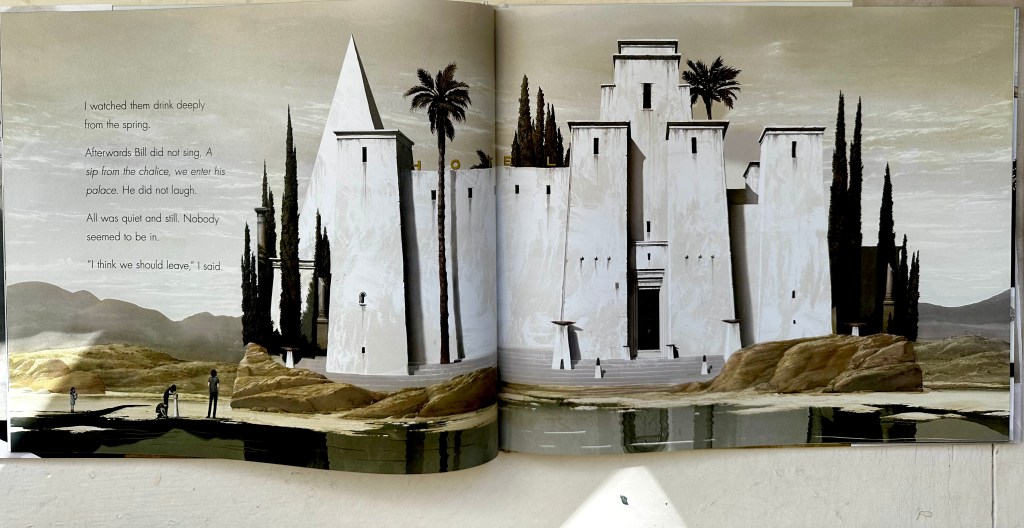
The illustrative style is painterly. It is both surreal and architectural. A dreamlike meeting with the grand lion-figure, the animal diners and an explosion of dust is superimposed onto a realistic road trip in a desert setting. The architectural design of the hotel, with its tall foreboding walls that are designed with lines that are slightly on the diagonal suggest formidable size as well as the unpredictability soon to be faced inside. The broken plinths with missing statues and the patterns on the walls beside the pool suggest destruction, danger and imprisonment.

The composition of both the illustrative text and the story In Paradise Sands: A Story of Enchantment is outstanding. Levi Pinfold creates a classical yet ominous and suspenseful atmosphere. He generates extraordinary narrative and emotional tension between the temporal and transcendental. It is a universal tale.
Using the book with students:
There is much to explore in this book and repeat readings will be rewarded.
Some (of many possible) ideas follow:
Paradise Sands: A Story of Enchantment To what could the title refer? How is this a story of enchantment?
Premonitory Poem The story begins with a poem written in italics (shown at the beginning of this review). It is a prophetic or cautionary tale that foreshadows much of what occurs next.
The poem refers to white roses, Teller’s Hollow, “the house of a king”, a chalice, and being “washed clean in his pool we fall under his rule”.
Before reading the book, students could predict to what these (and the other elements in the poem) may refer. They should be as imaginative and lateral in their ideas as possible (also using cues from the book title and cover) to emulate the creative, surreal nature of the story they are about to enter.
Sequence of Events During or after reading the book, students sequence the events using a timeline or flowchart.
They could compare these with what they predicted in the ‘Premonitory Poem’ activity (above).
Setting Students use cues (particularly from the illustrations) to ascertain where the story may be set.
Architecture How does the architecture of the hotel and the temple portico indicate a time in the past? How much of the architecture suggests that it may be set outside time?
Colour Students explore where Levi Pinfold has used colour. Where and why has he used monochrome? Where has he used colour? [note the blue dress, the coloured fruit and gold goblet at the banquet]
Shadows, Reflections and Echoes Where has Levi Pinfold used shadows, reflections and echoes? Why?
Symbols Students discover symbols, such as flowers, water, birds, fruit, sand and others in the book. Select one of these to explore further. Represent findings using words or pictures.
The Teller Students discuss the persona of The Teller. How big is he, how is he positioned on the page and where is his gaze directed? What do they learn from his words, body language and facial expressions? Is he a benign or malign character? Or both? Explain reasons.
Page Composition Where and why are double- and single-page spreads used?
Where and why are vignettes or small framed panels used?
Traditional and Other Literature Students could find the traditional, mythical, Biblical and other literature to which Paradise Sands may refer.
[Some ideas follow but there are others which are not suggested here:
The lion could refer to Aslan from the Narnia series by C.S. Lewis or a Godlike figure from the Bible or other literature. The stone table could refer to the Stone Table on which Aslan is sacrificed in the Narnia series.
Other Biblical allusions are the temptation of Christ in the desert where, like the girl, he could not eat or drink, the death of Jesus for three days between the Crucifixion and the Resurrection, the Last Supper of Christ (also a famous Renaissance painting by Leonardo de Vinci, which may be an inspiration for the table scene in Paradise Sands), and the Garden of Eden with its trees and forbidden fruit.
The number ‘three’ is an important part of fairy tales and folklore, such as The Twelve Dancing Princesses whose secret the princes must guess within three days and three nights or they die.
Not eating and drinking to avoid captivity is also a part of fairy tales such as The Raven by the Brothers Grimm and Greek mythology epitomised by Persephone in the underworld.
Some of the above may also be part of other religions or folklore.]
Other books Read the surreal works of Shaun Tan, Chris Van Allsburg (particularly The Mysteries of Harris Burdick), David Wiesner and Elise Hurst (particularly The Storyteller’s Handbook).
Thank you to Walker Books for the review copy of Paradise Sands: A Story of Enchantment.
Paradise Sands at Walker Books
Other books by Levi Pinfold at PaperbarkWords blog

 paperbarkwords.blog
Wow, the visual text is wonderful, I want to run out and buy this book right now (and I very rarely say that!) 🙂 Gretchen.
LikeLiked by 1 person
Isn’t it incredible Gretchen! I hope you can buy the book very soon. It’s such a standout.
LikeLiked by 1 person