
Farmhouse by Sophie Blackall
Published by Lothian Children’s Books, Hachette Australia
Book review and suggested activities by Joy Lawn (Joy in Books) at PaperbarkWords blog
Inside the CBCA Shortlist
Inside the 2023 CBCA Shortlist
Australian-born, USA-resident, dual Caldecott Medallist Sophie Blackall’s book Farmhouse is shortlisted in the Picture Book category of the 2023 CBCA awards.
There are many picture books set on farms but this book far exceeds the usual offerings. As with all of Sophie Blackall’s books, Farmhouse has a unique perspective and exudes care, class and craft.
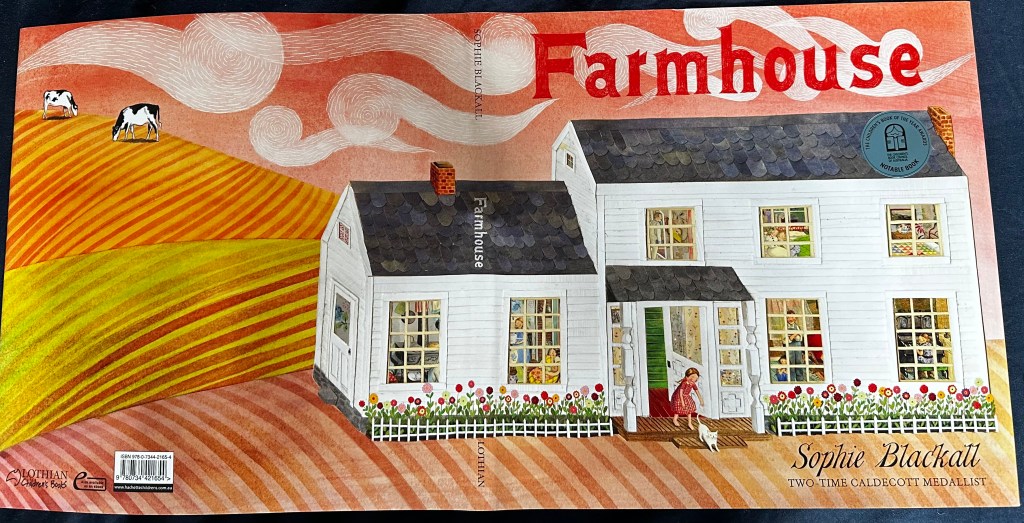
A luxe wrap-around dust jacket shows the outside of a picture-perfect farmhouse (see image above). The eye is drawn to a young girl on the front step about to pick up a cat. Then we look through the windows to see glimpses of characters and scenes inside.
Under the removable cover, the hardback cover shows the farmhouse interior as a cross-section that resembles a doll’s house with the front façade removed. We see vignettes of what the family are doing inside at different points in time: an older daughter helps to serve the meal, another plays the organ, the children prepare for bed …

Once inside the book, we learn that the farmhouse nestles in an idyllic setting: “Over a hill, at the end of a road, by a glittering stream that twists and turns”. Twelve children were nurtured, loved and disciplined in the house. They helped create the spirit of the home with their own wallpaper decorations of nature-inspired potato-print patterns and were taught, reprimanded and then forgiven as they grew.
Rooms in the farmhouse become the focus of many of the pages: the “serious room”, and the bedrooms and the kitchen are hubs. The staircase is a liminal space that joins the rooms and is particularly significant near the end of the book when the youngest child “who is now quite old”, prepares to leave.
The farm outside, with its ongoing chores of milking the cows, forking hay and picking apples is also important.
The richness of the relationships between family members and their collaborative task-sharing and joy in each other’s company is a highlight.
Time encroaches – into the narrative structure and as an unexpected change of focus and pace. For much of the book we feel encapsulated inside a stable time in the past of family and seasonal ritual. But time passes, the roof leaks and the children …
“…who all
grew up in this house,
who went off to school
or to work on a farm,
or to drive a truck
or train as a nurse,
or study the stars
or have babies themselves,
until one day,
the youngest child,
who was quite old,
took a last look around
and picked up her case
and opened the door
and stepped outside …’
From Farmhouse by Sophie Blackall
As if given permission to finally rest after the last child leaves, the farmhouse sighs, slumps and begins to deteriorate. Nature subsumes it.
Later, a woman, presumed to be the author herself, finds a path to the farmhouse and collects some of the precious remnants left behind. She turns them into a book, “where they’ll live on, now, in this book that you hold, like your stories will, so long as they’re told.”
Farmhouse contrasts the ‘inside’ interiority of housework, cosiness and nurture of a home with the ‘outside’ freshness of nature and farmwork. Both are essential.
We are reminded that, no matter how seemingly sturdy and longstanding, a building is dependent on being occupied, used and tended by people.
In Farmhouse, Sophie Blackall poignantly and perfectly shows the legacy of a family. Even though the tangible fruits of their work and endeavour may disappear, their indelible impact remains.
Using the book with students:
There is much to explore in this book and repeat readings will be rewarded.
Some (of many possible) ideas follow:
Farmhouse
The farmhouse in this picture book represents a microcosm of a life.
Children/students brainstorm other types of houses that are known by a recognisable compound ‘house’ name. [examples: lighthouse, treehouse, beach house, townhouse, mill house, manor house, doll’s house, gingerbread house]
List their special characteristics.
Classify them into residential, work or functional and fictitious or imaginary houses.
Twelve children
Twelve children live in the farmhouse.
Children make a paper doll of one or more of the characters. On their clothing (or on an attached label) describe in brief, carefully chosen words who they are, what they are like and/or what they do. Like the author, do not name them.
Wallpaper
The children in the book used potato prints dipped in paint to “pattern the walls with flowers and leaves”. Children select images from nature that reflect a farmhouse and copy what the characters do by making their own potato printed (or similar) wallpaper. Details could be added with paint or marker pens. A sheet of butcher’s paper could be used to represent the wallpaper. This could later be cut to size and used in a class or family farmhouse model.
Make or decorate a farmhouse doll’s house
The farmhouse in the picture book resembles a doll’s house. An existing doll’s house could be repurposed and decorated as a farmhouse. Ideas from the book could be used to do this, or children could create their own version of a farmhouse. In her Author’s Note, Sophie Blackall explains that the “pictures in this book are made of layers. I began with the reverse side of a roll of wallpaper and added floors and walls and furniture, made from scraps and fragments …”. Children could use this technique to emulate the layered nature of lives and stories.
Alternatively, a doll’s house could be built using boxes or other materials.
Otherwise, a lift-the-flap style farmhouse could be constructed. Two layers of cardboard (one of top of the other) could be attached with a hinge-effect on one side. The top layer is painted or drawn as the exterior of the house, with windows cut as flaps to show scenes of the rooms underneath. The lower layer of cardboard becomes the interior of the house where the room details are shown. NB The ‘windows’ on the top exterior layer need to be positioned and cut in line as flaps with appropriate interior scenes underneath.
Wallpaper could be used in the farmhouse doll’s house (see the ‘Wallpaper’ activity above). Collage materials, fabric for curtains and bedding, hand-drawn illustrations like the characters’ pictures, “a button that was one a shell in the sea” and doll’s house furniture or ‘made’ furniture could be added to the farmhouse doll’s house. Seeds or small plants could be planted in soil around the house.
Rooms as panels
The interior illustrations show the rooms as ‘panels’, with small parts of surrounding rooms glimpsed. This creates context for the rooms, showing them as part of the whole house. They are also ‘teasers’ that entice readers to return to ‘establishing shots’ – illustrations that show the whole house interior, and to illustrations of those specific rooms.
Panels are used as vignettes in graphic novels and some picture books. Sophie Blackall uses them in Farmhouse to focus on certain rooms and what the characters are doing inside them.
Children could sketch 1 page of rooms from inside their farmhouse doll’s house if they make one (see activity above) or otherwise sketch an original farmhouse or house interior where they design the rooms as panels.
Dreams as ‘bubbles’
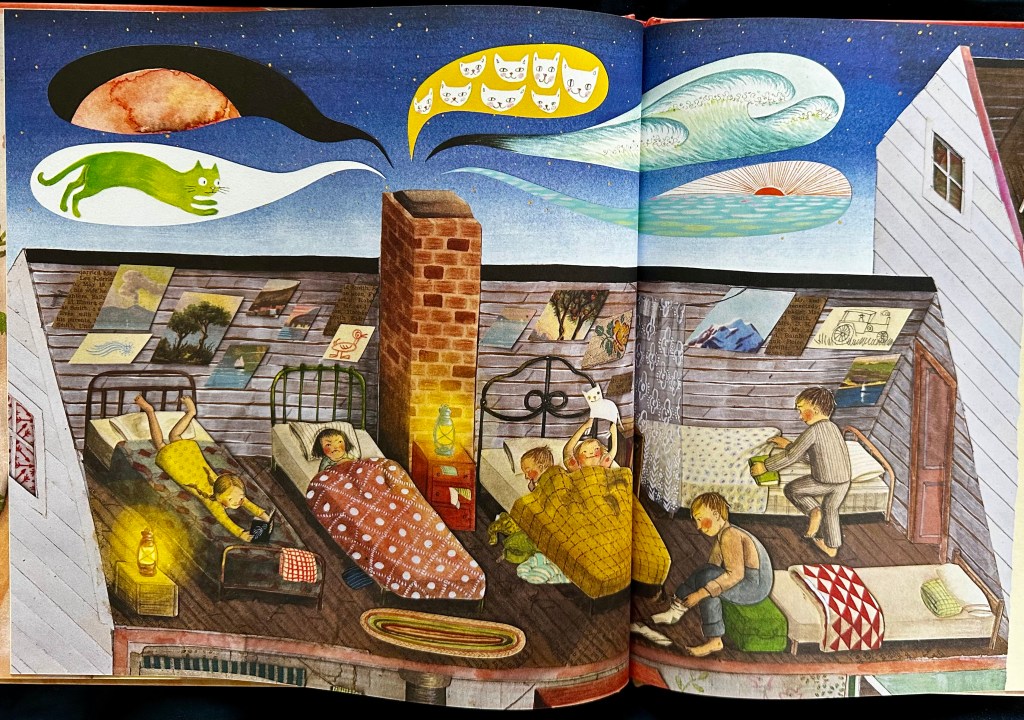
Following on from the activity above – ‘Rooms as panels’, in graphic novels and elsewhere, speech is shown inside speech bubbles and thoughts are shown as thought bubbles.
In Farmhouse, dreams are shown as illustrations (cats and scenes from nature) inside bubbles.
Children sketch a picture of sleeping characters then show their dreams as illustrated ‘dream bubbles’.
Perspective
The picture of the cows lined up alongside a path made of two diminishing diagonal lines shows perspective.

Children choose another scene from the book that shows perspective, for example, the road winding towards (start) or away from (near end) the farmhouse.
They draw or paint their own scene using a path or road to show perspective, i.e., getting smaller in the distance.
Endpapers
The endpapers at the beginning and end of the book are different from each other. Children try to identity what (or where) the images in the endpapers refer to from the book.
Other books
Read other books by Sophie Blackall, particularly Hello Lighthouse , which features a different kind of house and where the lighthouse exterior and cross-sections of the interior are shown.
Millie Mak the Maker is a new children’s book by Alice Pung and Sher Rill Ng. The first story features an old doll’s house that Millie and her grandmother restore. It could give children some ideas about renovating or building a doll’s house.
Thank you to Hachette Australia for the review copy of Farmhouse.
Farmhouse at Hachette Australia
Publisher Teacher Notes Excellent resources for teachers by Robyn Sheahan-Bright on the Hachette website.
Other books by Sophie Blackall at PaperbarkWords blog
The Beatryce Prophecy by Kate DiCamillo, illustrated by Sophie Blackall (interview with Kate)

 paperbarkwords.blog
What a beautiful story book with detailed images. Something about the illustrations remind me of Alison Lester’s books which I used to read to my boys when they were little.
LikeLike
Thanks for your thoughtful comment, Melody. Glad you enjoyed Farmhouse.
LikeLike