
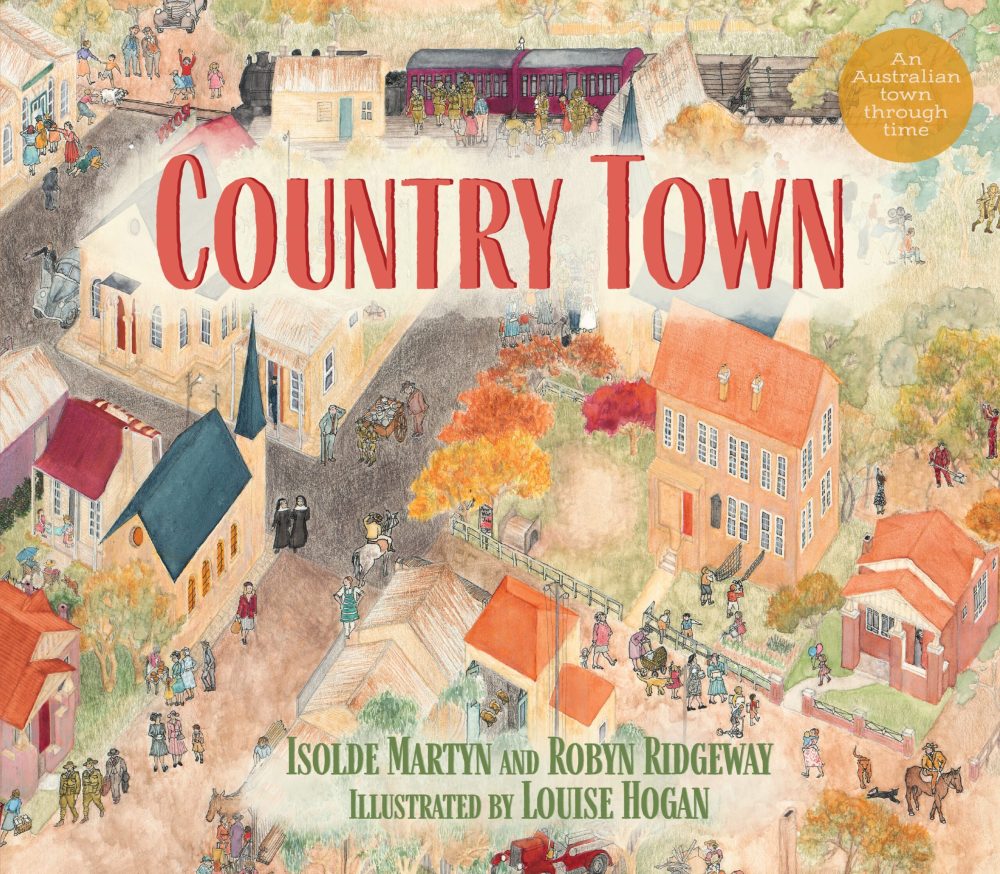
Country Town by Isolde Martyn & Robyn Ridgeway, illustrated by Louise Hogan
Published by Ford St
Inside the CBCA Shortlist
Inside the 2024 CBCA Shortlist
Country Town is the WINNER of the CBCA 2024 Eve Pownall Award.
At the time of writing it is also shortlisted for the 2024 NSW Premier’s History Awards.
Book review and suggested activities by Joy Lawn (Joy in Books) at PaperbarkWords blog
“For the First Nations People, there have been two centuries of alienation, but they have much to teach now on how to care for Country. One of the Elders will receive the Order of Australia for her service to the community. For the rest of the town, whose ancestors came to Australia over the last two centuries, whether as migrants seeking a new start or as asylum seekers feeling persecution, this place is their creation.
Come with us now. It’s time to go back over 200 years!” (Country Town)
Country Town is billed as an ‘Australian town through time’. It expertly fulfils its brief of tracking the history of a place via an imagined town as a microcosm. The country town is created by piecing together historical events and original sources and inhabiting the place with authentically fabricated people. In other hands the town may have become too generic but the book is so authoritative and immersive, it all comes to life through the pairing of historical verisimilitude and imagination. Not only does the country town of the book seem to be a real town, but it shows us much about our past.
First Nations People are integral to the whole history and are appropriately acknowledged and shown respect in the telling.
The text is well researched, clearly written and engaging. It references primary sources and quotes and includes both expected and surprising facts and anecdotes. Written and visual texts seamlessly refer to each other and generate interaction with the reader.
The layout is well-composed and interesting. It is lovingly and lushly illustrated, with generous and detailed attention to history, people and story.
Country Town is a master class in sharing Australian history in an original, appealing way. I wish it continued for many more pages. Congratulations to the creators and publisher.
****
Using the book with students:
There is much to explore in this book and a second reading will be rewarded.
Some (of many possible) ideas follow:
Timeline
The book has a comprehensive timeline on page 47.
To show the distinct and overlapping histories of First Nations People and Colonisers/Settlers, students create a new timeline using information from throughout the book and from the existing timeline. They format their findings as 2 timelines shown side-by-side and organised by date: one side shows the history of First Nations People, the other side shows the Colonisers/Settlers.
The timelines could also include thumbnail sketches to visually illustrate strategic happenings or events.
River Camp 1822
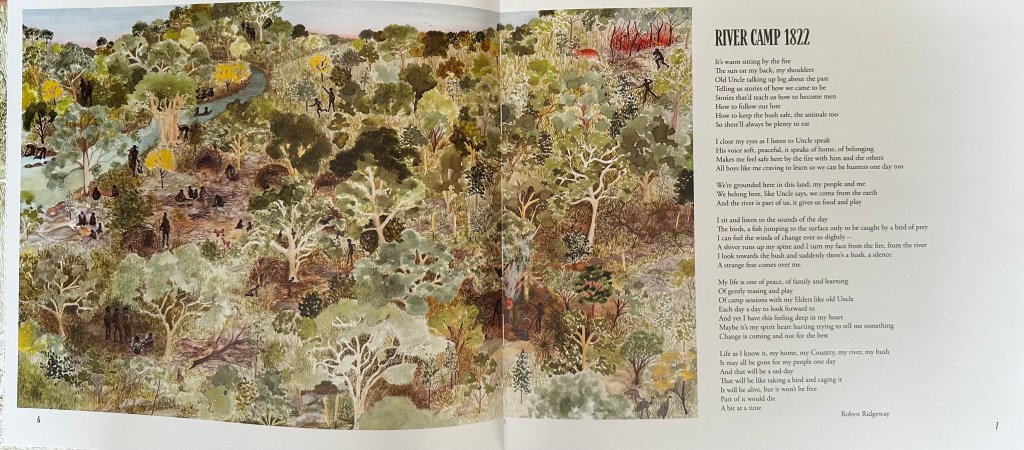
Read Robyn Ridgeway’s poem on page 7 (see above). What does it say about life in 1822? What emotions does it elicit? How does it foreshadow a different future? How is the writing style different from the rest of the book? Students could write a response from a coloniser/settler perspective. Or they could create their own version of this scene using watercolours (or equivalent) and ink.
Waterways
How are the waterways significant to the history and development of the town?
How do they affect infrastructure?
The Grant Family
The fictitious Grant family are early settlers in the area. Students trace their story through their movements and contributions. [pages include 9,13,23,25,30,43]
After becoming familiar with Country Town, its time in history and characters, students invent their own character and place them via writing and/or illustration into any era shown in the book. (They may need to do further research.)
Illustrations
- Point of View The large illustrations of the town are shown from a bird’s eye view (high up). How is this vantage point ideal here? Students could then sketch a scene from ground level or a worm’s eye view to show another perspective.
- Encroachment and Change How do the illustrations show encroachment and change? [One of the biggest changes comes from tree-clearing, where trees and the natural landscape are replaced by buildings and a largely built environment.] What is the irony of what happens to the trees? [Trees are cut down to use for the very buildings that replace them, as well as using the timber in other ways.]
- Lines How do the types of lines change as the town develops and spreads? [The earlier, more natural landscape is often shown using rounded, more organic lines while the lines become straighter, often on the diagonal, as human construction takes over.]
- Colour How do the colours change over time?
Students could draw sequential panels or create animations to show some of these changes visually.

Children’s Lives
- Schools Schools are described on page 21. Students could contrast these with their own school.
- Toys Read page 38. Ask older family members to show them old toys that they may have kept. Find out when they were made. Use or play with them. Make a labelled class or library display with some of the toys.
- Teenagers Read page 38. Ask family members about the music of their youth, particularly in the decades mentioned. Make a song list to play alongside the toy display (see above) or with any display related to the book.
- Recycling In the war, children collected metal and tyres to be recycled (page 34). Students brainstorm and research what they are (or could be) recycling. Discuss and research how to put this into place at home or school.
- Ask Your Grandparents Interview grandparents or others about growing up in a country town, as described on page 39.
The Role of Women
Women are integral to the development of the town. Student could look more closely at their changing role, such as protest marches and the Women’s Christian Temperance Union, the Married Woman’s Property Act and more. [pages 23-31,33-34] Research how this differed from the rights and lifestyle of First Nations Women.
Into the Future
The town is trying to attract tourists (page 45). In small groups, students design digital or other campaigns to attract tourists. Base campaigns on historical, natural and other attractions and interests in and around the town. Display.
Read other books

- Compare and Contrast Country Town with My Place Read My Place, the classic book by Nadia Wheatley and Donna Rawlins. Students could explore the difference in structure between Country Town and My Place (particularly the sequencing from either past to future or future to past) then transfer a scene from Country Town into the My Place format. This could include a personal introduction by a character, an illustration of the character with their house or dwelling and a map.
- Inventions Some inventions are described in Country Town, for example on pages 21,25. Read more about Australian inventions in What’s The Big Idea? Australian Inventions That Changed The World by Sue Lawson and Karen Tayleur.
- Other related books to read include Young Dark Emu by Bruce Pascoe and Our Country: Where History Happened by Mark Greenwood and Frané Lessac.
*****
Note that I deliberately haven’t read the publisher teacher notes about the book, so any overlap of my ideas above is natural, coincidental and hopefully complementary.

 paperbarkwords.blog
2 thoughts on “Country Town by Isolde Martyn & Robyn Ridgeway, illustrated by Louise Hogan”