

Super-Frog Saves Tokyo by Haruki Murakami
Translated from the Japanese by Jay Rubin
Illustrated by Seb Agresti, illustrated and designed by Suzanne Dean
Published by Harvill, Penguin Random House
Illustrated Short Story for adults
Book review by Joy Lawn (Joy in Books) at Paperbark Words blog
“Katagiri found a giant frog waiting for him in his apartment … I have come here to save Tokyo from destruction.”(Super-Frog Saves Tokyo)
Haruki Murakami is Japan’s most acclaimed and influential living author. Super-Frog Saves Tokyo, his short story for adults, is now published as an illustrated stand-alone book.
Super-Frog is an imagined contemporary superhero who seeks to enlist the help of an ordinary Japanese man to save Tokyo.
Book review
A courteous, albeit giant, frog is waiting in Mr Katagiri’s apartment for him to arrive home from work. The reader must immediately suspend disbelief (resembling the experience of reading Franz Kafka’s Metamorphosis) to accept the protagonist’s ensuing interaction with Frog.
Frog establishes his identity and credentials as not only a real frog but “the sum total of all frogs” before asking for Katagiri’s help to save Tokyo from imminent devastation by a rage-fuelled earthquake. The earthquake’s epicentre is directly underneath the Shinjuku bank where Katagiri works.

Frog reveals that he has been observing Katagiri as he goes about his job as a collection officer. He has a reputation of being cool, calm and tough. Lacking friends and forgotten by family, he is isolated. Like Cicada, in Shaun Tan’s seminal picture book for mature readers, Katagiri is unappreciated and despairing. Frog believes that Katagiri’s courage and passion for justice equip him for the role of co-fighter against the giant worm that dwells underneath the bank. Worm’s fury will soon erupt into an earthquake.
“Will you join me to fight against Worm?” asks Frog.
Katagiri is concerned that he lacks the skills for battle. Frog assures him that his unremarkable status as an ‘everyman’ is perfect to help save the ordinary people of Tokyo. To curb his fear, he recalls the words of Joseph Conrad, “true terror is the kind men feel toward their imagination.” Imagination is a theme of the book.
The battle, which epitomises light versus dark, becomes existential. As the climax nears, the tale slips further into the realm of the metaphysical. Through Frog, Murakami quotes Tolstoy, Dostoevsky, Hemingway and Nietzsche to allude to his philosophical and realistic concerns.
The story references Japan through place, customs and lifestyle. However, underscored by the threat of violence, disaster and the debility of mental illness, and laced with humour, it has wide and timely relevance.
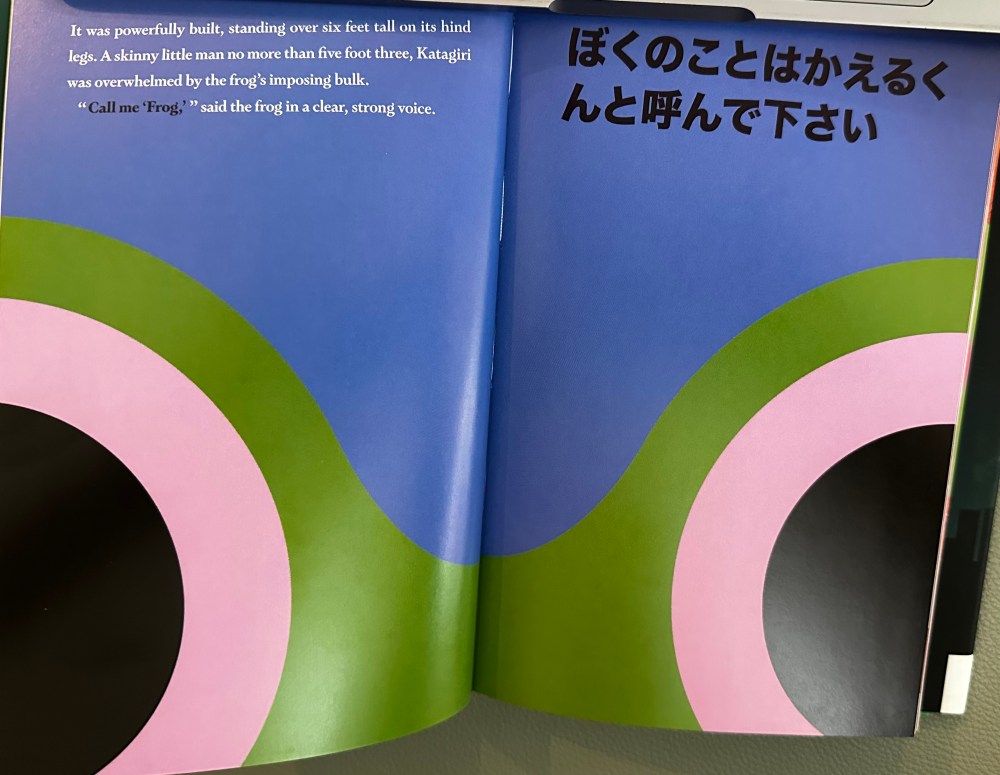
First published in 2001 as a response to the 1995 Kobe earthquake and in 2025 as a beautifully produced hard-cover gift book, Super-Frog Saves Tokyo is intended for adults (not for children). Translated from the Japanese by Jay Rubin, it is superbly illustrated and designed by Seb Agresti and Suzanne Dean. The atmosphere and tone are enhanced with psychedelic, geometrical shapes (particularly circles), collage and Japanese writing characters.
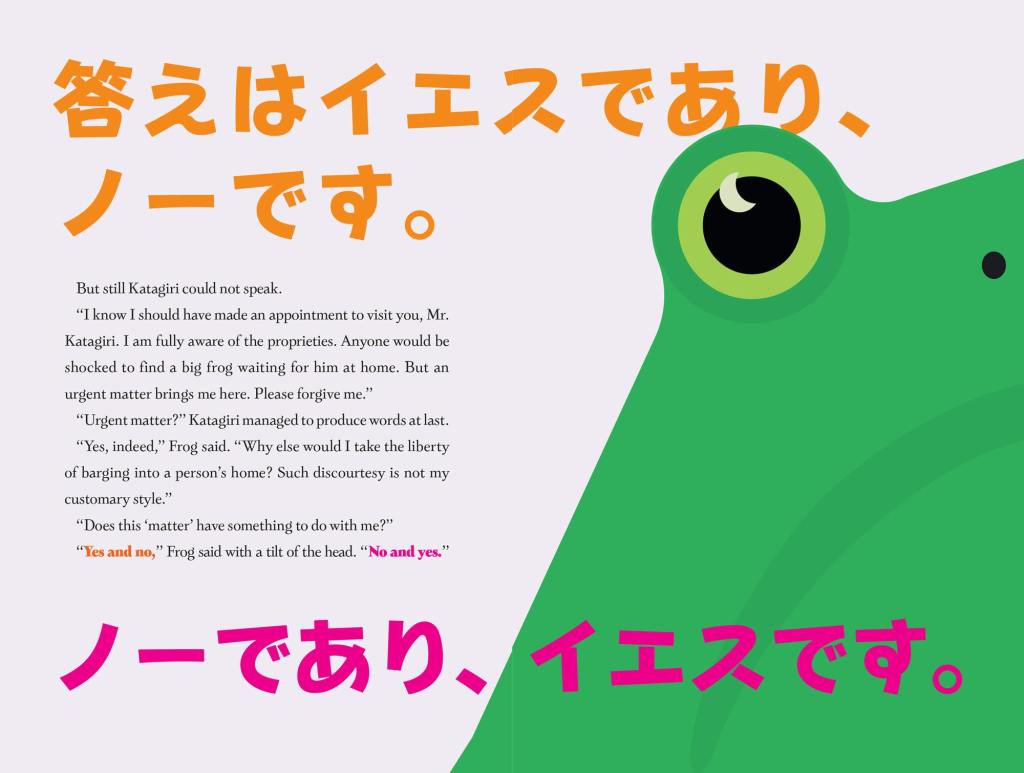
The illustrations zoom in to show close-ups of Frog and cropped parts of his body. These direct the eye and hence the mind to the symbols and focus of each page. They release the readers’ consciousness, freeing us to drift, explore and be alerted.
Frog aspires to superhero status, while Katagiri could become a hero if he embraces his mission. Both characters are parabolical reminders of what may be necessary and possible within their microcosmic setting and in our wider world. Super-Frog Saves Tokyo is a quintessential Japanese tale, while also an important edict for our time.
Murakami prompts us to consider who we are and how we behave. Are we antiheroes or, despite being ordinary, could we be heroes?
Super-Frog Saves Tokyo at Penguin Random House Australia
My review of Cicada by Shaun Tan at PaperbarkWords


