
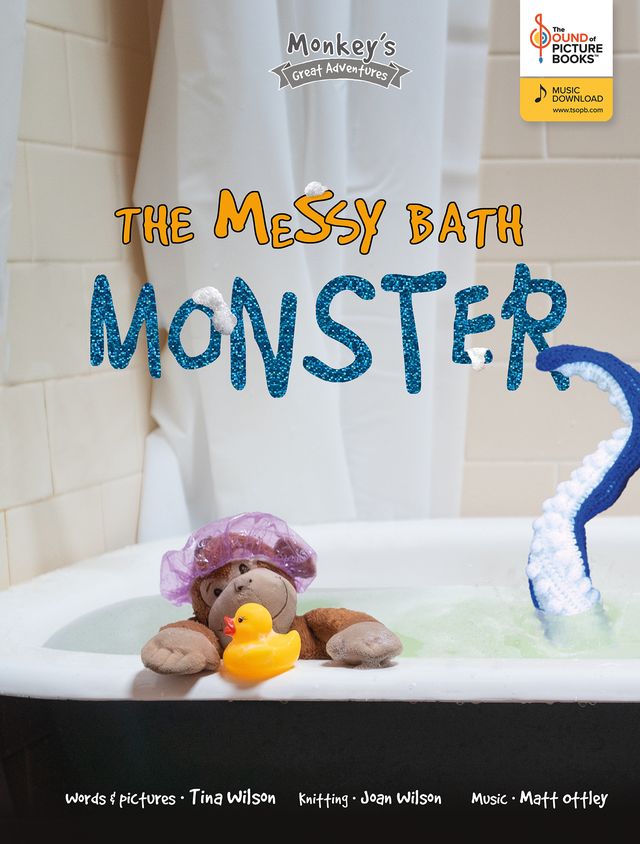
The Messy Bath Monster by Tina Wilson (words & pictures), Joan Wilson (knitting) & Matt Ottley (music)
(One Tentacle Publishing)
‘Monkey knew there was a monster lurking in the bath because it made such a BIG mess!
“It must be a HUGE monster,” thought Monkey.
It gurgled and it roared …
And left puddles on the floor.’
(The Messy Bath Monster)
The Messy Bath Monster from ‘Monkey’s Great Adventures’ series is created by a trio of collaborators who understand and appreciate children. Deceptively simple, yet sophisticated, and completely satisfying for young children, The Messy Bath Monster exudes child-appeal and will delight its readers. It playfully transforms a typical scenario in the life of a child – bathtime – into a lively, imaginative adventure. Adults will be captivated along the way as they also discover the book’s ‘hidden depths’.
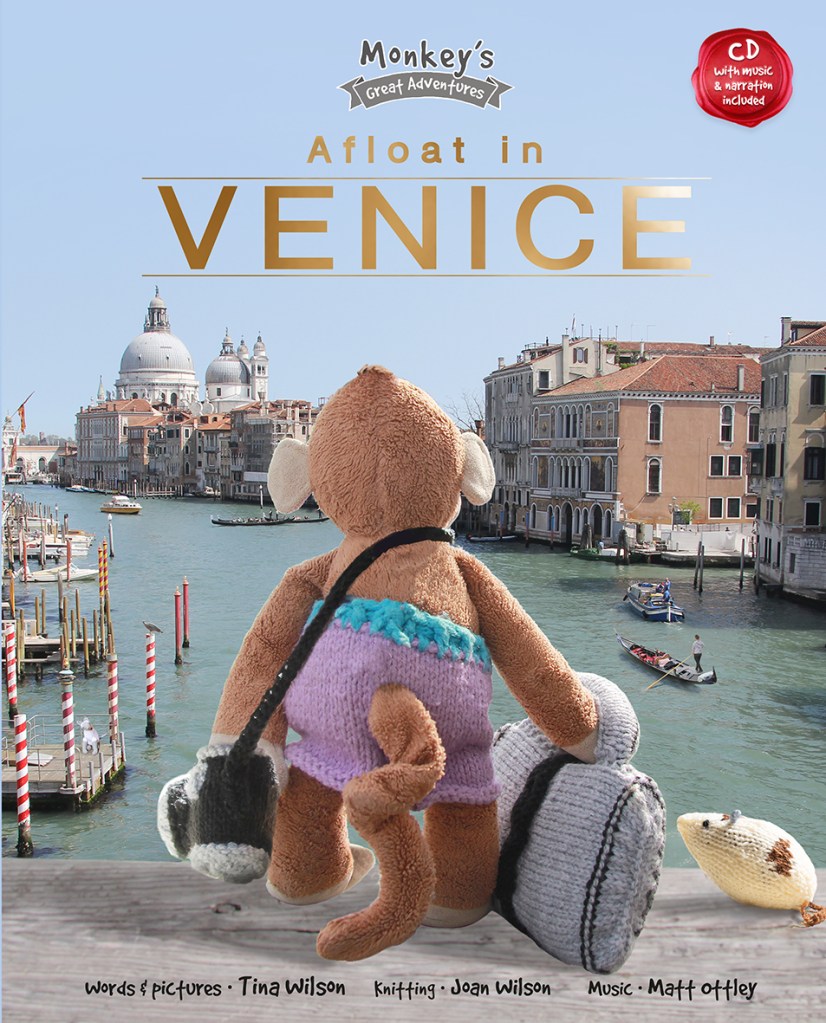
The two books so far in the series (Afloat in Venice is the first) are for young children and are a valuable addition to Matt’s groundbreaking ‘The Sound of Picture Books’ musical program.
Author/Illustrator/Composer Interview: Tina Wilson, Joan Wilson & Matt Ottley
Congratulations on your delightful picture book, The Messy Bath Monster from ‘Monkey’s Great Adventures’ series, Tina, Joan and Matt.
Thank you all for speaking to Joy in Books at Paperbark Words blog.
Tina, how is this story an adventure? How else would you describe it?
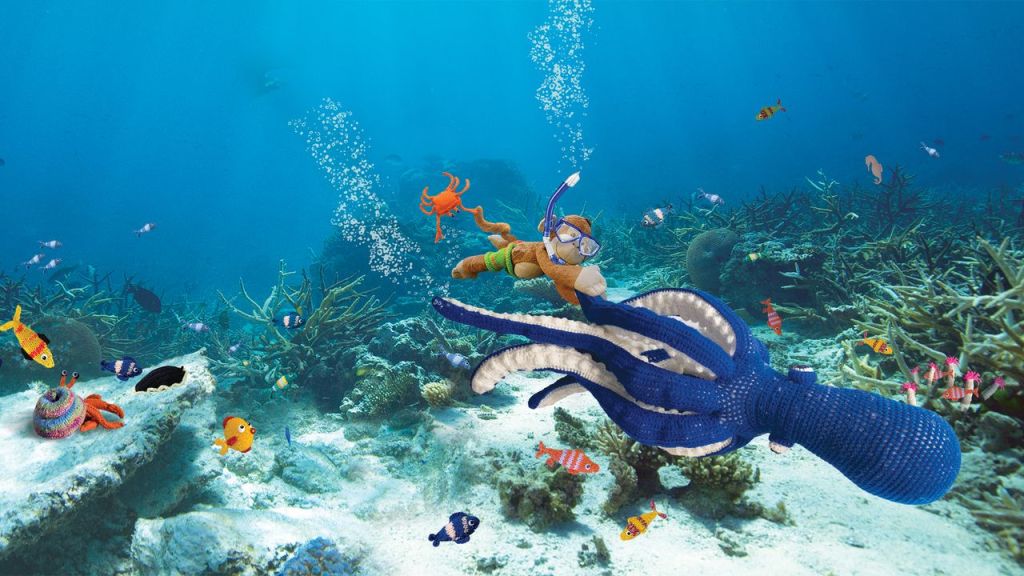
Tina: Adventures can take place anywhere – they don’t have to be daring or dangerous, or be set in exotic places, they are simply journeys that lead to discovery… a widening of your world perspective. In The Messy Bath Monster, Monkey’s world is his bathroom … yet within the confines of the bath his imagination takes him to the depths of the ocean where he discovers the wonders of the sea. His adventure is diving into the unknown and the reward is meeting new friends (which can sometimes be daunting for small children).
Everyone, in 3 words, what do you love about Monkey?
Joan: His cheeky personality
Tina: I have to agree with mum on this one. There is definitely something very cheeky about Monkey’s smile.
Matt: His appeal to adults (four words but Tina used 18!)
Anyone, how does Monkey change when he embarks on his quest for the Messy Bath Monster
Tina: For me the story is not so much about how Monkey changes, but rather how his world expands. Monkey’s life is enriched by his “imaginative” experience. By being brave and fearless he makes new friends and discovers a whole new world.
Joan: Monkey becomes very determined to find the Messy Monster.
Everyone, what is your favourite source of humour in the book?
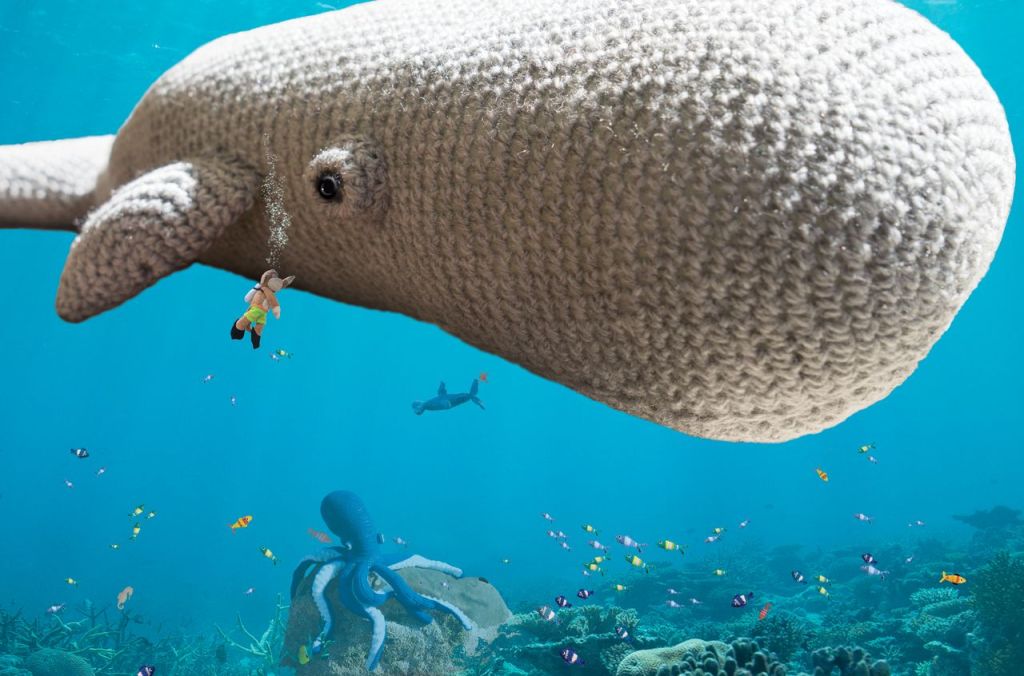
Joan: Where Monkey plays with the whale.
Tina: For me it is when Monkey is spurted out of the whale’s blowhole – when we perform this work live all the children laugh. Otherwise it is the tiny details such as the crab grabbing onto different things along the way.
Matt: For me it’s the details; the fact that Monkey can not only hold his breath for an inordinate amount of time, but that he can apparently speak underwater as well!
Joan or Tina, it’s unlikely to have a friendship between a monkey and an octopus in a picture book. Why did you choose an octopus as the new character? (Is it related to One ‘Tentacle’ Publishing?)
Joan: Because it was an underwater story, the octopus just fitted in nicely.
Tina: Octopuses are incredibly intelligent creatures and after falling in love with the documentary ‘The Octopus my Teacher’ I just had to include an Octopus in the story. We chose ‘One Tentacle Publishing’ as our publishing house name for the same reason. Octopuses have three hearts, blue blood, eight arms with independent brains and have an extraordinary ability to solve puzzles and camouflage themselves in different environments. They are also capable of using tools. What’s not to love! We want to encourage children to learn more about these fascinating sea creatures.
There’s plenty of visual interest in The Messy Bath Monster.
Joan, how do you show personality in your knitted characters?
Mostly I use simple facial expressions to help create the character’s personality. It’s amazing how you need so little expression because children create their own based on what is going on in each spread.
Which character gives you most delight, and why or how?
Joan: The small orange crab. It pops up in the most unlikeliest places.
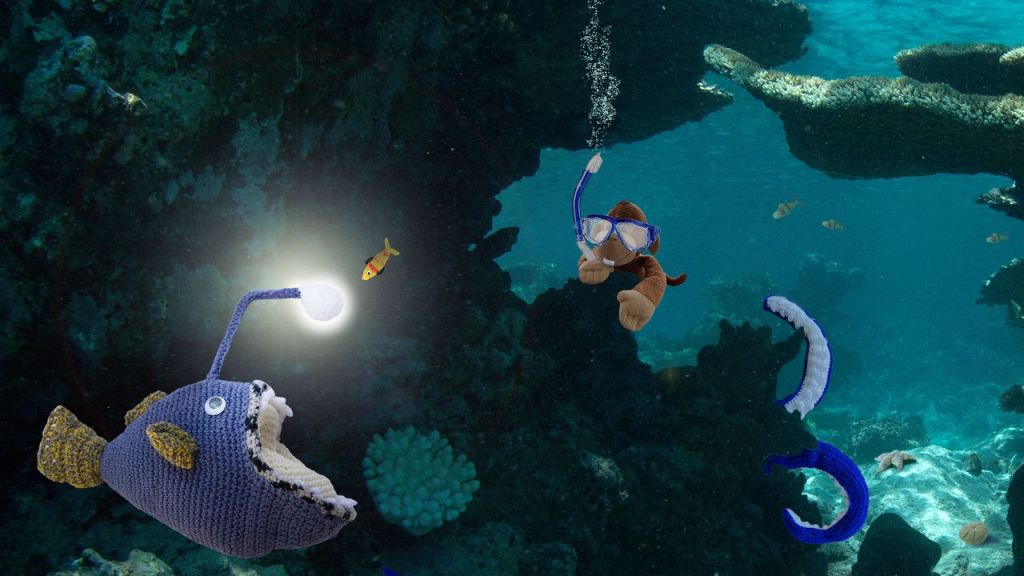
Tina: I love the angler fish … how amazing it must be to have a light on your head to attract food.
Which creature was the most difficult to create? Why?
Joan: The octopus took the longest time to make but getting the angler fish’s mouth right was quite a challenge.
Joan, how important is colour in your designs? Which creature has a colour scheme that ‘pops’ or that you think works particularly well?
Joan: I love to use bright colours as much as possible. The character that stands out in The Messy Bath Monster for me is the blue and white octopus, the bold colours work really well in the underwater scenes.
Tina, how did you position Monkey in different poses and hold him in place while you photographed him?

Tina: I love using simple tricks to pose Monkey; my favourite ways are using cotton string, broom sticks and sticky tape to hold Monkey in place while I photograph him. I never use AI for my images, but I do use the graphic design program Photoshop to help remove the background painstakingly by hand so that I can place Monkey in scenes seamlessly.
Tina, another technical question, how did you format the photographs of characters and knitted characters to be superimposed onto the background scenes?
Tina: I try to pose Monkey in situ wherever possible … as that’s part of the fun and children can replicate it with their own toys. This sometimes means using Matt to hold Monkey up by his tuft of hair and then ‘Photoshopping’ Matt’s arm out of the scene. But when I need to place Monkey and the other characters into the underwater scenes I photograph them against white paper, then cut the background out so that they can be manoeuvred into position. In Photoshop I can resize creatures – for instance, the knitted whale is actually quite small, but in the book I have enlarged it to mimic a real whale. I think my mum’s fingers would have been too sore if I asked her to knit a full-size whale!
By the way, I love the underwater scenes (based on photographs by Craig Parry). It’s clever how you’ve framed the underwater scenes inside ‘bubbled’ borders.
Thanks. I used the bubbled borders to provide a clue for children that all those scenes are happening within Monkey’s imagination.
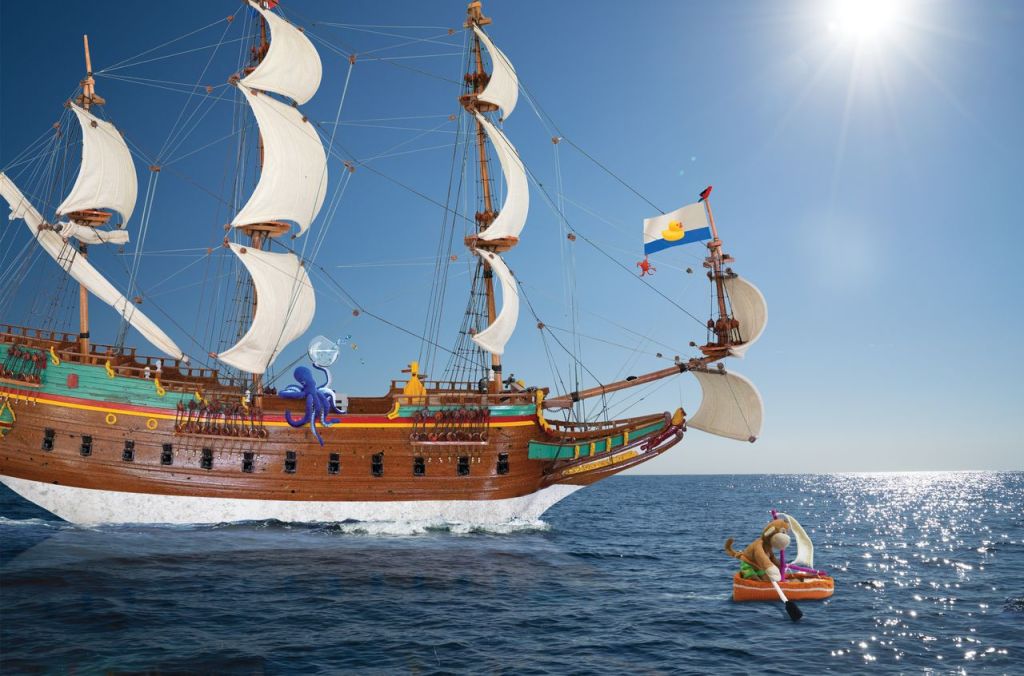
Tina, the boat is a wonderful inclusion. How did you create it?
The boat with the sails is actually a scale model replica of the Batavia, a Dutch East India Company ship that was shipwrecked off the coast of WA in 1629. The mutiny and survival story behind it is quite horrendous, so it was interesting to include it in the book knowing the extraordinary background. One thing I loved doing in this book was embedding clues in the bath scene at the start of the book. I’ve placed items that turn into other things later on in Monkey’s imagination… so the little boat in the bath at the start becomes the giant ship in Monkey’s imagination. The yellow duck becomes the round yellow fish that appears in lots of scenes. You will also see the yellow duck appear on the ship’s flag.
Tina, there’s an amazing amount of movement in the book, particularly of going up and down. How did you create this sense of movement?
The movement felt important, particularly from a live performance perspective where we get children to mimic Monkey’s actions in the book. Matt also used an up and down movement within the score which is a clever device.
Tina, how do you think Matt’s accompanying music enhances the story?
Matt’s music brings out the playful, magical side of Monkey’s adventure, it greatly enhances the emotions of the listeners and adds tension to specific scenes. The other advantage of having music with the story is that children can discover more in the images as they spend greater time looking at each page. It’s a fabulous device for deeply engaging audiences.
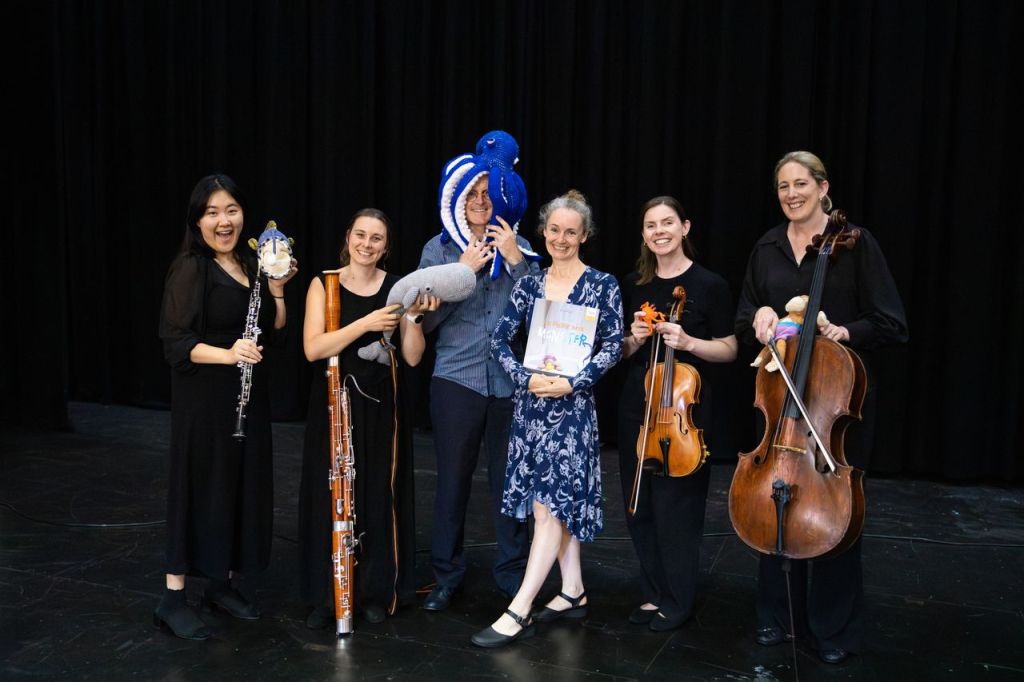
Matt, how would you describe the style (if that’s the correct term) of music that you have composed for this book? Which instruments play the piece?
For both Monkey books (Afloat in Venice and The Messy Bath Monster), I based the music loosely on Ragtime music, which is a late 19th century American syncopated jazz style. I chose this style as my inspiration because it often has such a sense of joy and a celebration of life about it. The Messy Bath Monster score is more authentically Ragtime than Afloat because it is more syncopated. Afloat was scored for string quintet, clarinet, horn and piano. Messy is for a quartet of oboe, bassoon, viola and ‘cello.
Matt, how have you created a sense of play through the music?
That’s one reason I chose Ragtime as a starting point, it’s naturally a playful style. But I’ve also mimicked what I imagine are Monkey’s physical movements in the music. When Monkey climbs the tall ship’s mast, for example, the music rises at a certain rate, and when he comes down the mast, the music almost slips – slides-down much faster, as if he’s sliding down the pole.
Matt, what other emotions does the music create?
I’ve varied the music in places away from the syncopated Ragtime feel so that when, for example, Monkey is travelling across the ocean floor with Octopus, there is an expansive, flowing feel. I’ve also injected moments of tenderness, reflecting Monkey’s vulnerability and his trust in everyone he meets. It’s a character trait we lose as adults, but wouldn’t the world be a kinder, gentler place if we could all somehow find that tenderness again?
Matt, is there anything else that you could briefly tell us about the music for this book?
Yes, thanks for the question. In all of The Sound of Picture Books scores I have written what some people might call ‘very adult’ music. I don’t believe in writing music ‘down’ for children. I have often found that children pick up on nuance in music to a far greater depth than adults, and though they often don’t have the language to describe what they are feeling from music, they do, very powerfully, feel things. I believe in creating works in which children can talk with their care-givers about what they are hearing and feeling and how that makes them think about the stories the music is associated with.
Tina, I love the open ending. What’s coming next for Monkey?
Tina: I have photographed all the images for a “penfriend” based story to be set in Cesky Kromlov in the Czech Republic (the world’s oldest medieval village) … but am also working on an alien adventure in space (Monkey can’t stop talking about it … he desperately wants to meet an alien!!). There’s also a work to be set in Sydney … and a gardening adventure! Mum has knitted over 500 toys to keep me very busy.
Anyone, what response to the book from a child has made your heart sing?
Joan: From grandparents to small children alike, Monkey brings a smile to everyone’s faces. What makes my heart sing is seeing a child asking for Monkey to be read over and over to them.
Tina: When children photograph their own toys doing things and send them to me it makes my heart sing! That’s what the series is all about – children using their imagination to play.
Matt: Watching how excited children become when they are watching a performance of the book with the music. They will point at the screen where the images are showing and sometimes spontaneously get up and dance!
Thanks for answering my questions about The Messy Bath Monster, Tina, Joan and Matt. Children will love this book. It is so child-friendly and understanding of their life experience. It honours children’s curiosity, mischievousness and courage.
The Messy Bath Monster at One Tentacle Publishing
The Sound of Picture Books website
Monkey’s Great Adventures website
Trailer and teacher resource notes for The Messy Bath Monster: https://tsopb.com/the-messy-bath-monster/
Matt Ottley at Paperbark Words blog:
The Tree of Ecstasy and Unbearable Silence
How to Make a Bird (written by Meg McKinlay)
The Gifts of Reading for the Next Generation curated by Jennie Orchard

 paperbarkwords.blog