
Borderlands: Riding the Slipstream
edited by Paul Collins
Ford St Publishing
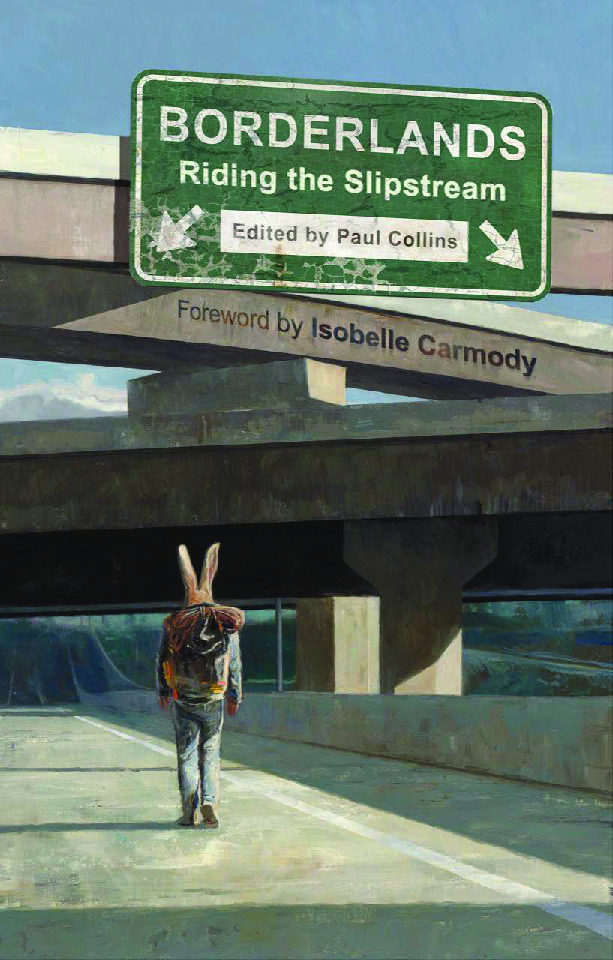
Borderlands: Riding the Slipstream is the successor to Ford Street’s popular and well-regarded anthology Rich & Rare. Both are books of short stories, poems and more. They share distinctive, otherworldly covers by Shaun Tan.

Australian fantasy writer Isobelle Carmody has written a fascinating foreword to Borderlands: Riding the Slipstream that captures some of her interest in the concept of the ‘slipstream’ that gives the book its title.
“I love genre stories, and good realism, but best of all, I love stories that straddle the wall built by criticism and marketing between those forms of writing, and tales that set up shop right alongside the border. I have come to define these sorts of stories as slipstream. That term was coined by author Bruce Sterling, who uses it to define books and stories that are neither realism or genre, but something slippery that moves between and around these terms.” (Isobelle Carmody in Borderlands: Riding the Slipstream)
Contributors to the anthology include Dianne Wolfer, Lorraine Marwood, Barry Jonsberg, John Larkin, Steven Herrick, Pamela Freeman, Meredith Costain, David Metzenthen, Victor Kelleher and many other notable Australian writers.
Significantly, the stories in Borderlands are originals. It’s not a reprint anthology.
Short story anthologies are attractive for readers to dip in and out of and are useful for educators because one or more story may be read quickly, particularly in contrast to a novel.
Suggested activities by Joy Lawn (Joy in Books) at PaperbarkWords blog
Using the book with students:
There is much to explore in Borderlands: Riding the Slipstream.
Some (of many possible) ideas follow:
The title – Borderlands: Riding the Slipstream – and Foreword
Students imagine what ‘Borderlands’ may represent and then what ‘Riding the Slipstream’ may suggest.
They could discuss how both parts of the title could lead to each other or be in opposition to each other.
After reading the Foreword, students design a visual image or animation inspired either by the idea of ‘Borderlands’ or ‘Riding the Slipstream’.
Cover
The cover illustration is from Shaun Tan’s painting ‘On My Way to Paradise’ (originally published in Creature, published by Windy Hollow).
Students discuss how the cover illustration helps them enter the book.
How does it relate to ‘Borderlands’ and ‘Riding the Slipstream’?
Literary Genres
Note: multiple copies of the book may be needed for the following activity.
In small groups or pairs, students read all the stories or pieces within one genre (or possibly two small genres). Genres include ‘Fantasy’, ‘Romance’, ‘Horror’, ‘Humour’ and more.
Genres could be allocated by interest and/or ability (e.g. The ‘Contemporary’ genre has 9 stories; ‘Crime’ has 1 story.)
Each group researches their genre to form a definition.
Using the definition (and any other resources), they develop a checklist of characteristics representative of their genre.
For each story, tick off the characteristics found.
As a group, they then select their favourite story, and write a short justification of why they have chosen it.
Each small group presents their genre definition and genre characteristics or criteria to the whole group.
Read their favourite story (or the first few pages) aloud to the whole group. (1 student may read the story, or the reading may be shared. For example, in ‘Ghost Bait’ by Michael Pryor, there could be a narrator, Mr Cavendish, Reg, Tom and girl ghost.

Explain why they have selected this story.
N.B. Students present their readings to the whole group in the sequence of the genres in the book, i.e. ‘Fantasy’ will be first. Afterwards, discuss why editor Paul Collins might have ordered the genres in this sequence.
Note that this activity could take several sessions.
After all the genres have been presented, each student reads a story from a different genre to the one they have focussed on.
Encourage students to read widely across different genres. Books from the library should be utilised.
Make a database of suggested book titles and authors. Include book covers for visual cues and reader appeal where possible.
Genre Book Covers
Wide reading of different book genres will enable students to recognise cover styles that help readers identify genres. Students survey book covers and make a table of typical genre book covers. This should include title, author and a visual representation of the book cover.
Analyse the features of the covers.
Each student creates their own book cover to represent a particular genre.
Visual Images

Black and white illustrations by Annie Ryan are interspersed throughout the book. Students find these.
In the same small groups that explored genres (see above), students with an illustration in their genre section explain how it complements or enhances the story it accompanies.
Short Story Writing
After close reading of this short story anthology (or some individual stories from the book) and wider study of literary genres, students write their own short stories. Collate these to form a group book. Classify the stories by genre to emulate the structure of Borderlands: Riding the Slipstream.
*****
Ford St is a small Melbourne-based publishing company that punches well above its weight.
Some of Ford Street’s recent highlights include the 2024 CBCA Book of the Year: Early Childhood Notable Our Mob by Jacinta Daniher and Taylor Hampton, illustrated by Seantelle Walsh and the 2024 CBCA Eve Pownall Award shortlisted book Country Town by Isolde Martyn and Robyn Ridgeway, illustrated by Louise Hogan. Country Town has also been shortlisted for the 2024 NSW Premier’s History award.
Ford Street’s I Need a Parrot by Chris McKimmie won the 2020 CBCA Picture Book of the Year.
******
Borderlands: Riding the Slipstream at Ford St
Paul Collins (Editor)
Note that I deliberately haven’t read the publisher teacher notes about the book, so any overlap of my ideas above is natural, coincidental and hopefully complementary.

 paperbarkwords.blog
Thanks for this, Joy. Much appreciated.
LikeLiked by 1 person