
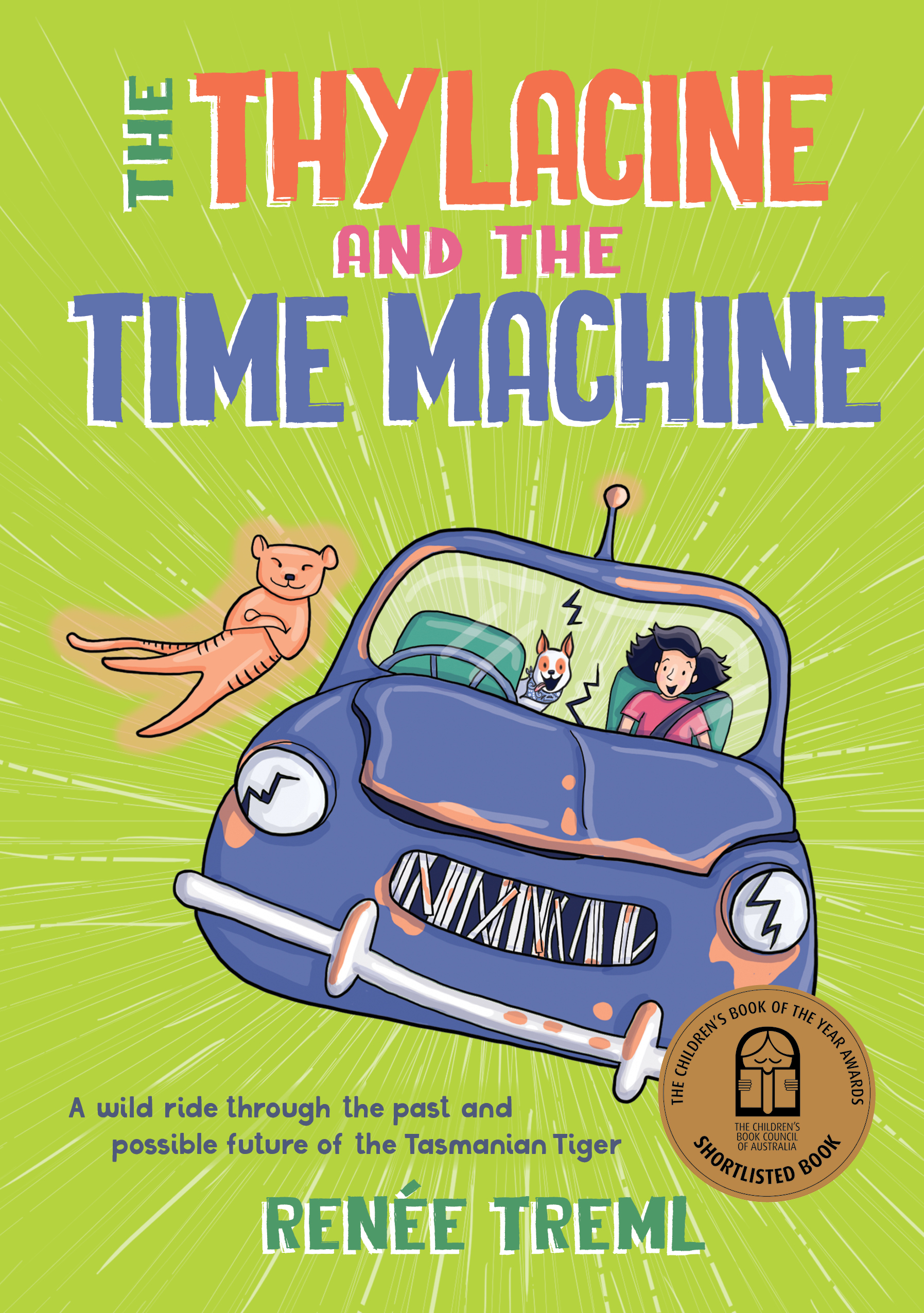
The Thylacine and the Time Machine by Renée Treml
The Thylacine and the Time Machine: a wild ride through the past and possible future of the Tasmanian Tiger written and illustrated by Renée Treml
(Allen & Unwin)
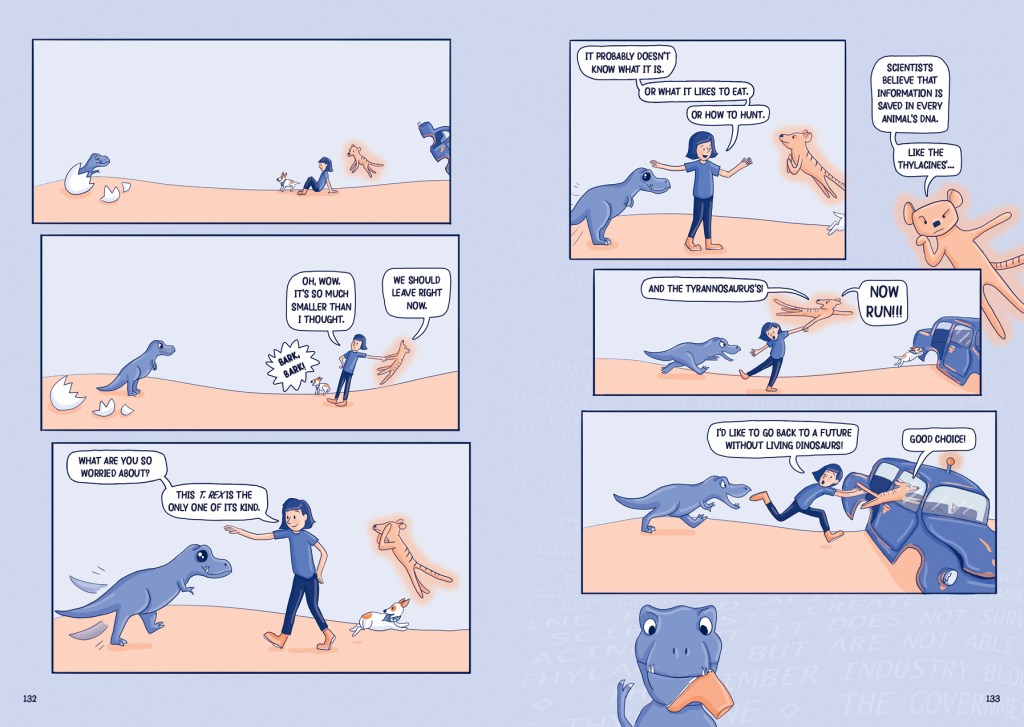
The Thylacine and the Time Machine is a graphic novel shortlisted in the Eve Pownall non-fiction category of the 2026 CBCA awards. Renée Treml shares far more than we could imagine about the thylacine in this impressive book. As a master of the graphic novel form, she uses humour and suspense, as well as an artful structure, to carefully reveal information to enable readers to imagine and think critically.
Interview with Renée Treml, the creator of The Thylacine and the Time Machine
Thank you for speaking with Paperbark Words, Renée.
Congratulations on The Thylacine and the Time Machine being a 2026 CBCA shortlisted book. It is a major work for primary and secondary school-aged young readers about the thylacine, its extinction, and the ‘sticky bits’ – the ethics of de-extinction. It is enlightening and fascinating.
You also deftly cover environmental destruction and conservation and other relevant issues in a scientifically rigorous – and fun – way.
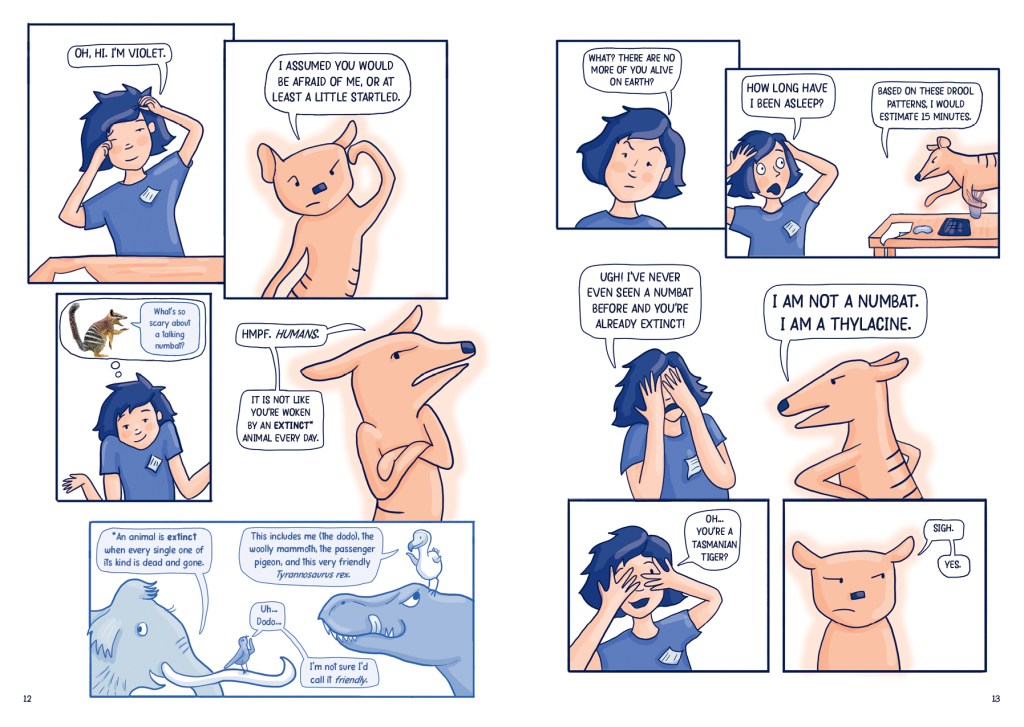
Could you please introduce your narrator and the circumstances of their encounter with Violet?
Thyla is the ghost of the last living thylacine (also known as Tasmanian tiger) to die in captivity. She’s cynical about the current research into de-extinction and visits Violet while she’s working a school project about the science.
Could you briefly explain ‘de-extinction’? What is so tricky about it?
De-extinction is the science of bringing an extinct species back to life (think Jurassic World, but without dinosaurs). It’s tricky because it requires the DNA of an extinct species, which doesn’t last very long after an animal dies.
What is a myth that you are dispelling in this work?
The name ‘Tasmanian tiger’ isn’t a great fit for this animal, which is why I refer to it as a thylacine. Thylacines once roamed the mainland of Australia and New Guinea (not just Tasmania) and despite having stripes they are a marsupial (which means they have a pouch like a wombat or kangaroo) and aren’t related to tigers at all.
Could you briefly explain the tension between the colonists and the thylacine?
Thylacines were hunted to extinction because the colonists blamed them for killing their livestock. It made sense at the time: no one knew anything about this nocturnal tiger-striped predator and the colonists’ sheep were dying and disappearing. People were scared and wanted something to blame for their hardships, and unfortunately, the thylacine was the perfect scapegoat.
What is the relationship between the thylacine and the Tasmanian Devil?
Thylacines and Tasmanian devils are both marsupials and in the same ‘order’ known as Dasyuromorphia (along with most predatory marsupials and includes quolls, dunnarts and numbats). I think of them like distant cousins separated by millions and millions of years. Despite being related, thylacines were a top predator and probably helped keep the number of Tasmanian devils in check through hunting and competition.
And with wolves?
Thylacines are a marsupial, so like a kangaroo, their babies are born very young and immature and develop in a pouch that’s on the outside of the mother’s body. Wolves are called placental animals because their babies develop internally (like humans). In fact, we humans are more closely related to wolves and tigers than thylacines! Despite being unrelated, it’s interesting that the bodies of wolves and thylacines evolved to look so similar.
Now could you please tell us something about the relationship between the thylacine and the dunnart?
Thylacines and dunnarts are also related… a little more closely than the Tassie devil. Scientists think dunnarts and thylacines shared a common ancestor millions of years ago and they use the dunnart’s DNA to help piece together the thylacine’s DNA.
Why are children and others so interested in predators?
Humans in general are interested in predators – look at all the sporting team names used around the world (Tigers, Hawks, Cobras, Lions, Eagles, etc.) – because we see them as strong and powerful animals.
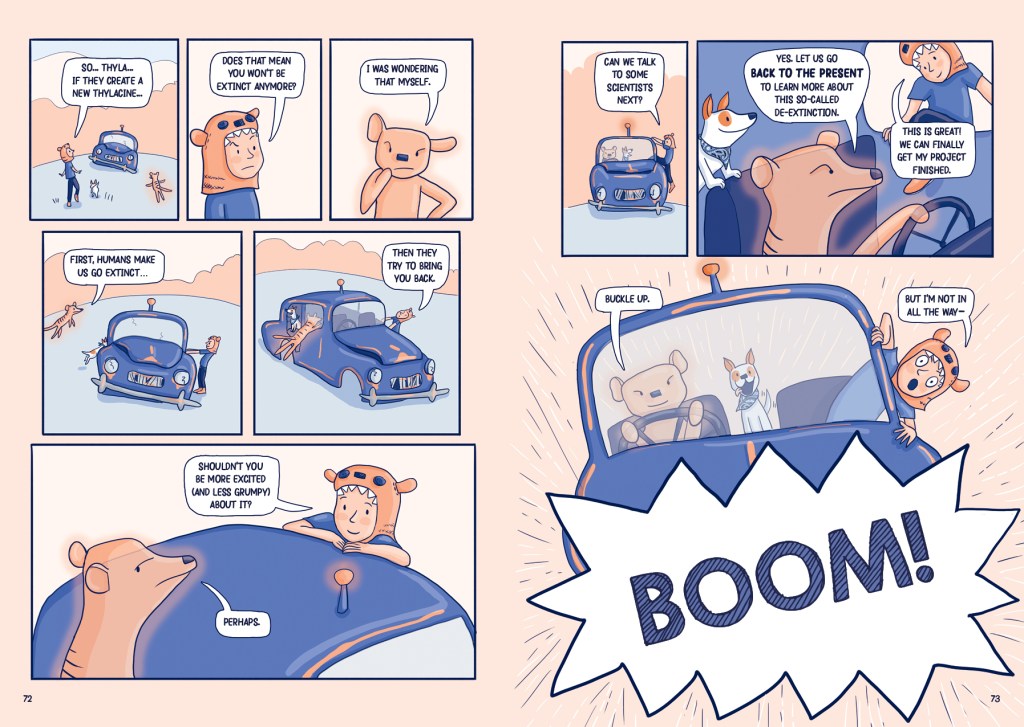
You have used the conventions of the graphic novel to expertly tell the story of the thylacine (and much more). What is a favourite example of a framed or unframed panel or frame-breaking in the book? Why?
I love the contrasts of page 53 and 54. On page 53 we see a silly ‘family reunion’ photo of the thylacine’s closest relatives and on the following page 54 we see the animals in a more natural setting. For me these pages capture my effort to have fun while still presenting facts and information.
What is the purpose or role of your brilliant footnotes or ‘foot bubbles’ shown in purple monochrome?
This graphic novel is a narrative non-fiction story, so I chose to include the footnotes on the page instead of bouncing a reader to a glossary for a definition or explanation. I was worried the readers would lose their momentum with the story if they had to keep flipping to the end. I used that monochromatic tone for the footnotes so readers would easily recognise them as footnotes and could skip over them if they weren’t interested in additional information.
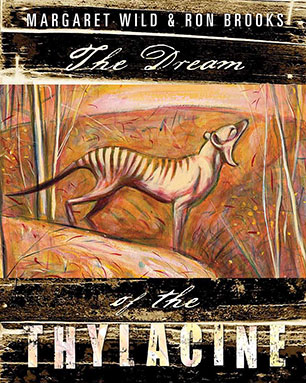
Why (and how) have you incorporated The Dream of the Thylacine by Margaret Wild and Ron Brooks in The Thylacine and the Time Machine?
The Dream of the Thylacine by Margaret Wild and Ron Brooks is a stunningly gorgeous and heart-breaking story about the extinction of the thylacine. Violet reads the book as part of her research and is very moved by it (as was I). I digitally collaged a copy of the cover into the story (with the creators’ permission).
What is your expectation or hope for the future in this field?
I think de-extinction is fascinating and could be a viable option to ‘right a wrong’ that’s happened to species that went extinct due to human activity. However, it’s extremely expensive and I hope we continue prioritising and funding conservation and preservation rather than relying on de-extinction to fix our mistakes.
How have your earlier books been leading up to this one?
My graphic novel series featuring Sherlock Bones (Sherlock Bones and the Natural History Mystery) was such great preparation to tackle this book. These fictional stories are set in a natural history museum, and I included a lot of sneaky scientific facts and information. There was a ton of research involved and a lot of pressure to ensure the science was accurate.
Why do you think a trend is developing where more graphic novels for children are being shortlisted by the CBCA?
There are more graphic novels being published in Australia every year, which naturally results in more of them being shortlisted by the CBCA. (Aside note: we have such amazing talent in this country and how great are our graphic novelists?!) I also think the world is finally embracing that graphic novels are an important and worthy literary format for engaging young (and old) readers.
What impact has being a shortlisted CBCA book had on you or the book so far?
I am honoured that The Thylacine and the Time Machine was shortlisted by the CBCA. I hope this recognition helps gets more children (and adults) reading the book, learning about de-extinction and conservation, and critically thinking about those ‘sticky’ ethical questions.
How would you suggest using The Thylacine and the Time Machine in schools?
The Thylacine and the Time Machine can be used to engage students in critical thinking about the ethics of de-extinction science and understanding ecological concepts such as predator-prey relationships and food chains, as well as the complexities of conservation. In addition, it could be used for visual literacy and storytelling, understanding and creating informatics such as charts, diagrams and maps. And of course, learning about Australia’s unique and diverse native animals and natural history.

The Thylacine and the Time Machine at Allen & Unwin
The Dream of the Thylacine by Margaret Wild & Ron Books


I love this book 🙂
LikeLiked by 1 person
It’s a standout, Dianne.
LikeLike