
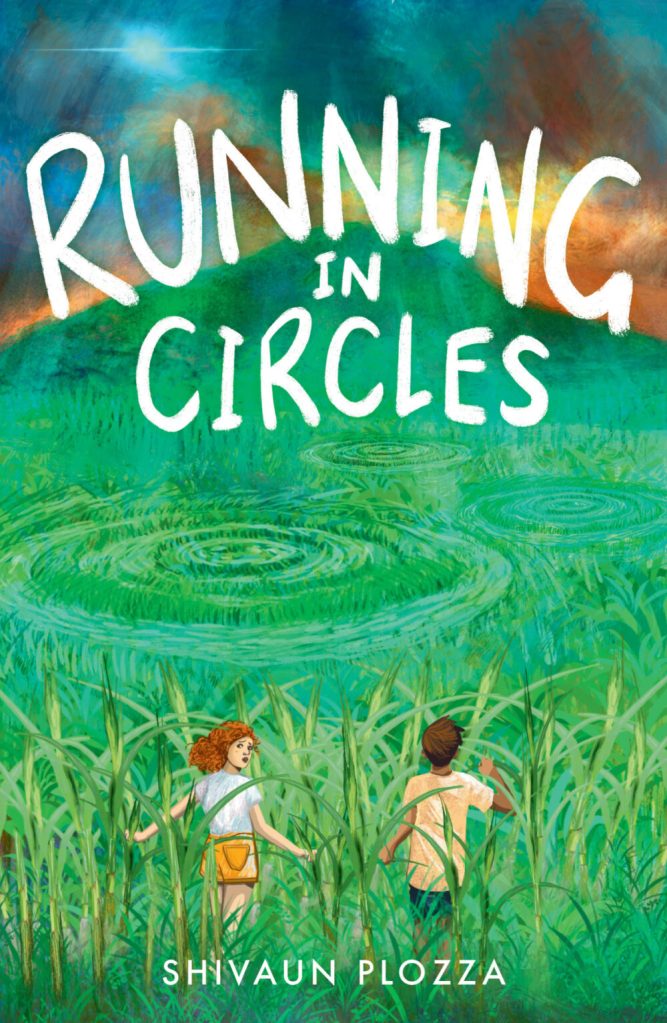
Running in Circles by Shivaun Plozza
(UQP)
Running in Circles Guest Blog by Shivaun Plozza for Paperbark Words blog
While researching a different book I stumbled across an article on unsolved mysteries in Australia, which included an entry on something called the ‘Tully Saucer Nest.’
When I visit schools for author talks and the kids ask me where I get my ideas from, I tell them that writers are like magpies: we keep our eyes peeled for shiny, interesting objects to bring back to our nests. And to my ever-curious writer brain, an unsolved mystery called a ‘Tully Saucer Nest’ shone brightly.
I soon discovered the key facts: In 1966 in Far North Queensland, a banana farmer was driving his tractor when he heard a loud hissing noise. He thought it was one of his tyres before he spied a UFO hovering above the lagoon on his neighbour’s farm. He watched it for 15 seconds before—whoosh!—it took off and when he looked down, he was shocked at what the UFO had left behind.
Bullrush reeds had been pulled out of the lagoon bed and laid on top of the water in a clockwise pattern, making a circular raft about 9 metres in diameter. As a structure it was so strong that a fully grown man was later able to sit on it and stay afloat.
At the time it was dubbed a saucer nest, but this strange phenomenon was one of the earliest photographed examples of what would later become known as a crop circle.
Now, I’ll be up front here: I’m not a big believer in aliens. Perhaps I should say I’m agnostic about aliens—I mean, who knows? The universe is big and if humans exist, why not other lifeforms on distant planets?—but for me crop circles are way down the list when it comes to credible proof of alien existence.
That wasn’t always the case. I was a kid in the late 80s and early 90s when crop circles really took off as a phenomenon. A bunch of them started popping up in the south of England and quickly became worldwide news. I was enraptured. I believed, like many others, that these strange patterns were the work of aliens.
That was, until two old men came forward and admitted it was all a hoax. That, after a night at the pub, they’d decided to pull a prank. Suddenly the idea that crop circles were the work of aliens became a worldwide joke.
But fast forward years later and the thing that really captured my attention about the mysterious Tully Saucer Nest was discovering that one of those men had been in Far North Queensland in 1966 and decided on re-creating a crop circle for their prank because of what he remembered about the events in Tully.
The hoax that had enraptured me as a kid could be traced back to events in Australia; in a town I knew nothing about other than it was the wettest in the country.
I read that article during the pandemic, when conspiracy theories were being platformed by mainstream media in ways they’d never been before, when disinformation was growing, when the cry of ‘fake news’ was a weapon being tossed around without care, when the idea of ‘truth’ became something a little less black and white and a whole lot harder to prove. So, as I was re-discovering crop circles, I was also thinking about the importance of critical literacy for kids and just how difficult it must be for them to grow up in this age of disinformation (which has only gotten worse with the rise of AI slop).
With both these shiny objects in my magpie nest—crop circles and disinformation—a story idea began to form. It started, as all story ideas tend to, with a ‘what if’ question: what if a crop circle appeared in Tully today? How easy would it be to convince people it was the work of aliens? How difficult would it be to prove it was a hoax?
Running in Circles grew from there, becoming a story in which twelve-year-old Dell, a budding climate scientist and firm believer in facts and truth, fights to prove a new crop circle in her hometown of Tully is a hoax. Unfortunately for Dell, her estranged mother is a ufologist determined to prove her alien conspiracies are true and equally determined to make sure everyone else agrees with her.
It’s an odd experience writing a book—fun and liberating and invigorating but odd in that the book I set out to write is never the book I end up with. This book more than any other changed so much from my first wispy ideas to what it looks like now as a finished book. I struggled for several years to figure out how best to distil such complex ideas into a story that was fun to read and engaging for my upper primary school audience.
I didn’t know how to approach the story from the right angle until I realised I needed to make my main character a fighter. Her dad calls her a chihuahua, a feisty young girl always ready to stand up and stand her ground. This allowed me to explore a theme I didn’t initially set out to explore but needed to write: the importance of picking your battles.
Because some fights suck up all your energy and time, more than they’re worth. And in a book about fighting against disinformation and conspiracy theories, it felt important to show that some fights aren’t worth your time, that’s it okay to let go and focus your energy on causes that really matter. That you can draw firm boundaries around yourself, even if those boundaries keep out people you wish you didn’t have to walk away from.
It was an unexpected journey to go on, though perhaps not as unexpected as turning your head one morning and seeing a UFO hovering above a lagoon.
Summer of Shickwrecks by Shivaun Plozza at Paperbark Words
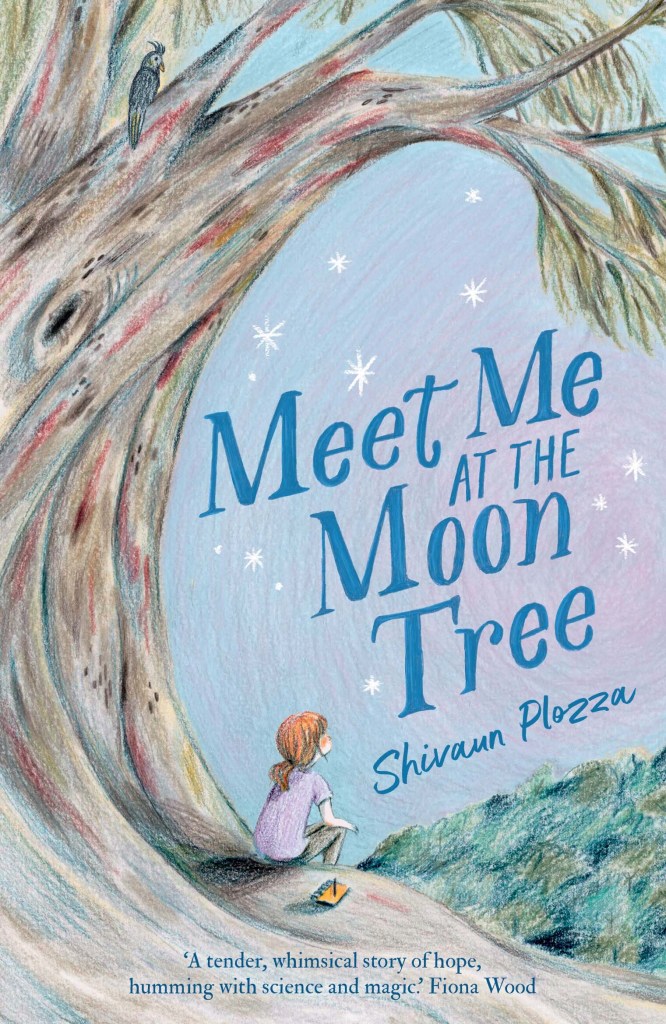
Meet Me at the Moon Tree by Shivaun Plozza at Paperbark Words


