
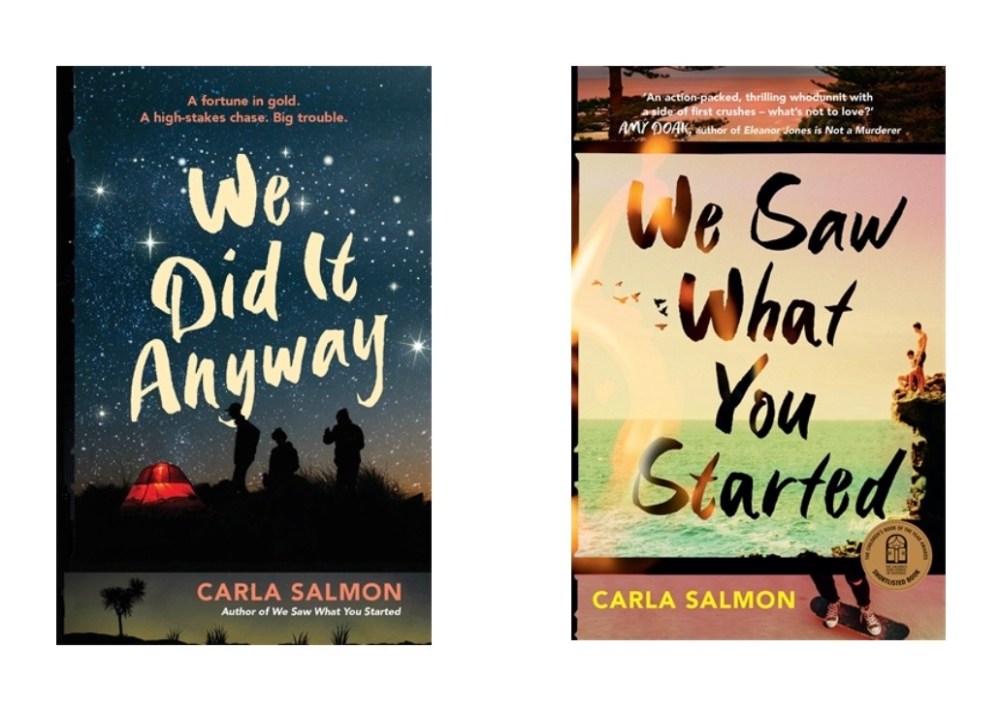
We Saw What You Started &
We Did It Anyway
by Carla Salmon
INSIDE THE CBCA 2026 SHORTLIST
(Pan Macmillan Australia)
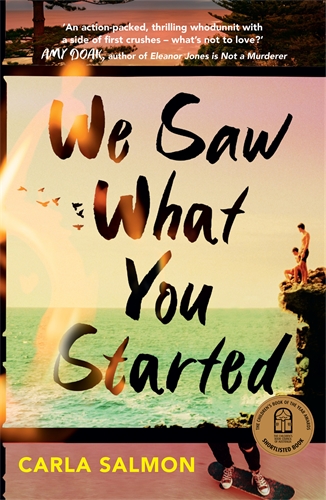
“I’d assumed Jasper was joking, since it’s impossible to tell when he’s being serious or sarcastic. His thick Aussie drawl means all his sentences end with a cheerful upward inflection. But breaking into the pool at midnight after you’ve spent hours at the police station is, logically a really stupid idea…
I am not a chicken. I’ve shielded my little brother so he will never have to swim for his life to please my father. I’ve survived a Californian wildfire and an Aussie bushfire. I can jump off this ledge.”
(We Saw What You Started)
Author Interview: Carla Salmon
Thank you for speaking to Joy in Books at PaperbarkWords blog, Carla.
It is a bucket-list tick to be chatting with you, Joy! Thank you for having me.
Congratulations on your thrilling YA novel We Saw What You Started being shortlisted for the 2026 CBCA awards in the Older Readers category. Your readers will be rushing to lay their hands on the sequel, We Did It Anyway.
I’m not sure that the beautiful sticker on my book will ever seem real! But I’m so excited that more readers now know about the series and are excited to read We Did It Anyway.
Where are you based and how are you part of the children’s literature community there?
I’m lucky to be based in sunny Brisbane, on the lands of the Turrbal and Jagera peoples, where I teach and write for young teens. I only discovered our local children’s literature community a few years ago while I was learning to write a novel but I immediately felt I’d found where I belonged. Meeting and learning from other authors, loading my calendar with bookstore and libraries events and connecting with the passionate organisations and volunteers who work tirelessly to keep kids reading has greatly strengthened my sense of purpose as both a writer and educator.
How did you celebrate We Saw What You Started being CBCA shortlisted and what impact has the award already made on the book?
With a squeal of surprise that shook my staffroom! Once my teaching colleagues had confirmed that nothing was wrong (and it was actually wonderful news) I was enveloped in hugs. At that stage I didn’t realise the impact that the award would have – I was simply elated to be recognised alongside authors who I have so much respect for. Just three and half years before, I learned how to write a book. Then I learned all about pitching and publishing. It’s only now that I’m understanding more about distribution and helping readers discover my books with the support of my publisher. The well-earned buzz of the CBCA’s 80 years of recommendations and annual events generates excitement that ripples through schools, libraries and bookstores. It is truly wonderful.
How do you use the natural elements to enhance your plot-lines?
My story ideas seem to begin with a small, specific moment in a place that left a visceral impression on me as a teenager. For example, initial thoughts for We Saw What You Started were triggered by a memory of running my hand along the smooth timber hand rail at the Rainbow Beach lookout, my face warmed by the afternoon sun as I gazed down at the surf lifesaving tower below. I wanted to capture the beauty and freedom of an Australian beach town while exploring what happens when that sense of safety is shattered. I also enjoyed clashing the natural elements of fire (first in the bush, then in the town) and water (first the tide, then the pool). There’s something compelling about juxtaposing beautiful places with terrible things that can happen within them.
The ideation process was the the same for We Did It Anyway. I thought back to the adventure stories I loved as a child, like the Famous Five, and imagined the perfect Australian setting that could offer a modern twist. I immediately thought of my beach camping holidays on K’Gari with my family. I loved the thrilling sense of freedom the island offered, but there was always an underlying feeling that something could go wrong. And if it did, we were on our own, with no way easy way to contact the outside world. My most poignant memory on K’Gari as a teenager still bursts with equal parts thrill and fear: swimming across Lake Mackenzie. In the middle where the water deepens to a midnight blue and the quietness is eerily surreal, my imagination ran wild. I wondered if anyone would remember I’d existed if something from the dark depths dragged me under, which of course heightened the adrenaline rush when we made it back safe. This mixture of wonder, vulnerability, adrenaline and bravery was the feeling I used to drive the plot in We Did It Anyway. I wanted to create a restlessness, never allowing the reader to stop turning the page even in quieter moments. But importantly, my stories always end with comfort and satisfaction, with the setting reflecting this lightness and hope.
What do you think is attracting young readers to your cool, confident characters?
The young teens in my world tell me that they want stories with characters who really ring true to their specific age and stage. The thirteen-year-olds in my classrooms sometimes find it difficult to relate to younger characters in Middle Grade stories, but they also don’t care enough about older characters navigating their final years of high school in Young Adult fiction. They want stories that feel ‘grown up’ with more mature humour and friendships and explorations of pressures in families, sporting spheres and social lives.
So before I started writing, I curated this young teen wishlist and realised it was consistent with my own children’s requests. My son was 11 and my daughter was 13 at the time, so when I was learning how to write and drafting my first manuscript which became We Saw What You Started, I invited my children to create the story with me. I read each new chapter aloud and our dinner conversations became animated discussions critiquing my characters’ motives, language and actions – sometimes even heating to the point of arguments! Obviously I was delighted that my children were reading and talking about stories again, but their insights became my editing superpower. I then shared early chapters at school and my students’ feedback further directed my work. I was writing with young teens, not just for them. I think it’s this process that created character voices, pacing and outcomes that are appealing to young readers.
How are they heroic?
My characters are really capable teens who keep going despite all of the terrible things I throw at them! If they were being honest and not just trying to impress their friends, they wouldn’t describe themselves as brave. In fact, they’d say they were scared about being rejected by their friends, making a fool of themselves or letting their team down. Yet they are most certainly heroic because they always pursue what they believe matters. Sometimes this conflicts with our understanding of what is ‘right’, which is an interesting philosophical provocation to explore: is it ever okay to do the wrong thing for the right reason? I often pondered this idea when I was Head of Year and guiding students from a student wellbeing perspective. Kids with good intent sometimes sacrificed the rules to protect their mates, even risking their own credibility – and this was impossible not to admire. Perhaps this same selfless rebellion is what I love most about my characters and why they are heroic – they show us that the outcome may not be perfect, but everything is always ‘figureoutable’ if you keep going.
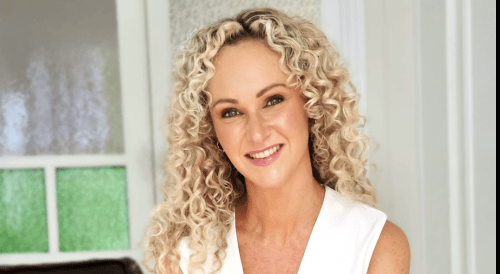
How much of your own youth or life experience have you brought to these novels?
I draw a lot of inspiration from my own teen experiences as a starting point, but then I create the kind of teenager I wish I could have been. That’s one of the things I love about writing – it’s a second chance to respond to a similar situation with greater courage and more compassion. For example, I was quite similar to Milly as a teen – I loved sport, I wanted to compete and to be taken seriously, but I also felt like my determination was a weakness as it wasn’t a trait often paired with kindness. I ended up muting my competitive spirit to feel accepted. But in We Saw What You Started, Milly is gifted a moment of clarity, realising that it is okay for her to be fiercely competitive as an athlete while also being a kind and vulnerable friend.
For what age-range are your intended readers? How does this influence what you include and leave out?
Because my books are written specifically for young teens, they must be safe for an 11-year-old to read independently but also mature enough to keep a 15-year-old hooked. So my thrillers have mysteries without murder, teen talk without swearing and crushes without spice. I love that librarians in upper primary and lower secondary can confidently recommend my books for students who are crossing the bridge from Middle Grade to Young Adult fiction. Research tells us this is the age group who are most likely to stop reading for pleasure, so my aim is to offer a goldilocks ‘just right’ series for young teens to continue their regular reading habits.
As well as telling action-packed stories with well-told contemporary friendships, sibling relationships and small town community, you integrate some issues seamlessly into the stories. Could you tell us about some of these?
I really like peeling back the layers of self-assured confidence that teens use to protect themselves. As a kid, I was always in awe of teenagers who appeared to have everything sorted. I’m sure we can all name the popular kid who was beloved by students and teachers alike, who appeared to cruise through high school with ease. But I’ve learned that no one had it all figured out. In fact, the coming-of-age nature of teens means power and friendship dynamics are in a constant state of flux. So I think it’s important to explore themes of belonging, trust and identity from a range of perspectives.
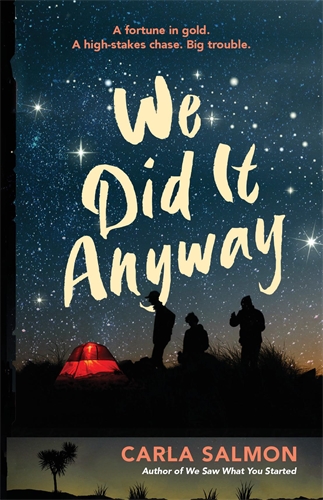
Without spoilers, what’s a teaser from the sequel to We Saw What You Started, We Did It Anyway? Whose point-of-view do you feature?
We Did It Anyway follows the same group of kids from Red Sands as they head to Talmar Island for a week-long surf lifesaving training camp. But when they accidentally discover treasure meant for international smugglers, they make the one decision they know they shouldn’t. They take it anyway. Hunted by armed criminals and separated across the island, they have to decide who they can trust – and they have to get it right.
I had so much fun creating this high-action fast-paced thriller narrated by Alex and Luna. Alex makes me laugh. I adore his cheeky personality and his character is very much inspired by the students I teach. Luna is equally entertaining with her hilarious observations and very public protests about camping and the great outdoors. Pleasingly, many readers are saying We Did It Anyway is their favourite so far in the Red Sands series.
Your titles flow together. Why have you chosen them and to what do they refer? What’s coming next?
I was very deliberate in my word choice because I’d hoped to write a series and I wanted my titles to have a consistent style. I think inclusive language is intriguing, so I started there. But I also wanted simple words that together provide a clue about the story. In We Saw What You Started, Otto’s problems really begin when he makes an assumption about something he sees. His decisions that follow are based on this incorrect information, complicating the situation further.
For my second book, my publisher and I decided that the title should start with ‘We’ and also contain six syllables. We agonised for weeks, never landing on something that felt right. Then, my teenage son saved the day – by making a mistake! One evening, Billy continued gaming long after I told him stop, so I confiscated his device. The next day he tried to make amends, apologising and explaining that he didn’t know why he’d kept playing. He knew he wasn’t allowed to. But ‘he did it anyway’. I paused, counting the syllables on my fingers as he continued offering his heartfelt apology (which he’d hoped would reduce the length of the confiscation period).
‘We Did It Anyway!’ I exclaimed. ‘Billy, you did it! You just gave me my next book title!’
‘Does that mean I can have my Switch back?’ he asked.
‘No.’ I declared firmly, hiding my smile.
How do you see We Saw What You Started being used in schools?
I’m thrilled that this story has been selected as a set text for creative writing and novel study units in schools throughout Australia. While I wrote it specifically for readers aged 11-15 years, it seems to best fit in Years 7-9 curriculum. I also love visiting schools and offer a range of writing workshops and presentations.
What is a memorable response that you’ve had from a reader?
I recently received an email from a young teen in regional NSW who has read We Saw What You Started five times. To think that a reader has returned to Red Sands repeatedly brings me so much joy as perhaps it means I have achieved my goal: to offer a beautiful world where teens want to escape to, where they can hang out with relatable characters who push boundaries and make mistakes – but at the end of the day, they know that everything is figureoutable.
Thanks so much for answering these questions with such enthusiasm and generosity, Carla. Your are creating such an important niche and your ‘Red Sands’ books will no doubt become top picks for young teens to young adults.
We Saw What You Started at Pan Australia
We Did It Anyway at Pan Australia
Inside the 2026 CBCA Shortlist
Inside the 2026 CBCA Notable Books
Next reads: A Walk in the Dark by Jane Godwin, One Would Think the Deep (for older readers) by Claire Zorn


2 thoughts on “We Saw What You Started & We Did It Anyway by Carla Salmon ”