
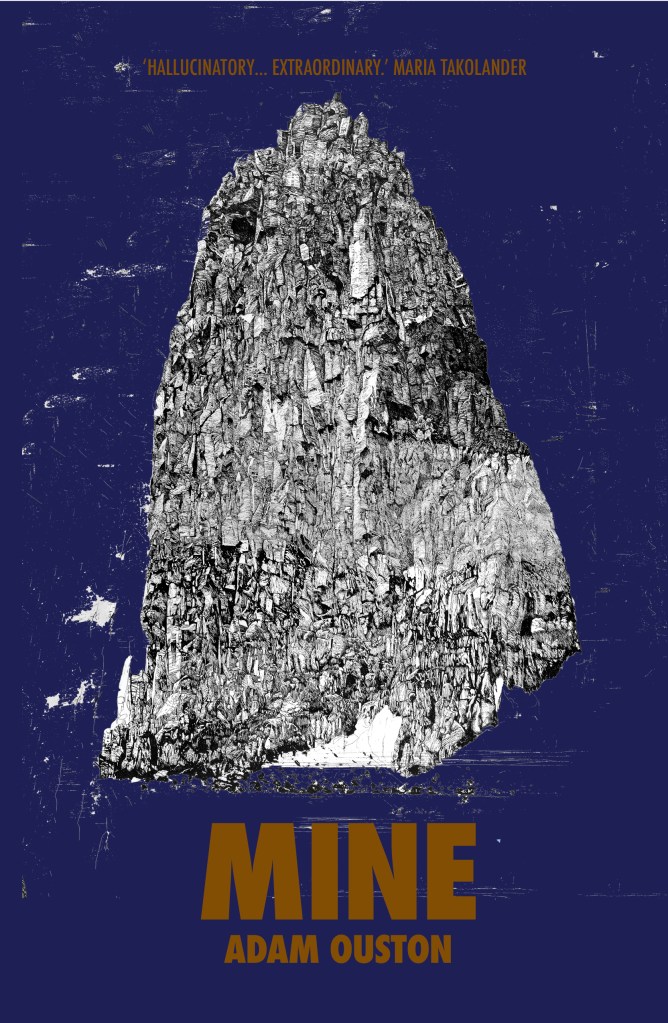
Mine by Adam Ouston
Transit Lounge
“… considering the situation, which was in large part where the element of terror originated, the sense that there was something else happening, something bigger than him, a secret story beneath the apparent one, for which he had no words or even capacity for understanding, more mindbloggling than the shift from human to geological time, a menace he had felt ever since coming down here …” (Mine)
Adam Ouston, author of Waypoints, writes about the inspiration behind Mine, his extraordinary, single-sentence novel for adults, for Joy in Books at Paperbark Words blog.
The inspirations for the book came both in a flash and over many years. It’s always hard to pin these things down. On one hand, I’d been interested in ghost towns and vanished towns as the spectres of heavy industry for a long time. An early story I had published was entitled ‘The Chaos of Life Beyond Death in the Outback,’ which featured a small, independent film crew going from ghost town to ghost town in WA in an effort to make a zombie film. These places where the earth has been stripped bare, eviscerated, and left behind. More recently, I came into possession of Tasmanian historian Michael Holmes’s Tasmania’s Vanishing Towns, which documents the island’s abandoned towns and settlements, some of which are still inhabited. Just because it’s abandoned doesn’t necessarily mean nobody lives there.
On the other hand, I’d just watched the film adaptation of Japanese author Kobo Abe’s Woman in the Dunes in which an entomologist, while exploring a beachside town for specimens, finds himself at the base of a steep dune where, inexplicably, a woman lives in a small house (it’s more like a deep hole in the sand). There’s no way out for either of them. They live in this world of sand that pours in on them while they are trying to sleep, when they have dinner, when they argue. The landscape consumes them. I found myself feeling the discomfort and claustrophobia and dehydration hours after the film ended. With my skin still burning, I literally started Mine the following morning.
Ever since Europeans landed in Van Diemen’s Land/Tasmania/Lutruwita, the place has been contested. Colonial forces, commercial interests, and artists (among others) have all tried to lay claim to the island, all the while it has been inhabited by the original owners. So the title of the book is a play on this word both as a noun and adjective. I placed my protagonist down an abandoned mine on Tasmania’s west coast in order to talk about ghost towns, the exploitation of the earth, and what it means to be of a particular place. In a way, the history of the landscape unfolds within the protagonist’s mind because it is always there in all of us. We confront and endure the history of this place every day. It is never past. Which is also why I found the form of the single sentence so powerful and necessary. This one sustained gesture, one utterance, of you like, contains the entire history of the plight of the Tasmanian landscape in which you cannot separate what happened in the 1840s when the track cutters hacked their way through the most impenetrable forests on the planet, from what happened in 1912 during the North Mt Lyell mine collapse, from what is happening to the poet stuck down the mine in the present day. In a way, it is all the same thing; it is one single event. In another way, we see the patterns repeated over and again of extractive interests taking what they want from this place and leaving its inhabitants to pick up the pieces.
It’s important to say, too, that this is not necessarily an anti-mining book, though it does highlight the environmental and social consequences of irresponsibility. What interests me is the way in which the contest for Tasmania is much more nuanced than one side versus the other. It is not as cut and dry as that. As the poet speaks to the earth it opens itself up to him and he finds the boundary between animal and mineral not as solid as he once assumed. At the end of the day, that’s what I wanted to explore, how this consciousness is shared between us and the planet.
Thanks to Scott Eathorne of Quikmark Media


