
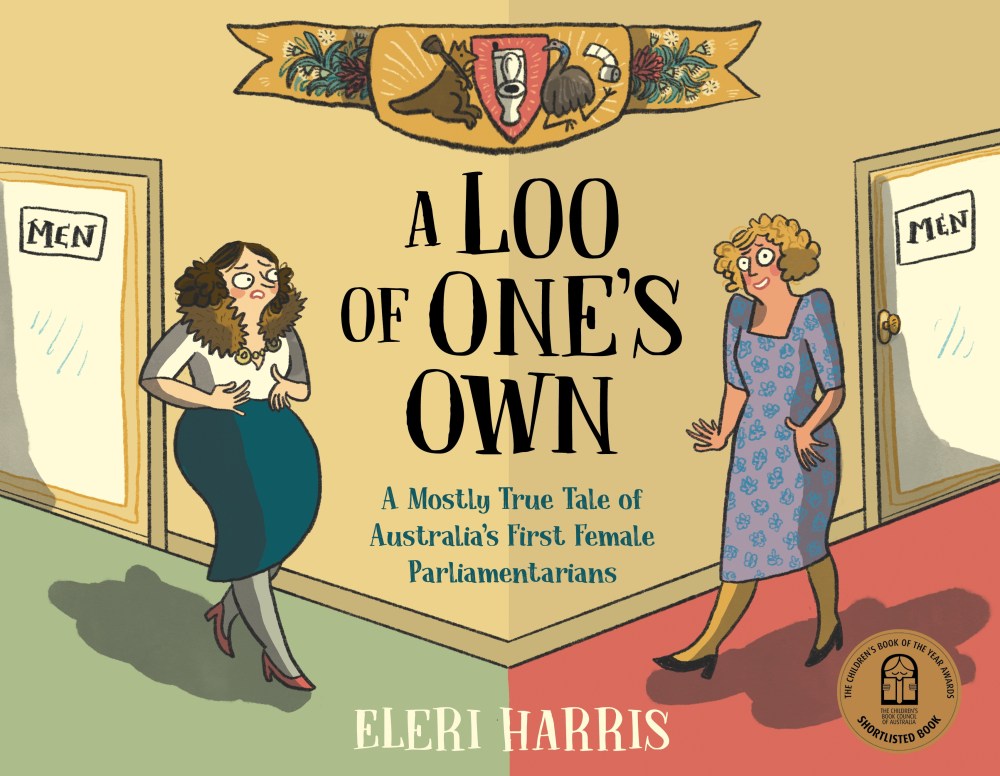
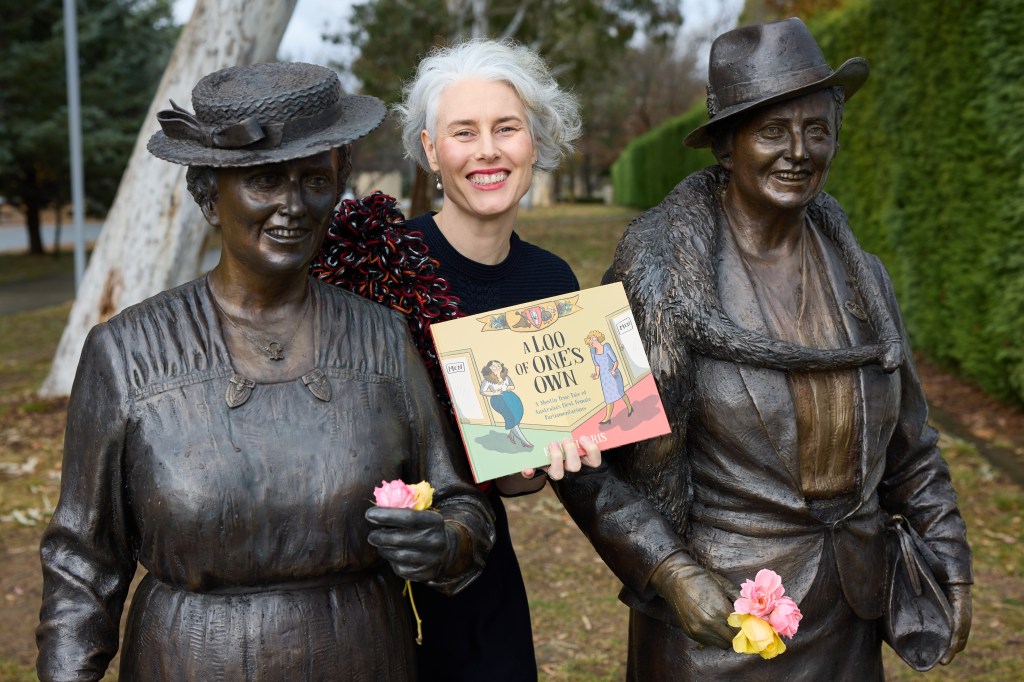
A Loo of One’s Own: A Mostly True Tale of Australia’s First Female Parliamentarians written and illustrated by Eleri Harris
(Allen & Unwin)
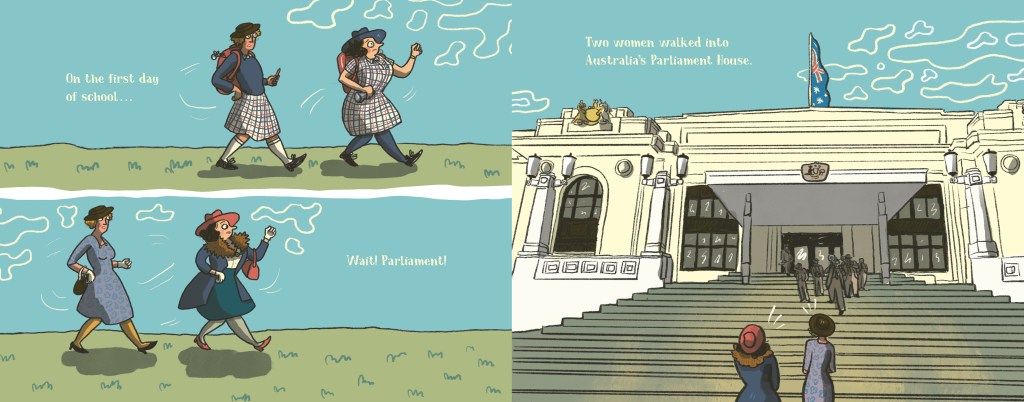
“Our story starts eighty years ago in Canberra, where all the cool stuff happens…
On the first day of school …
Wait! Parliament!
Two women walked into Australia’s Parliament House.
And came face to face with a whole bunch of men.”
(A Loo of One’s Own)
A Loo of One’s Own is a narrative non-fiction picture book shortlisted in both the Eve Pownall non-fiction and New Illustrator categories of the 2026 CBCA awards.
Eleri Harris has created a clever microcosm of feminist history told with humour. The first two Australian female parliamentarians, Enid Lyons and Dorothy Tangney, have a very busy first day and things get worse when they need a toilet…
They quickly devise one of the twentieth century’s greatest secret codes to help solve their predicament and then go on to achieve even more.
Interview with Eleri Harris, the creator of A Loo of One’s Own
Thank you for speaking with Paperbark Words, Eleri.
Congratulations on A Loo of One’s Own being a 2026 CBCA shortlisted book in, not only one but, two categories! The book gives a very important background into modern Australia history, while being entertaining and humorous.
Where are you based, what is your day job and what is your involvement with cartoons and graphic novels?
I am based on beautiful Ngunnawal and Ngambri country in the Australian national capital. I’m a full time creative. This means a I do a lot of different things! While I mostly make comics, I also am a freelance graphic novel editor, I write and illustrate kids books, I do research for cartoon exhibitions, I write and lead history walking tours, I draw illustrations, I do performance storytelling and run workshops.

I graduated from the Center for Cartoon Studies in Vermont, USA, with an MFA in comics in 2014 and have mostly been working as a cartoonist ever since. For 10 years I worked as the Features Editor for an American publication called The Nib, which ran political cartoons and long form nonfictions comics. I made some wonderful friends at The Nib, including Shay Mirk, who I coauthored Making Nonfiction Comics: A Guide to Graphic Narrative. This book helps break down a lot of practical aspects of comics making generally, but also very specifically tackles the best practice and ethics of nonfiction comics. That book also came out in 2025 and was shortlisted for an Eisner Award, which is basically the Oscars of the comics world, which was super amazing.
Why have you created A Loo of One’s Own?
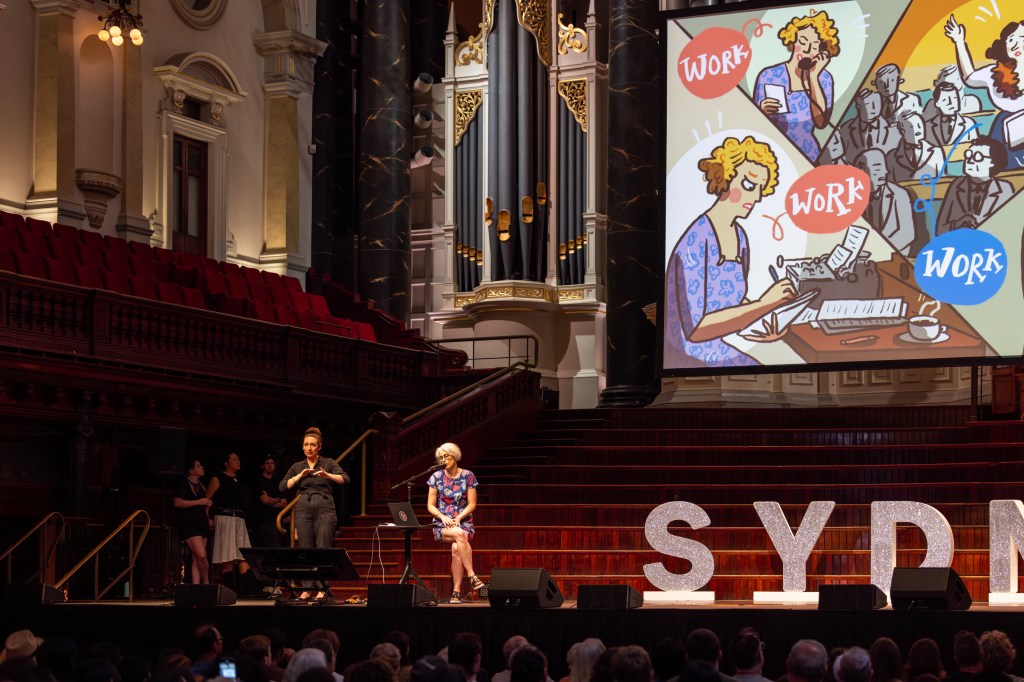
My friends Fionn McCabe, Gabe Clarke and Evie Hilliar host a live storytelling event called Read To Me, which I’ve participated in many times here in Australia and also abroad. At Read To Me events, the storytellers show slides and click through to tell a story with sequential art – so it’s a performance incorporating oral storytelling, projections and sometimes music. In 2024, Fionn called to ask if I’d be keen to do one at Sydney Town Hall just for children. I said yes, even though I hadn’t actually done a comic for kids before. At the time I was regularly running walking tours in Canberra for She Shapes History, a feminist history company, and I’d noticed that children on the tour were enthralled when I told them that Old Parliament House’s original design had no toilets for women in the working part of the building. All kids wanted to know was where the ladies went to wee.
I had two weeks waiting on edits for another project, so I used that time to make up a kids comic based on Dorothy and Enid’s story, with Fionn editing. I started with the premise of what would it feel like if on your first day of school – sorry Parliament! – you were the first person who looked like you to be there. What if there was nowhere for you to go to the bathroom? What would you do and how would that feel? I wanted to tell the story of Australia’s first female parliamentarians through that lens.
And the event at Sydney Town Hall went really well! I got a lot of encouraging feedback, including from one of my art heroes Freda Chiu who was like, “Oh dude that could be a kid’s book.”
After the reading, I asked my friend Erica Wagner at Allen & Unwin to take a look at the slides I’d created, and the rest is history! I’m pretty sure I am the only person to accidentally pitch Allen & Unwin with a powerpoint presentation.
What was a helpful research resource or process?
I have two kids of my own and my son was a toddler during the pandemic, so I’ve read thousands of picture books out loud. I feel like a lot of children’s authors forget that picture books are actually a performance piece. Most of the time, the audience for that book is not reading it themselves. For me, it’s not enough that a picture book has nice images or a good story, that story has to be conveyed well through an oral telling WITH the images.
When I created the original comic for Read To Me, I enlisted the help of some little friends, Elsie, Theo and Hanalei, to workshop the story. I read it out loud to them and asked their thoughts on every page. I was surprised to learn that little girls generally don’t know what a urinal is, so I had to change the ending a bit to unpack that for them or it wasn’t going to land. I also shuffled some of the images around to help make the humour beats work. Their feedback was absolutely invaluable.
Enid and Dorothy’s story about finding a toilet is big and interesting enough to fill the book. However, these women also achieved further noteworthy contributions to democracy. What is one of your favourites of their achievements?
Enid Lyons stood up on the floor of parliament at the end of the second world war and argued for returning servicewomen to receive a pension. There had been no plan to give them anything at all, but because of Enid they received half the pension that men did. Many First Nations Australians who fought did not receive a pension for 40 years after that war, to give you an idea of how important it is to have someone like you in Parliament to fight for your rights.
Dorothy Tangney was an incredible advocate for education in Australia, having worked as a teacher in marginalised areas and also coming from a working class family herself. Dorothy benefited from scholarships in education, without scholarships she would never have attended high school or university. She strongly believed in the power of education to lift people out of poverty and was one of the founders of the Australian National University.
You have included a very helpful written and visual timeline of women in parliament and political life. What is one highlight and why?
Fanny Finch, who was the first woman in Australia to cast a ballot. A remarkable woman of British and African heritage, who came to Australia to work in domestic service and ended up running a pub in the goldfields.
How have you incorporated elements of a comic into this picture book?
Because I am a cartoonist, I use the language of comics in a lot of my art, so the book includes speech balloons, emanata and sequential imagery. It’s the natural way for me to make work. This book is my first picture book. I didn’t exactly plan for this story to be a picture book, I designed it as a comic. So I guess you could say this is a comic that was adapted as a picture book?
Why have you used diagonal lines to form panel frames on the “Work Work Work …” page?
The diagonal lines don’t symbolise anything in particular for me, I just want this page to be BUSY and reflect all the things that a politician of that day would be doing. I wanted to show that Enid and Dorothy’s jobs weren’t symbolic, they were really working! Speaking on the floor, reading, writing, consulting with staff and so on. I wanted the young readers to look at it and think, goodness me they are are really working hard doing a lot of things.
What is both terrifying and funny about your portrayal of the bunch of men in parliament?
They have no idea they are misogynists.
What is something that you’ve ‘hidden’ in the book that amuses you?
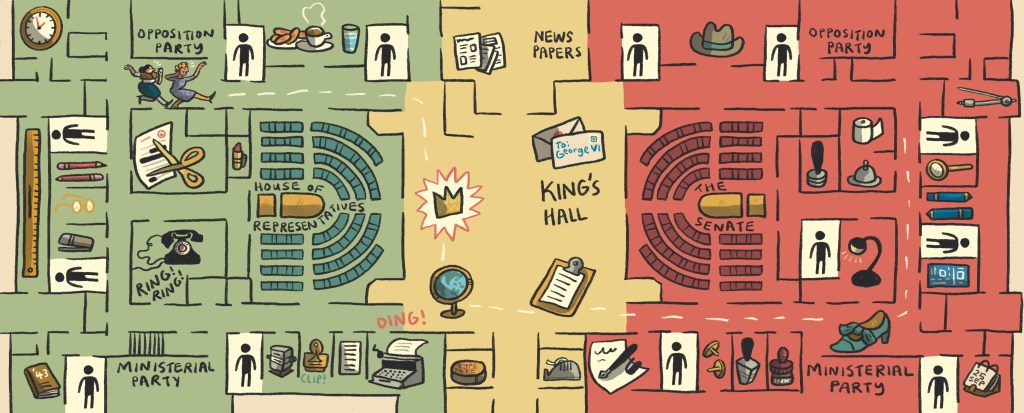
I loved making the endpapers, which are based on original blueprints for Old Parliament House. It ends up looking like a maze where I placed inordinate number of male toilet signs and lots of random fun 1940s parliament stuff with Dorothy and Enid, desperate to wee, in one corner. The endpapers were made specifically for the book and they might be my favourite thing I drew for it.
What impact has being a shortlisted CBCA book had on you or the book so far?
A few days after the CBCA announcement, I was sitting in the primary school library with my seven year-old son and his friend Minha. Minha was trying to find something to read and she pulled out a book that had a CBCA sticker on it. “This sticker, Eleri, this means it is a good book,” she told me solemnly. I said, “Minha, do you know that my book is going to get a sticker like that?” and she grinned like a maniac and gave me a high five, squealing, “REALLY!? THAT IS SO COOL!”. I’m assuming that in real terms the book has probably sold more copies and been accessed by more children in more libraries, but honestly Minha’s reaction to the honour of the all important sticker is the one of most significance to me.
How would you suggest using A Loo of One’s Own in schools?
The wonderful Stephanie Smith at the Museum of Australian Democracy wrote the teaching notes for A Loo of One’s Own, which I think are absolutely great so maybe go there first! Otherwise, as a non-teacher, I would say this book is about inclusion and exclusion in public spaces and what that means for democracy. In order to include everyone in our democracy, we need to have facilities that support everyone. This book can be used as a starting point about what exclusion and prejudice feel like. It can be a launchpad for asking kids questions about places where they feel welcome and unwelcome, and what people need and should have to feel like they can participate in Australian society.
How do you think the book will help transform young people’s knowledge of history, and possibly change the future?
Having a grasp of history is important to understanding where we came from and thus where we should or could go.I’m all for sharing stories with kids about people who history has forgotten or perhaps not elevated to their due.Last book week, I was sent photographs of little girls all around Australia dressed as Enid Lyons and Dorothy Tangney. It gave me heart that the future of Australian politics at all levels has capacity for greater gender diversity and that the story of Enid and Dorothy won’t be forgotten.
A Loo of One’s Own at Allen & Unwin


2 thoughts on “A Loo of One’s Own by Eleri Harris”