
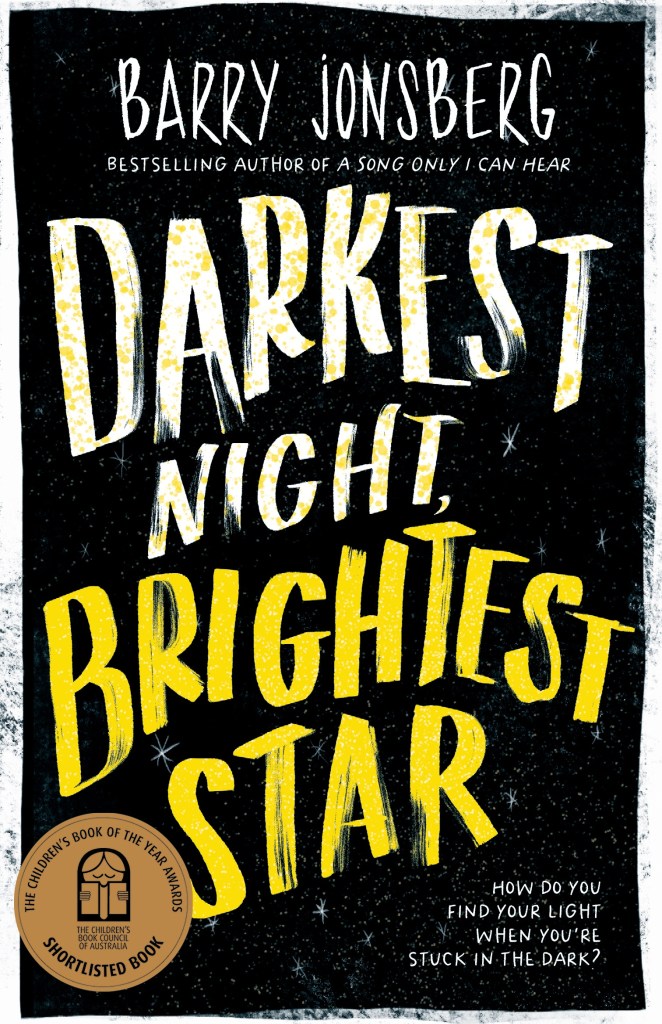
Darkest Night, Brightest Star by Barry Jonsberg
(Allen & Unwin)
INSIDE THE CBCA 2026 SHORTLIST
“ ‘Think about this,’ Dad said. If you are to be the brightest star, like Diego Maradona, then you must go through the dark bits first. The practice. Working hard even when you don’t want to. You understand?’”
(Darkest Night, Brightest Star, Barry Jonsberg)
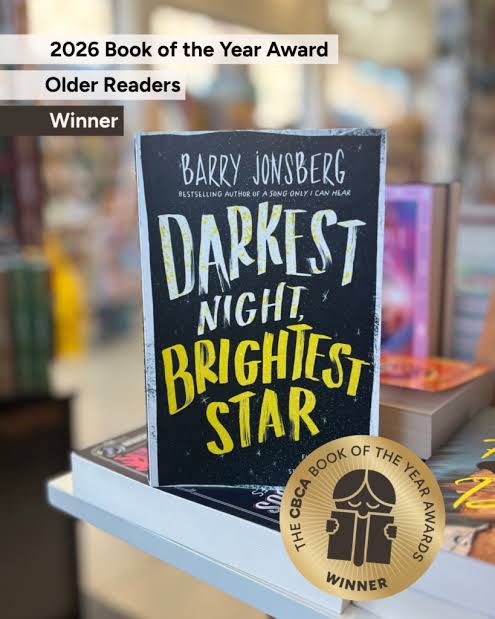
WINNER: 2026 CBCA Book of the Year, Older Readers
SHORTLISTED: 2026 Ethel Turner Prize for Young People’s Literature
LONGLISTED: 2026 Indie Book Awards, Young Adult Award
Author Interview: Barry Jonsberg
Thank you for speaking to Joy in Books at PaperbarkWords blog, Barry.
My pleasure
Congratulations on your YA novel Darkest Night, Brightest Star winning the 2026 CBCA Older Readers award. It is both a compulsive and sensitive read that portrays a pivotal time in 13-year old Morgan’s life.
Thank you.
Your writing is interesting and accessible while showcasing three-dimensional characters and different ways to grow and become a man. Even the most unlikeable are revealed to have qualities that make us care for them.
Morgan has a tough life on most fronts. What are his redeeming qualities?
He endures, I think. He has had a tough life, mainly because he has to live up to standards that he hasn’t chosen and doesn’t understand. But at the heart of Morgan is a kind, sensitive kid placed in a family environment that doesn’t allow these parts of his character to bloom [the gardening reference is appropriate here, I believe]. But when he is given the opportunity, through his friendship with Gray and his interactions with the old lady Mrs Guy, then his innate kindness and compassion is allowed to flourish.
Why is his father like he is?
Why is any toxic male the way he is? It’s a tricky, though valid question. I suspect the answer lies in his father’s upbringing. It’s possibly not a stretch to think that his formative years were spent in a similar way to his son’s. Men cannot be questioned. Women are, by definition almost, inferior. Being tough is the way to prove that you are a man. And it’s also very important to pass on these ‘values’ to your children.
Why did Morgan turn out differently from his brother Mitch?
I think I wanted the reader to understand that it doesn’t have to be this way. Mitch takes on and doesn’t question the lessons that his father has taught him. It’s almost a cliché to suggest that the sins of the father can often be passed on to the children. Mitch completes the depressing cycle of generational intransigence, whereas Morgan finds a way, through the support of others, to break free. Mitch was made into the person he became, Morgan is lucky to be given another way of thinking and acting.
Morgan‘s father forces him to play soccer. Sport is a two-edged sword in the novel with its demanding training that is sometimes lightened with hope of glory. What do you see as its role in augmenting and possibly changing young people’s lives?
Australia, in general, venerates sporting success and finances it very generously [something that doesn’t happen to the same extent with the arts, for example]. We love sporting heroes and put them on a pedestal. What better way to prove that you are a success in life? Of course, sports are important for young people and can have enormous health benefits. But it’s not about pleasure or health for Morgan and his father. It’s about proving your worth. He doesn’t play soccer for fun. Nothing is done for fun. And that is something of a tragedy.

How are Morgan’s lack of interest (and poor results) at school holding him back?
I have taught many students like Morgan throughout my teaching career, students who don’t understand why they are being asked to excel at something they are ill suited for. Not everyone is, or should be, academic. Yet we often judge them on their school records. Morgan has other skills and by the end of the novel he is beginning to find an occupation that fulfils him and that he is good at. School isn’t holding him back. It’s his father who is doing that.
When can a teacher turn a student’s life and possible future around?
Not by anything dramatic. But rather by being a good listener and caring. Students always know when a teacher cares or is simply pretending to.
The importance of education and academic and other qualifications are made clear in the novel. Apart from education, is there any other way that a young person can disrupt or break the cycle of toxic masculinity or other family dysfunction?
Education plays a role in breaking the cycle of toxic masculinity, but it’s not something that is high up on the list of priorities in most curricula [though it probably should be]. And I wish I had the answer to your question! It seems to me that a large part of the problem is the way in which viewpoints are increasingly narrowed through social media. We are fed values that various algorithms have decided most align with our existing views. As a result we tend not to debate, because everything we see or read is supporting our existing views. So, listening to those who disagree with you might be a good start!
How influential can significant adults outside the family unit be?
Absolutely vital. What do they say? You start by loving your parents, then you judge them. Rarely, if ever, do you forgive them. Significant adults outside of the family bring different perspectives and as I’ve said earlier, one key to a healthy life is to be exposed to as many opinions and perspectives as possible.
When do you think it’s time for outsiders or authorities to step in?
Oh, wow! I’m a writer and this is way outside my area of expertise. I would guess when someone is in imminent danger, though how this is judged must be problematic. Too early an intervention can be very damaging, too late can be catastrophic. Sorry. I don’t know.
When should a parent/family member leave?
When they feel it’s right. There’s no easy answer to this. It all depends on individual circumstances.
What is 1 thing Morgan’s mother did right and 1 thing she did wrong?
I can’t judge her. Was she wrong in leaving in the first place? Not for me to say. Was she right in coming back into Morgan’s life when he had lived for so long without her? Again, I don’t know.
Loyalty is a valued trait in your story. Who personifies loyalty inside Morgan’s family? Outside his family? How?
Morgan is loyal to his father [though not so much with Mitch]. He wants to help his dad and wouldn’t dream of abandoning him, but he knows that he can’t support him by going along with his father’s dreams of sporting success. So he finds a way to keep the family going whilst also taking his own path to happiness. He’s a good kid, Morgan! Outside of the family, Gray is the obvious candidate for demonstrating loyalty. He suffers abuse from Morgan, but sees that he is not a hopeless case, that he is, indeed, someone who is lost and needs the support of others as he navigates all the problems he faces.
How do you show the power of friendship and kindness?
By listening and empathising and not by knee jerk judgements. Gray does this throughout in difficult circumstances.
Apart from the protagonist, Morgan, which character do you most care about? Why?
I think Gray. He has had a tough life as well and has come to terms with who he is. He is comfortable in his own skin after many experiences that have made him doubt himself. It would be nice to think that Morgan will achieve a similar sense of self-confidence in the future.
The novel addresses being gay and the homophobia that this can pile onto a young gay person with daily and compounding impact. How do you hope your story changes homophobic reactions and behaviour? [optional] How do you suggest young people suffering this abuse find help?
I would love to think that a reader might change his or her views on homophobia as a result of reading my book, but societal change rarely happens like that. If a reader thinks about issues, all issues, after reading then that would be great. And any suggestions I might be able to give to those suffering from homophobic abuse would be patronising, I think. Talking is always the first step though, because internalising pain is never the answer.
You also raise the issue of the elderly with dementia – both living alone and in dreary residential care (despite the staff’s best efforts) with great sensitivity and kindness. Morgan helps elderly Mrs Guy. Perhaps even more importantly, how does helping her help Morgan himself? Optional: What is one way that you would like to see change in the aged care sector?
Mrs Guy gives Morgan two opportunities – to help someone in need and to develop his burgeoning love of gardening. Helping her sets Morgan on the path to finding his own way, both in terms of his future career path and his ability to respond with kindness to other people. For Mrs Guy, she gets a connection with family. Morgan becomes the son she maybe deserved but never had. At the end of her life, she feels love again.
What is the symbolic (or other) significance of plants and gardening?
Cor. Deep! I suppose it’s all about growth and caring. Morgan shrivels under the guidance of his father, he blooms when he’s given care, support and the metaphorical food for his own personal growth.
How would you describe your writing style and tone here?
Most of my books have protagonists that are smart and funny. This book was different. I had to write from the perspective of someone who was totally lacking in self-confidence and who has few academic abilities, especially in terms of written and spoken language. It was hard to pare down my normal style to fit Morgan’s personality.
Which scene or conversation are you utterly happy and satisfied to have have created?
I liked the scene at Mrs Guy’s nursing home when he and Gray reveal the orchard. It felt like the perfect way to show Morgan’s kindness and the change in his world view.
You attribute the title Darkest Night, Brightest Star to a quote from a couple of possible sources. Who would you like to believe conceived it? What do you hope its impact will be on your readers?
The first reference said John Green, but no one really knows who said it first. So for me it doesn’t matter. I would hope that readers would see it as a reflection of Morgan’s development from the darkness of his family life to the potentially bright future.
What response to this story has warmed your heart?
There have been some lovely reviews [and a few that weren’t impressed]. My wife is always my first reader. Her positive response to the story was always going to be the most important.
Of which of your other significant backlist of novels does this one share its heart? How?
Like I said, this is very different from most of my other books. As far as turning darkness into brightness goes, then maybe A Little Spark is the closest. The main character there suffers before being given a gift that changes her life.
How do you suggest the novel be used in schools?
I hope as a good story, rather than an opportunity to discuss issues. I think the issues are important but no one wants to be preached to. That can really put students off.
What is the impact of being CBCA shortlisted on the novel?
Well, it’s always lovely to be shortlisted but I don’t get carried away. It means the novel will receive greater attention than before which is always a consummation devoutly to be wished. But for me it’s onto writing the next book …
Thanks so much for answering these questions, Barry, and particularly for opening our eyes to different forms of masculinity – and which to aspire to – with such empathy.
Thank you.
Joy Lawn, in association with Dmcprmedia
Darkest Night, Brightest Star at Allen & Unwin
Inside the 2026 CBCA Shortlist
Inside the 2026 CBCA Notable Books
***************************************
Interviews with Barry Jonsberg at PaperbarkWords blog:
Some of my reviews of Barry Jonsberg’s books
- My Life as an Alphabet in Australian Book Review
(review as part of a survey – scroll down to bolded part)
ABR Junior Fiction Survey
April 2013
Joy Lawn
Fog a Dox (Magabala Books, $19.95 pb, 111 pp, 9781921248559)is a significant novel for primary-aged children by esteemed Indigenous writer, Bruce Pascoe, who is also currently retrieving and teaching the Wathaurong language of south western Victoria. The intriguing title springs from fox cub, Fog, who was rescued by ‘tree feller’, Albert Cutts, and reared by his dingo-cross dog, Brim. Fog’s vixen sisters left when they were old enough to survive but Fog stayed, balancing his fox instincts with learned dog behaviour, and so Albert describes him as a ‘dox’.
Brim and Fog accompany Albert into the bush where he cuts trees. The surrounds, the wild-life and the cycle of life are described with affinity.
For Albert it was like being surrounded by friends and relations, some of them close and confidential, others haughty and a bit superior, some frantic to fill their bellies or, like the grey thrush, harried to exhaustion by a coronet of gaping beaks squalling their hunger.
Albert finds love and companionship from the natural world and it is the reciprocal care from his animal friend that saves his life when he is felled by a tree. This episode activates a major plotline. Another narrative threshold into the story is the parallel, and later merged, situation of young girl, Maria, who is dying from cancer. She reinforces Pascoe’s belief in the fundamental quintessence of being alive, which is enhanced by the thrill of the natural world: the ‘threads of vibrant colour’ stitched by the birds and the ‘hectic glory of the country’.
The animals in Figaro and Rumba and the Crocodile Cafe by Anna Fienberg, illustrated by Stephen Michael King (Allen & Unwin, $19.99 hb, 96 pp, 9781742373119) are portrayed very differently. They are anthropomorphised as idiosyncratic urban house dwellers. Figaro is a free-spirited dog and Rumba is a rather sad, possibly subtly displaced or traumatised, cat from Cuba. Friends are important and many of their adventures revolve around them, beginning with their search for bushy-tailed Nate who has gone missing on the river. The format of the book complements the episodic structure of the story. Each chapter tells a story but these flow and build to a fanciful climax with a Cuban flavour. The book is well designed and produced, an ideal gift-book for five to eight year-olds, with a very generous infusion of King’s whimsical, yet exuberant and character-filled illustrations. Humour mainly springs from the animals’ eccentricities such as phoning each other from the next room.
Humour is gleaned even from a quick glance through the chapter headings of Meg McKinlay’s Definitely No Ducks! (Walker Books, $13.95 pb, 111 pp, 9781921977855). These include ‘Dog in a Bog’ and ‘Duck Goes Down’. The fun is also signposted by Leila Rudge’s expressive black and white line drawings and continues through a highly satisfying and unconventional plot, which culminates in a climax of innovative but realistic slapstick.
Noah and Abby look after Max, the class duck. The class has worked hard on their Antarctica display for assembly but, when it is destroyed, the principal says, ‘definitely no ducks!’ It seems that the class will also lose beloved teacher, Mrs Melvino, if Max has to go. There is an elusive wisp of the fantastic about this teacher. She has a special relationship with the duck, is creative and intuitive in her dealings with the students and inspires respect and affection in them. Some of her aphorisms about the duck such as, ‘He is giving up … because no one is listening’ could equally be applied to children in her class. While Abby practises her perfect sentences, Noah has trouble with public speaking. Their roles reverse when Abby’s words tumble and Noah uses his knowledge to ad lib at just the right time. Mrs Melvino recognises that people can more easily accept the ordinary than the extraordinary:
People will accept guinea pigs and hamsters, furry lumps that lie there and do nothing. They will accept budgies that sit on plastic swings and peck at themselves foolishly in mirrors … I have not yet found a school that will readily accept a duck.’
McKinlay and Rudge share deep insights lightly and as an integral part of their well-built and paced plot in Definitely No Ducks! This story for readers aged about seven to ten years eclipses their earlier CBCA short-listed book, Duck for a Day.
Another series whose debut title was awarded in the 2011 CBCA awards is ‘Violet Mackerel’. This excellent series for young girls is written by Anna Branford and illustrated by Sarah Davis and is of an unequivocal high standard. The latest in the series is Violet Mackerel’s Possible Friend (Walker Books, $19.95 hb, 109 pp, 9781921977565). Violet’s mother has married gentle, creative Vincent who they met at the markets in the first book and the family has now moved to a new house where Violet hopes to befriend the girl next door. Her best idea is the ‘Theory of Swapping Small Things’ and she plants a tiny bell in purple tissue paper in the knot-hole in the fence. Appropriately, Rose leaves a pink-wrapped parcel in return, along with an invitation. The author and illustrator are equally gifted in their depiction of endearing, thoughtful Violet, who is not without natural worries and fears, especially as she prepares a gift for Rose’s flower-themed birthday party.
The names Rose and Violet also feature in Jacqueline Harvey’s new series for young girls – ‘Clementine Rose’. Clementine’s Aunt Violet, however, is a much more formidable and disagreeable character than young Violet Mackerel. In the second book in the series, Clementine Rose and the Pet Day Disaster (Random House, $12.95 pb, 153 pp, 9781742755434), Aunt Violet is expected back from her cruise and Clementine Rose starts school. She is brimming with expectation and gets up at four o’clock in the morning, a time she didn’t know existed. But like Anna Branford, author Jacqueline Harvey is all-too aware of children’s worries. The beautiful, kind and wise teacher she expected is actually the head teacher and her own class teacher is unsympathetic Mrs Ethel Bottomley who wears brown. Embarrassed to be caught sticking out her tongue at a bully, sensitive Clementine then determines that she will not wet her pants like another girl. She has a genuine concern about the boys getting away with bad behaviour, and the shame and powerlessness of being treated badly but not believed makes her ill. In spite of these fears, the tone of Clementine Rose is uplifting and positive, like an Australian Milly Molly Mandy with some European influences such as Queen Georgiana.Clementine has staunch friends and family and she adores her teacup pig, Lavender. The Pet Day is a beacon of anticipation and the gentle humour throughout the book becomes hilarious in this climatic scene.
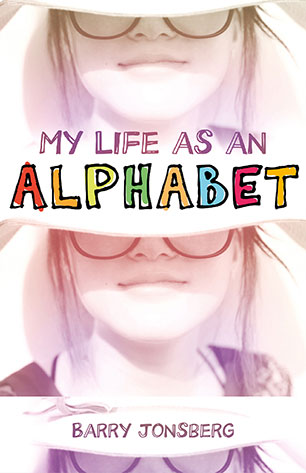
Fine teachers feature in a number of these books, including both the English teacher and relief teacher in My Life as an Alphabet by Barry Jonsberg (Allen & Unwin, $14.99 pb, 264 pp, 9781743310977) but classrooms and schools are revealed as battle-grounds. Twelve-year-old Candice Phee is called ‘Essen’, short for Special Needs, by some students. The teacher has set an assignment where the students have to write twenty-six paragraphs about themselves, each one starting with a letter of the alphabet. Every chapter in this middle-school novel also begins with a letter of the alphabet. Fortunately Candice loves the dictionary, which she is reading chronologically.
It has thousands of different words and it doesn’t try to tell a story, and fail. It just deals in words for their own sake. It is pure. The only other thing I read is books by Charles Dickens. He has taken many of the trickiest words from the dictionary and put them in an interesting order.
Candice refuses to be labelled autistic and declares, ‘I’m me.’ Her new friend, Douglas, believes that he is from another dimension and must jump from a tree and take a ‘tesseract’ to return home. He takes opportunities to kiss Candice and even makes her artificial breasts. Candice’s family is almost dysfunctional after the cot death of her baby sister and a perceived treachery by Rich Uncle Brian. Candice tries to divorce her parents using a house conveyancer and has a secret planned for her thirteenth birthday. Like most of the Australian authors reviewed here, Jonsberg relishes humour and difference and conveys them ably.
- Game Theory in the Weekend Australian
(review as part of a survey – scroll down to bolded part)
Young Adult Lit July 2016
by Joy Lawn
Family is critically important for the healthy development of children and young adults. Those who are unsupported or abandoned are vulnerable. Those who have loving families, of which even the best are imperfect, have some shelter and a sound storyline.
Melbourne-based Zana Fraillon’s The Bone Sparrow (Hachette, 234pp, $19.99) is long listed for the international Guardian Children’s fiction prize. Fraillon has crafted a unique voice in her exquisitely written universal refugee tale.
Subhi’s family is from Burma, now Myanmar. Its Rohingya people were told that they don’t exist, and tortured and killed as they tried to leave their country. They fear, probably justifiably, that they have been forgotten by the world.
Subhi has grown up in an isolated Australian detention centre with his ailing mother, older sister and friend Eli, the only survivor of a truckload of passengers, who is now at risk of being sent overseas. The camp detainees aren’t medicated and good food is only provided when the Human Rights Watch visit. Newcomers to the camp quickly lose their optimism and lip-sewing and hunger-strikes escalate.
In a surreal encounter redolent of John Boyne’s The Boy in the Striped Pyjamas, Jimmie, an illiterate girl who carries a book written by her deceased mother, finds a weakness in the fence and discovers Subhi. He loves to draw and read and, while Jimmie tells him about the ‘Outside’, he unravels the serendipitous story of Jimmie’s ancestors.
There are many parallels in their dual narratives: birds, rats, sickness and the stories that are essential to preserve memories, although Subhi figuratively loses his story after one horrific death and betrayal too many. He wishes that he hadn’t reached an age where he knows the truth about his life because understanding makes it worse.
Subhi is waiting for his father who seems to be sending him treasures on the Night Sea. The author layers metaphorical images of the red dirt lapping at the tent, the family photo and other treasures half buried in the sand, and the whale and other Night Creatures who appear to Subhi. Story as a ‘whispered memory’ is entwined in the deep song of the imagined sea and the entrancing stars and lights.
The bone sparrow is a potent symbol from both Jimmie and Subhi’s heritage. Is the sparrow a harbinger of death or a symbol of change and hope in this exalted, flawless book?
The mullet fish is the recurring motif of Blue Mountains author Steven Herrick’s Another Night in Mullet Town (UQP, 224pp, $19.95). Herrick is Australia’s premier verse novelist for children and young adults with highlights that include The Simple Gift and The Spangled Drongo. He has spearheaded this form to capture and portray realistic youthful voices in a poetic yet accessible and colloquial style.
In the lakeside town of Coraki, Manx describes himself as a mullet cruising in the shallows when he should be tackling the ocean but he knows that ugly bull sharks have been let loose in the lake and they eat more than their share of the fish.
Manx looks older than the other sixteen-year-olds in the community and buys their beer. A drug and drinking culture takes place between the sand hills and lakeside pier. Manx thinks that he and best mate Jonah, the tale’s narrator, ‘drag down the price of everything we touch’.
Jonah’s parents are fighting. His father is a sweat-stained, big-drinking truckie and his mother was the prettiest girl in the town now working in the filleting-line at the fish factory. They both love Jonah but decide to separate.
Jonah is handsome and attracted to Ella but too shy to speak until a deliberately awkward scene where he frames three-words sentences: ‘Ella reads quietly’, ‘Ella smiles imperceptibly’. Their relationship then somehow ignites.
A social and wealth divide is growing between the locals in their rundown houses on the only coastal road without a view and beach with a rip and the weekenders in their mansions. The developers have paid out the council and lured tourists with espressos.
Through skirmishes and charges of graffiti, the boys protect each other. ‘We trust mullet with mullet/no matter what.’ Fishing is the time they communicate, absorbed in a shared ritual.
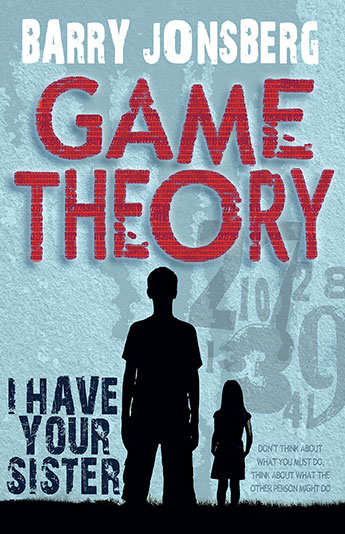
Darwin author Barry Jonsberg also recognises the connection between males who share experiences without looking at each other. In Game Theory (Allen & Unwin, 320pp, $19.99), Maths whizz Jamie’s best friend is overweight Gutless, who is so obsessed by slaughter video games he urinates into bottles to avoid leaving his festering room. Jamie isn’t so reclusive. He has friends at school but can talk most honestly to Gutless.
Jamie’s family is polarised by their different personalities. His parents do their best but his father seems useless and resents his wife making this obvious. His younger sister Phoebe is innocent and they have an affectionate relationship but older sister Summerlee despises most of the family. When she wins Ozlotto after taking Jamie’s advice on possible numbers, she becomes even more toxic and is arrested for trashing a hotel room and other offenses.
When Jamie and Phoebe are at the supermarket, where Summerlee had previously sprayed her boss with Coke, Phoebe disappears. Has she been kidnapped because of Summerlee’s new wealth?
The story is humorous but also becomes an exciting thriller when Jamie uses his mathematical knowledge of game theory to predict how the kidnapper might think and react. Jamie tries to change the balance of power by not following the rules and disorienting him. When the kidnapper first calls, Jamie audaciously tells him to phone back later because he’s busy. He also observes that the kidnapper ‘likes the juxtaposition of articulate vocabulary like “sensibilities” with slang like “slut”’. As a mathematician Jamie isn’t comfortable with narrative although he does use game theory to invent violent stories for Phoebe.
Ben in New Yorker Paul Griffin’s luminous, empathetic novel When Friendship Followed Me Home (Text Publishing, 256pp, $16.99) loves stories and books. He particularly enjoys sci-fi and believes that ‘some books change the way you see the world, and then there’s the one that changes the way you breathe…’
Ben has had an uprooted life. He has been in foster care since birth, unable to find a permanent home because drug traces were discovered in his blood, making potential families wary. He is a hardworking, honorable, although displaced, boy who is finally adopted by his speech pathologist. They have a wonderful two years together before she unexpectedly dies, leaving him adrift and at risk once more.
He is drawn to the warm school librarian and finds shelter and escape in the library, where he also meets her daughter who looks like a rainbow with bright clothes and multicoloured wigs. Halley has cancer and their friendship, like the books and story they devise together, create perfect moments of light and hope.
The elusive magic of nearby Luna Park and Coney Island is reflected in the illusions of Halley’s magician father. Halley urges Ben to transform his bad experiences into treasure and, even when he is forced to sell his fine book collection, he tries to heal the lives of others.
Love springs from new sources, including stray dog Flip who Ben trains as a reading therapy dog. Flip becomes very successful at encouraging children to read.
Even though she may be ten years old, Ada cannot read. As a ‘cripple’ she isn’t allowed to disgrace her ignorant, vicious mother by ever leaving her room. The War That Changed My Life (Text Publishing, 316pp, $16.99) by American author Kimberley Brubaker Bradley is a Newbery Honor Book. It is an inimitable, robust, yet lyrically written bildungsroman. Its gentle humour is poignant and heartwarming.
Set in WW11, Ada secretly teaches herself to walk, even though the pain of her untreated clubfoot is excruciating, so that she can leave London with other young evacuees. Much of her childhood has been spent locked in the cabinet under the sink so she is amazed by the outside world. She wonders at grass but is scared when leaves change colour and fall.
Ada and her younger brother Jamie are not chosen by any of the Kent foster families and are forced onto Miss Susan Smith, who tells them that she isn’t nice and doesn’t want them. However, she does provide food and clothes and their first bath, bed sheets, books and Christmas presents. Ada even teaches herself to ride and, eventually learns to read and write.
She is angered and stunted by the realisation that this new, golden life is temporary. Even though there is rationing, raids and bombs and Ada helps care for wounded soldiers, she is saved and set free by this war. Susan nurtures the children but when she tells them that they have saved her life, Ada feels something unfamiliar: ‘It felt like the ocean, like sunlight, like horses. Like love. I searched my mind and found the name for it. Joy. Love can enable a deprived childhood to blossom.


2 thoughts on “Darkest Night, Brightest Star by Barry Jonsberg”