
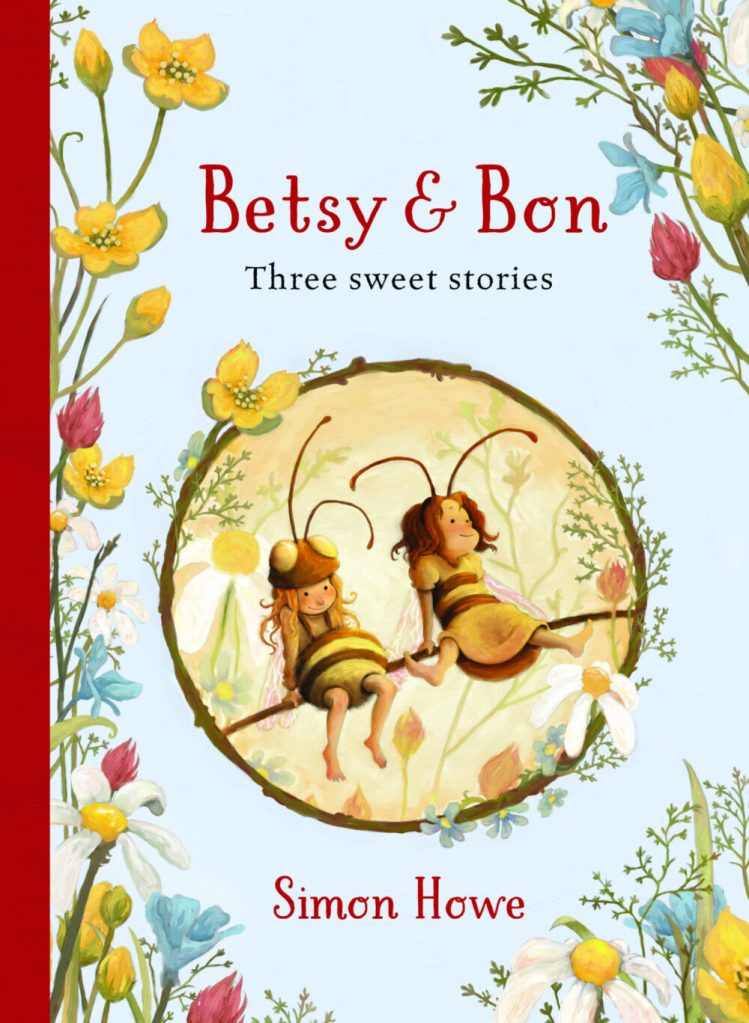
Betsy & Bon by Simon Howe
Betsy & Bon written & illustrated by Simon Howe
(UQP)
Betsy & Bon is a gift-packaged hardcover book of three gentle, whimsical stories for young children. It explores empathetic and collaborative friendship and community, imaginative play and the natural world. It is recommended for ages 5-8.
Thank you for speaking to PaperbarkWords, Simon.
Where are you based and what is your background in children’s books or the literary community?
I live in the Macedon Ranges in Central Victoria. I’ve been working steadily as a children’s book illustrator for about 10 years now, but I’ve only just begun to write and illustrate my own stories. It’s an exciting turn and a welcome challenge.
What was the vision or brief that you gave yourself about creating Betsy & Bon?
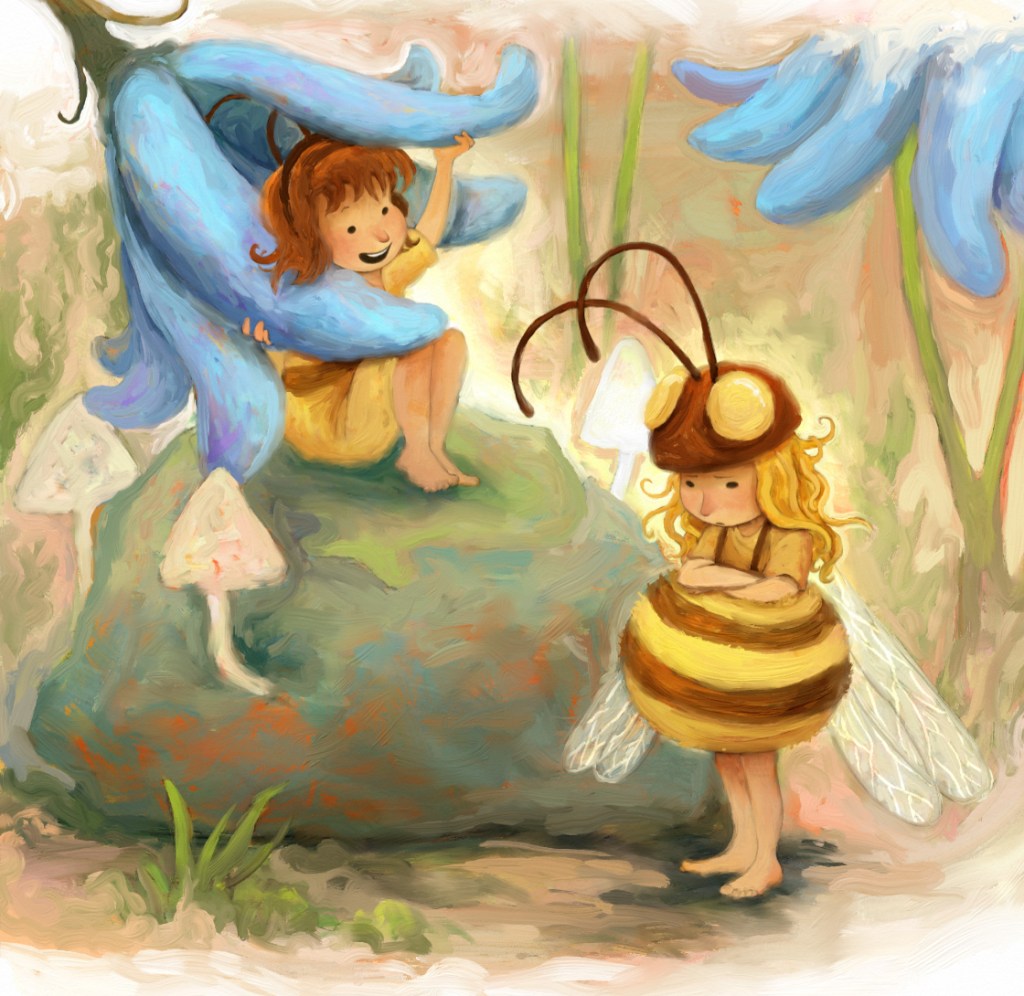
The ideas for Betsy & Bon grew from a single illustration I made of two children dressed up as bees and sitting on a giant flower stem. I thought they looked bored, and I wondered what they would do about that. I suppose my brief was to answer that question!
I’m intrigued by the composition of the characters in Betsy & Bon. Are they real children dressing up or imagined creatures? What are you happy to share about their identities?
Well, I don’t know! When I drew that original picture, the same question occurred to me: are they children in costumes or are they actually bees who look like children? They talk about being bees. And they even talk about being able to fly, but we never see them do it. Personally, I imagine them as children in an imaginary play-space. But I don’t think the stories prove this. The question is open. They may very well be bees.
How do you show their different personalities?
Betsy and Bon are best friends and complimentary personalities. Betsy is more reserved and careful, and Bon is more outgoing and bold. But both of them benefit from the others’ temperament. Bon pushes Betsy out of her comfort zone and into activities and pursuits she’d otherwise forgo. And Betsy’s calm and gentle reflections console Bon when things go wrong. They pair very well.
How does your colour palette enhance the tone you have aspired to (and achieved!) in the book?
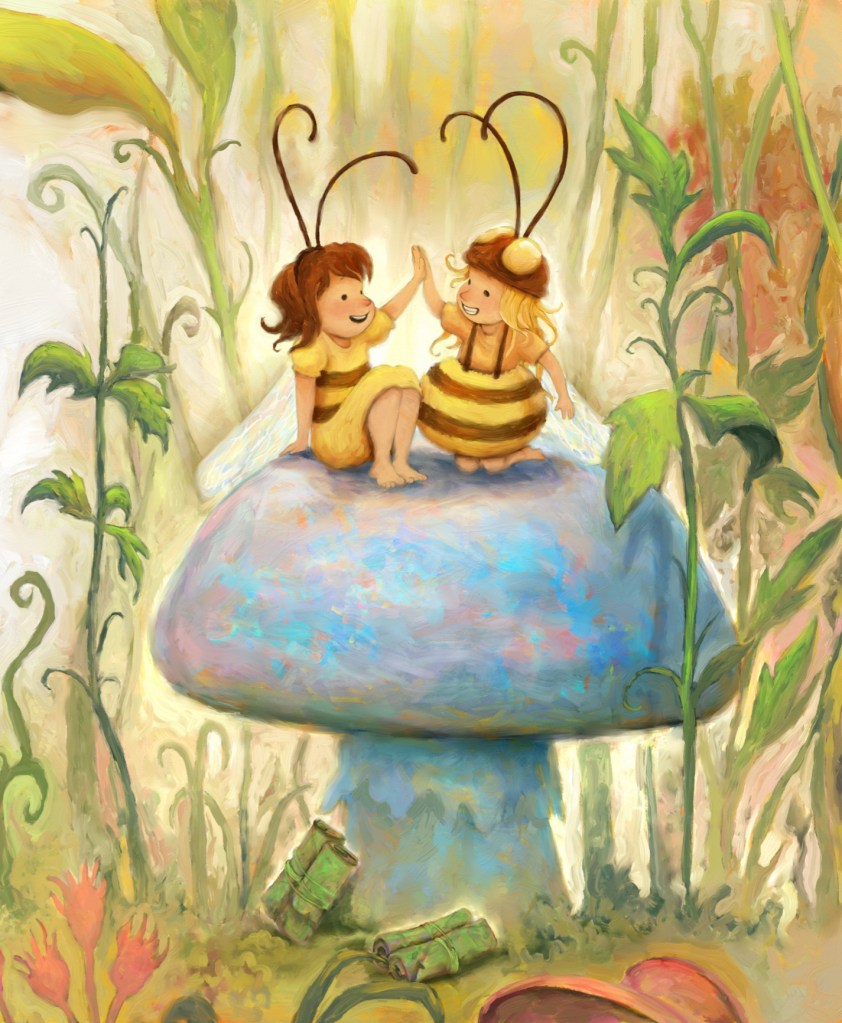
I enjoy playing with colour, but I’m very hesitant with it. I always begin with browns and yellows and maybe muted greens and slowly layer in other colours from there. Many of the pictures become quite colourful by the end, but because I build up from muted, earthy tones, the bright colours don’t get too saturated or garish. I aspired to a palette that reads soft, warm and gentle, which is exactly how I hope people describe the stories themselves.
The story is set in the natural world and filled with flowers – natives and others. Why have you chosen some of these?
I’d like to say that each flower and plant was carefully chosen for its symbolism within the story. But the truth is that I looked at many, many pictures of flowers and plants, and painted the ones I found most beautiful. Sometimes I gravitated towards flowers with delightful or interesting names. Milkweed, for example, is a word impossible to pass up.
Which illustration did you find particularly satisfying to complete? Why?
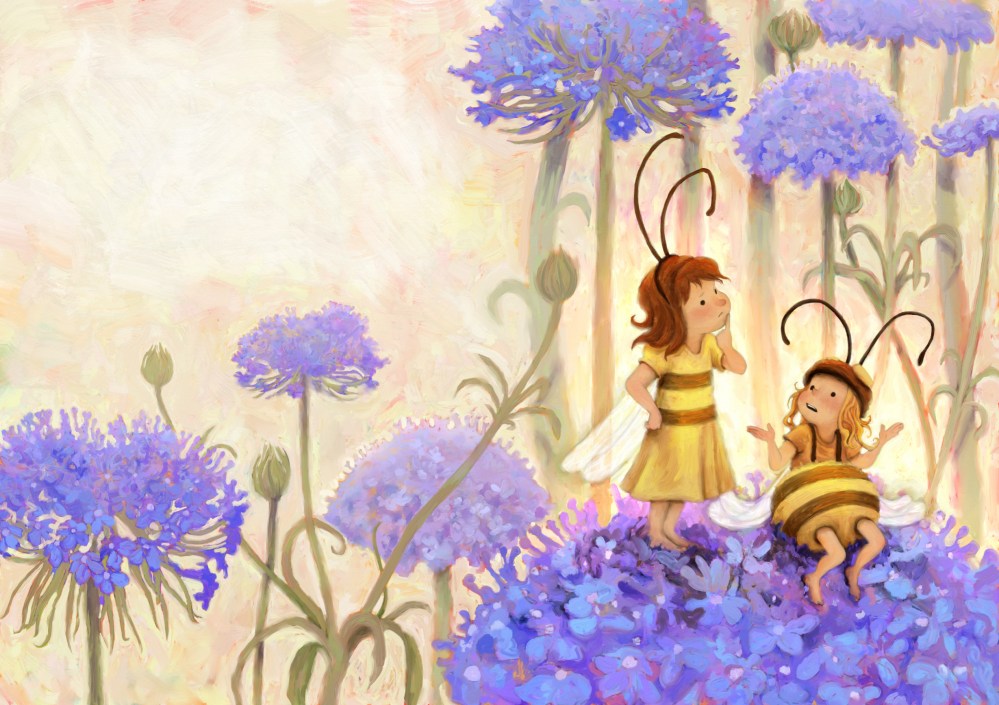
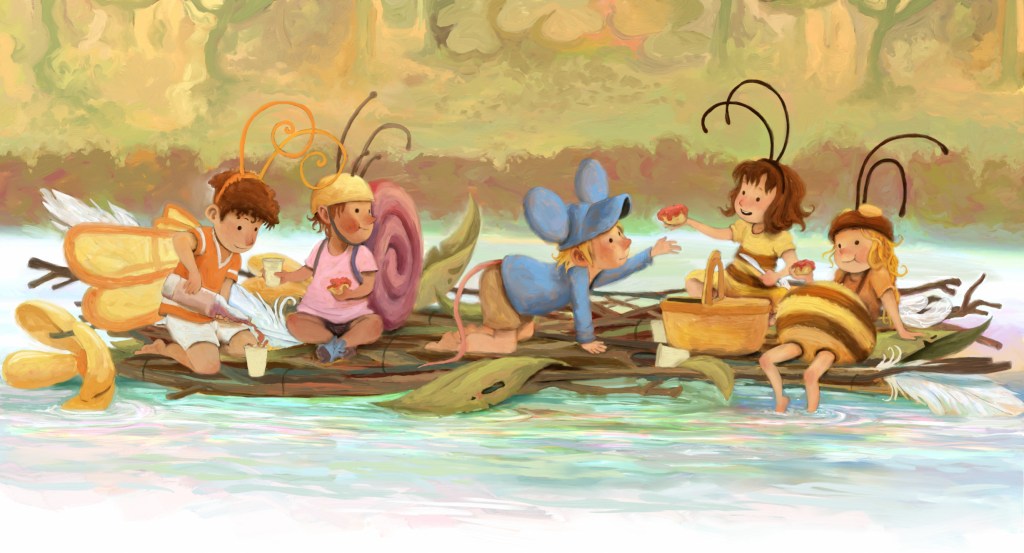
There are two that jump to mind. One is a painting of the two titular bees on top of a purple wildflower floret. Behind them, other flowers tower up and catch an orange sunset glow. It was lovely to make. The other is a double-page spread of the bees and their friends on a raft, floating down a stream and sharing food. It’s a charming scene. The water is glistening with pinks and greens and the characters are happy with full mouths and filling stomachs. It’s a vision of a good life, and I think it’s the most satisfying image of the whole book.
What is something readers may not notice or be aware of in a first reading of Betsy & Bon?
One thing that might go unrecognised at a glance is the lack of adult authority figures. There are no parents or teachers around. This was partly to lean into the fantasy of them being insects. But I was also aware that if I introduced adults, it would be reasonable for them to intervene in the children’s problems, attempted solutions and (most importantly) their failures. I like writing parent characters, but in this instance I wanted them out of the way. I wanted the children’s consolation to come from each other.
Are there any literary or artistic influences behind this book? I wondered about May Gibbs.
I’m not sure I could name specific influences for this book alone, but there are many influences behind my work in general. Yes, May Gibbs. Ida Outhwaite also, and other Golden Age illustrators like Arthur Rackham and John Bauer. My biggest influences are probably Brian Froud, James Gurney, Graeme Base and Shaun Tan.
How do your stories encourage children to problem-solve?
I show the characters creatively attempting to solve a range of problems. But the encouragement in this book is less about problem-solving and more about the ability to push through failure. Betsy and Bon fail at just about everything they set out to do. But they’re fine. They make the most of what they have, and what they have is usually what matters most.
Betsy & Bon is definitely a book to share. What is a response that you hope to see…
What I hope to see is children inspired to play. The characters are drawn as children in simple costumes that suggest the animal they are in the game. They’re the kind of costumes kids could make at home with their parents. I also hope to see kids and parents reading this together. It’s a book that bridges picture books and early readers. Perfect for parents reading to kids, and just as good for new readers to read back to their parents!
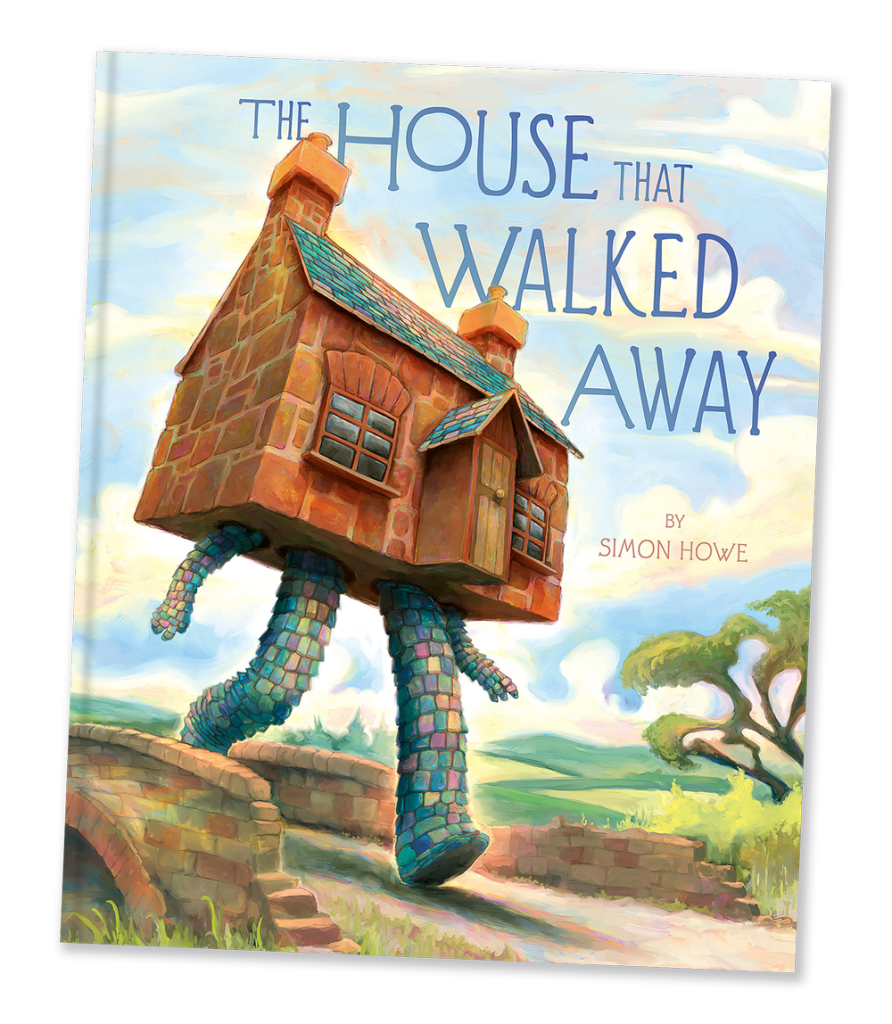
Could you tell us about your beautiful picture book, The House That Walked Away?
The House That Walked Away is the story of a restless house that doesn’t feel at home, and so it walks away to find one. It’s about the idea of home being something to become, not find, and it was inspired by my experiences of immigration and fatherhood. I hope it inspires readers to reflect on the houses they can be for the hearts of those they love.
And Shoosh! ?
This was a fun one. Shoosh! was my first author-illustrated book. I made it for the State Library of Queensland for their First 5 Forever program. It’s about a baby, finally asleep, and a group of children trying to keep it that way by shooshing the noisy animals in their garden.
You have a surprisingly large backlist. Could you please briefly tell us about some of your other books?
Yes, I’ve done a few things over the years! I made about 400 black and white illustrations for Natalie Jane Prior’s junior fiction series, Naughty Dragons. I also made the covers for Reece Carter’s three Elston Fright books, and illustrated all six picture books in the Teeny Tiny Stevies series by Byll and Beth Stephen.
Could you encapsulate your philosophy about children’s books and reading with children?
What I love about children’s picture books specifically is that they’re a communal activity. A child might read or peruse the pictures by themselves, but more often someone else is invited. It’s something to be shared. The book becomes a connection point between people participating in a story; both on the page and in the moment. In this way, I think the picture book is an heir to our oral storytelling tradition. They’re a shared experience between people who know and love each other. It’s conversation, questions, repetition and interruption. It’s laughter and observation. It’s intimate. Not an intimacy between author and reader, but between reader and listeners. Picture books don’t just enrich children. They enrich families.
Is it true to say that your books tend to reflect home and hope? If so, could you please explain or give an example.
I think so. I hope so. I like the theme of home, and in truth I find it hard to avoid. Both Going Home and The House That Walked Away deal with home explicitly, though in different ways and inspired by different experiences. In Going Home, I wrote about a child’s comprehension of home as a predictable and inevitable return to safety, familiarity and comfort, and the wholesomeness and hopefulness of wishing that for everyone and everything. In The House That Walked Away, the homeless house doesn’t realise it already is what it seeks. Or at least, it can be if it chooses. I think the idea of home connects to a range of human longings that touch all stories. It’s universal and evergreen.
And hope? Well, childhood and hope are the same thing. A child is a person made of potential, possibility and aspiration. They have the future inside of them. In Betsy and Bon, things don’t go right and they’re repeatedly faced with failure and disappointment. But each ending is happy, because when the dust settles, they’re all still there. They have each other. And that’s where hope is.
Thanks for your responses, Simon. I’m sure that many children (and their parents and carers) will love sharing Betsy & Bon and will seek out your other work.


