
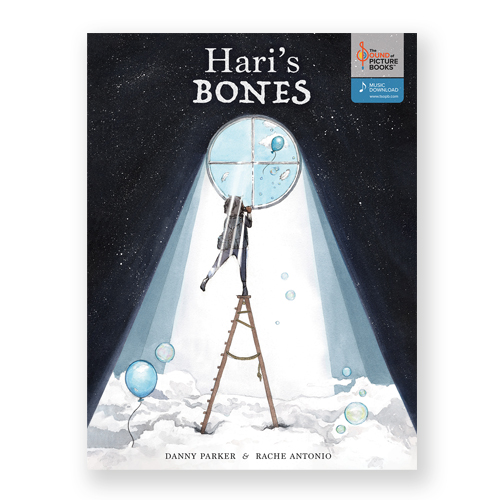
Hari’s Bones
written by Danny Parker,
illustrated by Rache Antonio,
music by Matt Ottley
(One Tentacle Publishing)
‘Hari wouldn’t climb a tree, wasn’t tempted by trampolines, bicycles, skateboard or scooters.
And she was happy, Hari and her bones.” (Hari’s Bones)
Interview with Rache Antonio, illustrator of Hari’s Bones & Matt Ottley, composer of Hari’s Bones
Thank you for speaking about the illustrations for the imaginative, multilayered picture book Hari’s Bones with Paperbark Words, Rache, and Matt for answering my questions about the music.
Rache Antonio
Where are you based and what is your background in illustration?
Thanks for having me! I’m based in the UK on the edge of the beautiful city of Bath. I would say my background in illustration is mixed – I took an indirect route to get here. I’ve always been an artist and designer – a fashion designer, print designer, architectural assistant, painter, music festival site creative… but it was when I got involved in running the music festival that I started illustrating more seriously.
You illustrated and designed Danny Parker’s picture book, Hari’s Bones. For starters, the cover design is very strong. Could you talk us through it?
Danny and I had a lot of calls as the book was coming together, and I remember he said of the rough sketch for the spread it references (‘and she was happy, Hari and her bones’) that it would make a great cover. He was right, of course. I took that image and adjusted the composition to give it more symmetry, and repainted it with deep space and clouds to reference more of the themes inside. I wanted to create something that looked intriguing on the shelf, and invites you to look inside… which I hope it has achieved.
What do the bones symbolise for you?
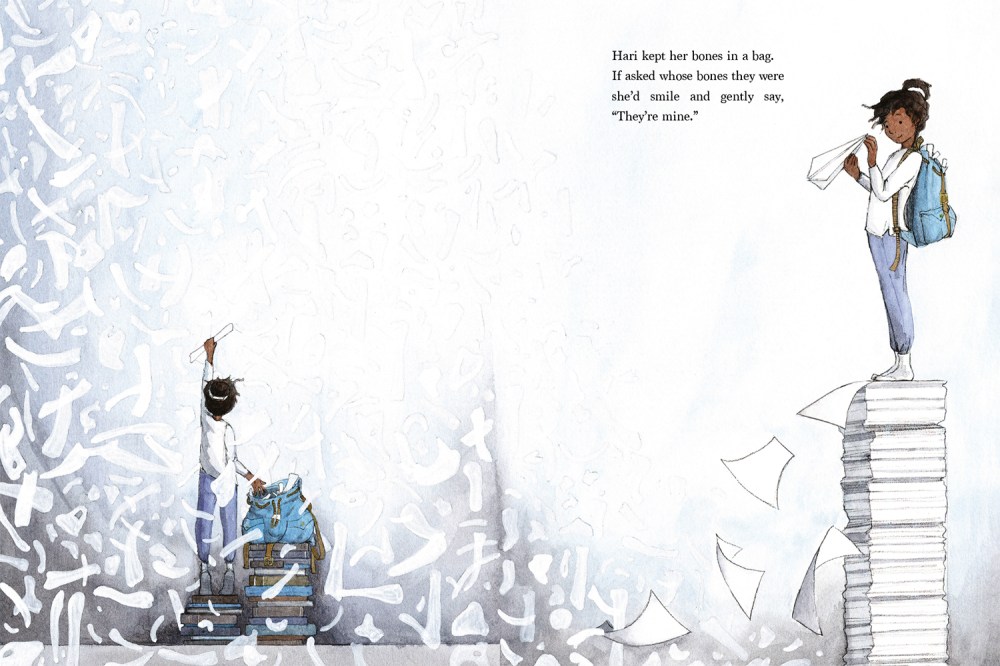
I did a lot of research into the significance of bones across different cultures; they carry so much symbolism and meaning. For me, in this book, they are story tellers, hopes, dreams, fears, expectations, self preservation, resilience, endurance… But I hope that whoever reads it will find the symbolism and that speaks to them.
How would you describe your colour palette? Why have you chosen it?
It’s a calming, earthy palette, and chosen for those reasons. Hari came first, and the blue bag of bones, so the palette developed from there. I also wanted colours that reflected her personality, and really wanted to let the paper do some of the work. I enjoy picture books that embrace a bit of empty space, and don’t chuck everything at you, but I also love a high contrast and deep colours.
What has influenced your illustration of the creatures on the page with the words, “Away from trouble.”
I’m a sucker for a constellation chart and vintage celestial maps. My grandparents gave me a Stellarscope when I was about Hari’s age and I’ve been fascinated ever since. I also love scientific drawings, so wanted to combine it all.
There also used to be a blue whale skeleton suspended in the hall at the Museum of Scotland in Edinburgh. I saw it often as a child, almost too huge to comprehend, magical and ethereal.
Balloons, bubbles … What is their role and impact?
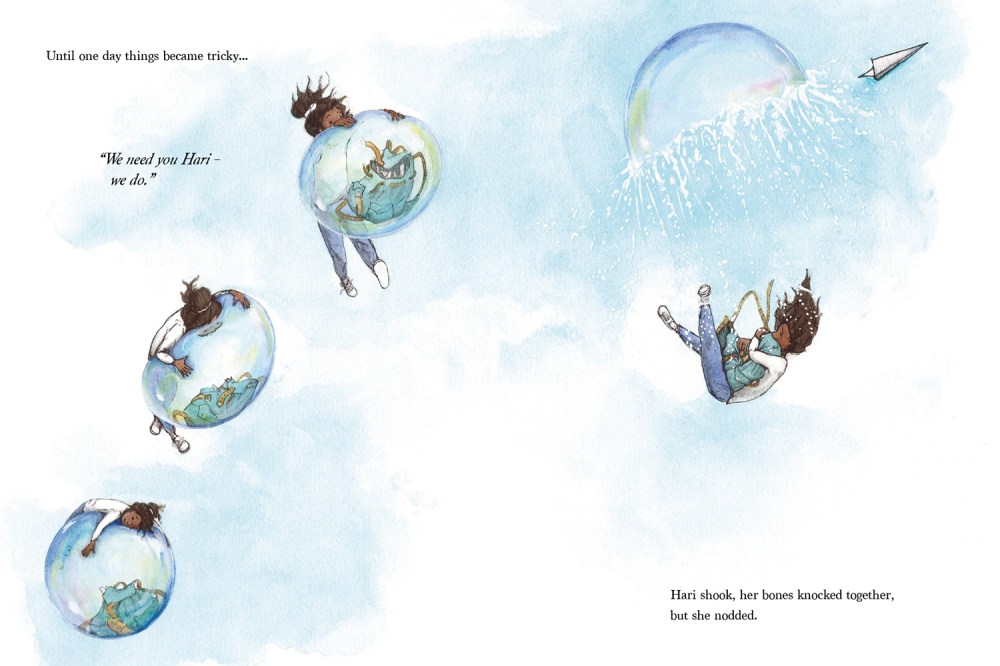
They bring children so much joy, yet are so precarious.
What is your concept for the endpapers?
I hope it will help a reader or two make their own planes and see how they fly. Maybe see what inspiration you can find when you look up, and see where it lands.
What is your process and media?
Well I’m pretty slow… I like pencils and paper, so I sketch a lot and will develop most ideas on paper but have recently started transferring to a drawing tablet if I’m away from the studio and want to keep working, which is most evenings (I have three young children and try to fit everything around them, and the tablet has helped a lot with that!).
I then hand draw final compositions on paper, scan and clean up in photoshop, and print the drawings onto watercolour paper with waterproof inks. Once the papers are stretched I use watercolour, gouache, ink and coloured pencils for colour and tone. Everything is then scanned and tweaked in photoshop.
Occasionally I’ll work in layers and combine these in photoshop to get the best result.
I tend to work on the book as a whole storyboard, so will have a mini physical version that I chop and change as pages develop. I’ll simultaneously have a working copy in InDesign so I can drop in new images and play with the design and text placement, essentially designing as I go.
Hari’s Bones is my first published picture book and I had assumed the publishers would want something that was print ready (or close enough), so I put a lot of focus into the design. I have no idea if that’s normal, but it’s how I like to work!
Which page composition are you particularly pleased with? Why?
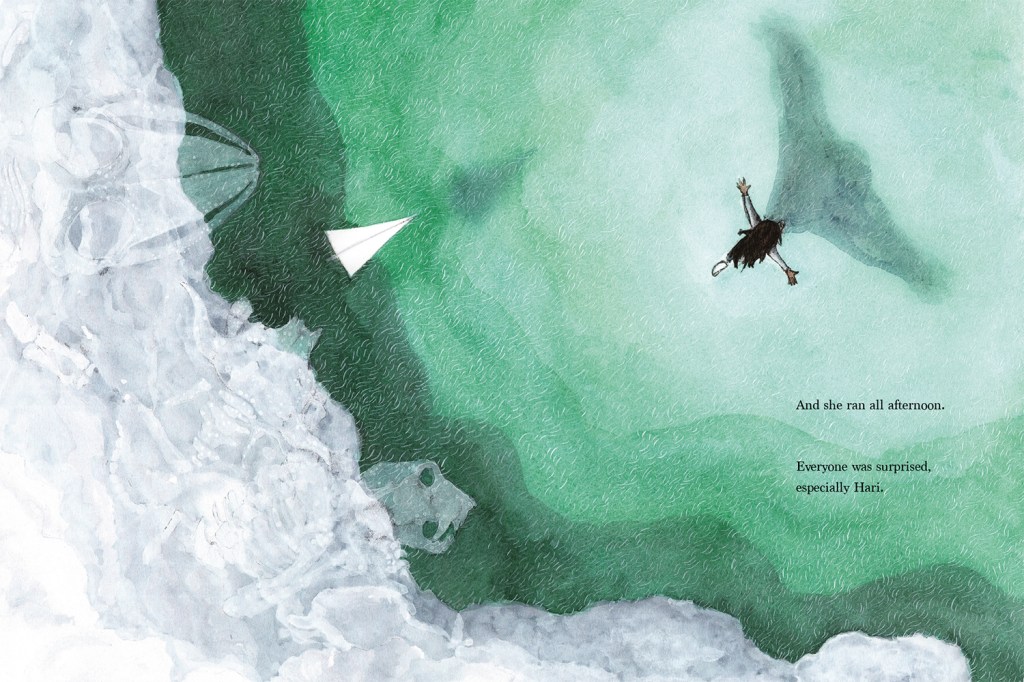
Tough one! I guess ‘And she ran all afternoon’ … for the colour, different textures, animal skeletons, and the shadow of the plane. Or the rocket blueprint – I don’t think it will fly but it’s a lovely technical drawing, and Hari has such determination even though we can’t see her face!
How can the book be read at different levels?
Danny always writes these stories so brilliantly; small stories with big ideas. Although it might seem like a relatively simple story on the surface there’s a lot for readers of all ages to take away, and the concept is on the right side of abstract, with different visual narratives to follow. Being quiet, curious and imaginative can also be adventurous, and resilience and aspiration will get you a long way.
How do you show the ambiguity of the story? (perhaps give an example)
There’s always the question of bones – is she really carrying her bones around in a bag? From the start it’s fairly ambiguous, she’s almost plucking them out of thin air, and when she has to face her problem the bag disappears until we see it again, empty…
Anything you’d like to add?
Its been a pleasure, and I feel very fortunate to have landed on my feet with Danny Parker, One Tentacle and The Sound of Picture Books, and am working away on a couple more books with Danny as we speak. I just need to speed up a bit…
Matt Ottley
Hari’s Bones is another superlative musical composition from you, Matt.
What is the best direct link for people to hear it?
All of the The Sound of Picture Books recordings are freely available in full from: http://www.tsopb.com
How did you compose this piece to intimate the sound of bones? Which instruments best suit that? Do they use certain techniques?
This score is orchestrated for oboe, bassoon, viola and cello, which is a particular line-up of instruments that I used in Stickboy and in The Messy Bath Monster. There have been very few scores written for this particular mix of instruments throughout western European music, which is odd because the timbres and tonal qualities they produce together can be lyrical, dark, light and rich and quite percussive as well. To get the bones sound I have the oboe and the bassoon players doing key clicks, which just means they press the keys on their instruments vigorously without blowing into their instruments to produce a rattly, clacking kind of sound. At the same time I have the string players striking the strings with the back of the bow in a percussive technique called col legno. All together the effect is what I imagine a skeleton would sound like if it went for a walk!
How do you also make the piece sound playful and joyful?
That’s where the addition of the bassoon to the ensemble has such an impact. The bassoon just makes me smile! It can be both dark and lyrical, but also bursting with joy and often in this piece I have it playing jaunty rhythmic melodies. I also wanted, with the whole ensemble, to reflect Rache’s idea in the illustrations, that Hari’s feet, for most of the story, never touch the ground. I tried to create a flowing, bouncing sound almost like the flight of a butterfly.
Could you explain how you crafted the music to amplify one particular page or double page spread?
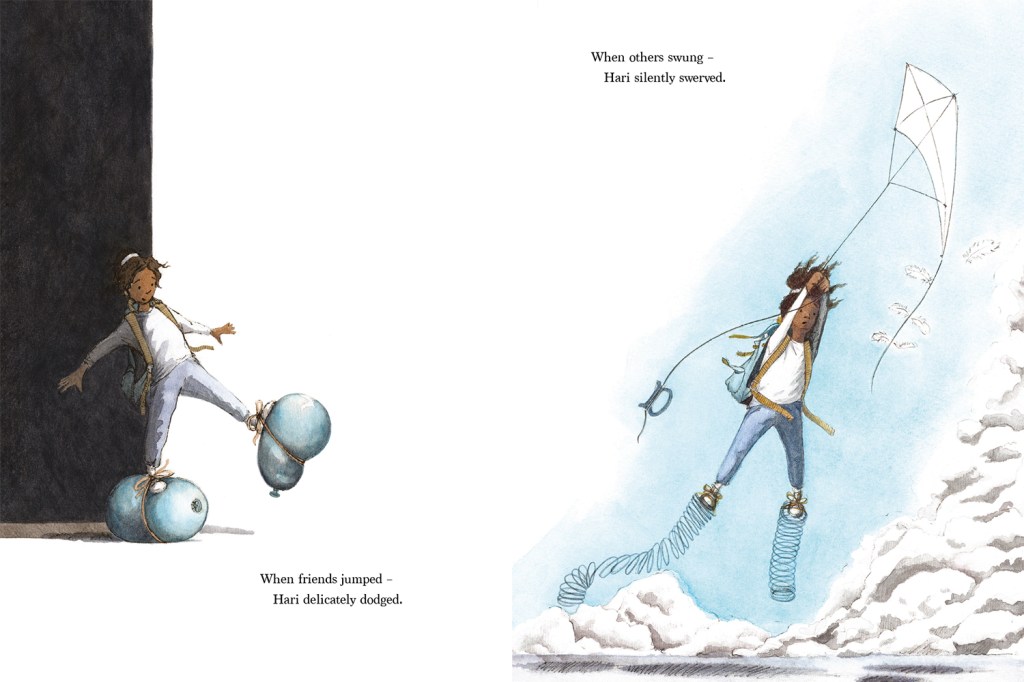
Where the text reads, ‘When friends jumped – Hari delicately dodged,’ I have the cello playing the main theme syncopated, which means off the beat in between the rhythmic pulse of the other instruments. It sounds like it is dodging in and out of the gaps between those instruments. Then the bassoon takes over with a triplet version of the tune (the melody bouncing around in groups of three notes), as if it is swaying as it dodges around the other instruments. On the same spread, where the text reads, ‘When others swung – Hari silently swerved,’ there is a huge gap in the audio of the narration between the words silently and swerved, playing on the idea of silently. But the full ensemble then bursts in joyously with the tune as if they are all swaying together, reflecting Rache’s image of Hari becoming airborne.
Anything else you’d like to add?
I used part of the back cover blurb as a guiding principle to the music. After the rattly bones sounds right at the beginning, there is a tentativeness, a kind of shyness to the music that slowly develops until the section where Hari suddenly finds the ball at her feet and has to do something about it. The music becomes quite lyrical at this point, as if time has slowed right down, but then, when the sound of cheering reaches Hari’s ears and she has to ‘Run, Hari, run!’ the music takes off again and becomes more adventurous, arriving at the completion of the piece in a recap of one of the earlier themes, played a little faster with a sense of resolution.


