
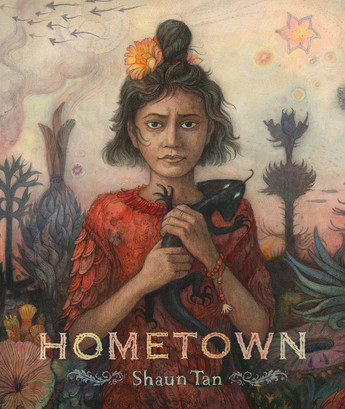
Hometown written & illustrated by Shaun Tan
(Allen & Unwin)
“Feel with your head and think with your heart” (Hometown)
Hometown is Shaun Tan’s exemplary new picture book/graphic novel.
Interview with Shaun Tan, creator of Hometown
Thank you for speaking with Paperbark Words, Shaun.
Thanks! Grateful for the opportunity.
How is Hometown a book for a diverse, encompassing readership?
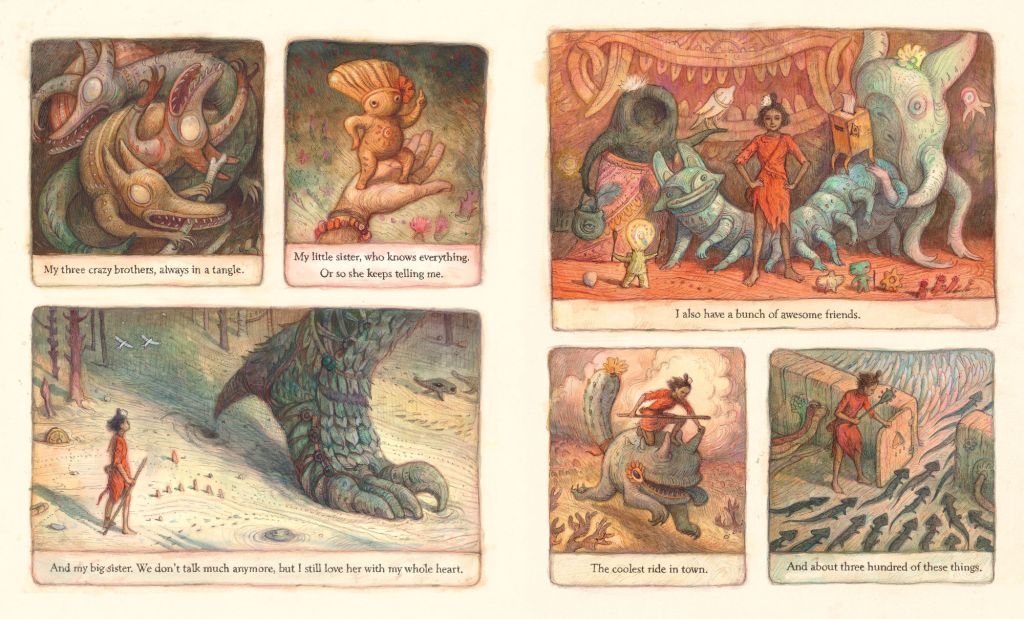
I do think all picture books – which is kind of what Hometown is, as well as being a graphic novel – do try to approach the broadest audience of all, if you think about the spectrum of age. That’s a very diverse readership, if you can interest adults and children equally. The story itself is fairly pared-back, on the surface quite simple, and the images are strange and dreamlike. That helps a lot in giving different readers an opportunity to fill in the gaps with their own speculative thoughts, thoughts which are allowed to be quite diverse (as readers necessarily are) because there are these interesting unwritten spaces between images and words which operate as simple captions, and between each page and the story skips forward, across lots of different places and characters.
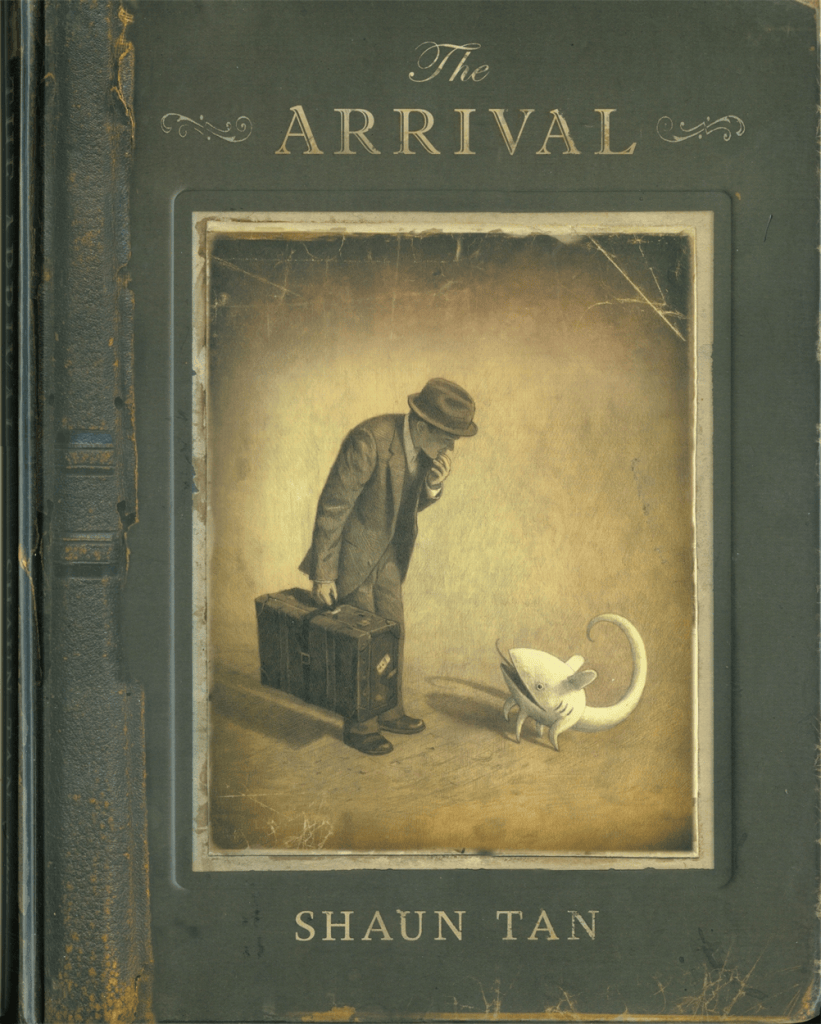
I think it also always helps if your story is set in an entirely fictional world. No matter where you are from, whether it’s Melbourne, rural Alaska, or maybe the distant future, as a reader you enter an entirely imaginary world on an equal footing, knowing very little about the landscape, disarmed of knowledge, symbolism and expectation. In this way, Hometown is a little like my immigrant story The Arrival. The strangest landscapes are sometimes the most accessible for all readers, all in the same way.
What do you think is the finest quality or characteristic of the girl’s hometown?
I would say harmony. It’s not without problems, conflict, and a certain creepiness and violence, but all together it is harmonious, filled with a kind of respect, reverence, even love – of an alien sort. On first glance, this world might look dark, primitive and dystopian, but as you read (I hope) you come to realise it’s actually quite advanced and utopian. It’s a land of multiple strange creatures of all shapes and sizes who somehow manage to live peacefully together. That was always a grounding sensibility in my mind: a place that feels strange and uncomfortable to the outsider, but very familiar and comfortable to the insider, the girl who narrates this story.
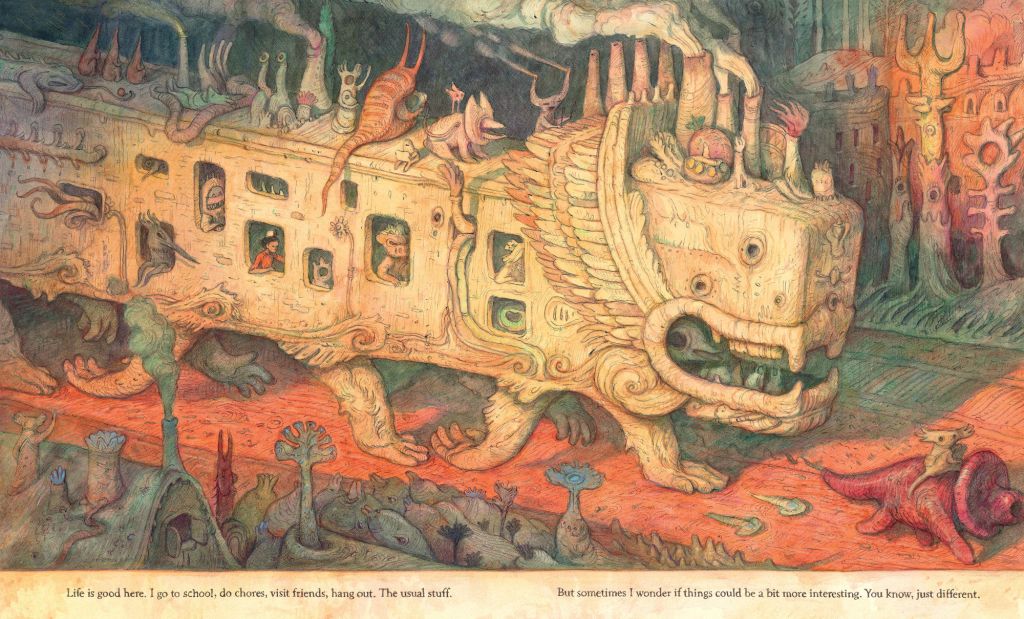
It also happens to be very fun and engaging. Even though the girl complains of being bored sometimes, as most young people must do, we see that her days are filled with interesting and meaningful things: growing animals on farms in big vats, carving giant totems, interacting with her bizarre family, going to her open-air desert school, getting into street fights that she seems to provoke with gusto. One of my favourite scenes involves all the creatures in ‘school’, which also seems a kind of prayer service, touching their different appendages together – hands, claws, tentacles and things less nameable – as a sign of mutual respect. They are not above fighting and eating each other, but there is still harmony and respect within that system.
What is the importance of “the book” in the story?
Yes, the book is something brought into her world by an unexpected visitor. We never really see what is in it, but this confident traveller claims it has ‘all the answers you are looking for’. Is it a bible, a map, a scientific text, an encyclopedia of his home world? We don’t know, and it doesn’t really matter. The interesting thing for me is not recorded knowledge or stories, but how we choose to use them, and believe in them.
This boy who falls from the sky is very committed to the book, and treats it as an absolute truth that eclipses all others. I don’t feel that any book should be regarded that way, because the risk is that your thinking cannot move in any new direction, it can become quite closed. That’s not exactly a criticism of religion or scientific belief, or any political ideology, all things that have their use and value, and it’s interesting that the most enduring religious stories are very open to interpretation. But the insistence that reality can be circumscribed so simply, in a hard-line fundamentality way, doesn’t seem very conducive to growth and discovery, it doesn’t seem very human to me. You can believe in one system deeply, as the girl of this story does, and still be open to new perspectives, to generously consider them, and allow your own conceptions to be challenged. This is how we find out if our beliefs are robust, or possibly faulty, even dangerous.
Of course, my book is a book too, and there is a suggestion at the end of the story that the narrator has created it. So any dodgy drawing or writing is not my fault, ha ha, my character wrote it! (I wrote all the text by hand, because in her world, fonts don’t exist). I imagined that the boy introduced to her the concept of a book, a thing that has not previously existed in her world. She decides that she will try to make her own story with this new device. I think this is what we are all trying to do, really, we are trying to tell ourselves a story about our own lives that takes in bits and pieces of all other stories we have picked up along the way, using whatever devices we can borrow.
How is Hometown both a graphic novel and illustrated book?
Well, I don’t know what it is really. It’s a book with paintings and words. There has always been a big struggle with naming different types of illustrated literature, as there is with many other artforms, even the word ‘art’ of course. Definitions are hard. But they change over time, like Wittgenstein’s description of the word ‘game’ which is made up of different collective threads, from tennis to chess, riddles, party games, reality TV and things yet to come. I think what used to be thought of as a ‘graphic novel’ has also grown, so it no longer needs to have little panels with speech bubbles – something I rarely use myself, I find they are visually intrusive for the kind of images I create. A graphic novel can be almost any combination of word and images these days, or at least I hope so.
Could you tell us about an innovative or expressive illustrative element or feature you’ve used in the book?
Yes, that’s an interesting question, because this book is a little different to my other books in terms of technique. I mostly used watercolour, which is not something I’ve worked with much since I was a kid. I’d avoided watercolour for a long time, preferring to use acrylics and oils mostly, due to the ability to change things and work from dark to light in such an opaque media. That is, more control, more predictability, more chance of revision.
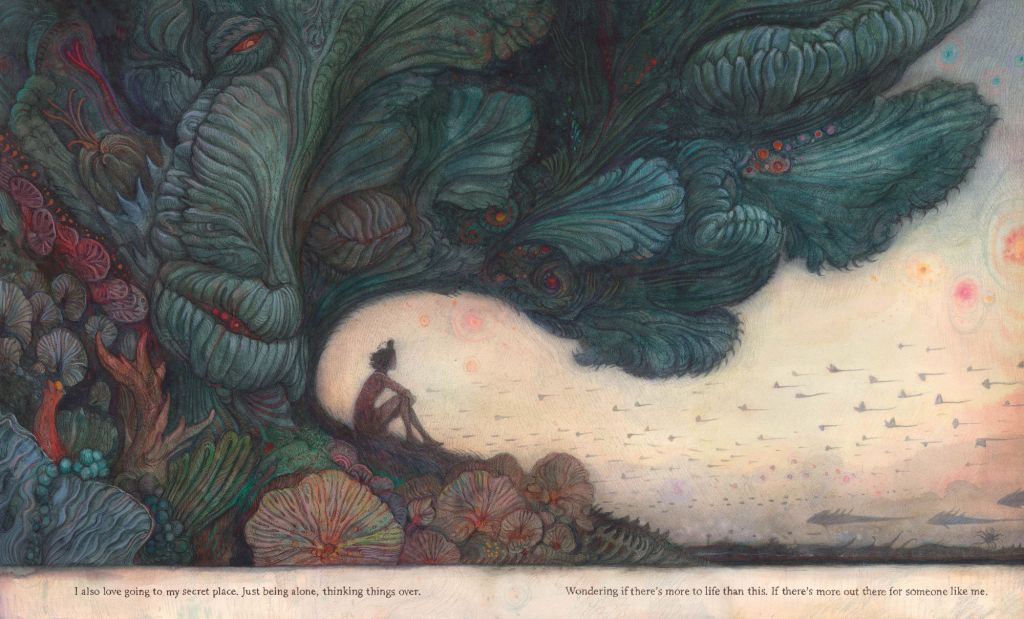
But I found that with the images in this world, that level of control was not so important. There is a kind of bleed and flow with watercolours that works with the organic, unpredictable forms of the Hometown world. I guess this loosened me up a little bit, which is always welcome. There is something a little unfinished and joyfully accidental about the world, with all its convoluted plants and weird sky things, drippy shadows and blooms of light, all of that prevents it from feeling ponderous or laboured or too static. I think there is a lightness in the work, a bit of transparency that kept it fresh and fun over a long time, as it took about three to four years to render the final illustrations. It needs to be fun!
What are some artistic influences, including your own work, on Hometown? How have you used them here?
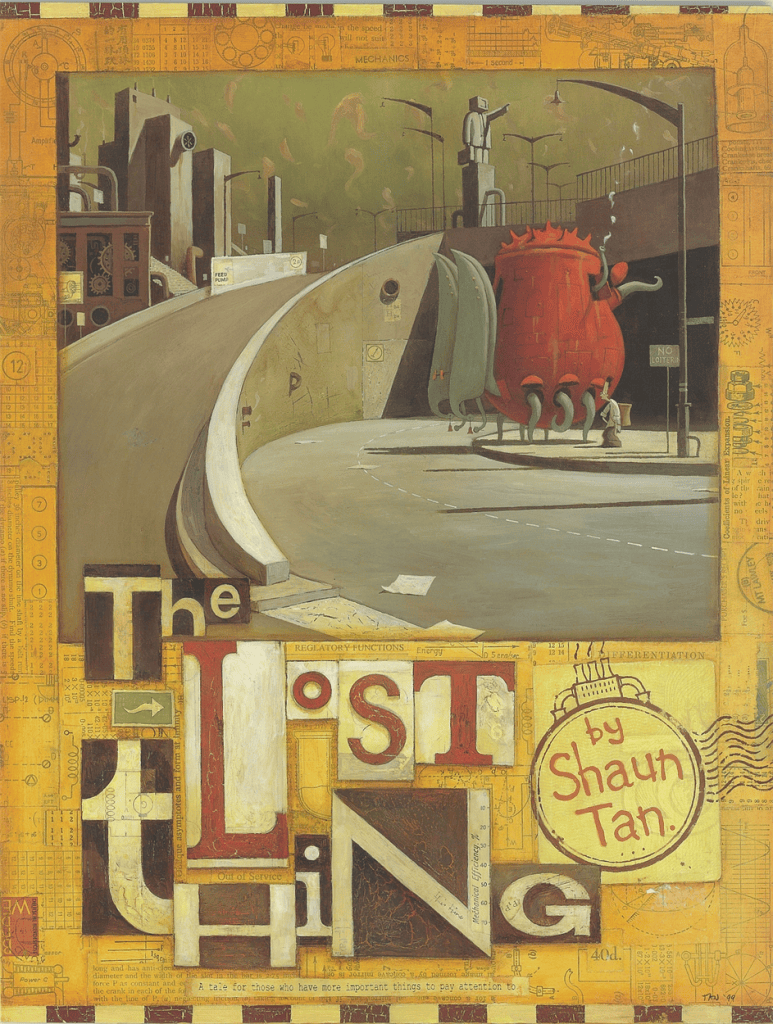
It’s interesting to include my own past work as influences, I’d not really thought about that but it’s true, they are there. I think The Lost Thing, a book of mine from 26 years ago, has something to do with Hometown. There is a scene at the end where a boy who lives in a very drab, dystopian world has an opportunity to escape into a strange, brightly-lit, colourful playground of odd creatures, but he chooses to go home – as most of us probably would – back to family, to school, work and other obligations. I have always wondered what it would be like if he entered that world and grew up there, a bit like Mowgli in The Jungle Book (another possible influence). What aspects of his humanness would remain, and what would be unrecognisable. Hometown very much explores a similar premise.
Other artistic influences: many, many. A few I can mention, but this is just the tip of a very big iceberg. A strange animated film from the ‘70s Fantastic Planet, about large blue aliens for whom humans are vermin, this was the first thing I ever saw on a VHS tape (and so watched a few times) and it left a very strong and unsettling impression, in part because I was probably a bit too young for it! But I returned to looking at it after I noticed my own drawings had similarities to the work of Hieronymus Bosch, the 16th century Dutch painter of fantastical lands and creatures, also a clear reference for Fantastic Planet. I also examined the work of British Romanticist painters of the 19th century, such as Samuel Palmer, whose images of British rural landscapes are often dark, disquieting and quite alien-looking. I looked at the illustrations of Arthur Rackham, who visualised Grimms fairytales in the early 20th Century, and a lot of older forms of illustration, both narrative, observational and scientific too – all those engravings of sea creatures and exotic animals from newly discovered lands. These all had some direct influence on the style of Hometown.
How do you use colour to represent different characters?
Very intuitively, without any rules I can pin down, nor do I separate characters very much from the mixed palette of their backgrounds. Certain things just look and feel right, and I trust my instincts with colour, much more than anything symbolic. I think that’s true for all aspects of the drawing and painting, I’m very careful not to overthink things, because the reader should not have to overthink things either. Each page should strike them as a wave of feeling, through colour, tone, word arrangement, all these little elements, an overall, simple effect. I typically make a lot of studies, including little colour studies with pastel crayons in a very rough form, and then line everything up to see how it flows, almost as a musical composition. This is a technique I learned from animated film production, often called a colour script.
How have you incorporated spirituality?
Gosh, I’ll leave readers to decide that! It hasn’t been a very conscious thing, and I’m not entirely sure what ‘spirituality’ necessarily means. I’m certainly interested in religion, and the vast array of things that humans have believed, with deep faith, over the thousands of years that we have been shuffled around this planet by various calamities and awakenings. The endpapers of Hometown suggest a couple of possible spiritual views, they are meant to be pages from the boy’s book (at the beginning) and the girl’s book (at the end). One is very structured somehow, and organised, looking like a clarifying map of the universe. The other is flowing, organic, with no clear pattern, but some sense of a known order. Elsewhere in the book there are similar things: huge, mummified ancestors, indecipherable scripts, totemic objects, creatures in different states of prayer, song and dance, but we don’t know what these are exactly.
I’ve always been very interested in human prehistory, and early religious-looking artifacts whose meaning has been lost: cave paintings, mammoth bone carvings, figurines of animal-headed people dug out of the ground. They still feel very familiar and meaningful, even to our ‘distant future’ and ‘alien’ culture. I tried to approach that same feeling in my drawings and paintings.
How have you incorporated humour in the tale?
I think mostly through understatement or slight contradiction between images and words, things the narrator is commenting upon. I’m not sure ‘humour’ is exactly the right word, maybe more broadly it’s a ‘weird surprise’. The girl telling us the story is not trying to be funny, and her world is not particularly comical. But when she says something like ‘we went out for dinner’ and we see the family hunting a giant bug, then tearing out its innards, that to me is funny, while also being unsettling, while also having a lot of important things to say about cultural relativity, what ‘out for dinner’ can actually mean. So I like humour especially when it flows into more complicated, thoughtful places. The casualness of the tone is, I think, what makes the whole story work, for me at least, and gently takes the reader by the hand through this strange dream.
What is something that people may not notice on a first read?
Well there may be some little things, certainly the second reading is probably a little richer, knowing the lay of the land. It might be a spoiler to say anything, so I won’t. But there are no really hidden things, or special knowledge. I keep revising a story until it feels fairly simple and straightforward upon first read, with extra layers, usually in the illustrations, which can reward subsequent readings. I think the best picture books usually work that way, one reason I’ve always been attracted to the form.
What is the role of the lizard creature motif?
That’s a good question! It just felt like the right kind of thing to open and close the story, this little serpentine, prehistoric looking lizard. We see the girl holding it on the cover, and as some kind of security animal when she is confronted by troubling news. These are the same ‘lizards’ that she lets out through a gate at the beginning, and back in at the end. These little wandering things that are pretty inscrutable, but move according to some plan and reason of their own. Perhaps they are metaphors for story. Stories are things we hold onto for security, but they also go out into the world and come back, carrying a quiet message. And there are hundreds of them.
How do you use flowers as a symbol?
Again, it’s very intuitive, and I wouldn’t call them a ‘symbol’ really, as I don’t think of them as having any encoded meaning. But I suppose they do appear often in the story. There is a suggestion that if you wear a flower outside, you might be protected from being eaten by a predator. Who knows why?
Of course, in our culture flowers are given as a gift representing different positive, loving and consoling feelings, which is quite an interesting thing when you think about it. The reproductive organs of a plant as a gift. But we don’t have to think about this, it just feels very ‘right’ for humans, and maybe even other animals – insects, for instance. I think that says something about a deeper unity of nature, that both humans and butterflies can find flowers equally attractive.
How did you create the glorious effect of the star-studded sky?
I’m glad you say it’s glorious because I wasn’t sure if that was coming across, that sense of wonder and energy, and I had a lot of trouble with this image! I think partly it’s how you frame it, with little figures in the foreground, suddenly it feels large and looming. It’s swirling with movement, and that’s largely due to the flow of a watercolour wash, the way the pigment spills and turns in the water. The glow of the stars is created by a sprinkling of paint on that wet wash, as well as blotting dry watercolour away with a tissue to reveal the white paper under the paint.
How have you extended your earlier work from I Feel Machine into Hometown?
Yes, the earlier work was a short comic I was invited to create for a comics anthology on this theme of machines and emotions. I did not have any great ideas for this assignment, but I had been thinking about this story of a girl who can ‘make’ animals and machines, in a world where these two things are not so separated. I was given about 20 pages and a fairly tight deadline, and created this whole story fairly quickly, almost as a stream of consciousness. Surprisingly, it worked very well – maybe the pressure to get it done quickly helped keep it lively and flowing – which encouraged me to expand it into a longer work, the Hometown that you see.
I mainly wanted to include more emotional depth related to the girl’s family life, and show her introducing the visitor to her world, actually bonding with him a bit. The girl also became older, a teenager, more than the small child in the original book, which makes her decision to leave home in the story much more plausible. In many ways, this reflects the age of my own daughter as I was drawing different versions, she went from five years old to thirteen as I worked on this book. While she is not exactly a model for the girl in my story, they share some personality, and I think she helped me better understand how an open-minded girl who grows up in a strange, wild and somewhat monstrous world would manage. I think she would do pretty well.
Sincere thanks, Shaun, for answering my questions with such generosity and thoughtfulness.
Hometown is a superlative book. It is essential reading.
(Joy’s review for the Weekend Australian will run 31 October 2026 – behind the paywall)
Cicada by Shaun Tan at Paperbark Words blog

Selection of my reviews and notes about Shaun’s work:
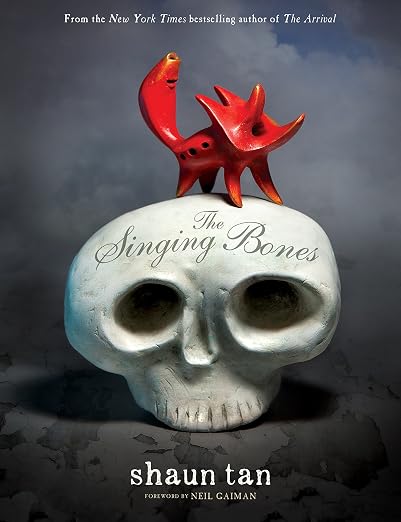
My review of The Singing Bones for the SMH/The Age
The Singing Bones by Shaun Tan: Grimm’s fairytales in 3D
The artist unearths another dimension from the familiar stories, writes Joy Lawn.
October 23, 2015
The Singing Bones
Shaun Tan
Allen & Unwin
Shaun Tan subverts literary illustration, forging new styles and transforming what a book is, where it can transport us and who can read it. Piles of his books, ostensibly for young adults but also for adults, are displayed in bookshops around the world. His picture books span The Arrival, an almost wordless migrant story with surreal elements; Tales from Outer Suburbia, vignettes in words and pictures; and Rules of Summer, a predominantly visual and unnerving exploration of what two boys learnt one summer.
Tan won an Academy Award for his animated short film, The Lost Thing, and has won international and Australian literary awards. One of his early picture books, The Rabbits, with words by John Marsden, is now an opera. Tan’s visionary art with its fantastic portrayal of rabbits and marsupials and improbable but authoritative sci-fi elements make the book a contemporary classic.
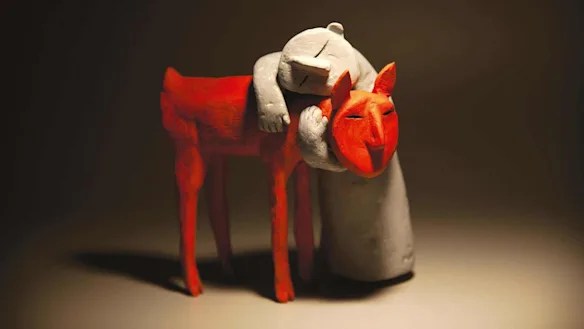
His new book, The Singing Bones, unearths another dimension from much older works, 75 fairytales collected by the Brothers Grimm. His sculpted figures, inspired by ancient carvings and figurines, evince each tale. Many of them are squat and elemental, as though evolved from earth, rock or clay. Many have the pointed or rounded shapes identifiable as his unique style. They are constructed from papier mache and clay, some with wire, paper, string, nails or gold leaf. The clay has been carved and painted with acrylics, oxidised metal powder and even shoe polish. Some surfaces look bronzed. Other sculptures feature some of Tan’s signature colours of red and orange.
Seeing the sculptures en masse as an exhibition is impressive but belies the formidable impact of the final photographed and edited artwork in the book.
The book’s composition is quite formal and static. Every tale sits on a double page, with a brief written excerpt from Jack Zipes’ version of Grimm’s Complete Fairy Tales on each left-hand page. The accompanying sculpture is posed on the right-hand page.
Light sources are used skilfully in the book to highlight selected, often textured, surfaces of the figures and to cast shadows. A candle balanced on the figure of The Master Thief innovatively and ironically sheds its own light. Tan as master-designer has control over the direction and distance from which we view the sculptures. This also increases the stasis of the literary form here.
The tales don’t appear to be in sequential order: the Hans tales are interspersed throughout the book, and familiar stories such as The Worn-Out Dancing Shoes and Thumbling are surrounded by the more obscure The Moon and The Lettuce Donkey.
Some of the visual highlights are the jaunty stance of The Brave Little Tailor standing on the bulky giant; the leaning, leering witch of Hansel and Gretel; the curved lines and supple shapes of the kneeling figure in The Water of Life; and the rounded figure of the prince juxtaposed against the sharper lines and angles of the red fox in The Golden Bird.
The dark blacksmith contrasts with the red, twisting devil in mouse form in The Blacksmith and the Devil. The diagonal lines of the symmetrical scissors and elves signify mischief and movement in The Elves; and the elongated surfaces and strong lines of the red queen in Snow White emanate pride and power. Entrapment is personified in the emerging face of Bearskin and in the elusive All Fur, a girl covered in furs.
Tan urges readers to seek the complete versions of these tales, but many will be content to assume his vision and renderings.
Essay by Shaun Tan in The Books That Made Me edited by Judith Ridge
My review in The Weekend Australian
************************************
Cicada – Shaun Tan
My judge report on Cicada, 2019 Prime Minister’s Literary Awards
Young Adult shortlist
A non-human protagonist tells a very human tale of abasement and disregard in this extraordinary picture book for mature readers. Cicada is ambiguous and enigmatic. It is open-ended, thought-provoking and invites multiple readings. Cicada could be an unappreciated migrant worker without friends, or it could represent any displaced, overlooked person.
Incongruously, green cicada wears a grey suit, causing it at one level to blend in or disappear into its near monochromatic, sterile office surrounds. Yet it is disparaged by its similarly grey-clad human co-workers, whose faces are never revealed. Cicada is told it is not human so needs no resources. It is not allowed to use the office bathroom, it must use amenities twelve blocks away and has its pay docked for its travel time. It cannot afford to pay rent and so lives in the office wallspace, with the company turning a blind eye to its needs.
Cicada speaks in broken English or a stilted dialect, reinforcing its status as the “other”. It laments,
“Human never finish work.
Cicada always stay late. Finish work.
Nobody thank cicada.
Tok Tok Tok!”
The repetition of “Tok Tok Tok!” replicates the office-workers’ obsession with time and clocking on and off. Corporate drudgery is also represented by the bleak surrounds and geometric, uniform maze of cubicles rendered in dramatic light and shadow. Cicada’s green head contrasts with the grey patterns that surround it. Cicada is different. When it retires after seventeen years without a party or handshake, cicada ascends Escher-like stairs. When it stands at the edge of the roof the reader fears for its life and safety until becoming aware of the subtle warming change of colour tone followed by the bright red metamorphosis of cicada before it flies back to the forest, laughing at the humans left behind.
The opening endpapers hint at the holocaust memorial in Berlin and the closing endpapers celebrate the verdant natural world of the forest. The changing colour palette reflects transformation from a dire scenario of darkness, despair, depression and possibly death to metamorphosis, renewal, freedom and hope.
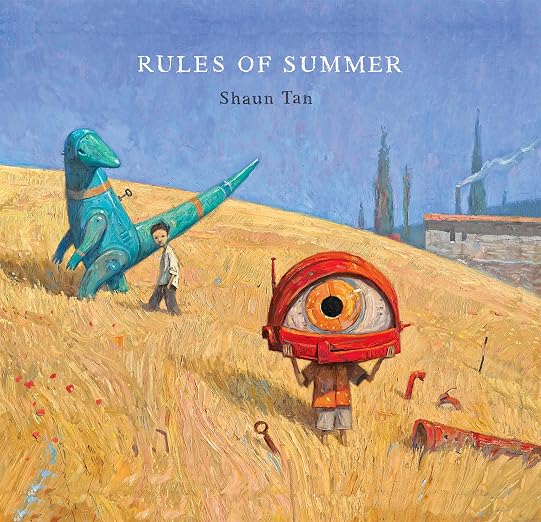
Rules of Summer by Shaun Tan
(Lothian)
Teacher Notes by Joy Lawn for Inside the Shortlist, published CBCA Qld
It is the time to celebrate the CBCA Books of the Year: a plethora of excellent books. No one will be surprised that Shaun Tan’s inimitable Rules of Summer has won Picture Book of the Year. From a visual literacy perspective, it excels in composition – what is put where and how distance and depth is created; salience – what is most prominent on the page; juxtaposition – contrasting elements such as light and dark and texture; and symbolism.
Readership Primary and secondary school
Award Shortlisted 2013 Aurealis Award
Genre Surrealism
Setting A surreal metropolis
Language Aphorisms, adages or rules
Illustration Media: mainly oils on canvas
Themes Unusual rules; close but possibly antagonistic relationship; dominance and subjugation; imagination
Synopsis Two boys, possibly brothers, may or may not understand the rules of summer. They deliberately, or accidentally, break them. Unexpected outcomes invariably follow broken rules. The younger boy follows the other through the city, often coming off worse for wear. But they learn much this summer, particularly Always know the way home and Never miss the last day of summer.
Teaching Applications
- Visual Literacy and Zines 1. Composition What is put where? [Generally each left-hand page has one sentence written on textured paper, and each right hand page has a full page illustration which bleeds to the page edge.]
Consider perspective – how is distance and depth created in the first double-page streetscape, where one boy is whispering?
2. Salience What is most prominent? Particularly consider size – why might the rabbit be so large and the child characters appear disproportionately small?
3. Juxtaposition Compare and contrast different textures, such as the oil paint brushstrokes on the cover and the ground around the oversized strawberry. Find the contrasting bright and dark places within any one picture. Find the light sources [like a spotlight onto the backyard and giant rabbit; through doorways; badminton court light; light from TV; bicycle lamp; sunset]. What is their purpose? Where are the colours bright and where are they dim? Why?
4. Symbolism and Surrealism Define surrealism. Find examples of surreal symbols in the book, such as the mechanical creatures.
5. Humour Find examples of visual humour [e.g. the robot’s broken tail; cutlery spears]
Zines Students make zines, incorporating a selection of the above techniques. www.wemakezines.ning.com Plan, draft and publish imaginative and multimodal texts, choosing text structures, language features, images and sound appropriate to purpose and audience (ACELY1704)
Create literary texts using realistic and fantasy settings and characters that draw on the worlds represented in texts students have experienced (ACELT1612)
- Point of View Students view the episode, ‘Sand’ from the movie The Turning where an older boy buries a younger boy in the sand. Then re-read Rules of Summer noting the roles and possible viewpoints of the two boys. Who might the boys in the book represent – refugees, those with special needs, the young, anyone in a close relationship? Present a point of view about particular literary texts using appropriate metalanguage, and reflecting on the viewpoints of others (ACELT1609). Pose and discuss questions, such as ‘Should this character have behaved as they did?’, and make balanced judgments about the dilemmas characters face and relative merit and harm.
- Read Compare the surreal cityscapes in Shaun Tan’s The Arrival, with those of Tohby Riddle, such as Nobody Owns the Moon.
Display
- Cityscapes Compare and contrast the two cityscapes near the end of Rules of Summer (both feature birds). Students then create their own ‘intact’ and ‘derelict’ pictures of a scene using collage and thick, textured paint, or with digital tools.
Publisher Teacher Notes at Hachette Australia
Author/Illustrator Website http://www.shauntan.net/


